

Bonn's historic centre is small enough to walk in a morning, which is why a one-day visit should be built around a single loop rather than a checklist. The Minster, Munsterplatz, the Old Town lanes and Bonngasse sit within a few minutes of one another, and Beethoven-Haus is the anchor most visitors come for. The real planning problem is the afternoon, because the Rhine promenade and the Museum Mile pull in different directions from that centre.
The Minster is an active Catholic parish church rather than a monument, so its visiting rhythm depends on services and parish life; the parish describes it as a place of encounter that has been repeatedly adapted over almost a thousand years, which is why no single art epoch dominates. Beethoven-Haus is the birthplace and museum of Ludwig van Beethoven, born in Bonn in 1770, and it remains the city's most visited music museum. Both are best confirmed against their own current pages rather than a secondary summary.
A workable shape for the day is the Old Town and Minster first, Beethoven-Haus as your one fixed block, lunch as the pivot, and then an explicit either/or afternoon. As a suggested duration rather than an official figure, allow roughly 60 to 90 minutes for the birthplace museum if you engage with the audio content. Everything else depends on your pace and on the opening times you confirm on the day. For wider planning, see 3 Days in Bonn.
Why Bonn Rewards One Tightly Routed Day
Bonn's centre is dense with the things first-time visitors want, and the walking distances between them are short. The Minster, Munsterplatz, the market square with the Altes Rathaus and the lanes around Bonngasse form one cluster, so backtracking is a choice rather than a necessity. The trade-off is that the Museum Mile and the riverbank sit apart from that cluster, which means a day that tries to do both thoroughly usually does neither well.
The practical answer is to commit the morning to the centre and the afternoon to one direction. Bonn's own tourism pages list the city's sights and cultural institutions, which makes them the right place to confirm what is open on your date. That also keeps you flexible if a church turns out to be unavailable because of a service or restoration work.
The Shape of the Day and How Long Each Stop Needs
Start with the square, because the Minster and Munsterplatz set the tone for the Old Town and do not demand a long stop. From there the walk into the lanes around Bonngasse is short, which keeps Beethoven-Haus within reach before lunch. Treat the museum as your one fixed timed block and let the rest of the morning stay loose.
For the museum itself, the operator says the birthplace and its exhibitions can be explored on guided tours and that a tour takes about one hour, with details and prices published on its own site. An independent visitor account describes the visit as a house rather than a large museum, and notes that museum staff suggested around 90 minutes, though that writer finished in a little over an hour without listening to everything. Budgeting 60 to 90 minutes is therefore realistic rather than tight, and guided formats vary, so confirm what is running on your date through the museum's own events calendar.
Lunch is the natural pivot, and where you eat effectively chooses your afternoon. Staying in the Old Town keeps the Rhine and the Museum Mile equally reachable afterwards, whereas moving east or south before eating commits you to one direction. If you want a slower day, eat closer to the river and let the afternoon drift rather than run to a schedule.
Morning: Bonn Minster and Munsterplatz
The Bonner Münster is the visual centre of the city, and the square in front of it is where most walking routes naturally begin. The parish presents it as a place of encounter between God and humanity that has been brought up to date through the centuries, so no art epoch is missing, and the historian Heinrich Lützeler called it a European monument. That layered history is the reason to step inside rather than only photograph the towers.
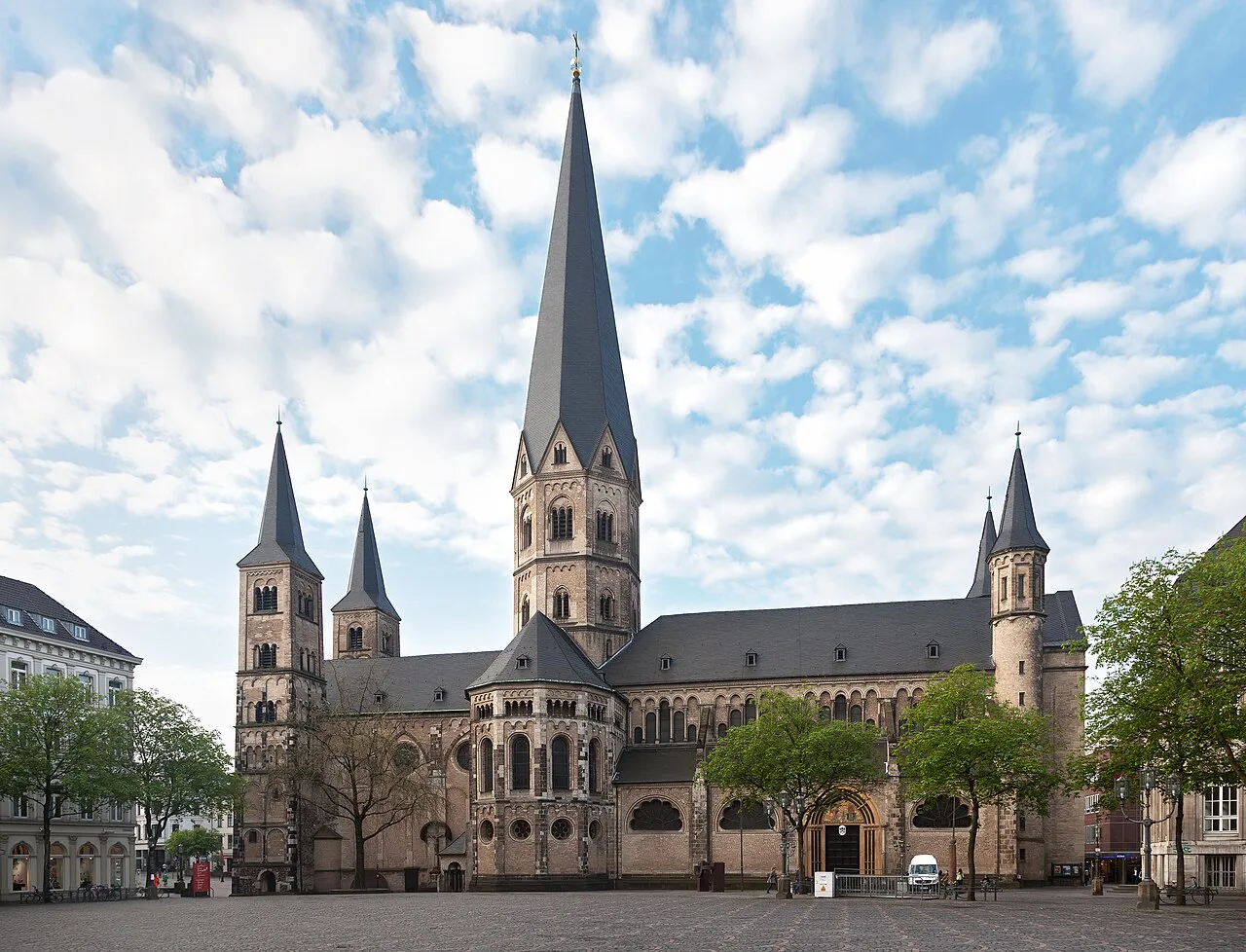
Because it is a working church, check the parish site for service times, visits and any restoration news before you build your morning around it. The parish maintains pages for visiting hours and guided tours, and it has been running a general renovation, so the interior may not be fully available at all times. If a service is underway, step back to the square and return later instead of treating the building as a fixed attraction.
The Beethoven monument on Munsterplatz is the other reason this square earns a morning slot, because it places the composer in the city's civic story rather than only inside a museum. Reading the square first gives context to Bonngasse later, where the scale shifts from civic monument to an ordinary 18th-century town house. The walk between the two costs you almost no time.
Crossing the Old Town on Foot: Altes Rathaus and the Market Square
From Munsterplatz the Old Town unfolds on foot, and the Altes Rathaus is the natural next landmark because it sits on a market square that keeps the surrounding lanes busy. The building is a Rococo showpiece with gilded details that reward a slow look at the facade rather than a quick pass. The surrounding streets are pedestrian-friendly, which makes this stretch easy to combine with Bonngasse.
Market activity on the square varies by day and season, so treat any food stalls as a bonus rather than the plan. If a market is running, it is a convenient place to buy something simple for lunch; if not, the surrounding streets have plenty of alternatives. Either way, keep this section short so the museum does not get pushed into the crowded middle of the day.
This is also the moment to accept that Bonn's Old Town is best experienced as a wander rather than a route. Pick two or three streets, orient yourself by the Minster tower, and let the rest be incidental. The compactness means you cannot get lost for long.
Beethoven-Haus: What the Birthplace Museum Actually Is
Beethoven-Haus is not one building but an institution: the Beethoven-Haus association, founded in 1889, runs a museum at the composer's birthplace alongside a research centre, a chamber music hall, a collection, a library and a publishing house. The museum occupies a preserved 18th-century town house on Bonngasse, which is why visitors consistently describe it as intimate rather than vast. Expect a house-scale experience spread over several floors rather than a hangar of exhibits.
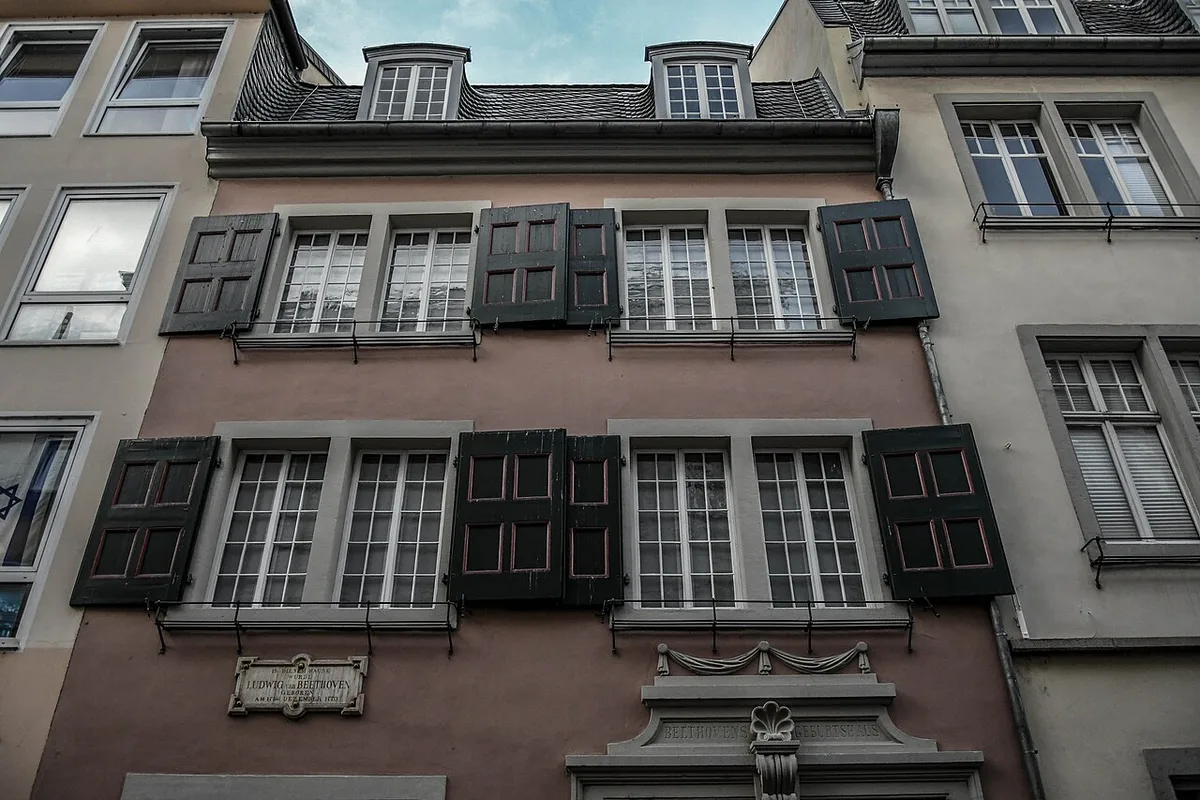
The permanent exhibition was renewed in December 2019 and presents Beethoven as artist and as person, with rooms devoted to his Bonn roots, his working life, his patrons and his deafness. Objects on display include the organ console he played as a child, his desk, a fortepiano he owned in Vienna and ear trumpets made especially for him, alongside manuscripts, letters and portraits. The original manuscripts mean most to visitors who read music, which is worth knowing before deciding how long to stay.
A practical point that trips people up: the birthplace, the ticket office and shop, and the other associated addresses on Bonngasse are separate entrances on the same street. Check the museum's own visit page for the current arrangement on the day rather than assuming one door does everything.
Guided Tours, Accessibility and Language Options at Beethoven-Haus
The museum states that the birthplace and its exhibitions can be explored on guided tours, and that a tour takes about one hour, with details and prices published on its own site. Because those details change, read them at the source rather than from a secondary summary. If a dated tour slot matters to you, book ahead instead of hoping to join one on arrival.
For visitors with particular needs, the museum lists multimedia guides in easy language, for visually impaired and blind visitors, and in German sign language, handed out at the cash desk subject to availability and free of charge, with booking recommended. The same page sets out bookable guided tours in easy language, for learners of German, for visually impaired and blind visitors, and for visitors with impaired hearing; these run 45 to 90 minutes depending on format and cost 80 euros plus museum admission, and visitors with impaired hearing are asked to bring a sign language interpreter. Carers and relatives can take part in the dementia-friendly activities, and the museum also offers outreach programmes that come to institutions.
The Lunch Decision: Stay in the Old Town or Move Toward the River
Where you eat lunch effectively chooses your afternoon, so treat it as a routing decision rather than a break. Staying in the Old Town keeps you close to the market square and leaves both the river and the Museum Mile open as options. Walking toward the Rhine before eating tips you into a slower, outdoor afternoon by default.
If you are unsure, decide based on energy rather than ambition. A museum-heavy afternoon after a long morning is harder than it looks, and the Museum Mile institutions are spread along a single boulevard rather than stacked in one building. A river afternoon costs nothing and needs no bookings, which makes it the safer choice when your morning runs late.
Afternoon Fork A: the Rhine Promenade and a Slower, Free Afternoon
The Rhine is Bonn's release valve: promenades, river views and the sense that the city is smaller and calmer than its former-capital status suggests. This option suits anyone who has already absorbed a lot of indoor content and wants the day to end without a schedule. It is also the better fork if you are travelling with children or anyone who needs breaks.
Treat the riverbank as a loose hour or two rather than a fixed itinerary, and let the weather decide how far you walk. Because this option has no ticket and no closing time, it is the one part of the day you can move without consequence. Save it for last and you will not be rushing a museum to make a sunset.
Afternoon Fork B: Museum Mile, Haus der Geschichte and Bundeskunsthalle
The Museum Mile is a boulevard of institutions rather than a single destination, and the two most useful anchors for a one-day visit are the Haus der Geschichte and the Bundeskunsthalle. The Haus der Geschichte covers German history since 1945 and states that admission to the museum and all exhibitions is free, which makes it the low-risk choice if you arrive late. It lists opening hours of Tuesday to Friday 9am to 6pm and Saturday and Sunday 10am to 6pm, with holiday hours published separately.
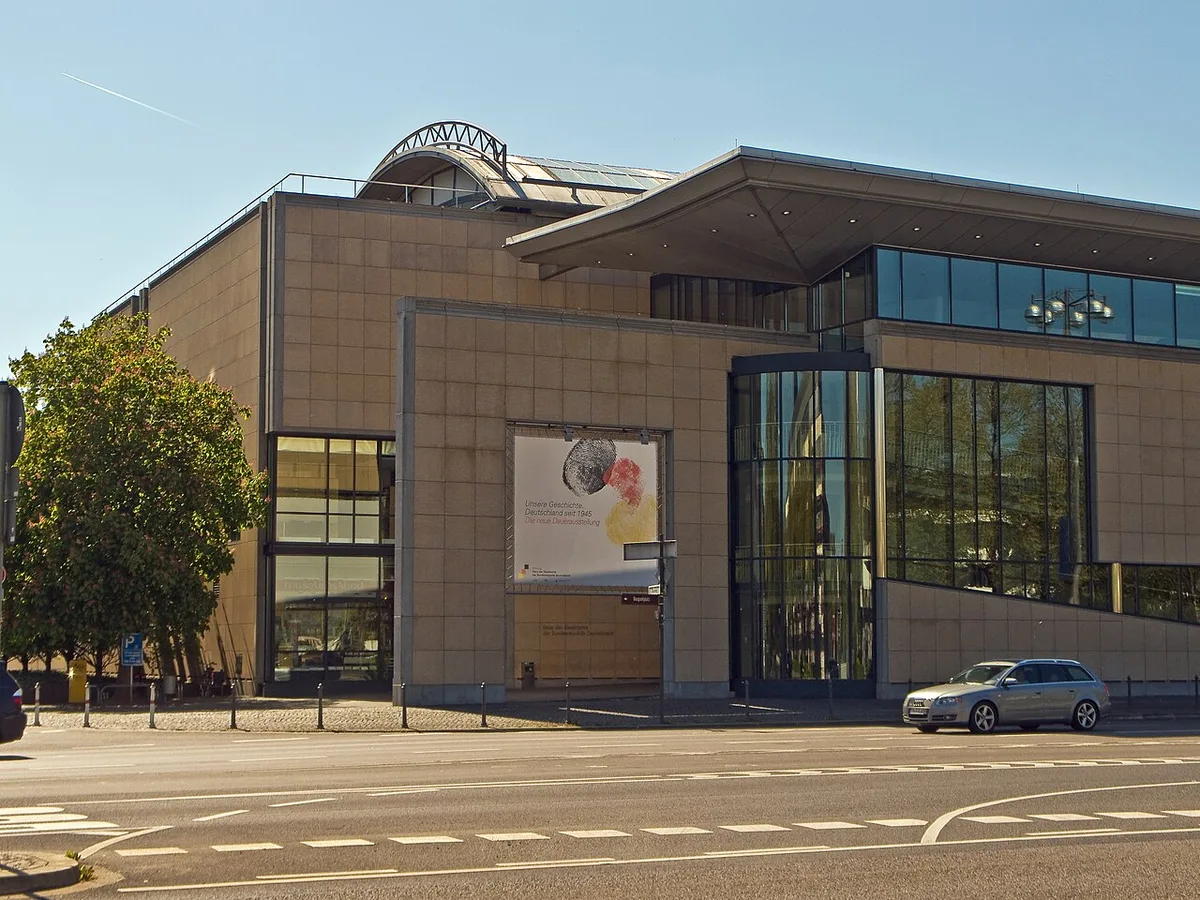
The Bundeskunsthalle next door is the ticketed counterpart, and its prices, hours and inclusion rules are set out on its own tickets and prices page. It lists a day ticket of 14 euros, a reduced ticket of 7 euros, a group rate of 11.20 euros per person from ten people, and a happy-hour ticket of 7 euros in the final hour; visitors up to and including age 18 enter free with proof at the desk. It is closed on Mondays, opens Tuesday 10am to 6pm, Wednesday 10am to 9pm, and Thursday to Sunday and public holidays 10am to 6pm.
One caution worth internalising: the day ticket covers the Bundeskunsthalle's own exhibitions, and the Museum Mile museums do not share a single ticket or a single closing day. Check each institution's own page on the morning of your visit rather than assuming the street behaves as one venue.
Kunstmuseum Bonn: Same Street, Different Ticket, Different Closing Day
The Kunstmuseum Bonn sits on the same stretch at Helmut-Kohl-Allee 2 and is a separate institution with its own programme and admission. It publishes opening hours of Tuesday to Sunday 11am to 6pm, Wednesday 11am to 7pm, and closed on Monday. Note that its Wednesday evening extension is shorter than the Bundeskunsthalle's, so a late-Wednesday plan needs to respect both.
If your interest is 20th-century and contemporary German art rather than history or touring exhibitions, this is the museum to prioritise, and the Museum Mile becomes a single-stop afternoon. Its digital short tours provide exhibition context you can read before arriving, which is a cheap way to decide whether it earns your limited time. Combining it with the Bundeskunsthalle is possible, but only if you accept a faster pass through each.
What a Combined Museum Mile Ticket Does and Does Not Cover
The Bundeskunsthalle publishes a combination card valid for itself and the Kunstmuseum Bonn across exhibitions running concurrently, priced at 20 euros, or 10 euros reduced. That is a specific two-museum product, not a Museum Mile pass, and it says nothing about admission at the Haus der Geschichte or any other institution on the boulevard. Read the exact scope on the ticketing page before you buy, because the value depends entirely on what is showing at both venues on your date.
The general rule for the street is that each museum sets its own ticket, its own free-entry categories and its own closing day. Haus der Geschichte is free to enter, while the Bundeskunsthalle charges and also offers free admission up to and including age 18. Assuming a blanket pass is the most common way visitors waste money here.
If You Only Have Half a Day: What to Cut First
With half a day, protect the Old Town core and Beethoven-Haus and drop everything else. The Minster and Bonngasse are close enough to combine without transport, so a compressed visit still feels complete rather than rushed. Cut the Museum Mile first, because a meaningful museum stop needs more time than a rushed one deserves.
If the museum is your reason for coming, invert it: go straight to the Museum Mile and accept that the Old Town gets a walk-through rather than a slow morning. Either way, decide before you arrive, because improvising at midday is what turns a half day into a stressful one.
Common Mistakes on a One-Day Bonn Visit
The classic error is treating the Museum Mile and the Rhine as add-ons to the Old Town instead of alternatives, which produces a day of walking with little actual seeing. The second is assuming all the museums on that boulevard share one ticket or one closing day, when each publishes its own. The third is arriving at Beethoven-Haus without knowing what its guided formats are, then discovering the slot you wanted is not running.
A related mistake is building the day around an out-of-town castle or a neighbouring city and still expecting a proper Bonn day. Those are separate trips and belong on a different date and a different guide, such as those covering Cologne or multi-day stays. Keep the one-day plan inside Bonn and the whole thing becomes calmer.
Practical Notes: Monday Closures and Confirming Hours
Monday is the recurring problem day on the Museum Mile: the Bundeskunsthalle is closed, and the Kunstmuseum Bonn is closed as well. The Haus der Geschichte runs Tuesday to Friday and weekend hours instead, so it can absorb a Monday visit if its own schedule allows. Beethoven-Haus keeps its own calendar, which is exactly why you should check its site rather than generalise from the museums.
Before you set out, open the official pages for the Minster parish, the Haus der Geschichte and the Bundeskunsthalle, and note any dated closure notices; the Haus der Geschichte, for example, has published time-limited notices about parts of its site, and the Bundeskunsthalle lists temporary access changes for the Heussallee stop. A five-minute check in the morning prevents a wasted trip across town.
Plan Your Visit
A good one-day Bonn itinerary is really a sequencing decision: Old Town and the Minster first, Beethoven-Haus as the fixed block, then one deliberate afternoon. Choose the Rhine if you want air and freedom, or the Museum Mile if you want substance and are willing to check two separate sets of hours and tickets. Either way, confirm opening times, closures and ticket scope on the official pages on the day, because those are the details that quietly break a good plan.
Frequently Asked Questions
Is one day enough for Bonn?
Yes, for the historic core. The Minster, Munsterplatz, the Old Town lanes and Beethoven-Haus sit close together and can be covered comfortably in a morning and early afternoon. The limit is the Museum Mile: its institutions are spread along one boulevard and each sets its own hours, so a single day realistically allows one or two of them rather than all. Decide which matters more, the river or the museums, before you arrive.
Should I pick the Rhine or the Museum Mile?
Pick the Rhine if you want a free, unhurried afternoon with no bookings and no closing times to respect. Pick the Museum Mile if you want exhibitions and are willing to plan around individual opening hours and separate tickets. Note that the Haus der Geschichte states free admission while the Bundeskunsthalle sells its own day ticket and a two-museum combination card, so check both pages before deciding how much time you need.
Do I need to book Beethoven-Haus in advance?
The museum recommends booking for its multimedia guides and for guided tours, and says the devices are handed out at the cash desk subject to availability. Guided tours run in several formats and durations, so if a particular language or accessible format matters to you, arrange it ahead rather than on arrival. Check the museum's own visit and education pages for what is currently offered, since formats and schedules change.


