
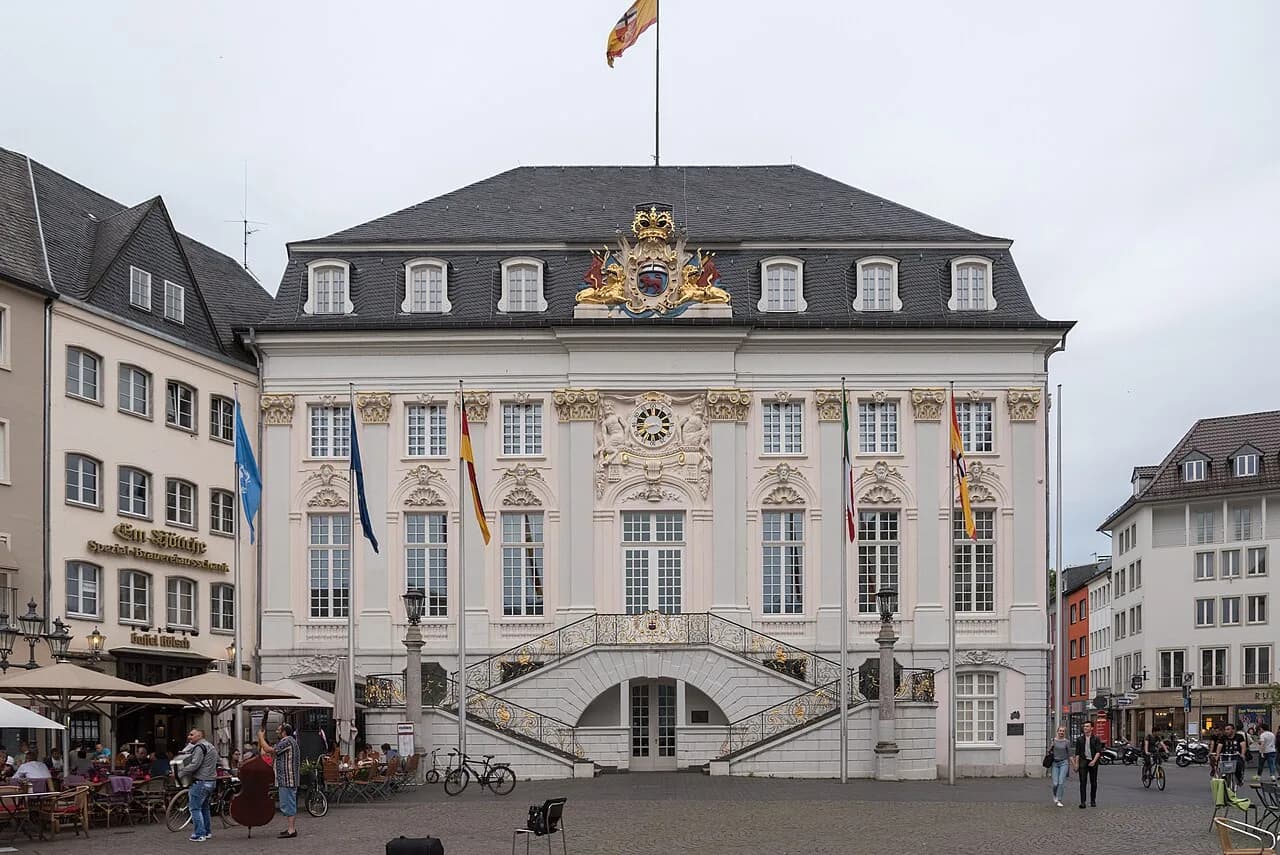
The Altes Rathaus sits at the head of Bonn's Markt, a three-cornered square in the pedestrian Altstadt, and it is one of the city's most photographed pieces of Rococo architecture. Lonely Planet describes the building as glistening with silver and gold trim and overlooking the triangular Markt, with a double-sided staircase from which politicians including Charles de Gaulle and John F Kennedy waved to crowds. That description frames the visit: the facade and the square are the main event, not a museum interior.
As a suggestion rather than an official figure, budget five to fifteen minutes for the facade and the square, and extend the stop if you buy food from the market. Treat the Altes Rathaus as one deliberate pause within a wider Old Town walk rather than a standalone destination, since the square is small and easy to cross without noticing what makes the facade unusual.
Why the Altes Rathaus Deserves a Deliberate Stop
Bonn's Old Town Hall is not a monumental building; it is a comparatively modest structure whose impact comes from ornament rather than scale. A travel account notes that compared with town halls in other German cities, Bonn's is quieter and more elegant, with a pink exterior and gold and silver paint. That contrast is exactly why a drive-by photo undersells it and a short, focused stop works well.
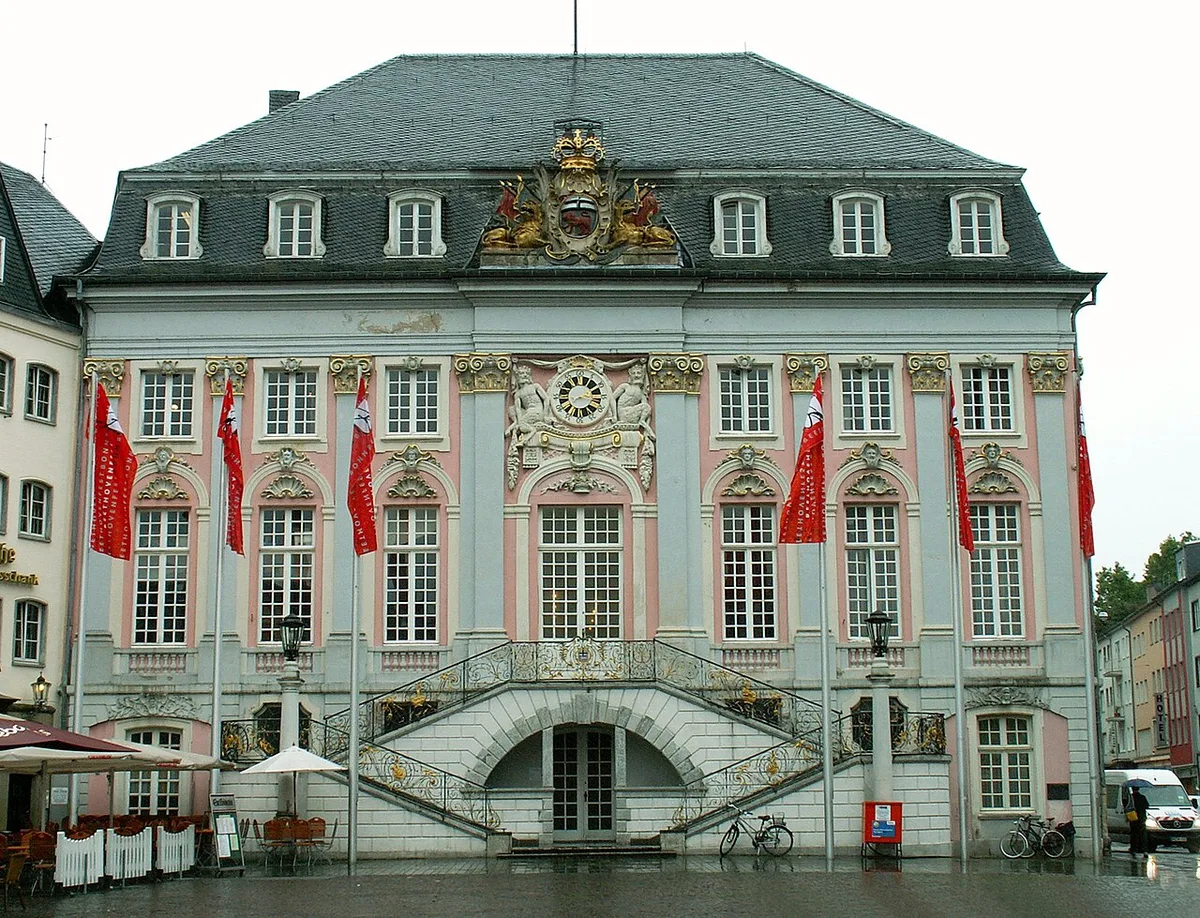
Lonely Planet places the building overlooking the triangular Markt and calls it Rococo, glistening with silver and gold trim. Those details, style, ornament and the square's geometry, are the core of any visit. Stand back far enough to see the full width of the facade against the three-sided square before moving closer to inspect the trim.
One travel account adds that the building is a strong example of Rococo architecture with gilded stair railings and an elaborate ornamental facade. That description is consistent with the Lonely Planet summary and is useful mainly as confirmation of what to look for. Treat such third-party descriptions as orientation, not as a substitute for current official information about access.
The Rococo Facade Decoded
Look first at the horizontal bands of the facade, where gilded and silvered elements sit against a lighter wall surface. The contrast is what makes the building read as Rococo rather than as a plainer civic block. Photograph it from the square's wider side rather than from directly beneath, where the ornament compresses and the roofline disappears.
The double-sided staircase is the second feature worth locating, because it is the stage on which the building's most public moments took place. Lonely Planet notes that politicians from Charles de Gaulle to John F Kennedy waved to the crowds from that staircase. The balcony-side view of the square is best framed from the opposite corner of the Markt, where both flights of the staircase remain visible.
Because the square is triangular, the building does not sit behind a wide plaza, so the viewing distance is limited. Move to whichever of the three sides is least crowded at that moment, usually the one without market stalls. Midday light on a clear day flattens the gold, while softer late-afternoon light picks it out more clearly.
Exterior Versus Interior: What to Verify Before You Travel
The reliable, observable experience is the exterior and the square. No verified source in this research establishes that the Altes Rathaus interior is open to the public or can be toured. Do not plan your day around entering the building, and do not rely on third-party listings that present it as a ticketed attraction.
The city of Bonn publishes a tourism page for the Altes Rathaus, and that is the appropriate place to check whether anything has changed regarding access. Acknowledging the building is still used for civic purposes, so even if access exists it is unlikely to follow ordinary museum rhythms. Confirm with the city before travelling rather than after arriving at the square.
Some third-party travel sites publish an opening-hours window and a suggested sightseeing duration for the Altes Rathaus, but those pages present the building as a bookable attraction and are not official. Treat any such schedule as unverified until the city or the organiser confirms it directly. If an hours or ticket figure appears only on a resale platform, the safe assumption is that it is not authoritative.
Bonn's Old Town Hall in City History
The Altes Rathaus functioned as Bonn's town hall and, in the post-war period when Bonn was the capital of West Germany, the square in front became a stage for state receptions and public appearances. Visiting dignitaries appeared on the staircase and greeted crowds gathered in the Markt. That history is why the staircase, not just the ornament, is the feature worth locating on your visit.
The commonly repeated claim that foreign leaders entered the building is not supported by the sources used here; what is supported is that they appeared at the staircase and waved to crowds. Charles de Gaulle and John F Kennedy are the names most consistently linked with that stairs-side tradition. Keep the distinction in mind when reading plaques or guide commentary on site.
The building's better-known decorative state is the result of restoration, and its commonly cited completion date of 1780 is a figure repeated in travel writing rather than a settled fact confirmed here. Treat the date as orientation only. The square and its market, rather than a single construction date, carry more of the building's everyday identity.
Timing Your Visit Around the Markt Market
The single biggest scheduling variable is the market in the Markt, which runs daily except Sundays. One travel account notes the market has two parts, a green market selling staples such as fruit, bread, cheese and sausage, and a street-food area with juices, vegan options, bratwurst and baked potatoes. A weekday visit and a Sunday visit therefore look completely different, and the square's usable standing room shifts with the stalls.
If you want an unobstructed view of the facade, a Sunday or an early morning slot is the better bet because the stall line-up is reduced. If you want the square at its liveliest and you intend to buy food, arrive during market hours and treat the Rathaus as one element of the scene. Market days vary by season and holiday, so check the city's own pages before committing to a specific morning.
Note that the market's except-Sunday pattern is the sourced claim, not a guarantee that it operates every other day without exception. Public holidays, seasonal breaks and weather can interrupt a market. If the market is the reason you are going, verify the day's activity locally rather than assuming a fixed weekly rhythm.
Suggested Duration and Where It Fits in a Walk
As a suggestion rather than an official figure, budget five to fifteen minutes for the facade and the square, and extend the stop if you buy food from the market. That makes the Altes Rathaus an addition to a walk rather than its centrepiece. If you already plan a self-guided route through the Altstadt, this stop slots in naturally near the start.
A simple sequence is to start at the Markt, look at the facade and the staircase, then walk south toward Münsterplatz. The distances in the Altstadt are short and the streets are pedestrianised, so you do not need to plan transport between these stops. Keep the Rathaus first while your attention is fresh, since the ornament rewards unhurried looking.
If your visit to Bonn is part of a longer trip, the city's other landmark pages give useful context on how this stop fits into a larger sightseeing plan. The building itself does not require a half-day, so pair it rather than isolating it. Over-scheduling a small square is the easiest way to leave disappointed.
Pairing the Stop with Nearby Old Town Sights
Münsterplatz, a few minutes' walk from the Markt, holds the Bonn Minster, one of Germany's older churches, along with the bronze Beethoven monument. Visit after the Rathaus and you get two very different architectural registers within a short walk. The Bonn Minster visitor guide covers what to see inside the church and its cloister.
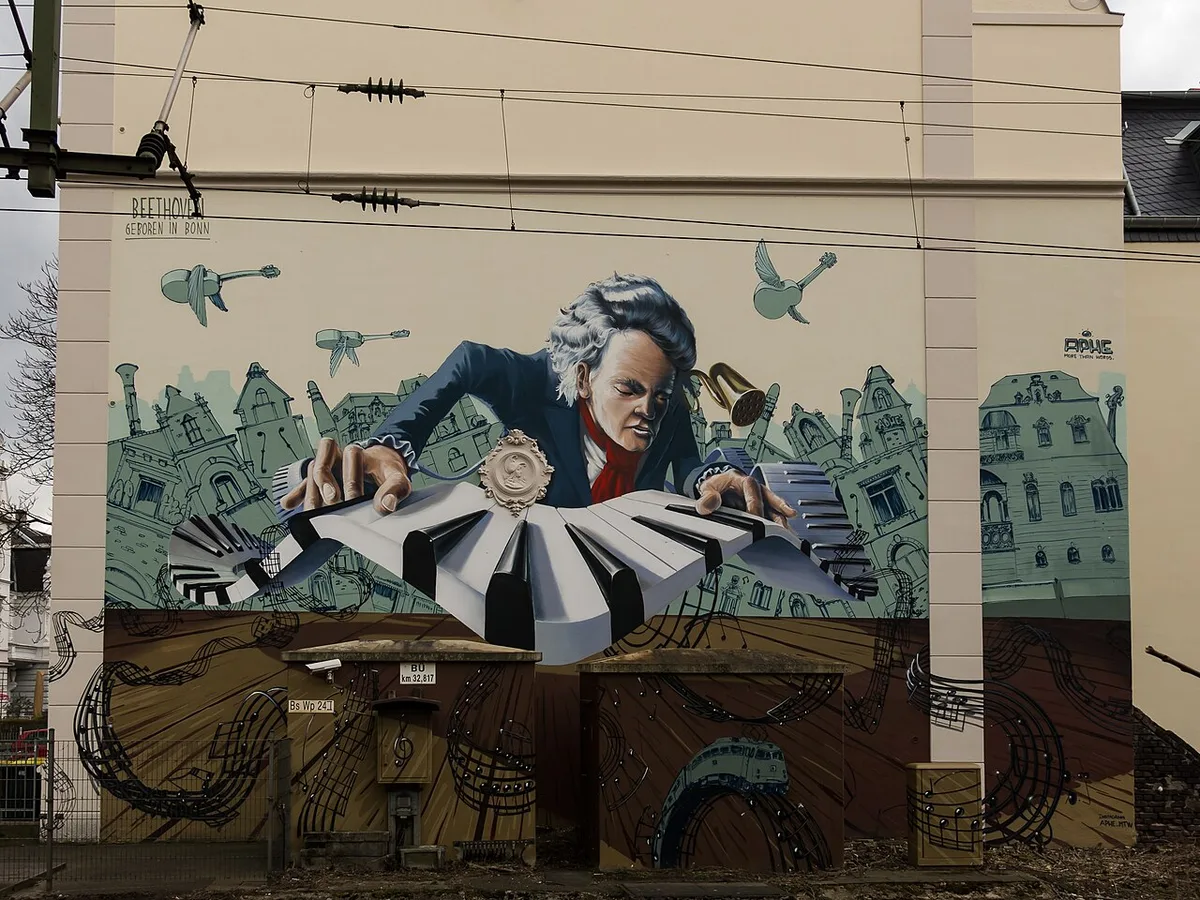
Beethoven's birthplace on Bonngasse is also within the Altstadt, which makes a three-stop circuit of the Rathaus, the Minster square and the Beethoven quarter an efficient half-day. If you want the museum as well, plan more time, since a Beethoven House Bonn visitor guide will flag that the house is a compact museum rather than a large one. Book or check admission details with the house directly.
For an evening option, concert programming in Bonn includes the Beethovenhalle, whose schedule changes by season. That is a different type of stop from the Rathaus and works best as a separate evening plan rather than an add-on to a daytime walk. Check the venue's own listings for what is actually on during your dates.
Practical Orientation for the Square
The Altes Rathaus faces the Markt in the Altstadt, and the square is small enough that you can cross it in under a minute. The building's address is often given as Markt, which is the square itself rather than a numbered street frontage. Use the Markt as your search term when navigating on foot.
Because the square is pedestrianised and hemmed in by buildings, tour buses and vehicles do not pull up to the facade. Arrive on foot from the surrounding Altstadt streets rather than expecting a drop-off point at the door. This is also why the building reads better as a walking stop than as a coach-tour stop.
For a broader view of what to see in the city beyond this one square, the Bonn: Landmark Visitor Guides hub collects the individual landmark pages. The Bonn: Itineraries and City Travel Guides hub is the better starting point if you need to sequence multiple stops across a day or a weekend. Both are useful before you finalise a route.
Plan Your Visit
Treat the Altes Rathaus as a short, worthwhile pause built around what you can actually see: the gilded and silvered Rococo facade, the triangular Markt, and the double-sided staircase with its modern state-visit history. Verify current access and any market variations with the city before you travel, and do not assume the interior is open. Build the stop into an Altstadt walk rather than making it the whole plan.
The most common mistake is arriving on a Sunday expecting a bustling market or arriving on a weekday expecting an empty square, so decide which version of the Markt you want before you set out. Either way, the stop rewards a few minutes of deliberate attention rather than a glance from a passing bus.
Frequently Asked Questions
Is the Altes Rathaus in Bonn open to the public inside?
That is not established. The building is best treated as a civic structure whose reliable visitor experience is the exterior and the Markt square, not a museum interior. Check with the city of Bonn before travelling, since access arrangements for a working civic building can change and are not published as a standing tour offering.
What can you see at the Altes Rathaus from outside?
You can see a Rococo facade decorated with gilded and silvered ornament, set against the triangular Markt square, along with the double-sided staircase from which state guests historically waved to crowds. Stand to the side of the square rather than directly beneath the building, so both the trim and the staircase remain in view.
When is the market held in front of the Altes Rathaus?
The market in the Markt is held daily except Sundays, with a green market for staples and a street-food section. Public holidays, seasonal changes and weather can interrupt it, so confirm the day's activity locally if the market is your main reason for going.
How long should you budget for the Altes Rathaus?
As a suggestion, allow five to fifteen minutes for the facade and the square, and longer if you stop to eat at the market. It works best as one stop in a short Altstadt walk that also takes in Münsterplatz and the Beethoven sites rather than as a destination on its own.
Did famous politicians enter the Altes Rathaus?
What is documented is that figures including Charles de Gaulle and John F Kennedy appeared at the building's double-sided staircase and waved to crowds. Claims that they entered the interior are not verified here, so treat staircase appearances as the supported detail and avoid repeating stronger versions without a source.
Is there an admission charge for the Altes Rathaus?
No verified admission price for the Altes Rathaus is established, because the building is not confirmed as a ticketed visitor attraction. Do not rely on third-party booking pages for a price or a slot. If access arrangements ever change, the city of Bonn is the place that would publish it.


