

St. Peter's Church, the Petrikirche, was built in the 13th century and is the oldest of the three town churches in the Hanseatic city of Rostock, alongside St. Mary's and St. Nicholas; a fourth, St. Jakobi, was heavily damaged in the Second World War and later demolished. The parish association publishes a page on the view from the tower and describes the viewing platform inside the tower as offering a view in every direction. As a suggestion rather than an official time, allow roughly 30 to 45 minutes for the church and a pause at the top, and about 60 to 90 minutes for the wider old-town loop if you also walk the shopping street and the market square.
The real decision is not whether the church exists but whether the climb fits your time, and the details that decide it — hours, admission, and what the route up involves — are not all published. This guide keeps the confirmed facts quoted to their sources and treats everything else as something to check on the day. The city visitor site, which covers local transport, the GästeCard and seasonal events, is the sensible next stop for the rest of your stay in Rostock.
But Is the Climb Actually Worth It?
The honest answer depends on what you want from a tower. If your aim is to understand the shape of the old town — the low roofscape, the ring of the former fortifications, the harbour side — then a climb is the one thing that pulls the map together. If your aim is architecture, interiors and the famous medieval astronomical clock, St. Mary's is the stronger visit, and skipping the tower costs you very little.
Two things decide it in practice. First, visibility: a panorama is worth the entry and the effort only in clear conditions, and Baltic weather can change within an hour, so watch the sky during an old-town walk and go up if it clears rather than committing in advance. Second, the group: if anyone struggles with confined vertical routes, or if step-free access is essential, this is a poor candidate for a fixed plan, because nothing we found confirms whether a lift reaches the platform.
A reasonable decision rule: climb if you are reasonably mobile, the weather is clear and your schedule has slack; skip it if you are fitting the old town into a tight port window, or if the town churches matter to you mainly as interiors. No official figure tells you the climb is 'worth it' — that is your call, and the rest of this guide gives you what you need to make it without guessing.
Why the Petrikirche Tower Is the Old-Town Viewpoint Decision
Rostock's old town is largely low-rise, so a church tower is what makes the layout legible: the shopping spine, the market square, the wall line and the harbour side. St. Peter's is the oldest of the three town churches, which places it firmly among the old-town landmarks rather than on the city's edge, so a tower here gives you the aerial version of the same ground you will walk at street level.
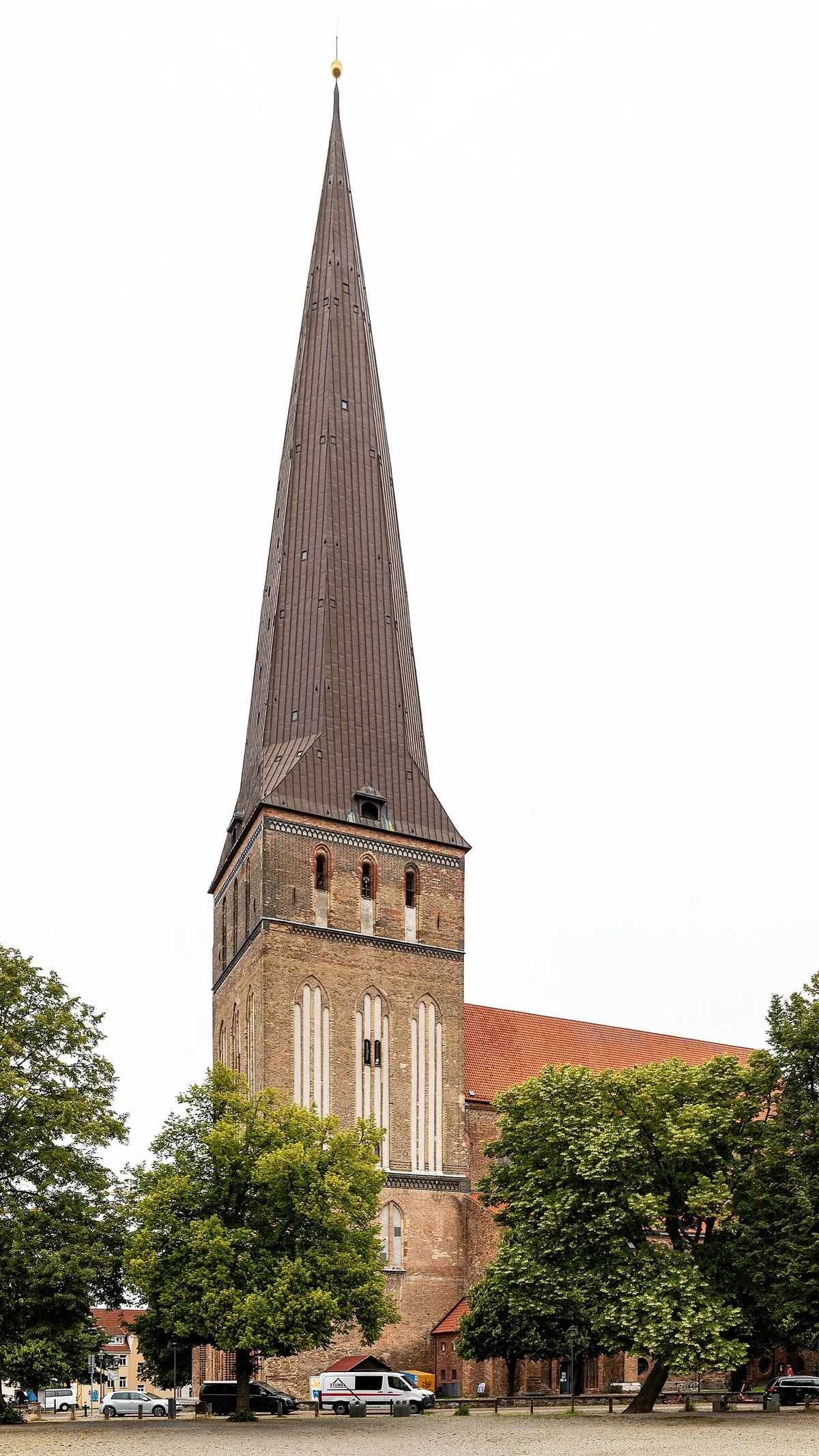
If a church interior is your priority, St. Peter's is not the obvious first stop — St. Mary's is the largest of the three town churches and the one most walking itineraries are built around. The tower is what gives St. Peter's its separate reason to be on your list. Decide first whether you want elevation, then decide which interior you want; doing one of each is usually better than doing two interiors.
The old town is not only churches. The former Abbey of the Holy Cross, founded in the 13th century by Cistercian nuns, is the only fully preserved abbey in the city and now houses the Museum of Cultural History alongside the university church. If your day is centred on the tower, a short museum stop like this one can fill a cloudy hour that a viewpoint cannot.
What St. Peter's Actually Is
St. Peter's, in German Petrikirche, was built in the 13th century and is the oldest of three town churches in the Hanseatic city of Rostock, in northern Germany. The map record for the building places it at Bei der Petrikirche 1, notes that it has the operator listed as the Evangelical Lutheran inner-city congregation of Rostock, and classifies it as a Lutheran church. It is the easternmost of the three surviving town churches, which matters when you plan the loop on foot.
The parish association publishes a short chronology and explains that the tower lost its helm during the church's troubled history and had it rebuilt in 1994 thanks to donations from the public and public funds. Its current fundraising project is for a new bell frame so the bells can ring out over Rostock again. A ten-minute pass over that material before your visit changes how you look at the tower: it is a building under active restoration, not a finished monument.
The Viewing Platform: What the Parish Publishes and What It Doesn't
The parish association's own site is explicit that the viewing platform in the tower offers a view in every direction, and it hosts photographs taken from up there plus a webcam feed showing the current outlook. That is enough to plan a climb around. What the same site does not publish in the material we reviewed is a current timetable for the tower, a tower admission price, or a route description.
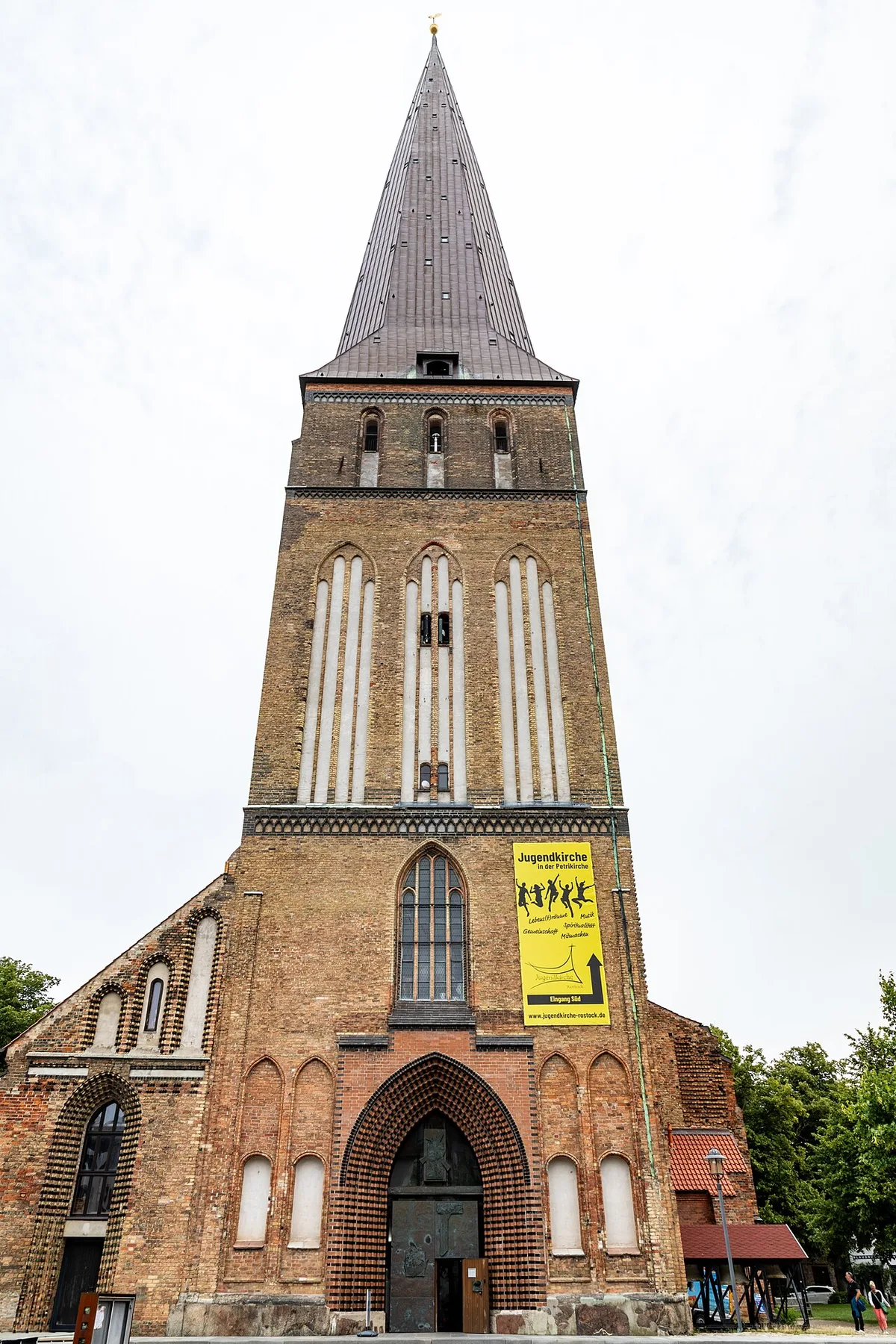
Third-party listings do carry seasonal times — one map record gives opening hours for the church building of 10:00 AM to 4:00 PM from January to April, 10:00 AM to 6:00 PM from May to September, and back to 10:00 AM to 4:00 PM from October to December — but that record says nothing about whether the tower follows the same hours as the church floor. Treat any posted time as a rough planning window and confirm the actual opening at the door or by contacting the parish.
One more variable worth checking: the parish uses the church and its hall for services, concerts and other events, and it publishes that programme on the same site. If a concert or service falls inside your window, the tower may not be the priority that day. Skim the current programme on the morning you plan to go rather than weeks in advance.
For plain visitor orientation — what the church is, where it sits in the city's church landscape — a short audio-guide entry describes it as the oldest of the three town churches and notes the fourth, St. Jakobi, as damaged in the war and demolished. It is a light source, useful for the basics and not for schedules.
Lift or Stairs: Planning When the Route Isn't Published
Nothing in the material we reviewed states whether the tower is reached by a lift or by stairs alone, and none of it makes an accessibility claim for the platform itself. Do not build a plan around an assumption either way. The practical move is to ask at the entrance, or contact the parish in advance, and to have a fallback if the route turns out to be unsuitable for someone in your group.
One nearby record notes wheelchair access for the church building, but that describes the building generally and is not evidence about the tower platform. A level church floor tells you nothing about the final stretch of a climb. If step-free access to the viewpoint is essential, ask specifically about the platform rather than about the church.
Two things you can control regardless: footwear and layers. Cobbled old-town streets, a confined vertical route and a breezy platform all argue for flat shoes and a jacket you can zip up. And if anyone in your party dislikes tight vertical spaces, settle that before paying rather than at the foot of the stairs.
Ticket Scope: Free Grounds Versus Paid Interiors and Towers
Rostock's town churches are not run as a single ticketed circuit, and nothing in the available material supports the idea that one admission covers several of them. Assume each site answers for itself: a church may be open for quiet visiting at no charge while a tower or a special exhibition is handled separately. Confirm at the entrance instead of extrapolating from the last church you paid to enter.
St. Nicholas is a useful illustration of why the word church needs a qualifier here. It was badly damaged in the Second World War, and from 1976 the tower, roof and nave were rebuilt with offices and service rooms in the tower; three residential floors with apartments and guest rooms were installed in the rebuilt roof. Today it functions as a cultural and event centre with a concert and exhibition programme, so visiting it is closer to visiting a venue than attending a parish service.
Commercial old-town walking tours advertise entry to St. Mary's as part of their package and list St. Peter's and St. Nicholas among optional or extended stops, which reinforces the point that these sites are handled individually rather than bundled. If you are weighing a guided tour against wandering on your own, read the inclusions line by line before assuming a tower climb is included.
Timing Your Climb: Light, Weather and Crowds
No source we reviewed publishes a best time to climb, so treat timing as reasoning rather than fact. Midday light flattens a city panorama, while lower sun picks out brick gables and the harbour edge more strongly; Baltic weather can change the visibility within an hour. If the view is the point of the climb, watch the sky during your old-town walk and go up when it clears.
Crowds are the other variable, and they are shaped by ships. Rostock-Warnemünde is described as the most popular and significant cruise port in the southern part of the region, visited by more than 180 ships annually, with passengers heading into Rostock from the port. On a heavy call day the old town and its church towers absorb that flow, so the quietest window tends to be early or late relative to the ship's schedule rather than the middle of the day.
If you are a cruise passenger, your day is bounded by the ship's departure and the tower competes with everything else in the old town. Build in a buffer for the return leg rather than climbing last. The city visitor site is the place to check seasonal events that might crowd the old town on your date.
Fitting the Tower Into a 60 to 90 Minute Old-Town Walk
A compact circuit works well here: begin at the Kröpeliner Tor, follow the shopping street towards the market square, take in the town hall and Neuer Markt, then continue to St. Peter's for the tower. The gate is the natural start — it was built in the Gothic style around 1270 as the westernmost of the four large gates of Rostock's fortifications and still marks the western end of Kröpeliner Straße. Give it a few minutes, then keep moving.
From the gate, the walk cityward passes the Wallanlagen and the surviving stretches of the medieval wall. Rostock's fortifications enclosed the city from the middle of the 13th century and, after the three constituent town centres formally united in 1265, a joint wall of roughly three kilometres with more than twenty gates was built. That context makes the view from the top far easier to read when you get there.
The market square is worth more than a photo stop, and the town hall is the landmark that anchors it. If you want a slower version of the same route, add the wall and the gates rather than a third church interior. Itineraries like this should always flex around whatever is open on the day, and around how much light you have left.
Comparing Viewpoints: St. Peter's, St. Mary's and the Warnemünde Lighthouse
St. Mary's is the biggest of the three town churches and the one most guided tours build around, with a Gothic interior and an astronomical clock dating from the fifteenth century among the headline sights. Its appeal is largely interior and historical. St. Peter's is the vertical option, which is why the two are worth splitting rather than treating as substitutes — one for the interior, one for the elevation.
The Warnemünde lighthouse is the third option, and it wins on subject matter rather than height. It is described as about a 15-minute walk from the cruise terminal and offers panoramic views of the Baltic Sea and the beach. Choose it when you want a sea view, and St. Peter's when you want the city itself; the lighthouse has the advantage of pairing with a walk along the Alter Strom and the piers.
For a flat, green alternative to any tower, the university botanical garden is a walk or a short ride from the centre and makes a good afternoon once you have seen the old town. Check its official pages for seasonal hours and any separate greenhouse schedule, because garden and greenhouse timings can differ.
Warnemünde Day-Trippers: The Train Decision That Changes Your Timing
If your ship berths at Warnemünde, the station sits immediately outside the cruise terminal, and one cruise-port account describes frequent S-Bahn services between Warnemünde and Rostock taking under thirty minutes. That makes the old town a realistic half-day rather than an all-day commitment, and it also means the tower is competing with a walk along the Alter Strom and the beach.
Treat that account as one traveller's experience rather than official port guidance, and check your own ship's schedule for arrival and departure times. The city's own visitor site covers local transport, the GästeCard and seasonal events in a general way. Use it to orient yourself, then verify the specific train times you intend to catch on the day itself.
The decision is simple enough: pick either a Warnemünde day with a short old-town hop, or an old-town day with the tower as the centrepiece. Trying to fit the harbour, the beach, the market square and a tower climb into one short call usually ends with a rushed version of all four. Decide which one you would regret missing.
Common Mistakes to Avoid
The most frequent assumption is that the town churches share a ticket, or that a tower climb is free because the church is open. Neither is supported by what the parish and the tour operators publish. Ask at the door specifically about tower access, and keep both cash and card options open in case admission is handled separately.
The second mistake is skipping St. Nicholas because it no longer looks like a working parish church. Its conversion history — burned out in 1942, rebuilt from the 1970s with offices in the tower and flats in the roof, then reopened as a hall in 1994 — makes it one of the more unusual interiors in the city. Read the parish and event listings before deciding it is not for you.
The third is over-scheduling. Two church interiors, a tower climb, a market square and a wall walk is a full day, not a morning. If your time is short, pick the tower plus one interior and let the rest be a reason to come back.
Practical Checklist Before You Go
Check the parish site for the current programme and any notice about the tower, then check the city visitor site for events that might crowd the old town on your date. Look at the forecast on the morning of your visit, because a panoramic viewpoint is only worth the effort when visibility cooperates.
Wear shoes suited to cobbles and a possible vertical route, carry a layer for the platform, and confirm both the route up and the admission arrangement at the entrance. If you are arriving by ship, set a hard turnaround time and check the return connection before you start the old-town walk.
Plan Your Visit
The climb is worth it if you want to understand Rostock's shape rather than just its street level, and if you are willing to confirm the practical details rather than assume them. Check the parish site for the tower and its programme, and the city site for events, before you set out. Then decide between a tower-centred old-town morning and a Warnemünde harbour day — not both at once.
If you build the rest of the day around the old town, the surviving wall and gates give the walk a natural frame and make the view from the top far easier to read. Handle hours, admission and access questions on the day, and the decision becomes straightforward: climb if the sky is clear and your schedule has room, and save it for next time if it does not.
Frequently Asked Questions
Is there a viewing platform at the top of St. Peter's Church in Rostock?
Yes. The parish association's own site describes the viewing platform in the tower as offering a view in every direction, and it publishes photographs taken from up there alongside a webcam feed. That confirms the platform exists as part of the church, but it does not tell you when it is open or how you reach it, so confirm those details on the parish site or at the entrance on the day.
Do you need a ticket to climb St. Peter's tower?
The available material does not state a tower admission price or whether climbing is free, and Rostock's town churches are not run as a single ticketed circuit. Check the parish site and ask at the entrance, and do not assume that admission to one church covers a tower at another. If you book a guided old-town tour, read the inclusions carefully rather than assuming tower access is bundled in.
Is there a lift up the tower, or only stairs?
That detail is not published in the material available for St. Peter's, so treat it as unconfirmed and ask before you rely on it. One map record notes wheelchair access for the church building, which says nothing about the tower platform or the climb itself. If step-free access to the platform matters for your group, contact the parish office in advance and ask specifically about the viewing platform.
How long does the tower climb take?
No official climb time is published. As a personal planning estimate rather than official guidance, allow roughly 30 to 45 minutes inside the church including a pause at the top, and about 60 to 90 minutes for the wider old-town walk on foot. Add extra buffer if you are visiting on a cruise port day, when the return connection needs to be protected.
Is St. Peter's tower better than St. Mary's for old-town views?
They serve different purposes. St. Mary's is the largest of Rostock's three town churches and is best known for its Gothic interior and fifteenth-century astronomical clock, so it is the stronger interior visit. St. Peter's is the one with the tower viewpoint, which makes it the elevation option. If you have time, do one interior and one climb rather than two interiors.
Can you visit St. Peter's Church for free?
Admission arrangements are not stated in the material available, and church buildings and their towers are often handled differently. Check the parish site before your visit and ask at the entrance what applies on that day. Keep both cash and card options available in case a separate contribution or ticket applies to tower access.
How do you get to St. Peter's Church from the Warnemünde cruise port?
Warnemünde's train station sits immediately outside the cruise terminal, and one cruise-port account describes frequent S-Bahn services between Warnemünde and Rostock taking under thirty minutes. From Rostock's centre, the church is a short walk in the eastern old town. Treat that account as one traveller's experience, check your own ship's timings, and verify current connections before you set out.
Sources
- First visit to Rostock - St. Nicholas Church as living space
- Self-guided Sightseeing Tour #1 in Rostock, Germany | Visit Sights
- St. Peter’s Church Map - Rostock, Mecklenburg-Western Pomerania, Germany
- Audio guide for St. Peter's Church, Rostock | SmartGuide
- Warnemünde Cruise Port Guide: Beach, Rostock & Top Tips
- Willkommen in Rostock
- Rostock Old Town Tour | Private Walk & Historic Highlights


