

Rostock, the largest city in Mecklenburg-Vorpommern, has a compact, largely pedestrianised old quarter of red-brick and pastel Hanseatic buildings dating to the 14th and 15th centuries, and a single straight axis is the most practical way to walk it (source: Expedia Rostock travel guide). For planning purposes you can allow roughly two hours for the street-level walk alone, treating that as an editorial suggestion rather than an official figure.
The sequence below runs from Kröpelin Gate at the western end of Kröpeliner Strasse to Neuer Markt, then continues to St Mary's Church and out to the surviving gates, churches and monastery buildings of the eastern old town. It is deliberately linear: you finish near sights that need their own time, their own tickets and their own opening rules. Read it as a spine you can lengthen or shorten, not a fixed itinerary.
Setting Up the Walk: Free Street Level Versus Paid Interiors
The walk itself costs nothing. Kröpeliner Strasse, Neuer Markt and the surrounding lanes are public streets and squares you simply walk through, and the facades of the Town Hall and the medieval gabled houses are visible from outside. Budget your money, not your feet, for the interiors along the way.
Treat each interior as a separate decision. St Mary's Church publishes its own entrance fees and its own seasonal opening times, and there is no shared old-town church ticket: St Nicholas, St Peter's and the other churches are run separately, so admission arranged for one does not carry over to the next. If you want to see inside more than one, check each site's own page rather than assuming a combined pass exists.
Kröpeliner Strasse as the Spine of the Old Town
Kröpeliner Strasse is the wide pedestrian artery that carries you from the gate towards the centre, lined with shops and cafés rather than monuments, which is exactly why it works as an orientation line. Use it to get your bearings on the first pass, then double back for the buildings that deserve a proper stop. Walking it once in each direction is a reasonable way to separate orientation from sightseeing.
The Fountain of Joy of Life, the Brunnen der Lebensfreude, is the obvious mid-street pause: a bronze sculptural group that celebrates everyday pleasures and gives you a fixed point to meet people or rest before the square. Sit for ten minutes here rather than pressing on, because the next stretch through Neuer Markt rewards a slower pace and a look upward at the rooflines.
Kröpeliner Tor: The Documented History at the Western End
Kröpelin Gate was first recorded in a document in 1280, and it survives as the most elaborate of what were once 22 city and water gates. The six-storey structure stands 54 metres high and now serves as a city history meeting centre, with an exhibition relating to Rostock's fortifications. Those dimensions and dates are the documented facts worth knowing before you arrive.
Do not build your day around getting inside. No reliable statement is available here about when the gate or its exhibition is open to the public, and a past listing does not prove current access. Photograph the brickwork and the arch from the street, then check the city tourism site or ask at the tourist information before walking over specifically for the exhibition.
Neuer Markt and the Town Hall Seen From Outside
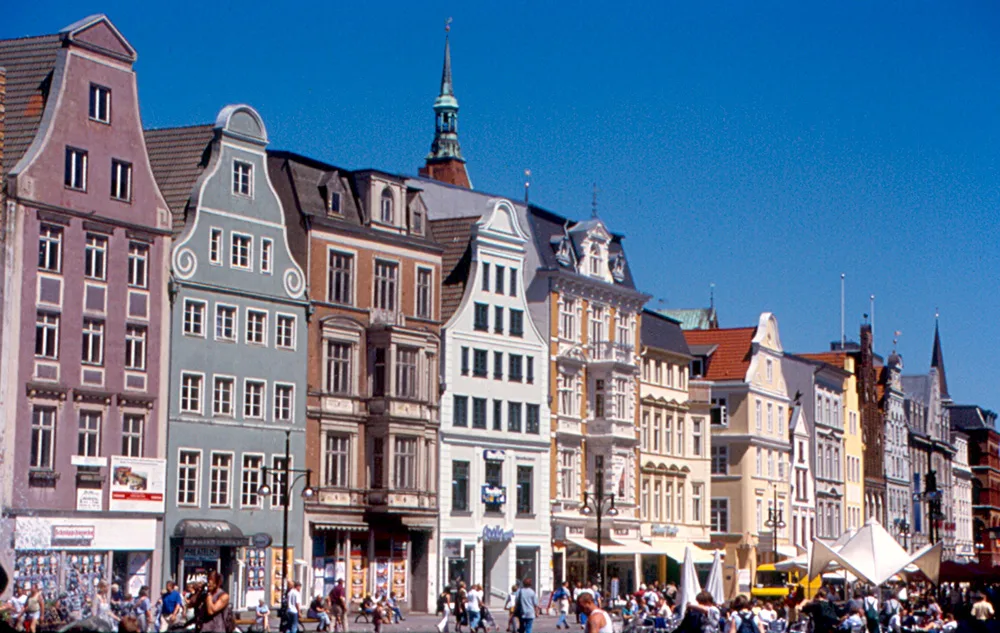
Neuer Markt is the central square where the marketplace history of the old town reads most clearly: a broad cobbled space ringed by historic buildings, with the Town Hall on its edge showing a blend of Gothic and Baroque architecture in a single facade. Circling the square once and looking at the rooflines gives you more than a quick photo stop. For wider planning, see St. Mary's Church Rostock.
Assume nothing about the interior. Walking tour operators use the Town Hall forecourt as a meeting point precisely because visitors are not expected to enter the building, and no published visitor access is documented. Look at the facade, read the square, and plan your indoor time for the churches and museums that genuinely admit the public.
The Medieval Houses Most Visitors Walk Past
The House of Krahnstöver is a seven-axle late Gothic gabled house first mentioned in 1376, which makes it one of the oldest medieval houses in Rostock. From 1803 to 1986 it housed Julius Krahnstöver's distillery and liqueur factory, and the brick building you see today was largely constructed around the middle of the 19th century. Stop and read the gable: this is the layer of the old town that most street-level visitors miss entirely.
Because these are working buildings, the pleasure is architectural rather than curatorial. Look at the proportions of the gables, the axes of windows and the brick detail, and keep walking: the old town rewards attention to buildings you are not meant to enter. Set a slow half-hour aside for this stretch between Neuer Markt and the church.
St Mary's Church: Hours, Fees and the Midday Queue
St Mary's Church opens May to October Monday to Saturday 10:00 to 17:00 and Sunday and holidays 11:00 to 16:00, and November to April Monday to Saturday 10:00 to 16:00 and Sunday and holidays 11:00 to 15:00. Those seasonal times and the following fees are published by the church itself. Entry is 4 EUR for adults, 3 EUR reduced, free for under-18s, with a one-year ticket at 15 EUR.

Reductions apply to students, Warnow-Pass holders, disabled visitors, Bürgergeld recipients and owners of the EA-card HRO or MV, so bring the document that proves your category. In summer there is a queueing risk around the Apostle's Procession and Noon Prayer, and the church advises arriving at the entrance before 11:40 if you want to attend. Visiting is not possible during prayer and worship times.
Inside St Mary's: the Astronomical Clock and Practical Limits
The reason most people pay to enter is the astronomical clock, a 15th-century mechanism dated to 1472 that still functions and sits among the church's altars, fonts and side chapels. Private tour descriptions pair the clock with the church interior as the centrepiece of a two-hour old-town walk, which is a fair indication of how long the interior itself deserves. Aim to see the clock without rushing the surrounding chapels.
The church states plainly that it is no museum with guaranteed accessibility, and it asks groups to check in advance whether events will make visiting impossible or restricted. Wheelchair access is possible through the entrance and, for larger devices, via a ramp at the southern entrance, with staff able to open an additional door if needed. There are no public toilets in the church, so plan that stop elsewhere.
Extending Beyond the Axis: Churches, Monastery and Gates
Once you leave St Mary's, the eastern old town continues with St Nicholas Church, described as the oldest church in Rostock after its transformation into a cultural venue, St Peter's Church with its tower, and the Monastery of St Catherine, an old Franciscan foundation. Parts of the medieval city wall and four city gates also survive. Each of these is a separate stop with its own access logic and its own opening arrangements.
St Peter's is a useful example of why you should check locally: its support association runs its own site with service times, concerts and tower information. Rather than stringing all the churches together on one rushed afternoon, pick one or two interiors per visit and accept that the rest will be exterior viewing. That keeps the day humane and the tickets honest.
Arriving from Warnemünde: Cruise and Day-Trip Framing
Warnemünde is the coastal resort attached to Rostock and the region's main cruise port, and the city describes the fastest link to the centre as the S-Bahn, which connects the centre directly with the beach station; buses and passenger boats are alternatives. Keep the guidance general and check the current timetable on arrival, because frequencies change by season. The centre itself is compact and pedestrianised, so once you arrive most of the axis is walkable.
For cruisers the real decision is scope, not transport. This axis plus one church interior fits comfortably into a half day, while adding the eastern churches, the monastery and a museum pushes you into a full day. Berlin is a much longer commitment and is best left to an organised excursion; the old town axis is the option that keeps you close to the ship. If you want to compare the centre with the coast, look at a dedicated Warnemünde day trip plan before committing.
Pacing, Timing and Access Along the Route
Walk the axis in the morning if you want the square at its calmest, then use midday for an interior such as St Mary's, where the queueing risk around the Apostle's Procession and Noon Prayer is concentrated. The Fountain of Joy of Life is the natural lunchtime pause, and the streets either side of Neuer Markt give you benches and café seating without needing a reservation. Keep the sequence linear so you never retrace more than a block.
Access notes here are limited to what St Mary's itself publishes: the entrance and southern ramp arrangement, staff assistance with doors, and the absence of public toilets. No comparable official detail is available for the square, the Town Hall or the streets, so visitors with specific mobility needs should contact the relevant site or the tourist information directly rather than rely on assumptions. For a fuller alternative route, compare the stops against a dedicated Rostock old town walking route before you commit.
Combining the Axis With the Rest of Rostock
The axis is a spine, not the whole city. If you have a second half-day, the Botanical Garden of the University of Rostock publishes its own seasonal outdoor hours separately from the greenhouses, making it a good pairing when you want greenery after brick and stone. Admission there is free, and the university asks visitors to follow its garden regulations, including keeping dogs outside and staying off unmown meadow areas.
Before you go, confirm the season you are travelling in: St Mary's switches its hours between the May-to-October and November-to-April schedules, and occasional restrictions can suspend visiting altogether, which the church announces on its own site. Check the city tourism pages for current event information and any temporary changes along the street. A five-minute verification the night before is worth more than any fixed plan made months ahead.
Frequently Asked Questions
How long does it take to walk Kröpeliner Strasse to Neuer Markt?
The street-level walk from Kröpelin Gate along Kröpeliner Strasse to Neuer Markt and on to St Mary's Church is short enough to do in a single relaxed stretch, and around two hours is a sensible planning figure if you pause at the fountain and read the facades. Add time for any interior you enter, since St Mary's alone deserves a proper look around the astronomical clock and side chapels. Treat the figure as a suggestion and adjust for how often you stop to photograph the gabled houses.
Is Kröpeliner Strasse and Neuer Markt free to walk?
Yes. The street and the square are public space, and the Town Hall facade, the Fountain of Joy of Life and the medieval gabled houses are all seen from outside at no cost. What costs money are the interiors, and each one is separate: St Mary's Church publishes its own entrance fees on its visitor information page, and it has no shared ticket with the other old-town churches. Budget for the interiors you actually choose rather than for the walk.
Can you go inside Rostock Town Hall at Neuer Markt?
Do not plan on it. No visitor access to the interior is documented, and guided walking tours use the Town Hall forecourt purely as a meeting point, explicitly asking participants not to enter the building. Treat the square and the Gothic-Baroque facade as the attraction and confirm any change through the city's own tourism pages before you travel. If you want an interior on this axis, St Mary's Church is the reliable option.
What are St Mary's Church opening hours and entrance fees in Rostock?
The church publishes two seasonal schedules on its own visitor information page: a May-to-October set and a November-to-April set, with different weekend times in each. Its published entrance fees are listed there too, along with the categories that qualify for a reduction and the free admission for children and young people under 18. Check that page on the day, because occasional restrictions can make visiting impossible or restricted.
Do all Old Town churches in Rostock share one ticket?
No, and it is worth being clear about this before you set out. St Mary's Church publishes its own admission prices and is run separately from St Nicholas, St Peter's and the monastery sites, which have their own arrangements. The multi-hour private tours that include entry to Nikolaikirche and the Culture Museum are describing what their package covers, not a city-wide pass. Check each church's own page if you want to visit more than one interior.
Is Kröpelin Gate open to visitors and does it have an exhibition?
Kröpelin Gate, first documented in 1280 and now a six-storey, 54-metre building, is described as a city history meeting centre housing an exhibition on Rostock's fortifications, but no reliable statement is available on current visiting access or times. Do not treat a past listing as proof of opening. See the gate from the street, and ask the city tourist information directly if the exhibition is a priority for your trip.
Is the walk from Warnemünde to Rostock's Old Town doable in a half day?
Yes, if you keep to the axis. Warnemünde is the resort attached to Rostock and the region's main cruise port, and the city's own tourism pages describe the S-Bahn as the fastest link between the centre and the beach station, with buses and passenger boats as alternatives. The centre is compact and pedestrianised, which helps. Berlin is a far longer commitment, so leave that for an organised excursion and spend your half day on the axis.
Sources
- Kröpelin Gate, Discover Rostock: city tour with audio guide - Audio walk city tour | guidemate
- House of Krahnstöver, Discover Rostock: city tour with audio guide - Audio walk city tour | guidemate
- Rostock Travel Guide 2026: The Best of Rostock | Expedia
- Willkommen in Rostock
- Petrikirche Rostock – der Förderverein der Petrikirche Rostock e.V.
- Visitor Information for St. Mary’s Church – Marienkirche Rostock


