

Rostock grew rich as a Hanseatic trading city on the Warnow, and its old town still reads like a merchant's ledger: brick churches, gabled houses, defensive gates and a working waterfront, all within a walkable core. The Altstadt rewards a loose loop rather than a checklist, because the streets between the headline sights are themselves part of the visit. One useful benchmark for planning comes from a private operator, Rosotravel, which describes its own paid old town tour as a moderate walk of roughly 2.5 to 3.5 kilometres with uneven surfaces and steps; treat that as a labelled comparison point for the walking itself, not an official city measurement.
The practical distinction that shapes this route is between free outdoor ground and ticketed interiors. Squares, walls, gates and the harbourfront cost nothing to walk through, while churches and museums set their own admission rules and hours that can change with services, events or restoration work. Rostock's official city site confirms that the whole region is linked by S-Bahn, tram, bus and ferry services, which makes the old town easy to reach from other parts of the city without a car.
Choose Your Start and Direction
Two natural starting points divide the route. Starting in the eastern quarter near St Peter's and St Nicholas church puts the quietest cobbled lanes first, when they are least crowded, and lets you move west toward Neuer Markt as the day gathers pace. Starting at Neuer Markt puts the town hall, the main square and the shopping street within minutes of the first coffee stop, which suits anyone arriving by public transport into the centre and wanting orientation before atmosphere.
The trade-off is backtracking. An eastern start means the harbour and Kröpeliner Tor sit at the far end of the loop, so tired legs carry you back through the centre. A Neuer Markt start reverses that, giving you a short approach to the harbour but sending you east again if you want the church quarter at its calmest. Either way, walking the route as a rough loop rather than doubling back along the same lanes keeps the day varied and saves the duplication that turns a pleasant stroll into a slog.
Leg 1: The Eastern Quarter and Its Brick Churches
The streets east of Neuer Markt hold some of Rostock's most atmospheric corners, with restored houses, brick churches and quiet courtyards packed into a small area. St Peter's Church is the district marker, a tall brick tower that once helped sailors orient themselves as they approached the Warnow. The tower remains a visible landmark across the flat surrounding landscape, which makes it a useful compass point if the lanes start to blur together.
St Nicholas Church nearby is an unusual case of medieval fabric adapted to modern use, with parts of the building converted into homes. That conversion makes it a striking illustration of how Rostock tends to fold old structures into contemporary life rather than sealing them off. Because church openings depend on congregations and events, check locally on the day rather than assuming a fixed visiting window for either building; the same caution applies to any tower ascent.
The parish association behind St Peter's publishes current information about the church and its tower viewing platform, including that the platform offers views in all directions. That association page is the right place to check what is actually accessible on your dates, since tower access is not something to build a morning around without confirmation.
Leg 2: Medieval Walls, Kuhtor and the Steintor
Sections of Rostock's medieval city wall survive, and following them gives a sense of the old town's original scale. From St Nicholas the short walk to the Kuhtor, or Cow Gate, brings you to one of the oldest surviving gates, built in the thirteenth century and since restored. It is a compact, easily missed stop, so slow down and read the masonry rather than hurrying past on the way to the next square.
Continuing along the wall line reaches the Steintor, a sixteenth-century gate built in a Dutch Renaissance style on the site of earlier fortifications. Its elaborate decoration, including the griffin sculptures that guard the tower, replaced the austere appearance expected of a defensive gateway and shows how the city's priorities shifted as its merchants grew wealthier. Across the road stands the neo-Gothic Ständehaus, which now houses the regional court and makes a strong architectural contrast with the older gate.
Gate interiors are not guaranteed public spaces, and the evidence for Kröpeliner Tor reports scaffolding, so plan these stops as exterior architecture rather than indoor visits. Treat any gate as a photographed landmark first and an optional interior second. If a door happens to be open, that is a bonus rather than the point of the leg.
Leg 3: Neuer Markt, the Rathaus and the Kerkhoffhaus
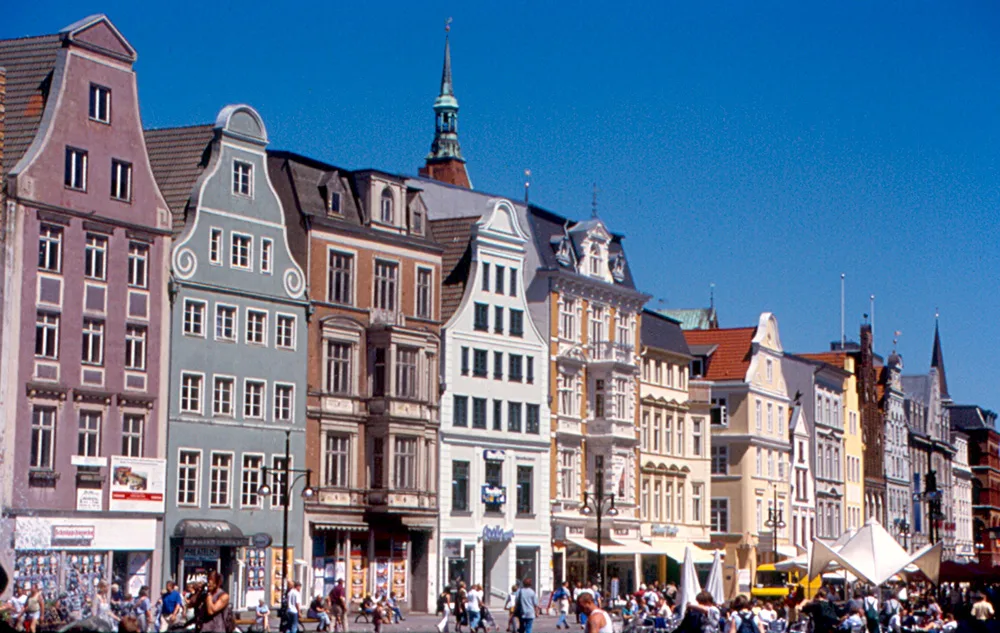
Neuer Markt is the spacious heart of the Altstadt, lined on its western side by a row of colourful gabled houses whose pastel facades recall the city's merchant past. The square is a good place to pause, watch the rhythm of daily life and reset before the busiest stretch of the walk. It is also the easiest point on the route to swap a walking break for a café stop without losing your bearings.
The Rathaus dominates the square, and the architectural layering is the detail worth noticing. A Baroque facade faces the market, while Gothic turrets rise behind it as reminders of the original thirteenth-century brick building. Rostock repeatedly enlarged and refaced its buildings while retaining earlier structures behind them, so the habit here is to look up and around rather than only at street level.
Tucked behind the town hall is the Kerkhoffhaus, one of the most beautiful surviving examples of Hanseatic domestic architecture and easy to miss if you do not know it is there. Built around 1470 for the merchant and mayor Berthold Kerkhof, it carries a stepped gable decorated with glazed terracotta panels and Renaissance ornaments added in the early sixteenth century. Look for the playful reliefs among the classical motifs, including dolphins, mythical creatures and expressive human faces.
Leg 4: Kröpeliner Strasse to Universitätsplatz
From Neuer Markt, Kröpeliner Strasse runs west as the city's principal shopping street. Modern storefronts line much of it, but historic facades, ornate gables and narrow side streets reward anyone willing to scan above the shop signs. Dip into a side lane when something catches your eye rather than saving every detour for the end, because this is the stretch where the old town and the working city overlap most visibly.
The university's main building at Universitätsplatz is the architectural high point of this leg, with a richly decorated nineteenth-century facade of arches, columns, statues and carved detail. The square in front is lively and unmistakably shaped by the student population, which gives the area a younger energy than the market square. The Fountain of Joy sits in one corner, its bronze figures tumbling through the water as a modern counterpoint to the historic surroundings.
Leg 5: Kröpeliner Tor and Lange Strasse
Kröpeliner Tor is another of Rostock's surviving medieval gates, and it marks the western edge of the classic old-town circuit. It has been reported behind scaffolding during restoration, so do not build the stop around an interior visit. Photograph the gate, read what is visible of its fabric and carry on; if the scaffolding has come down by the time you visit, that is a pleasant surprise rather than a plan.
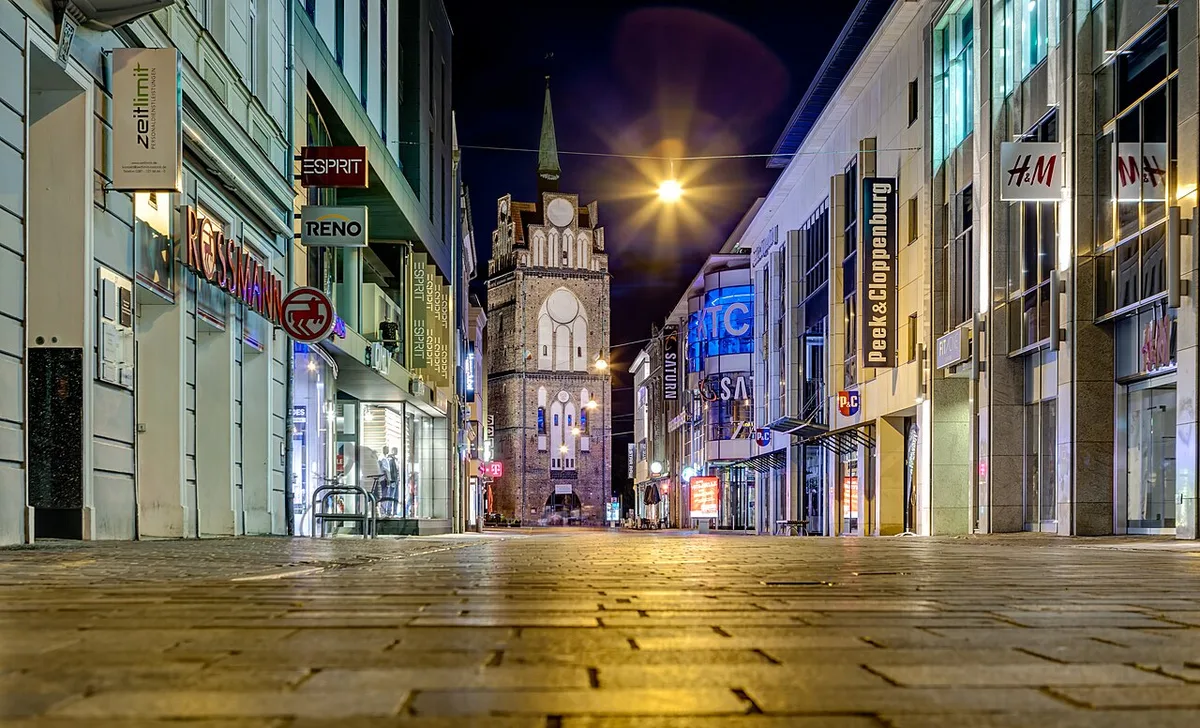
Lange Strasse beyond the gate is one of the city's most fascinating streets precisely because it is not uniformly historic. Before the Second World War it was a principal thoroughfare lined with elegant Hanseatic merchants' houses, much of which was destroyed in the 1942 bombing raids. The post-war socialist authorities rebuilt it as a grand boulevard for parades, with broad pavements and imposing apartment blocks in a Socialist Classicist style.
What makes the street worth walking slowly is the borrowing. The architects echoed stepped gables, red brick, pointed arches and decorative motifs from Rostock's Hanseatic past, so the boulevard reads as a blend of medieval tradition and mid-twentieth-century planning rather than a clean break with either. Reading the facades as a conversation between those two eras is more rewarding than hunting for a single perfect house.
Leg 6: Hausbaumhaus and the Harbourfront
Behind Lange Strasse stands the Hausbaumhaus, one of the oldest surviving Hanseatic merchant houses in the city and a reminder of the wealth that trade brought to medieval Rostock. Its name translates literally as House Tree House, and the reason becomes clear inside, where a massive oak trunk rises from the cellar and branches upward to support the upper floors. That internal timber frame allowed builders to keep an open trading hall at ground level, an ingenious solution worth understanding even if you only see it from the outside.
The walk finishes at the Stadthafen, the city harbour just north of the historic centre. The waterfront no longer functions as the main commercial port, but its quays, warehouses and harbour cranes retain an industrial atmosphere, and the promenade around the Hafentreppen is a popular place to walk, cycle or simply sit beside the Warnow. Restaurants and bars occupy parts of the former port area, and a multi-phase redevelopment project aims to turn the wider waterfront into a new district. For wider planning, see A Rostock Harbor Walk.
Where to Fold In Indoor Stops
The Culture Museum occupies the former Convent of the Holy Cross, a Cistercian monastery founded in 1270, and its peaceful cloisters and historic rooms are attractions in their own right. The collections span religious art, paintings, decorative objects and artefacts connected to everyday city life, with a newer section on coins and art. Because it sits slightly off the main walking line, it works best as a deliberate stop rather than a quick walk-by.
Paid tours illustrate how these interiors are usually packaged. The operator Rosotravel lists its two-hour option as covering the old town with entry to St Mary's Church, with Nikolaikirche added on the three-hour option and the Culture Museum on the four-hour option. That structure is a useful reminder that these are separate interiors with separate access arrangements, not one blanket admission for every building on the route.
St Mary's Church: Admissions, Hours and Tours
St Mary's is Rostock's greatest medieval monument, its enormous brick structure reflecting the wealth and ambition of the Hanseatic merchants who financed it. Inside, tall pillars lead the eye up to the vaulted ceiling, and light falls softly across centuries-old furnishings. Its most famous treasure is the astronomical clock, built in the fifteenth century and incorporating astronomical information and a calendar, a demonstration of how closely science, religion and craftsmanship were entwined in the medieval world.
The congregation publishes its own visitor information, and that page is the place to check before you go rather than relying on any third party. It sets out separate opening seasons for May to October and November to April, lists admission tiers including a reduced rate, states that children and young people under eighteen are admitted free, and describes summer guided tours with their own surcharges on top of entry. It also notes that the church is not a museum with guaranteed accessibility, that visiting is impossible during prayer and worship times, and that occasional restrictions are announced on the site.
Because those hours, fees and tour schedules are set by the congregation and can change with services and events, verify them shortly before your visit instead of planning months ahead around a fixed slot. The group arrangements, including free admission for the guide on larger group bookings and reduced rates above a certain size, are also described on the same page and apply to external guides as well as parish-led visits. If a service or event is taking place, expect access to be reduced or closed.
A common mistake is assuming that a paid walking tour automatically includes church entry. Bundle details come from each operator's own option descriptions, so check what a specific tour actually covers before booking, and compare that with the congregation's own published terms. If you want to attend the noon prayer or see a specific interior feature, the visitor information page explains how to time your arrival.
Detours Worth the Extra Minutes
The Botanical Garden of the University of Rostock is a green oasis run by the university and a genuinely useful change of pace after a morning of brick and cobbles. According to the university's visitor information, the outdoor garden is open from March through October, with a shortened winter opening from November through February, and admission is free. Guided tours in English are available on request for a donation, and children under fourteen must be accompanied by an adult. Because it sits away from the main old-town loop, fold it in only if you are building a longer day or returning on a second visit.
If the harbourfront redevelopment has you curious, spend the extra time walking the quays rather than doubling back into the shopping streets. The waterfront is also the natural place to end a longer day, since sunset over the Warnow is a well-known reward for lingering. Sailing events and maritime festivals concentrate in the summer months, so check the city's own event listings if your dates coincide with one.
Timing and Pacing the Route
A straight walk of the core sights is a comfortable few hours on foot, and the eastern quarter, walls, market, shopping street, gate and harbour all sit within a continuous wander. Adding museum or church interiors changes the shape of the day substantially, so decide early whether you are walking with a couple of short stops or building around two or three full visits. The private operator's moderate 2.5 to 3.5 kilometre description is a reasonable planning benchmark for the walking itself, though it describes that company's tour rather than this route.
For a half-day version, choose either the eastern quarter and the market or the gate and harbour end, and accept that you will skip something. A full day allows the eastern churches, the walls, Neuer Markt with the Kerkhoffhaus, Kröpeliner Strasse, the gate and Lange Strasse, with the harbour as the finish. Because several stops depend on opening hours you cannot control, build slack into the plan rather than scheduling back-to-back interiors. If you want a more structured plan, see our suggested one day in Rostock itinerary.
Accessibility and Surface Realities
Rostock's old town is historic ground, which means cobbles, uneven paving, kerbs and occasional steps along the wall line and in church interiors. The operator behind the private old town tour describes its own route as moderate with uneven surfaces and steps, which is a fair warning for anyone with mobility limitations or a pushchair. Plan around the smoothest available stretches and be prepared to reroute when a lane turns out rougher than expected.
Accessibility inside individual buildings cannot be promised from the outside. St Mary's visitor information notes that access is possible through the entrance and via a ramp at the southern entrance for larger devices, with staff help if an additional door needs opening, and it confirms that there are no public toilets on site. That is specific to that church, so check each building separately rather than assuming the same arrangements apply across the route.
What to Skip If You Only Have a Few Hours
With only a few hours, prioritise the stops that cannot be replaced elsewhere: the eastern quarter's brick churches, the surviving wall and gates, and Neuer Markt with its layered town hall. Kröpeliner Strasse can be walked briskly if shopping is not your interest, and the university square is worth a look even from the street. The Kerkhoffhaus should stay on the list because it is small, central and easy to miss entirely if you do not seek it out.
Skip the longer indoor stops unless one specifically appeals. The Culture Museum and a full St Mary's visit each consume a substantial slice of a short day, and the harbour walk is better saved for a version where you have time to sit rather than glance. If you are short on time, decide between a church interior and a museum, not both.
Mistakes to Avoid
The most common planning error is assuming bundled entry. St Mary's admission is set by the congregation, and tour inclusions come from each operator's own option list, so the two are not interchangeable. Check the congregation's visitor information and the specific tour description separately before you commit money or time.
Another is treating gates and church interiors as always open. The evidence for Kröpeliner Tor reports scaffolding, and church openings depend on services and events, so photographic stops should not be built around interior access. Finally, do not plan around unverified transport specifics; the city confirms that S-Bahn, tram, bus and ferry services connect the region, but exact lines and journey times should be checked with the local operator on the day rather than assumed from an old blog post.
Plan Your Visit
Rostock's old town works best as a loose loop with a clear direction and a willingness to swap stops when doors are shut. Start in the eastern quarter for calm lanes and brick churches, or at Neuer Markt for immediate access to the square and shopping street, then follow the walls, the market, Kröpeliner Strasse and the gate down to the harbour. Keep outdoor ground and ticketed interiors in separate mental columns, and the day will pace itself.
Before you set out, confirm the details that change: St Mary's opening seasons and admission terms on the congregation's visitor page, the status of Kröpeliner Tor, and whether any church event restricts access on your date. The official city site remains the best starting point for orientation, local transport and seasonal events. Everything else on the route can be improvised on foot.
Frequently Asked Questions
How long does the Rostock old town walking route take?
A straightforward walk of the core sights takes a few hours on foot, with the eastern quarter, walls, Neuer Markt, Kröpeliner Strasse, the gate and the harbour sitting along a continuous wander. Adding church or museum interiors extends the day considerably, so decide early whether you are walking with short stops or building around two or three full visits. A useful comparison benchmark is a private operator, Rosotravel, which describes its own paid old town tour as a moderate 2.5 to 3.5 kilometre walk with uneven surfaces and steps; that figure describes their tour rather than an official city measurement.
Is St Mary's Church free to enter, and can I combine it with Nikolaikirche and the Culture Museum?
St Mary's is not simply free to enter. The congregation publishes admission tiers with a reduced rate, free admission for children and young people under eighteen, and separate surcharges for summer guided tours on top of entry. Nikolaikirche and the Culture Museum are separate sites with their own access arrangements, so they cannot be assumed to share one ticket. Paid tours sometimes bundle entry as part of their own options, so compare the specific tour description with the congregation's visitor information before booking.
Can I walk this route from the Warnemünde side on a cruise day?
Warnemünde is a separate seaside district rather than part of the old town, so the route here begins after you reach the centre. The official city site confirms that S-Bahn, tram, bus and ferry services link the region, and the train station sits close to the Warnemünde cruise terminal, but exact lines and journey times should be checked with the local operator rather than assumed. On a port day, allow generous buffer time for the return leg and keep the old-town loop short enough that a delayed connection does not threaten your departure.
Sources
- Rostock: Old Town and St Mary's Church Private Walking Tour
- Willkommen in Rostock
- Petrikirche Rostock – der Förderverein der Petrikirche Rostock e.V.
- Rostock Old Town Tour | Private Walk & Historic Highlights
- Visitor Information for St. Mary’s Church – Marienkirche Rostock
- Your Visit - Botanischer Garten - University of Rostock


