Rostock grew rich as a Hanseatic port, and its medieval defences left marks that still shape the city centre. Some parts of the medieval city wall, with four city gates, have survived to the present day, which is why a stroll through the modern shopping streets keeps running into brick Gothic. The surviving fabric is not one continuous rampart you can follow end to end; it is a set of gates and fragments threaded through a working city.
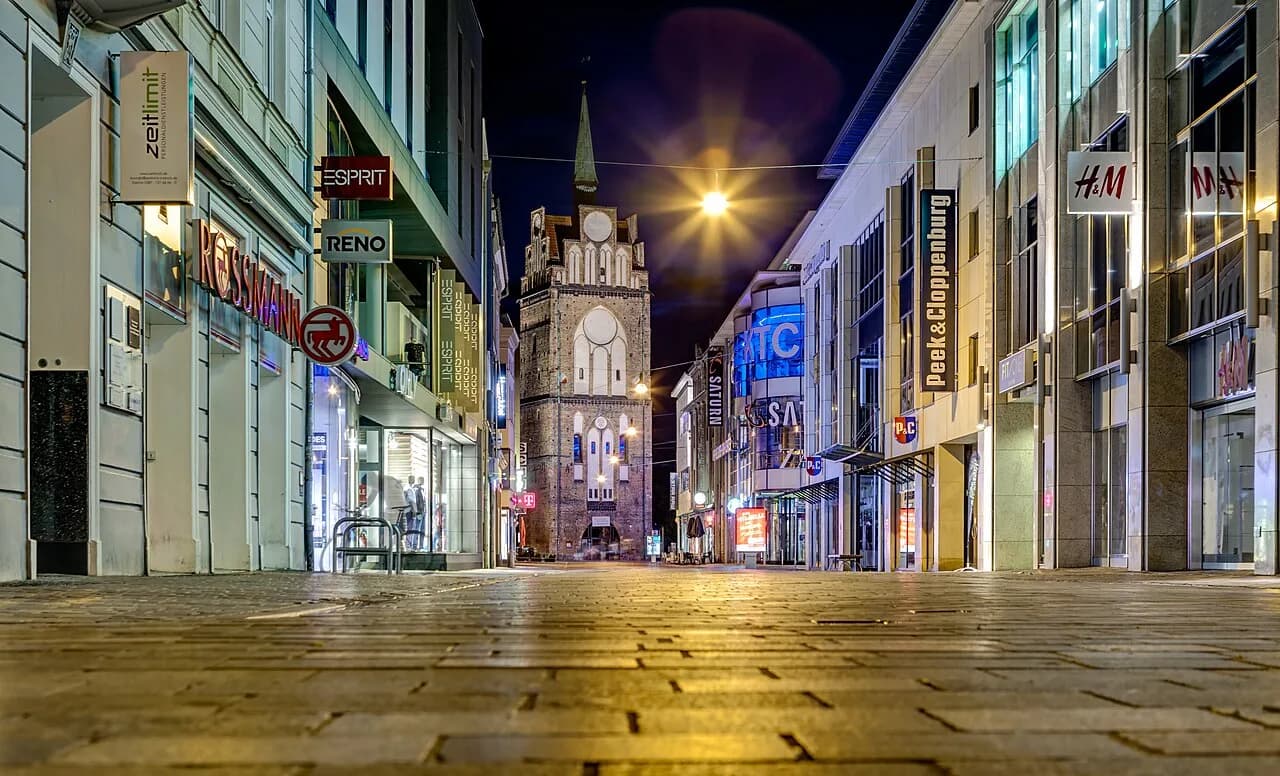
Kröpeliner Tor is the landmark most visitors meet first, because it stands at the end of Kröpeliner Strasse, the main shopping street of downtown Rostock. It is a six-storey gate from the old city wall with a height of 54 metres, and the surrounding quarter takes its name from the tower.
One practical constraint matters from the start. The available sources do not establish current opening hours, ticket prices or interior access for the gates, nor whether any section is free to enter. Treat the gate and wall exteriors as the reliable experience and verify anything beyond that locally on the day. As a suggestion rather than an official figure, allow roughly two hours for an unhurried exterior walk; nothing in the sources designates an official duration.
What the Rostock City Wall Is and Why It Matters
Rostock was a powerful member of the Hanseatic League, and the town's defences belonged to that era of trade wealth and civic ambition. Parts of the city walls and gates date from the 14th to the 16th century and survive into the present, rather than having been swept away entirely by later rebuilding. Because the city centre was extensively reconstructed after wartime damage, the surviving stretches read as fragments embedded in a newer streetscape rather than as a complete circuit.
The wall belongs to a wider brick Gothic story that runs along the Baltic coast, from Lübeck to Stralsund and Wismar, and the European Route of Brick Gothic lists Rostock among its German member towns. If brick churches and gatehouses appeal to you, this is a natural half-day theme rather than a single monument.
For orientation, Rostock is the historic Hanseatic city inland, while Warnemünde is the associated Baltic seaside resort, and the sea lies roughly 12 kilometres north of the centre. The wall and gates therefore belong to a city-centre sightseeing day rather than to a beach day, and are best planned alongside the Old Town instead of as a detour from the coast.
Kröpeliner Tor at the End of Kröpeliner Strasse
Kröpeliner Strasse is the main shopping street of the inner city, and Kröpeliner Tor sits at its end, which makes the gate easy to find without a map. The district around it, Kröpeliner-Tor-Vorstadt, takes its name from the tower and is known as Rostock's student quarter, with a supply of bars, galleries and cafés. Approach from the pedestrian street and the gate appears as a full stop to the shopping axis.
The gate is best understood as a piece of the old fortification rather than a standalone attraction: it once controlled one of the main roads into the town, and its six-storey bulk makes it the most prominent gate for most visitors. The city's official visitor site is maintained by the municipality, and its tourist information service is the realistic place to ask what is currently open. What lies inside the tower, and whether any viewing level is accessible, is not something the available sources establish.
Because the surrounding streets are commercial and busy, the gate is seen in passing by thousands of people daily; give yourself a few minutes to look up and notice the brick detailing. A short pause here also lets you decide your route: the wall fragment and the Abbey of the Holy Cross lie beyond, while the Old Town core and Neuer Markt lie back along the shopping street. If you want more context on the street itself, a dedicated guide to Kröpeliner Strasse and Neuer Markt covers that stretch in detail.
Other Gates and Wall Sections to Look For
Sources describe four surviving city gates along with fragments of the medieval wall. Steintor is the other gate named most often, and it is described as a city gate of stone with inscriptions, the seal and the coat of arms of the city, which gives it a different character from the brick towers. Look for it as part of the same defensive story rather than as an isolated monument.
Beyond the gates, the surviving wall appears in fragments, documented in the same area near Kröpeliner Tor together with a gate house structure on the wall. The Abbey of the Holy Cross, a former Cistercian convent founded by the Danish Queen Margaret I in 1270, is visible beyond the old city wall nearby. These fragments are what make the walk worth doing slowly rather than treating the gates as separate stops.
Avoid treating all four gates as equally visible or equally intact. Sources describe the survival of parts of the wall and four gates in general terms, not condition reports or access details for each structure, so what you can actually see on the ground may vary significantly from one site to the next. Build flexibility into the walk and let the city reveal what is there.
How to Walk the Wall and Gates
A sensible order starts on Kröpeliner Strasse, walking away from the Old Town core until Kröpeliner Tor appears at the end of the street. From there, head towards the documented wall fragment near the gate and the Abbey of the Holy Cross beyond it, then work towards Steintor and the gate house. This follows the logic of the surviving fabric instead of doubling back through shopping streets.
A self-guided exterior walk of this kind is best treated as a suggested couple of hours, with time built in for looking at details and for a coffee. No official route length or distance figure for the surviving wall and gates is documented in the sources used here, so do not plan around a fixed number. If you would prefer a guided version, a private Old Town walking tour passes the medieval city walls and covers several historic landmarks with a licensed guide.
Tours of this type carry specific scope conditions worth knowing before booking. St Mary's Church admission is included in all options, Nikolaikirche is included in the three- and four-hour options, and the Culture Museum Rostock is included only in the four-hour tour. The gate and wall themselves are not the ticketed component, and no interior access to the gates should be assumed from a tour listing.
What Is Free and What Is Not
Walking past the gate and wall exteriors is the part of the experience the sources support, and it costs nothing to look. However, the available material does not confirm whether any gate interior, tower or museum space is currently open, what it would cost, or whether a single ticket covers more than one site. Do not assume one admission covers multiple gates, and do not assume that free grounds mean free interiors.
The safest approach is to verify on the spot and treat any interior as a bonus rather than the plan. City signs, the tourist information service and the gate itself are the realistic places to confirm what is currently accessible, which also protects you from outdated claims you may encounter in older travel writing.
For contrast, some Rostock attractions have clearly documented free access. At the University of Rostock's Botanical Garden, admission is free, and the university publishes separate opening hours for the outdoor garden and the Loki-Schmidt Greenhouses, including a shortened winter schedule. That is a different kind of visit from the wall, but it shows how variable sightseeing economics can be across Rostock's sites.
Nearby Old Town Sights to Combine
The wall and gates make most sense as one layer in an Old Town day that also includes St Mary's Church, the Neuer Markt square and the Town Hall. St Mary's is described as one of the finest ecclesiastical structures in the Baltic region, with an astronomical clock built in the late 1400s, while the Town Hall mixes Gothic and Baroque styles.
Nikolaikirche is described as the oldest of the remaining hall churches in the Baltic region, with construction having begun in 1230. St Peter's is the highest church in the city, once a landmark for fishermen and sailors, and it has a tower with a viewing platform. If a tower climb is part of your plan, the St Peter's Church tower guide covers that visit as its own attraction.
If your interests lean towards modern art rather than medieval architecture, the city's Kunsthalle offers a distinctly different stop and can balance a day that otherwise runs heavily on churches and fortifications. The private walking tour options cover the churches and, in the longest version, the Culture Museum, so gate and wall interiors are not part of those itineraries.
Practical Planning and Getting Around
The region is knitted together by a dense network of S-Bahn trains, trams, buses and ferries, and the city centre is easily reached from the coastal resorts. From the centre, the fastest route to the coast is the S-Bahn, which connects the centre directly with the beach station, with buses and passenger boats as alternatives. For a wall-and-gates day you will mostly be on foot once you reach the centre.
If you are arriving from Warnemünde, the coastal resort is connected to the city by frequent S-Bahn services, and the ride is short enough to combine both places in a day. Station locations and current timetables are best checked with the local transport operator on the day rather than relying on old figures. Cruise passengers in particular should build in a buffer, because Warnemünde is the port while the Old Town is a separate trip inland; the Rostock to Warnemünde day trip guide covers that connection in more depth.
Signage in the historic centre is generally bilingual in practice in tourist areas, but German is the everyday language and English is not guaranteed at every smaller site. Learning a few basic phrases helps, and it also makes it easier to ask staff directly about what is currently open. Many vendors in the region accept cards and contactless payment, but carrying some euro cash remains sensible for small purchases.
Walking Conditions and Respecting the Site
The private walking tours in the Old Town are described as moderate walks of roughly two and a half to three and a half kilometres, including some uneven surfaces or steps. That is a useful proxy for the ground you are likely to meet on a self-guided wall-and-gates walk in the same area, though nothing in the sources states that a wall route is formally measured. Comfortable shoes matter more than any technical gear.
These are living streets, churches and residential quarters rather than a fenced heritage park, so behave as you would in any city centre. Cobbles, bicycles and delivery vehicles all share space with pedestrians, and the shopping street can be crowded at peak times. Early mornings and quieter weekdays give the gate and wall fragments more breathing room.
Weather along the Baltic coast changes quickly and wind is a constant, so layers are more useful than a single heavy coat. A rain shower can pass through within an hour, and gate façades look very different in low sun. If conditions turn unpleasant, the churches, museums and cafés of the Old Town are all within the same compact area.
Accessibility and Verification
Accessibility along the wall and gates is not something the available sources document, and it should not be assumed to be step-free. The cobbled centre and the surviving structures involve uneven ground in places, and older city centres rarely offer straightforward routes. Anyone with mobility requirements should contact the tourist information service directly before travelling.
The same logic applies to the gates themselves: if viewing a tower interior or an exhibition inside a gate matters to you, confirm it is currently open before making it the centrepiece of your day. The sources do not establish those details, and the honest answer is that you need to ask locally. Planning a route that works without interiors means no disappointment if they turn out to be closed.
Plan Your Visit
The strongest version of this visit is a relaxed walk that treats the surviving gates and wall fragments as pieces of a larger Hanseatic city rather than as a single attraction. Start at Kröpeliner Tor, follow the wall fragment towards the Abbey of the Holy Cross and Steintor, then fold in the Old Town churches and market square. That route works without relying on any interior being open.
What you cannot get from published sources is certainty about opening times, tickets or interior access at the gates and wall, so treat those as questions for the city's own tourist information on arrival. If you want those details resolved before you travel, that service is the right place to ask. Otherwise, bring comfortable shoes, dress for Baltic weather and let the brickwork carry the day.
Frequently Asked Questions
Is Rostock's city wall free to visit?
Walking past the gate and wall exteriors in the city centre is the part of the experience the available sources describe, and no source documents a charge or a ticket requirement for simply looking at them from the street. However, no source confirms whether any gate interior or tower is open to visitors or what entry would cost. Treat exterior viewing as the reliable option and check locally with the tourist information service if you want to know about interiors on your travel dates.
Can you go inside Kröpeliner Tor?
The available sources describe Kröpeliner Tor as a six-storey gate from the old city wall, standing at the end of the main shopping street, but they do not document interior access, tower viewing or any exhibition inside it. Anyone planning a visit around going inside should confirm current arrangements directly with the city's tourist information rather than relying on older travel writing. A walking route that stays outside the gate remains worthwhile regardless of whether the interior is open.
How long does it take to walk Rostock's surviving city wall and gates?
There is no official published length or duration for a wall-and-gates walk, and the sources do not give distances between the structures. As a suggestion rather than a formal figure, allow a couple of hours for an unhurried exterior walk linking Kröpeliner Tor, the wall fragment near the Abbey of the Holy Cross and Steintor, with time to look at details and stop for a drink. Add more time if you also want to visit the Old Town churches and Neuer Markt on the same outing.
Which other gates survive besides Kröpeliner Tor?
Sources describe four surviving city gates along with fragments of the medieval wall. Steintor is the other gate most often named, and it is described as a city gate of stone with inscriptions, the seal and the coat of arms of the city. A gate house structure on the wall also features in photographic records of the fortifications. The sources do not give a gate-by-gate condition report, so what you can see at each site may vary.
Do you need a guided tour to see the wall and gates?
No source requires a tour to look at the surviving gates and wall fragments, which sit in public streets in the city centre. Private Old Town walking tours pass the medieval city walls as part of their route, but their ticketed inclusions are specific: St Mary's Church in all options, Nikolaikirche in the three- and four-hour options, and the Culture Museum Rostock only in the four-hour tour. A guided walk adds context and storytelling, but the exteriors themselves are part of the everyday city.
How do you get to Kröpeliner Tor from the main station or Warnemünde?
The area is connected by a dense network of S-Bahn trains, trams, buses and ferries, and the city centre is easily reached from the coastal resorts. From the centre, the S-Bahn is described as the fastest route to the coast, linking the centre directly with the beach station, with buses and passenger boats as alternatives. Exact lines, stops and journey times are not documented in the sources used here, so check the current timetable with the local transport operator on the day. Once you are in the city centre, Kröpeliner Tor sits at the end of Kröpeliner Strasse and is straightforward to reach on foot.
Sources
- Rostock Travel Guide | Rostock Tourism - KAYAK
- Rostock Old Town Tour | Private Walk & Historic Highlights
- [2026 Rostock Attraction] Botanical Garden Travel Guide & Travel Experiences | Updated Oct | Trip Moments
- Güstrow - Europäische Route der Backsteingotik
- Willkommen in Rostock
- Rostock, (Port of Warnemünde), Germany | Where in the world is Riccardo?
- Your Visit - Botanischer Garten - University of Rostock