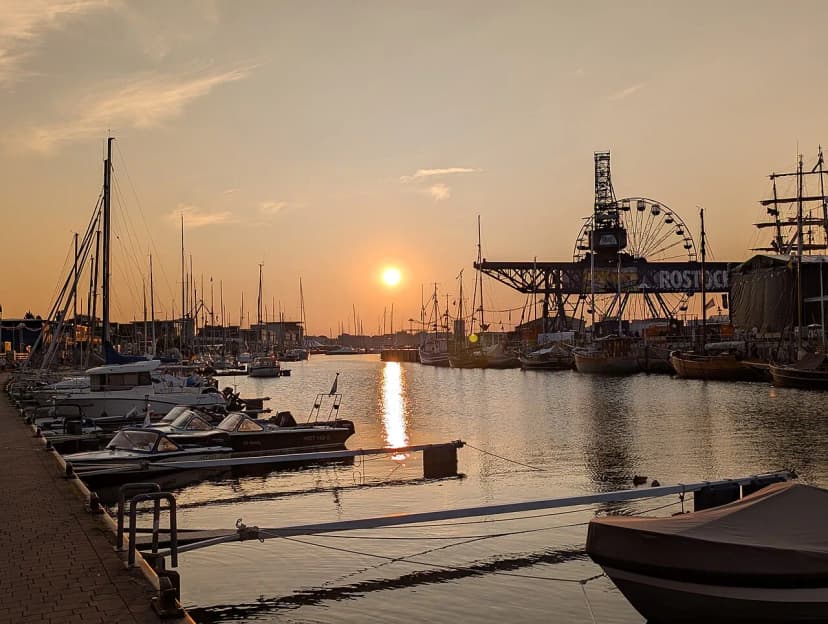
Wismar works as a day trip from Rostock for a simple reason: its historic centre is compact and coherent, so a short train ride delivers you into a walkable Hanseatic townscape rather than a sprawl you have to navigate. The city's own tourism pages present the market square, St. George's Church, the harbour and a brewery as the core of a visit, and the old town is recognised as UNESCO World Heritage. That combination lets you build either a tight half day or a slower full day without wasting time on transport between sights.
The trade-off is that Rostock already gives you a Gothic old town, a famous church with an astronomical clock, a cultural museum and a free university botanical garden, so Wismar has to earn its place in your itinerary. It does so by being more uniformly preserved across its whole core, and by putting the harbour and market square within a few minutes of each other. The choice is therefore less about which town is better and more about how many hours you can spare from your Rostock base.
Decide First: Half Day or Full Day
A suggested half day in Wismar covers the market square, the exterior and, if it is open, the interior of St. George's Church, a loop down to the harbour and one stop for a drink or a look at the brewery. That is a realistic shape for roughly four to five hours on the ground, and it suits travellers who want to be back in Rostock for the evening. Treat all durations here as a suggestion, not an official figure, because your pace and any queues will change the maths.

A full day, by contrast, lets you add a longer wander through the side streets, a second church or museum, and unhurried harbour time without watching the clock. It also gives you room for a proper lunch and for revisiting the market square when the light changes, which is often when the brick Gothic facades look their best. If you are travelling with children or with anyone who needs regular breaks, the full-day version absorbs those pauses instead of squeezing them out.
The practical rule is to count backwards from your return train. If the time you have on the ground is under five hours, plan the half-day route and accept that you will see Wismar at a glance. If you can give it six hours or more, the full-day route is the more satisfying use of the journey, because it stops the day feeling like a checklist.
Getting There from Rostock
The train is the default way to reach Wismar from Rostock, and it spares you the parking and one-way streets that complicate a self-drive version of the trip. Because timetables, departure frequencies and fares change, check the current operator's journey planner for the day you intend to travel rather than relying on any figure quoted elsewhere. Book or check the return leg at the same time, and note the last sensible train back so the end of your day has a fixed anchor.
On the Rostock side, a dense network of S-Bahn, tram, bus and ferry links ties the area together, as the city's own tourism site describes it. If you are staying in Warnemunde, the S-Bahn connection into Rostock takes under half an hour according to one cruise port guide, which makes a Wismar day trip feasible even from the coast. Build in a margin for the connection in both directions rather than aiming for the tightest possible change.
Once you arrive in Wismar, the old town is close enough to the station to walk, which is why the trip works without a car or a local bus ticket. Wear shoes you can spend hours in, and carry a small amount of cash alongside a card, since not every small counter or church box office is set up for contactless payment. Confirm the walking route on a map before you set out so you are not navigating on the pavement.
Suggested Half-Day Route in Wismar
Start at the market square, which is the natural orientation point and the place where Wismar's scale becomes clear. The square is public space and free to walk, so you can take it in at no cost before deciding which interiors are worth paying for. Look at the surrounding facades first, then pick your direction toward St. George's Church rather than drifting at random.

St. George's Church is the headline monument, and the sensible approach is to treat the exterior as guaranteed and the interior as conditional. Churches in this region restrict access during services and events, and opening arrangements change with the season, so check the current position on the day rather than assuming the doors will be open. If the interior is available, the brick Gothic proportions and the scale of the nave are what justify the stop; if it is closed, the exterior and the surrounding streets still carry the visit.
Finish with a harbour loop, which is a short walk from the market square and gives you the working-waterfront side of the town rather than more facades. The harbour is open public space, so this part of the day costs nothing and works in any weather short of a downpour. If you want one brewery stop, put it here at the end so the half day closes on a relaxed note rather than a timed entry.
Suggested Full-Day Route in Wismar
The full day keeps the same spine as the half day but removes the rush, starting with a slower circuit of the old town before the market square gets busy. Use the extra hours to walk streets that radiate off the main square, because Wismar's UNESCO listing covers the townscape as a whole and not only the obvious monuments. This is where a full day beats a half day: the texture of the place, not an extra tick on a list.
Add a second church or a museum in the afternoon, but verify separately what each one charges and when it opens, because a single ticket almost never covers a whole complex of religious and civic buildings. Public guided city tours run in Wismar, including themed walks led by costumed guides, and they exist alongside the self-guided option; check the city's events listings for what is actually scheduled during your stay rather than assuming a fixed daily departure.
Reserve the late afternoon for the harbour without a deadline, and use the time to sit rather than to see. If the weather turns, the old town's cafes and covered passages absorb a wet hour better than the waterfront does, so keep the flexible block at the end of the day where it can move. This structure also means a delayed return train costs you comfort rather than a missed attraction.
Wismar Versus Rostock's Own Altstadt
Rostock's Altstadt already delivers a strong Hanseatic core, with the cobbled Neuer Markt, the town hall mixing Gothic and Baroque elements, and St. Mary's Church, whose astronomical clock dates to the fifteenth century. If your only goal is a brick Gothic square with a famous church, Rostock covers it without a train ride. That is the honest case for staying put on a short trip.
What Wismar adds is coherence: the heritage designation covers the old town as a whole, and the market square, church and harbour sit inside a single continuous fabric you can cross on foot in minutes. Rostock is the larger, busier city with a working port and a wider set of urban attractions, so its old town is one district among several rather than the whole experience. Wismar feels like a preserved ensemble; Rostock feels like a living city that contains one.
The sensible split is to treat Wismar as the day you want a compact, walkable historic town and Rostock as the base that gives you the clock, the museums and the coastal excursions. Neither choice is objectively better, and the deciding factor is usually how much time you have rather than which town you prefer. If you have three days in Rostock, Wismar is easy to justify; if you have one, the Altstadt is already at your feet.
If You Stay in Rostock Instead
St. Mary's Church in Rostock is the anchor of a stay-put day, and its visitor information sets out seasonal opening windows plus separate charges for adults and reduced-rate visitors, with children and youth under eighteen admitted free. Entry to the church and any tower or vault tour are priced separately, so plan the ticket scope rather than assuming one payment covers everything. The church itself notes that services, events and occasional restrictions can make visiting impossible at short notice, so check the current visitor page before you go.
The Culture Museum Rostock occupies the historic Holy Cross monastery and covers the city's maritime history, medieval material and its wartime losses, which makes it the natural indoor counterpart to a church visit. A private walking tour operator sells admission to the museum only as part of its four-hour option, so treat the museum as its own booking decision rather than something bundled with every Rostock ticket. Allow at least an hour if you want more than a quick pass through the displays.
The Botanical Garden of the University of Rostock is the low-cost alternative, and its official site states that admission is free, with the outdoor garden open daily on a seasonal schedule and the Loki-Schmidt greenhouses on restricted weekday hours that exclude weekends and holidays. Since it sits by Holbeinplatz, you can reach it on S-Bahn lines S1, S2 or S3, trams 1, 2 or 5, or bus 28. Guided tours are offered on a donation basis, so a garden afternoon costs little beyond your transport.
Practical Constraints and What to Verify
Daylight is the main seasonal constraint on any autumn or winter trip, because the interesting part of Wismar is outdoors and the light goes early. Plan the harbour and the church exterior for the brightest part of your window and keep interiors flexible for the darker hours. Do not build the day around a single timed entry, since one delayed train can unravel the whole schedule.
Wismar's old town streets include cobbled and uneven surfaces, and no source reviewed here guarantees step-free access across the whole historic core. If you use a wheelchair or have limited mobility, check the specific venues you intend to enter rather than assuming the streets will be easy throughout. Ask about entrances and lifts when you book any guided tour, because private operators can usually adapt a route if they know in advance.
Before travelling, confirm church and museum opening hours, ticket scope and any event closures on the individual venue's own page, and confirm public tour schedules on the city's events calendar. Prices, hours and tour times are volatile and this guide deliberately does not quote them. For a second, contrasting day out from Rostock, the Bad Doberan Minster day trip uses the same rail-based logic and pairs well with a Wismar day on a longer stay.
Plan Your Visit
A Wismar day trip from Rostock rewards a clear decision up front: half a day for the market square, St. George's Church, the harbour and one relaxed stop, or a full day if you want the old town at walking pace. Take the train, check the timetable for your date, and keep the flexible block at the end of the day where a delay costs you nothing important. Treat every duration in this plan as a suggestion and every price or opening time as something to confirm with the venue.
If you decide to stay in Rostock, the Altstadt, St. Mary's Church with its astronomical clock, the Culture Museum and the free Botanical Garden already fill a full day without a train ticket. Add a Rostock harbor walk for the port side of the city, and save Wismar for the day you want the whole Hanseatic ensemble in one continuous walk.
Frequently Asked Questions
Is Wismar worth a day trip from Rostock?
It is worth it if you want a compact, walkable Hanseatic old town where the market square, a major brick Gothic church and the harbour sit within a few minutes of each other, and if you are willing to give it most of a day. It is less compelling if you only have a few hours in Rostock, because the city's own Altstadt already offers a Gothic square and a church with an astronomical clock. The deciding factor is time, not quality.
Can I visit Wismar in half a day?
Yes, in the sense that a four-to-five-hour visit can cover the market square, St. George's Church and a harbour loop with one relaxed stop. That is a suggested shape rather than an official itinerary, and it assumes the church interior is open when you arrive. If you want a museum, a second church or a guided walk as well, plan for a full day instead.
Should I skip Rostock's Old Town and go to Wismar instead?
No, treat them as complementary rather than competing. Rostock's Altstadt gives you Neuer Markt, the town hall and St. Mary's Church, while Wismar gives you an old town where the heritage designation covers the whole core and the harbour is a short walk from the square. If your time in Rostock is very short, stay in the city; if you have a spare full day, Wismar is the natural outing.
Is Wismar's Old Town free to walk around?
The streets, the market square and the harbour area are public space, so walking the old town costs nothing. Church interiors, museums and any tower or guided tour are separately ticketed, and a single ticket does not cover a whole complex of buildings. Check each venue's own page for its current entry arrangements before you travel.
How do I get from Rostock to Wismar without a car?
Take the train, which is the standard option and removes the need for parking in a historic centre. Timetables, frequencies and fares change, so check the current operator's journey planner for your travel date and confirm the last reasonable return service. In Rostock, the S-Bahn, tram, bus and ferry network connects most parts of the city to the station, including from Warnemunde.