

A self-guided walk out of Ulm Hauptbahnhof is a sensible frame for a single day in the city, and the Minster square is the natural first stop on foot. Treat the plan below as a suggested full day rather than an official schedule, and confirm current hours with each operator before you travel. The route runs from Münsterplatz through the Fischerviertel, along the city wall past the Metzgerturm, and finishes at Marktplatz, so you generally walk downhill and downstream instead of doubling back.
For a wider overview before you commit to a route, the Ulm: Itineraries and City Travel Guides hub is a sensible starting point, and the Ulm Old Town walk page goes deeper on individual stops and how they connect.
How a One-Day Ulm Route Fits Together
The essential sights sit within a short radius of each other, which is why a single day does not feel rushed if you keep moving. Münsterplatz and the Minster anchor the north of the old town, the Fischerviertel drops away to the south around the Blau canals, and the wall, the Metzgerturm and the Marktplatz link the two. Pedestrian streets and a largely car-free centre make this an easy route to walk rather than plan around transport.
Our suggested shape is a relaxed full day: Münsterplatz and the Minster in the morning, the Fischerviertel before lunch, the city wall and Metzgerturm at midday, then the Marktplatz and Rathaus in the afternoon. Cobbles and a few flights of steps, especially around the wall and the bridges, mean comfortable shoes matter more than any logistics. If you only have half a day, choose either the Minster and square or the Fischerviertel and wall, not both at depth.
Morning: Münsterplatz, the Stadthaus and Ulm Minster
Start at Münsterplatz, the square dominated by the Minster. The Stadthaus is a modern white building designed by a New York architect, and its construction in the early 1990s was controversial locally, according to the Ulm walking-tour account. The best small exhibition inside displays artefacts found during the excavations for the building, and the terrace gives a direct view of the cathedral opposite, so the Stadthaus doubles as a practical first stop.
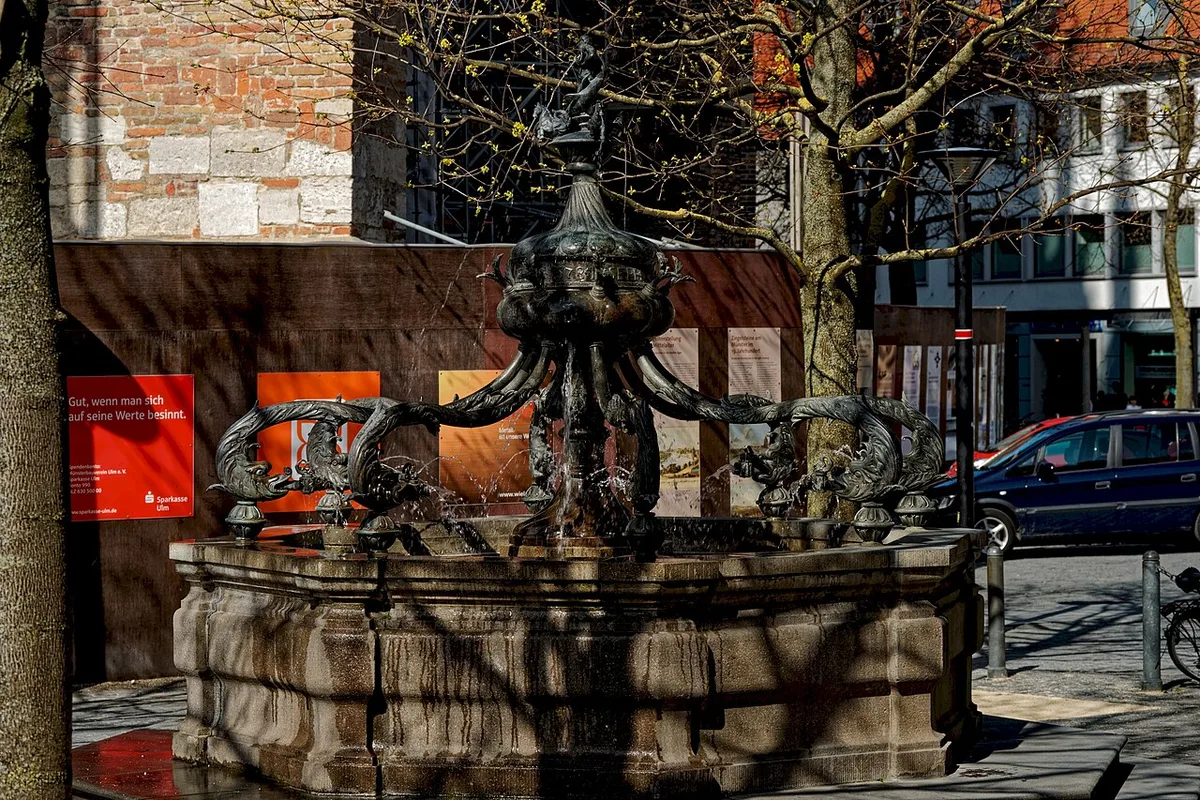
On Wednesdays and Saturdays, Münsterplatz hosts a market selling fruit, vegetables, meat, flowers and bread, according to the same walking-tour account. If your day falls on one of those, allow time to browse before heading inside the church. On other mornings the square is quieter but still the natural place to begin.
The Gothic Minster deserves the bulk of your morning. Inside, the oak choir stalls carved between 1469 and 1474 are the detail most visitors miss; the source describes 99 wooden figures drawn from the Bible or from figures of antiquity such as Cicero. At the back of the church you can see the Ulm Sparrow, the city emblem. The nave is free to enter, while the tower is ticketed and climbs a tight spiral staircase where you can see straight down to the square below. For detailed ticket scope and tower access, see the Ulm Minster visitor guide.
Late Morning: Fischerviertel, the Blau Canals and the Leaning House
Leave Münsterplatz behind the Stadthaus, pass the Neuer Bau warehouse on your left, and drop down into the Fischerviertel. This historic district is the most atmospheric part of the old town walk, with half-timbered houses from the 15th to 17th centuries standing over two channels of the Blau, a tributary of the Danube. Many of the old houses have foundations partly in the water, and the soft ground has shifted, which is why several buildings lean. Fishermen lived here in the Middle Ages and fished from small boats on the Danube; shallow-bottomed, tub-like boats built here later carried people and goods along the river.
Towards the end of the main street, turn left across the Häuslesbrücke. Built in 1316, it is described as the oldest bridge in Ulm and crosses both branches of the Blau. On the far side, climb the steps to the Schwörhaus, the oath house where the mayor swears an annual oath, a tradition the source dates to 1345. There is a free exhibit inside on the city's history, but captions are in German, so visit for the building and the artefacts rather than a full read.
Back in the quarter, find the Schiefes Haus, the leaning house, and walk around the back to view it over the canal, where the tilt is most obvious. The source notes it was built in 1406 and today leans around 10 degrees; it has been renovated so it is stable despite the lean. This is the densest cluster of cafés and small restaurants on the route, so it is a natural place to pause. For more on the district, see the Fischerviertel attraction page.
Midday: City Wall, Danube and the Metzgerturm
Walk up the steps to the city wall and turn left. The wall was built at the end of the 15th century according to the walking-tour source, and from it you see the Danube on one side and historic townhouses on the other. It is the best free viewpoint on this route. Take it unhurried, then head down through the Metzgerturm into the Marktplatz.
The Metzgerturm is a stone tower that likewise leans considerably, and the same source places it as part of the medieval fortifications. Treat it as a landmark and a transition between the wall and the market square rather than a sight in its own right. If you want a longer riverside pause, the Danube bank below the wall is an easy add-on before you rejoin the old town streets.
Afternoon: Marktplatz, the Rathaus and the Astronomical Clock
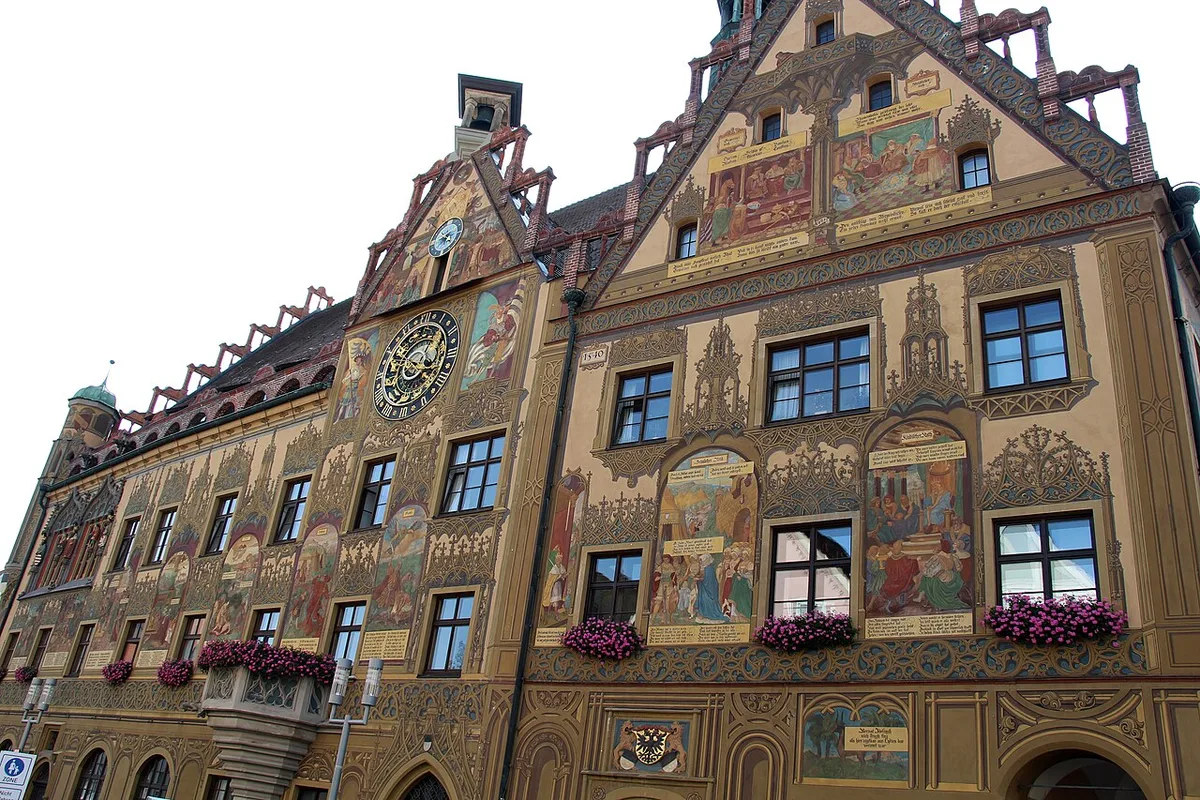
The Marktplatz is dominated by the Rathaus, its facade covered in paintings and carrying an astronomical clock. The oldest part of the building dates from 1370, though it only became a town hall a few decades later, and the astronomical clock dates from around 1520. The wall paintings include a depiction of a merchant tub sailing on the Danube and allegorical figures such as hope. The interior is still an administrative building: visitors normally only reach the entrance hall and the inner courtyard, and no guided tours of the building itself are offered on site. The facade and clock are free to view from the square. For more on the building, see the Ulmer Rathaus page.
Inside, on the staircase, look for the full-size replica of Albrecht Berblinger's hang glider. The tailor, who observed owls in an attempt to replicate their flight, tested his machine in 1811 and instead of soaring fell into the Danube. Around the square you will find cafés and restaurants with outdoor terraces. This is a good moment to sit down and reassess how much energy you have left before deciding on an afternoon option.
Museum Block: Choose One, Confirm Before You Go
Ulm's central museums sit close together but are not interchangeable, so pick one. The city's tourism site states that Museum Ulm has been undergoing renovations since 17 April 2023 and is therefore temporarily closed, with the Lion-Man and the "Hybrid Creatures" exhibition shown on the first floor of the kunsthalle weishaupt from 13 December 2025 until 4 October 2026. Check the operator pages before you walk over rather than assuming either museum is open in its usual form.
The Kunsthalle Weishaupt, a private museum formed from a collection built over 50 years and open to the public since November 2007, lists its opening hours on its own site as Tuesday to Sunday, 11am to 5pm, closed Mondays. The collection leans on abstract expressionism, American pop art and concrete art. The other central option is the Museum Brot und Kunst, a privately run museum on bread, baking and milling. Do not assume a shared ticket covers them: confirm what a ticket includes on the individual site.
Lunch, Neu-Ulm and the Afternoon Decision
Eat around the Marktplatz for convenience or back in the Fischerviertel for atmosphere. Swabian staples, Italian and Turkish options and cafés with terraces cluster within a few minutes of the square. Menus and prices change, so read the board before you sit down. After lunch you have three realistic choices: cross the bridge into Neu-Ulm for a Danube-side stroll and a different skyline back toward Ulm, spend the block in one museum, or retrace the Fischerviertel at a slower pace.
If you are comparing cities and want a sense of how a similarly compact centre can fill a day, the one day in Dresden itinerary is a useful contrast. For Ulm itself, the better use of a second block is depth on what you already saw rather than squeezing in a distant sight.
Optional Detour: Wiblingen Abbey
Wiblingen Abbey, a Baroque Benedictine monastery south of the centre, is best treated as a half-day extension rather than a rushed add-on. According to the walking-tour account, the basilica is free to enter, while the rococo library and museum are ticketed as a separate area and open on a seasonal pattern; the museum content is mainly in German, with an English audioguide for the library. Check the abbey's own opening information before you commit. If your single day already feels full, save Wiblingen for a return trip.
Alternative Shapes: Rain, Families and Train Arrival
On a wet day, lead with the Minster interior, the Schwörhaus exhibit and one museum, and treat the wall and Fischerviertel as short dashes between doors. With children, swap the tower climb for the Fischerviertel and add a park later in the day. Both variations keep the same geography and simply cut the walking. If you want a family-oriented version, see the Ulm with kids guide.
If you arrive by train, the walk from Ulm Hauptbahnhof into the old town is straightforward and signposted, and it brings you to Münsterplatz without a bus, according to the walking-tour source. That makes Ulm workable as a stop between larger cities without a car. If you are comparing capitals, the one day in Berlin itinerary shows the opposite problem of scale.
Practical Ground Rules for the Day
Wear shoes with real soles; the old town is cobbled and the tower stairs are narrow and steep. Carry a little cash for small purchases. Check each operator's page on the morning of your visit for current hours and any temporary closures, since seasonal schedules shift and museums can close for renovation. Treat every timing in this article as a suggestion you adjust to what the city publishes that day.
If you find you want more than a day, the extra time is better spent on Wiblingen Abbey, the parks or the museums than on repeating the old town. Plan a second day around whatever you skipped on the first, so the one-day version stays honest about what it can and cannot cover. The Ulm: Landmark Visitor Guides hub is a good place to look at options.
Making One Day in Ulm Work
One day in Ulm works because the essentials sit within a short walk of each other. Anchor the morning on Münsterplatz and the free Minster nave, decide early whether to pay for the tower, and let the Fischerviertel and the wall fill the middle. Finish with the Rathaus and a meal nearby.
If you have longer, spend it on Wiblingen Abbey or the museums rather than padding the central route. Check current hours on the operator pages the day before you go, and keep the plan flexible enough to drop a stop when the weather or your feet say so. For landmark detail on the single biggest sight, see the Ulm Minster visitor guide.
Frequently Asked Questions
Is one day enough time in Ulm?
For the central sights, yes. The Minster, Münsterplatz, the Fischerviertel, the city wall and the Marktplatz sit within a short walk, so a full day covers them at an unhurried pace. If you add a tower climb and one museum, expect a full day rather than a half day. Wiblingen Abbey is better saved for a second day.
Is Ulm Minster free to enter?
The nave is free to enter, while climbing the tower is a separate, ticketed experience with its own opening pattern. The spiral staircase is tight and you can see down to the square below. Check the operator's page for current hours and ticket details before you plan your day around it.
Should you climb the Ulm Minster tower?
Only if the view matters more to you than the time and the stairs. The staircase is narrow and views straight down can be uncomfortable for anyone uneasy with heights. If you skip it, you free up time for the Fischerviertel and the Danube-side wall, both of which are free to visit.
Is Wiblingen Abbey worth adding to a one-day Ulm itinerary?
It is worth adding only if you treat it as a half-day trip rather than a quick stop. The basilica is free to enter, but the rococo library and museum are ticketed separately, and the abbey sits outside the compact centre. On a single day that already includes the Minster and old town, save it for a return visit.
Can you walk the whole Ulm old town from the train station?
Yes. The route from Ulm Hauptbahnhof into the old town is straightforward and signposted and brings you to Münsterplatz without needing a bus. From there the main sights are all within a walkable radius. Comfortable shoes matter more than transport planning for a one-day visit.


