

Passau fits neatly onto a peninsula where the Danube, Inn and Ilz meet, so three days is generous for the Old Town alone. The reward for staying a third night is that Lower Bavaria's borders sit close together here: Austria is across the river, the Czech border is a short hop north, and several classic excursions sit within reach. This plan splits the stay into a compact city day, one self-directed day out, and a deliberately unhurried local day. Passau Tourism presents the city's sights, museums, boat cruises and excursion destinations as separate strands, which is a useful hint that you should not try to compress them into one day.
A practical note on timing before you plan anything: the wider Passau itineraries and city travel guides collection is the right place to confirm how many days the city itself deserves, while the separate landmark guides collection is where you go once you have chosen a specific sight. This article covers the three-day base plan only. If you are still deciding between two and three nights, compare against the two-day version before booking accommodation, because the two plans do not cover the same ground.
Why Three Days Suits Passau
Passau is a compact Baroque town stacked on a narrow peninsula, so the core sights are walkable in a single focused day. That is exactly why a three-night stay works better than a rushed afternoon stop: the city supplies the easy day, and the region supplies the ambitious one. You get a full walking day without watching the clock, plus room for the one long trip that most visitors regret skipping.
The Old Town is a network of narrow lanes rebuilt after a major fire in 1662, which is why the architecture reads Italian Baroque even though you are deep in Bavaria. Passau Tourism notes that the cathedral was rebuilt by Italian architects Carlo Lurago and Giovanni Battista Carlone after that fire, and that the same era shaped the streets around it. Wandering the centre means short distances between the cathedral square, the town hall and the riverbank, with little need for buses inside the old town. The main walk you will feel in your legs is the climb toward the fortress ridge.
Where three days really pays off is the geography. Passau Tourism lists the Bavarian Forest National Park, the thermal spa triangle and the medieval Czech town of Cesky Krumlov among its excursion destinations, which is a fair description of what a third day unlocks. As a starting reference for planning that day, a suggested duration of one full daylight window is realistic, but treat that as editorial advice rather than an official timetable and confirm live connections with the operator.
A useful framing device while you walk is the flood history written onto the buildings. High-water marks appear on facades around the Old Town, and one of the worst floods on record reached about 12.85 metres in 2013, which explains why ground floors are built and maintained the way they are. Reading those markers turns a pretty street plan into a story about a city that lives with its rivers.
How to Shape the Three Days: Old Town First, Excursion Second, Local Third
Put the city day first because arrival days leak time: you are finding the hotel, orienting, and probably tired. Saving the Old Town for when you already know how to read the streets wastes daylight that an excursion day needs. Do the peninsula immediately, then travel outward.
The middle day wants to be the excursion because it is the longest and least predictable. Whatever you choose, you will spend real hours in transit each way, so it should never be squeezed between a late breakfast and an evening reservation. Give it the whole daylight window and pick just one destination rather than attempting two.
Day three works best when you deliberately under-plan it. After a travel day, the Inn promenade, the pilgrimage church above the Innstadt and a long lunch do more for a trip than another museum marathon. This is also the correct day for the Glasmuseum Passau or the Museum of Modern Art Woerlen if the weather turns, and the city's own rainy-day planning is worth checking if the forecast looks uncertain. For wider planning, see Best Museums in Passau.
Day 1 Morning: St. Stephen's Cathedral, Domplatz and the Old Town Lanes
Start at Domplatz, the square that opens onto St. Stephen's Cathedral. The cathedral sits at the highest point of the Altstadt, which means the walk up from the river side is short but uphill, and the reward is the largest Baroque church interior north of the Alps. Passau Tourism publishes opening hours of daily 6:30 a.m. to 7 p.m. from April to October and 6:30 a.m. to 6 p.m. from November to March, with the cathedral closed during organ concerts from 10:45 a.m. to 11:20 a.m. Those are the operator's stated times for the building, so check them against your own dates rather than assuming they never change.
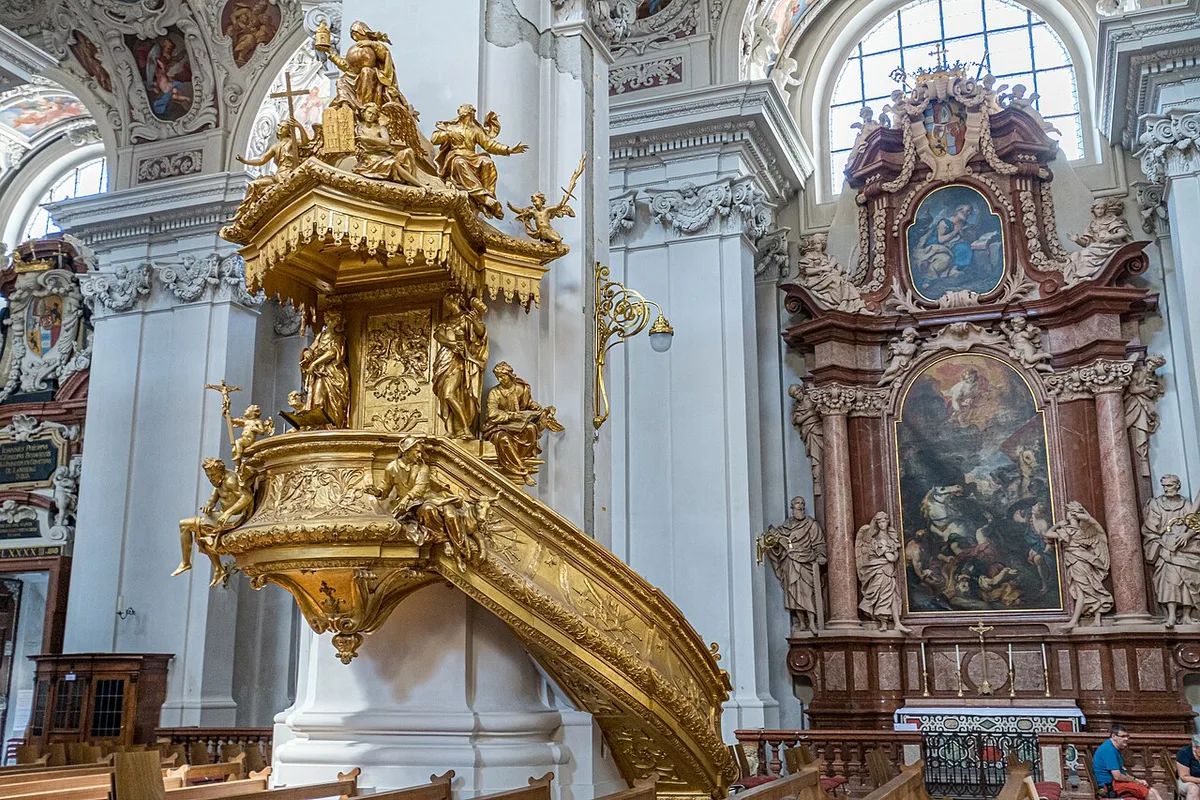
The cathedral's white towers and blue-green domes are the result of the post-1662 rebuild by Italian architects Carlo Lurago and Giovanni Battista Carlone, which is why the interior reads as heavy Baroque stucco rather than Gothic stone. Passau Tourism describes the modern high altar depicting the stoning of Saint Stephen in front of the old Gothic window facade. If you want a quiet look at the square, arrive early, because the middle of the day brings groups.
From Domplatz, the natural next move is to wander without a fixed route. Head toward the ScharfrichterHaus, the Hollgasse artists' alley with its tiled centre strip, and the streets dropping toward the town hall. The old town is small enough that getting slightly lost costs you nothing, and the shop-and-cafe streets are part of the appeal rather than a detour.
Expect to spend two to three hours on this stretch if you stop for coffee. Cafes cluster around Rindermarkt and the cathedral square, and several are traditional enough to make a mid-morning break part of the sightseeing rather than an interruption. If you prefer a written route to follow rather than improvising, use the dedicated Old Town walk and treat it as one option among many.
Day 1 Midday: The Cathedral Organ and What the Restoration Means for Concerts
The organ in St. Stephen's Cathedral holds 17,974 pipes and 233 registers across five separate installations that can be played together from one main console. Passau Tourism describes it as the largest Catholic church organ in the world and the largest organ in Europe, while ranking fifth globally by total pipe count. The largest pipe measures over eleven metres and the smallest six millimetres, and the instrument's baroque casing dates to the early eighteenth century.
The critical planning point for 2026 is that the organ has been under section-by-section restoration since 2023 and does not sound at its full extent in concerts. One regional source suggests the full instrument may not return until around 2028 and notes that parts of the rear of the church can be obscured by scaffolding in the meantime. Passau Tourism itself repeats the caution that the organ is being restored section by section and does not sound in its full extent at concerts, so this is an operator-level caveat rather than a rumour.
Concert formats have historically been split between a short midday performance and an evening programme, with separate prices for each. Passau Tourism lists noon concerts on working days from May to October and evening concerts on Thursdays at 7:30 p.m. on selected dates, and directs readers to the diocese's cathedral music pages for the current calendar. Because dates and programmes change annually and the restoration affects what is playable, treat any old timetable you find online as a starting point only.
If the organ is not your priority, the cathedral still deserves the visit for its interior alone. If it is your priority, verify the date and what is being played before you build a trip around a specific concert.
Day 1 Afternoon: Veste Oberhaus — Walking Up Versus the Shuttle
Veste Oberhaus sits on the ridge above the Old Town and has guarded the city since 1219, making it one of the largest surviving castle complexes in Europe. Today the site holds the Oberhausmuseum, a restaurant, a youth hostel and an open-air theatre, so the grounds and the museum are worth thinking about as separate things.
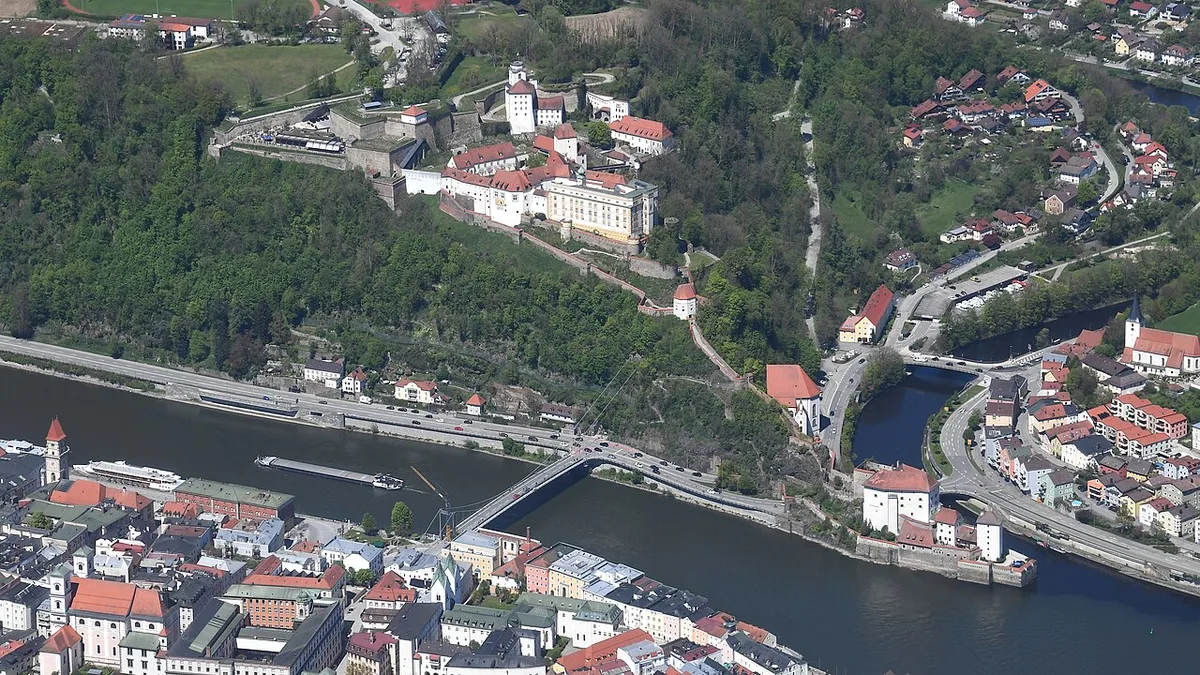
You can walk up from the trailhead at the end of the Luitpold Bridge, or take the shuttle bus that runs from Town Hall Square according to museum opening times and is timed daily on the half hour. Passau Tourism notes that showing your bus ticket earns a discount on the museum entrance fee, and that both the shuttle and the public bus have high entry steps that make them unsuitable for wheelchair users. If step-free access is a requirement, the elevator reaches the New Rampart viewpoint and the outer and inner baileys but not the observation tower, exhibition rooms, St George's Chapel or the Linde Battery viewpoint.
The museum's seasonal pattern is the thing most visitors get wrong. Passau Tourism publishes Oberhausmuseum hours of 15 March to 15 November, Monday to Friday 9 a.m. to 5 p.m. and weekends and holidays 10 a.m. to 6 p.m., plus a short late-December to early-January window daily 10 a.m. to 4 p.m. and closed on 31 December. The same page lists the observation tower with a slightly shorter season running 15 March to 8 November, and states that the entrance fee includes the tower, with adults at 7 euros, reduced at 5 euros and children under six free. Those are the operator's published figures, so confirm them for your dates before setting aside an afternoon.
If you only want the panorama, the walk up costs nothing and the view over the confluence is broadly the same one ticket buyers get from the grounds. Budget around ninety minutes if you are climbing on foot and adding exhibition floors, and less if you go up purely for photographs. That is a suggested duration rather than an official figure.
Day 1 Late Afternoon: Dreifluesseeck, Where the Three Rivers Meet
The Dreifluesseeck is the eastern tip of the Old Town peninsula, where the Danube, Inn and Ilz converge and then flow on together. What makes it worth the walk rather than a quick photo is the colour separation: the Inn arrives green, the Ilz reads black, and the Danube carries its own blue tone, and where they meet you can see the bands hold for a distance before mixing. Passau Tourism's own sight listing describes the walk along the Inn past the Schaiblingsturm tower and on to the confluence at the eastern tip.
This is the correct spot to sit still for half an hour. There is no ticket, no queue and no scheduled performance, but the confluence is the single image most people carry home from Passau, and it rewards patience more than speed. Come here after the fortress rather than before, because the light on the water is better later in the day.
The walk from the cathedral square down to the tip is short and mostly level, passing the Schaiblingsturm on the Inn side if you take the river path. Treat it as the natural hinge between the sightseeing day and dinner, and leave your camera out.
Day 1 Evening: Bavarian Food and an Early Night
Traditional Bavarian cooking is the easy choice on night one: schnitzel, roast pork, dumplings, sauerkraut and a local beer are the standard repertoire, and several old-town inns specialise in exactly that. The underground ScharfrichterHaus combines a restaurant with cabaret and a small cinema, which makes it a good option when you want atmosphere rather than a quick meal. Many old-town kitchens also serve Bohemian-Bavarian dishes that reflect the proximity of the Czech border.
Drinking on a terrace above the fortress or on a Danube-side terrace gives you the panorama with the meal, at the cost of a slightly longer walk home. The trade-off is real: eat in the lanes for convenience and character, or climb for the view. If you are dining anywhere well regarded on a weekend, a reservation is worth arranging in advance rather than relying on walk-in tables.
Keep the evening light if tomorrow is the excursion day. You want to be at a station or on the road early, and Passau's compact centre makes an early night genuinely possible without missing anything.
Day 2: Choosing Your Excursion — Weltenburg Abbey, Regensburg or Cesky Krumlov
Three options cover the realistic day-trip range from Passau, and each answers a different mood. Weltenburg Abbey gives you a monastery and a dramatic Danube gorge, Regensburg gives you a second, larger historic city, and Cesky Krumlov gives you a cross-border UNESCO town in the Czech Republic. All three involve several hours of travel in each direction, so one is the right number. The dedicated day trips from Passau guide compares which suits a three-day trip and which is better saved for a longer stay.
Choose Weltenburg if the appeal is landscape and a single atmospheric site rather than city streets. The abbey and the narrow Danube gorge upstream of Kelheim are the draw, and they pair naturally with a boat approach if the season allows. Choose Regensburg if you want Gothic architecture, a bridge, and a genuinely larger city with more to fill a full day.
Choose Cesky Krumlov if you want the most distinct change of scene and are willing to cross into the Czech Republic. Passau Tourism lists medieval Cesky Krumlov among its day excursions from the city, alongside the Bavarian Forest and Salzburg, which gives you a sense of how far the regional reach extends.
The honest advice is to pick based on what you will actually enjoy rather than on which is closest. A rushed dash through a town you barely reach is worse than a slow half-day at a monastery you can properly absorb.
Day 2 Decision Factors: Travel Time, Booking and the Type of Day You Want
The first filter is how much travel you can tolerate in one day. Anything involving a border crossing adds a planning variable, so Cesky Krumlov needs more buffer than Regensburg and rewards anyone who likes a firm schedule. Weltenburg, by contrast, is the option that feels most like a rural day out.
The second filter is booking. Trains and regional services on popular routes can fill on busy dates, and boat-based approaches to the Danube gorge are inherently seasonal. Work out whether you need a reservation before you commit to a specific departure, and build in recovery time rather than chaining connections tightly.
The third filter is what kind of day you want from a three-day trip. If day one gave you Baroque churches and day three will give you riverside walking, using the middle day for a second city risks repetition. A monastery-and-gorge day or a cross-border UNESCO town creates contrast that makes the whole itinerary read better in memory.
Why This Guide Prints No Timetables or Journey Times for Day 2
Train lines, service patterns and journey times on these routes change with operator schedules, seasonal timetables and engineering works. Printing a number here would risk sending you to a platform that no longer serves your connection, and no fixed figure would survive a single timetable revision. Check live departures through the relevant national rail operator or a journey planner on the day you book.
The same caution applies to boat services toward the Danube gorge and to cross-border buses. Availability is seasonal and route-specific, and a service operating in one summer tells you nothing certain about the next. Confirm current operations with the provider before you build your day around them.
What this guide can do is tell you the shape of the day: leave early, plan to be out for the full daylight window, and do not schedule anything important in Passau for the evening you return. That structure survives any timetable change.
Day 3 Morning: A Slow Start, the Inn Promenade and the Schaiblingsturm
Day three should begin without an alarm. Walk the Inn promenade on the southern edge of the Old Town, past the Schaiblingsturm, the medieval tower that once guarded the river trade and now serves as one of Passau's most photographed foregrounds. The path runs level and easy, which is exactly the point after a travel day.
Bavaria's official tourism site describes the Inn pier and confluence route as a riverside walk past the tower and on to the eastern tip of the Old Town, which makes it a natural continuation of yesterday's confluence visit if you want a second look in different light.
Coffee and a pastry belong in this morning. Old-town cafes around Luragogasse and Rindermarkt are the traditional stop, and a few have interiors that are themselves worth the detour. Arriving before the mid-morning rush is the difference between a table and a queue.
Day 3 Midday: Mariahilf and the Covered 321-Step Stairway
Above the Innstadt stands the Baroque pilgrimage church of Mariahilf, reached by a covered stairway of 321 steps whose entrance is on the Neutorgraben. The walkway is lined with votive tablets, which makes the climb itself part of the experience rather than just the means to a viewpoint. The church is a pilgrimage site of genuine significance: Passau Tourism explains that an image of the Virgin Mary here became associated with the Habsburgs after Emperor Leopold I fled to Passau in 1683 during the Turkish siege of Vienna.
The original painting by Lucas Cranach was a gift to Leopold, the Prince Bishop of Passau, in 1611, and the copy he left behind became the object of veneration; the original now hangs in the St. Jakob parish church in Innsbruck. The monastery complex dates to the 17th century and has been home to the Order of St. Paul since 2002. Allow around an hour for the round trip including time inside the church, as a suggested duration rather than an official one.
Two practical cautions matter here. Passau Tourism publishes church opening hours of daily 7 a.m. to 8 p.m. but does not state that the covered stairway itself is open year-round without restriction, so treat the stairway as something to confirm locally rather than assume. The same source describes the church as having limited wheelchair accessibility, with disabled parking in the courtyard and an accessible lavatory in the church. If accessibility drives your planning, check current conditions before you rely on this stop.
Day 3 Afternoon: Parks, Riverside Paths and an Optional Boat Trip
The afternoon is for water at eye level rather than from a hill. Riverside paths on both banks give you flat, shaded walking with constant views of the fortress ridge, and the small park near the confluence tip is the obvious place to sit. Cycling routes along the Danube also pass through Passau, so you will see touring cyclists using the city as an overnight base.
Boat trips on the Danube are a listed category of thing to do in Passau, and a short river trip is the low-effort way to see the city from the water. Specific operators, departure points and seasonal schedules change, so confirm what is running during your dates with the operator or the tourist information office before planning an afternoon around it. Treat this as an option rather than a fixed slot. If you want a viewpoint instead of a boat, the dedicated best viewpoints guide is the separate decision surface.
If the weather turns, this is the moment to use the indoor cards. The Glasmuseum Passau holds an extensive collection covering centuries of European glassmaking, and the Museum of Modern Art Woerlen on the Danube bank shows modern work with temporary exhibitions. Bavaria's official tourism site lists both among the city's highlighted sights, and it is worth noting that these are separately ticketed museums, so check each one's own admission and hours rather than assuming a single ticket covers both.
Day 3 Evening: Breweries, Beer Gardens and Cafes
Passau's evening scene splits between old-town inns, beer gardens and riverside terraces, and the sensible approach is to choose a category rather than a specific table. A beer garden with long benches suits groups and warm evenings, while an underground inn suits a cooler night or a smaller party. Local breweries in the city supply the standard Bavarian range of lagers and wheat beers.
Do not build your evening around a fixed opening time you found online. Restaurant, cafe and brewery hours and reservation policies change seasonally in a small city, and a closed kitchen is a frustrating end to a good day. Check the venue's own listing the same day, or ask at your accommodation, which is usually faster than searching.
If you want a final panoramic drink, the terrace above the fortress is the memorable option, though you will need to check whether the shuttle is still running at that hour or take the walk down in the dark with a torch or phone light.
Where to Stay for Three Nights: Altstadt Versus Near the Station
Staying inside the Altstadt buys you the whole trip on foot: the cathedral, the confluence, the riverside paths and most restaurants sit within a short walk, and you never think about transport. The cost is usually a higher nightly rate and no parking of your own, which matters if you arrive by car.
Staying near the station or on the northern bank buys easier arrivals, luggage handling and parking, plus quick access to trains on your excursion day. You trade atmosphere and a short evening walk back across the river after dinner. For a three-night trip with one heavy travel day, that trade is closer than it looks.
A reasonable compromise is one hotel for all three nights, chosen for walkability and proximity to public transport rather than for a single landmark. Switching accommodation mid-trip costs half a day, and Passau is small enough that you do not need to.
Practical Passau Notes: Flood Markers, Festival Days and Ticket Scope
Those high-water marks on Old Town facades are the city's own record of disaster, and 2013 remains the benchmark most accounts mention. The 12.85-metre 2013 flood explains why ground floors are built to be hosed out and why artists cluster in cheap ground-level units. It is worth ten minutes of your day to find a marker and read it.
Religious holidays are the other thing that can quietly disrupt a tight three-day plan. On a major Catholic feast day, such as Corpus Christi, shops can close and processions can reroute ordinary walking routes through the main squares, which affects both shopping and simple navigation. Check the church calendar and Passau Tourism's events listing for your dates before you commit to a schedule.
Ticket scope is the trap that catches careful planners. Passau's museums are separately ticketed institutions, and the city sells more than one sightseeing pass, including the PassauRegioCard and the DONAU-Card. Do not assume a single pass covers every collection: check which attractions each card actually includes before buying, because the museums in the fortress, the Glass Museum and the art museum are distinct operations.
The city is genuinely walkable, so public transport is optional inside the centre and useful mainly for the fortress climb or for reaching the station with luggage. If you want a full written route through the centre, the Old Town walk guide is a separate surface from this three-day plan, and it is worth using alongside it rather than instead of it.
What to Do With a Fourth Day
If you are not ready to leave, the natural fourth day extends the regional reach rather than adding another old-town loop. The Bavarian Forest National Park is the obvious nature option, and the spa triangle of Bad Griesbach, Bad Fuessing and Bad Birnbach offers thermal waters if you want recovery rather than hiking.
Salzburg is the other well-known add-on, reachable as a longer day out but better treated as an overnight destination in its own right. If you are comparing German city itineraries for the rest of your trip, the 3 days in Berlin itinerary and the 3 Days in Dresden itinerary show how a compact three-day structure adapts to much larger cities.
Whatever you add, resist the urge to fill every hour. Passau rewards a slower pace than its sight count suggests, and the best afternoons here are the ones with a river in front of you and nothing on the schedule.
Plan Your Visit
Three days in Passau is a structure, not a checklist. Day one covers the cathedral, the fortress and the confluence on foot, day two takes you out of the city entirely, and day three keeps you close to the water. That rhythm suits a compact Baroque town that sits within reach of three countries.
Before you travel, verify the volatile details directly with the people who run them: cathedral organ concerts and the restoration status with the diocese, fortress museum hours and admission with the city, and excursion timetables with the relevant rail or boat operator. Everything in this plan that involves a clock or a fee is worth one confirmation.
If you are deciding between lengths of stay, compare the two-day and three-day versions before you book accommodation, because the difference is one region, not one sight. Then go and stand at the tip of the peninsula at sunset, which costs nothing and is the reason most people remember Passau at all.
Frequently Asked Questions
Is three days too long for Passau?
Not if you use the third day well. The Old Town, cathedral, fortress and confluence fit comfortably into one walking day, so the value of a third night is the excursion day in the middle. If you only want the city itself, a shorter stay covers the core; if you want a monastery, a second historic city or a cross-border Czech town, three days is the point at which that trip stops feeling rushed.
Can I visit Veste Oberhaus without paying for the museum?
You can walk up to the fortress ridge and enjoy the view over the confluence without buying a ticket, and Passau Tourism describes the grounds and the museum as related but distinct. The published admission fee includes the observation tower, so if you want the tower and the exhibition floors you should expect to pay. Check the operator's current hours and prices before you go, because the museum and tower seasons differ slightly.
What should I check before booking a cathedral organ concert?
Check the current date on the diocese's cathedral music pages rather than relying on an old timetable. The organ has been under section-by-section restoration since 2023 and does not sound at its full extent in concerts, with parts of the rear of the church potentially obscured by scaffolding. Passau Tourism also notes that the cathedral closes during organ concerts, so plan your visit around those windows rather than assuming the building is always open.
Should I choose Weltenburg, Regensburg or Cesky Krumlov for day two?
Choose Weltenburg for a monastery-and-gorge day with a landscape focus, Regensburg for a larger historic city with Gothic architecture, and Cesky Krumlov if you want a cross-border UNESCO town and the most distinct change of scene. All three take up most of a day once travel is included. Pick based on what kind of day you actually want, and confirm live connections with the operator rather than relying on any printed timetable.
Sources
- What to Do With One Day in Passau, Germany
- Passau Tourismus | www.tourismus.passau.de | Passau Tourismus
- Pilgrimage Church "Mariahilf" in Passau | Passau Tourism
- Museum Veste Oberhaus in Passau | Passau Tourism
- Passau in Bavaria, Germany: 10 Sights and Highlights
- Bistum Passau: Katholische Kirche in Bayern - Startseite
- Passau Tourism | www.tourism.passau.de/en | Passau Tourism
- St. Stephen's Cathedral Passau | Passau Tourism
- Music in the High Cathedral "Stephans Dom" - Passau < Chill out ...


