

Passau's old town occupies a narrow strip of land between the cathedral hill and the point where three rivers meet, so its main squares and lanes sit within a compact area that suits walking. The pleasure of the route lies less in ticking off monuments than in the sequence itself: a baroque square, a shadowed alley, then a sudden opening onto water. This guide suggests an order and explains the trade-offs at each decision point. Because the sources do not publish walking times or distances between stops, treat the pacing notes below as suggestions rather than official timings.
One practical detail shapes the day. Passau Tourism lists St. Stephen's Cathedral as open daily from 6:30 a.m. to 7 p.m. from April to October and from 6:30 a.m. to 6 p.m. from November to March, but notes that the cathedral is closed during organ concerts from 10:45 a.m. to 11:20 a.m. Plan the interior visit outside that window, or build the concert into your day deliberately. A suggested duration for the core loop, excluding museums and concerts, is roughly two to three hours at an unhurried pace, and that figure is an editorial suggestion rather than an official one.
Why Passau's Old Town Suits a Walk Rather Than a Checklist
Passau is known as the three rivers city because the Danube, Inn and Ilz meet here, and the old town grew on the land at that junction. That geography explains both the drama of the setting and the recurring problem of flooding, which later shows up in the high water marks on the town hall walls. Walking connects these pieces: the water that made the city prosperous is the same water that periodically invaded it.
The lanes, squares and riverbank are free to wander. Ticketed interiors such as the Oberhausmuseum and the Glass Museum are separate paid attractions with their own operators, so do not assume one ticket covers an entire complex. If you want detail on individual buildings before or after the walk, the landmark visitor guides for Passau treat the cathedral, the old town hall and the fortress as separate pages.
Choosing a Starting Point
There are two sensible starts, and the choice is a real trade-off rather than a rule. Begin at the cathedral square if you want to arrive before the busiest hours and walk downhill toward the water as the day warms up; begin at the riverbank if you prefer flatter ground first and softer late-afternoon light, finishing uphill at the cathedral. Neither order is official, and both cover the same ground.
Starting at the cathedral means beginning at the highest point of the old town, so the rest of the walk trends gently downward. Starting at the riverbank gives the broadest views first and the architectural detail last. Whichever you choose, the loop works better when you avoid retracing the same lane twice.
Stop 1: St. Stephen's Cathedral and Its Organ
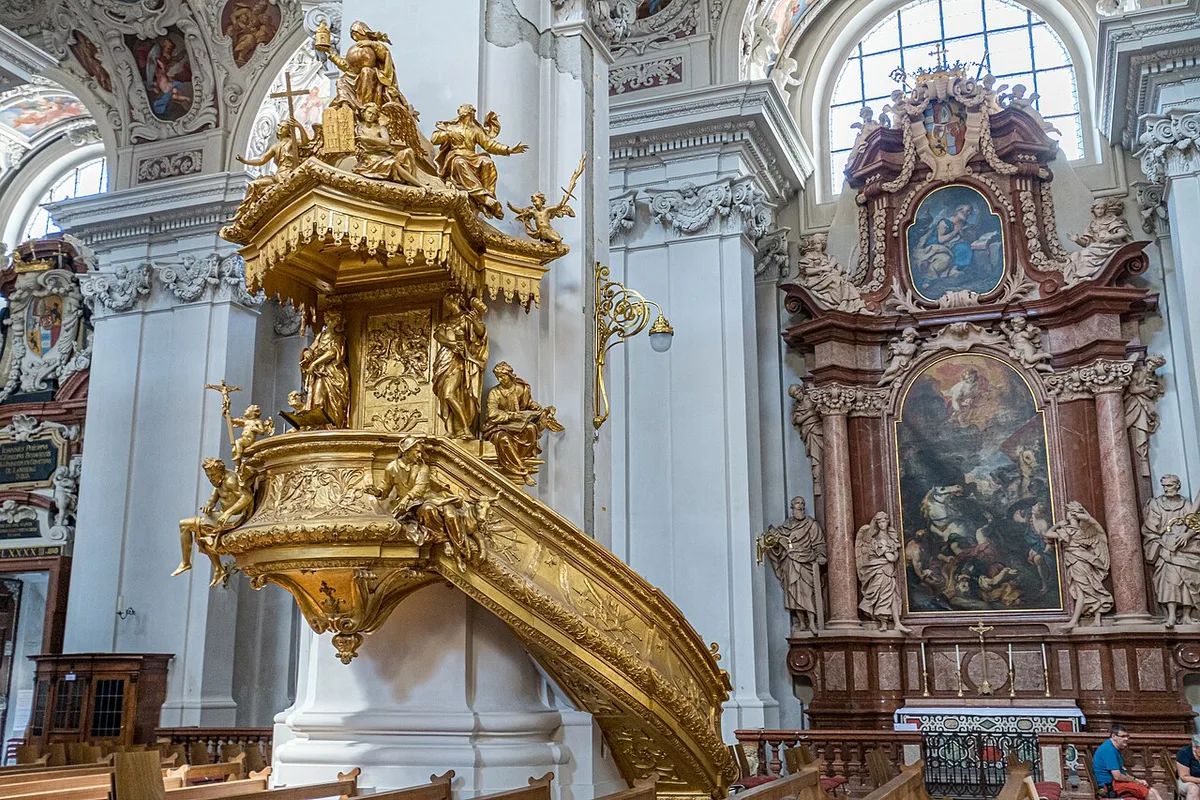
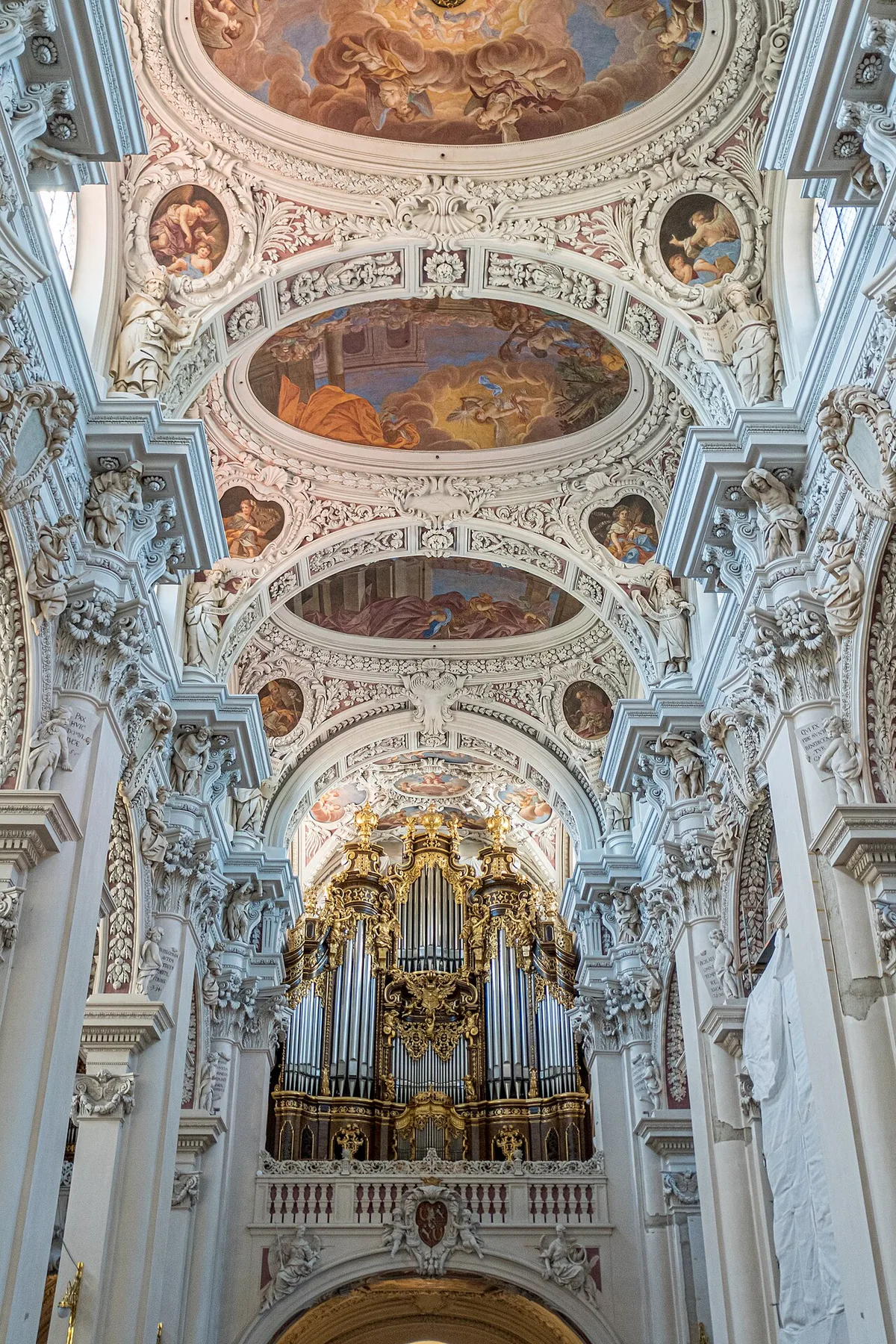
St. Stephen's Cathedral anchors any old town walk. Passau Tourism describes it as the leading baroque church north of the Alps, rebuilt by the architects Carlo Lurago and Giovanni Battista Carlone after the fire of 1662, and notes that it sits at the highest point of the old town. Its organ is the largest cathedral organ in the world, with 17,974 pipes and 233 registers spread across five separate installations played from one main console.
Passau Tourism lists organ concerts usually on working days from May to October, with noon concerts at adults 6.00 EUR and reduced 3.00 EUR; its schedule shown there also mentions evening concerts on Thursdays at 7:30 p.m., though the same page says the organ has been under partial restoration since 2023 and does not sound in its full extent at concerts. If the organ is your main reason for visiting, check current conditions and dates with the relevant church music office before travelling.
For those who prefer the cathedral's story told rather than read, the Passau Classical Tour is a guided walk through the old town that includes the cathedral and Residence square and is described as lasting up to two hours. It suits visitors who want context and commentary rather than a self-guided route.
Stop 2: Residenzplatz and the Wittelsbach Fountain
From the cathedral it is a short step to Residenzplatz, a baroque square framed by grand facades that include the New Episcopal Residence. The Wittelsbach Fountain in the square was built in 1903 to mark the centenary of Passau becoming part of Bavaria, according to Bavaria Tourism. The square itself is free to walk through and is a good place to pause and look up at the architecture.
The New Residence also houses the Cathedral Museum of Sacred Art, which documents the history of the bishopric. That is a ticketed interior separate from the square, and you should check its opening hours with the operator rather than assume them. Opening hours for the square itself are not limited by a ticket, since it is an open public space.
This is a natural pause point because it is level, open and central, which makes it easier to stop, check a map or decide whether to continue to the riverbank or detour uphill.
Stop 3: Town Hall Square and the High Water Marks
Town Hall Square is where the walk's storytelling clicks into place. The old town hall carries high water marks recording past floods, and the Passau Classical Tour is described as passing the town hall square with its highest high water marks before continuing, which confirms this as a recognised point of interest on a standard old town route. The old town hall building itself, together with what the tour describes as the executioner's house nearby, also appears on that guided route.
Opening hours for the town hall interiors are not published on the tourism pages, so plan to admire the exterior and the square rather than assume you can go inside. For broader background on the building, the Altes Rathaus Passau old town hall visitor guide covers its role in the city's history.
The square is also the departure point for the shuttle bus to Veste Oberhaus, which Passau Tourism says runs according to museum opening times, daily on the half hour. Showing your bus ticket earns a discount on museum entrance, which makes the shuttle worth considering if you plan to add the fortress to your day.
The Riverbank Stretch to the Dreiflüsseeck
From the town hall area the walk turns toward the water. Bavaria Tourism describes walking along the Inn river past the Schaiblingsturm tower to the confluence of the three rivers at the eastern tip of the old town.
The point where the rivers converge is one of Passau's signature views. If you are planning to photograph the city, the riverbank and the elevated viewpoints are the two main options, and the best photo spots in Passau guide covers both.
Optional Detours for a Longer Visit
With a half-day rather than an hour, three detours are worth weighing. The pilgrimage church of Mariahilf sits high above the Innstadt and is reached by a covered stairway of 321 steps, according to Passau Tourism. That page gives the church's opening hours as daily 7 a.m. to 8 p.m. and notes limited wheelchair accessibility, so treat the climb as a separate outing rather than part of the core loop. The Veste Oberhaus fortress, reached by shuttle from Town Hall Square, adds the Oberhausmuseum. The Passau Glass Museum is another option for visitors interested in decorative arts.
For the fortress, the Oberhausmuseum page lists seasonal opening dates, admission categories and accessibility notes, including that the castle complex itself is not accessible for disabled visitors and that the shuttle bus is not suitable for wheelchair users because of the high entry. Check those details before deciding whether the fortress fits your plan.
If your visit stretches beyond a day, a 3 days in Passau itinerary can help you spread the old town walk, the fortress and the riverbank across separate mornings rather than compressing them into one.
Suggested Order and Pacing
A sequence that avoids backtracking is cathedral square, Residenzplatz, Town Hall Square, riverbank and Dreiflüsseeck. It takes you downhill from the highest point to the water and ends in open space rather than a narrow lane. If you prefer the reverse, start at the riverbank and finish at the cathedral, which works well in late-afternoon light.
The sources do not publish walking times or distances between these stops, so any duration quoted elsewhere is an estimate rather than an official figure. A suggestion is to allow a morning or afternoon for the core loop, plus extra time for a concert, a museum or the fortress detour. The walk itself needs no booking, though organ concerts and guided tours have their own arrangements.
Pause Points and Practical Rhythm
The natural pause points are the cathedral square, Residenzplatz and the riverbank. Each is open, level and central, which makes them easier places to stop than the narrower lanes. During concert season, remember that the cathedral closes for roughly half an hour around midday, so plan the interior visit outside that window.
A guided tour can fill the gaps a self-guided route leaves. The Passau Classical Tour, for example, is described as lasting up to two hours and covering the old town, the town hall square and the cathedral with commentary. If you want stories rather than a map, folding a tour into your day is a reasonable alternative to walking the whole route alone.
Accessibility and Terrain Notes
Passau's old town is hilly in parts, and the route from the cathedral down to the river involves slopes and cobbled surfaces. Passau Tourism notes only limited wheelchair accessibility at St. Stephen's Cathedral, with small thresholds at the entrance and a barrier-free Steinweg entrance with a mobile ramp, and it flags limited wheelchair accessibility at Mariahilf. These are site-specific notes rather than a full assessment of the route, so check each site's own page if access is a deciding factor.
For the fortress, the Oberhausmuseum page notes that the castle complex is not accessible for disabled visitors, that the shuttle bus and public bus are not suitable for wheelchair users, and that there is no wheelchair-accessible toilet in the castle. If accessibility is a priority, plan the old town walk around the flatter riverbank sections and treat the fortress as optional.
What a Guided Tour Adds
A self-guided walk gives you flexibility and costs nothing beyond what you choose to spend at ticketed interiors. A guided tour gives you context, stories and a route shaped by someone who knows the city, which helps if your time is limited or you want the high water marks, the cathedral and the Residence explained as you go.
The Passau Classical Tour is one such option, provided by Donau Guides and described as lasting up to two hours for groups of up to 25 people, with commentary in German. It covers the town hall square, the executioner's house, the Inn riverbank and the cathedral, so it overlaps closely with the self-guided route outlined here. Current schedules and meeting points are best checked with the operator or the tourist information office.
Plan Your Visit
A Passau old town walk works best as a loose loop rather than a rigid schedule. Start where the light and your energy suit you, keep the cathedral's opening window in mind, and let the riverbank be your finish. The core route is free, and the paid interiors are choices rather than obligations.
Because hours, prices and concert schedules change, verify the details that matter to you with the tourist information office at Rathausplatz 2 in Passau or the relevant operator before you travel. That way the walk stays a pleasure rather than a race against a closing time.
Frequently Asked Questions
Is Passau worth visiting?
Yes, if you enjoy compact historic cities with strong geography. Passau sits where the Danube, Inn and Ilz rivers meet, and its old town packs a baroque cathedral, a historic town hall and a riverbank walk into a small area you can cover on foot. It suits a half-day or full-day stop and works well as a base for exploring the surrounding region.
What rivers meet at Passau?
The Danube, the Inn and the Ilz converge at Passau, which is why the city is known as the three rivers city. The meeting point lies at the eastern tip of the old town, at the Dreiflüsseeck, and it is reachable on foot from the town hall area.
Can I do a self-guided Passau old town walk?
Yes. The old town is compact, and the main squares, lanes and riverbank are open to walk through without a ticket. You can set your own order using the cathedral, Residenzplatz, Town Hall Square and the riverbank as anchor points. Exact walking times between stops are not published, so allow more time than you expect to need.
How long should I allow for a Passau old town walk?
No official duration for the route is published, so any figure is a suggestion. Allow at least a couple of hours for the core loop, and more if you add a cathedral visit, an organ concert, a museum or the fortress detour. If you prefer a guided alternative, the Passau Classical Tour is described as lasting up to two hours.
Do I need to book anything for the Passau old town walk?
The walk itself needs no booking, and the squares, lanes and riverbank are open public spaces. Ticketed interiors, organ concerts, guided tours and the fortress shuttle have their own arrangements, so check with the relevant operator if you plan to include them.


