

Passau's Altes Rathaus sits on Rathausplatz, a short step from the Danube promenade and directly beside the Glass Museum, which makes it one of the easiest landmarks in the Old Town to fold into a walk. The painted facade, clock tower and riverside position do the bulk of the work for casual visitors, while the historic council chambers behind the 1446 staircase are a separate proposition. This guide separates those two experiences so you can decide how much of the building you actually need to plan around.
The most reliable timing anchor is the carillon in the tower, which Passau Tourism states plays twice daily at 11:30 a.m. and 2:30 p.m. That gives an exterior stop a fixed rhythm even when interior access is unclear. If you want to understand how the Town Hall fits the wider city, the Passau: Landmark Visitor Guides collection maps the major sights, and the Passau: Itineraries and City Travel Guides hub helps with sequencing a day.
What the Altes Rathaus Actually Is
Passau Tourism describes the Old Town Hall as one of the most prominent buildings of Passau's Old Town, built in Venetian style and still functioning as the city's town hall. It is not a single-purpose museum but a working civic building, which shapes everything about how you visit it. The tower is 38 metres high and houses the tourist information on the ground floor, so you can start by asking staff what is currently open before committing to anything.
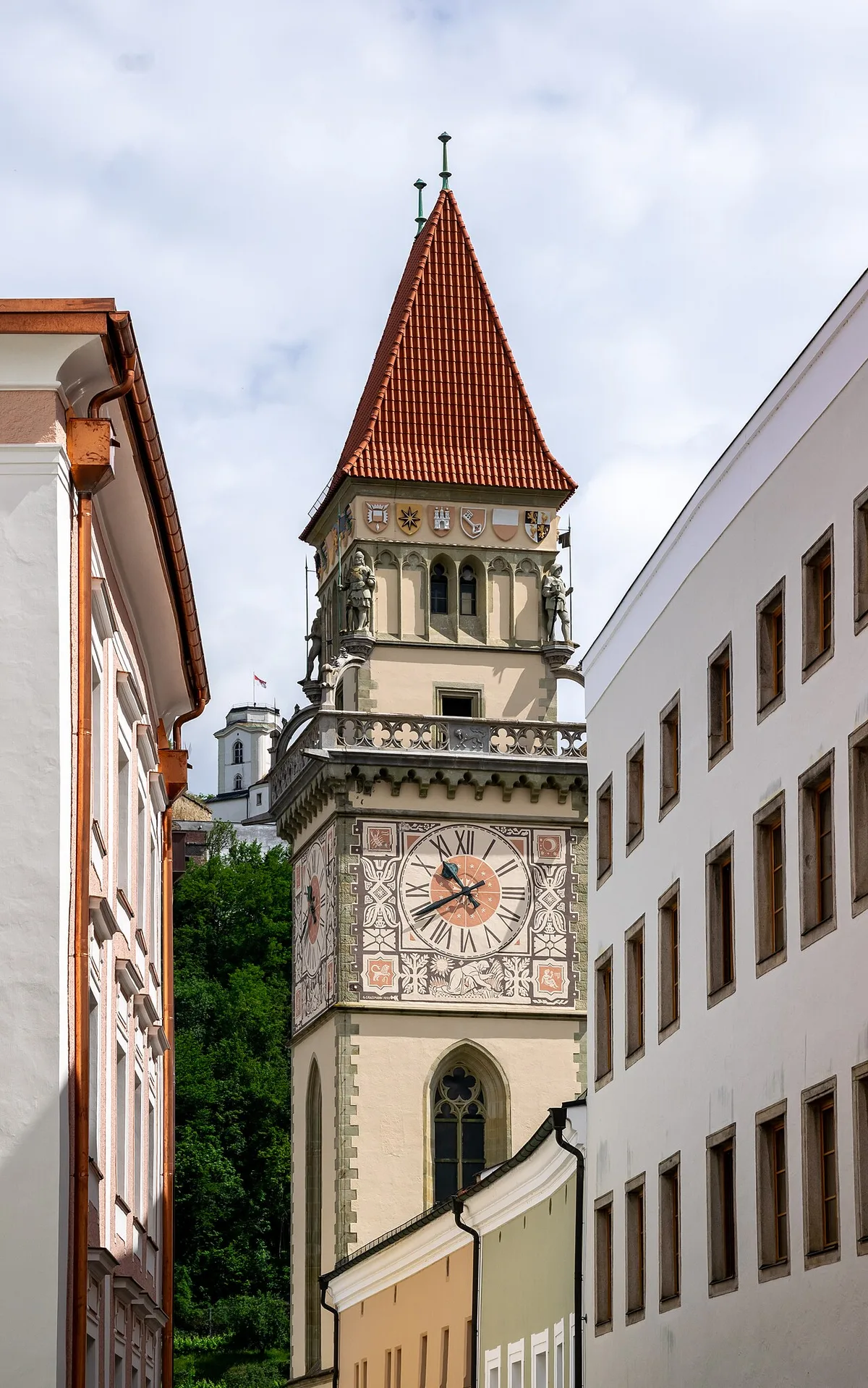
The complex occupies a spot on Rathausplatz where the riverside promenade meets the lanes of the Old Town, with the Glass Museum next door and clear views across the water toward the Veste Oberhaus fortress. That position makes it a natural hinge point on a Passau old town walk rather than a destination you need to schedule a half-day around. A suggested visit of roughly thirty to forty-five minutes for the exterior, including the carillon if your timing works, is this guide's own estimate and not an official figure.
What You Are Looking At: The Facade
The paintings on the outside show Emperor Ludwig of Bavaria and four flag bearers representing the Electorates of Saxony, Trier and Cologne and the Duchy of Bavaria, according to Passau Tourism. Those figures sit on a facade whose Italianate character comes from the rebuilding that followed the Great Fires of 1662 and 1680, when Italian masters Carlo Lurago and Giovanni Battista Carlone reworked the interiors. The result is the Mediterranean look that helped Passau earn its Venice of Bavaria nickname.
Photographers should look for the murals high on the wall and the stone flood markers that record water levels on the riverside face. These exterior details are the part of the Old Town Hall you can reliably enjoy without any question of tickets or opening times, so a short stop here carries no risk of disappointment. Read the facade slowly rather than treating it as a backdrop for one photograph.
The Tower and the Carillon
The tower rises 38 metres and its clock face has become the silhouette most people picture when they think of Passau's Old Town Hall. Passau Tourism states that the carillon in the tower plays twice a day at 11:30 a.m. and 2:30 p.m., which makes those the two moments worth planning an exterior stop around. Stand on Rathausplatz a few minutes early so you are not walking away as it begins.
Between chimes the square stays busy with passers-by and tour groups, so the carillon times also tend to be the most crowded moments on Rathausplatz. If you mainly want clean photographs of the facade and tower, arriving outside those windows can be the better trade-off. The ground-floor tourist information is the right place to confirm whether anything about the carillon schedule has changed.
The Gothic Staircase and the Council Chambers
Passau Tourism describes the Town Hall as consisting of a large council chamber and a smaller one, both located in the Old Town Hall and reached by a Gothic staircase dating from 1446. That staircase is the physical threshold between the reliably public exterior and the interior spaces whose access conditions visitors must confirm on site. Treating the two halves of the visit as separate decisions will save you frustration.
The Large Council Chamber was reconstructed with two naves and three flat ceilings after the fires, and the Passau artist Ferdinand Wagner decorated it between 1887 and 1890 with paintings of the town and historical scenes. Its stained glass windows were largely donated by individual citizens, with the sixth given by the Town Council. Six ceiling ovals depict virtues such as faith, strength and loyalty, so the room rewards attention rather than a quick glance.
The Small Council Chamber's Working Role
The smaller chamber is used for multiple purposes including civil wedding ceremonies at the register office, according to Passau Tourism. That civic function means you cannot count on it being available to sightseers at any given moment, however appealing its painted ceiling and Tuscan pillars are. Its ceiling decoration, first shown publicly in 1888, includes an allegorical figure of Passau with the Danube, Inn and Ilz rivers personified around her.
Because the room serves weddings and other civic events, a rigid expectation of walking straight in is the wrong way to approach it. Ask at the tourist information counter on the ground floor whether the chambers can be visited during your stay and under what conditions. If the answer is no, the exterior and the carillon still make the detour worthwhile on their own.
Inside or Outside? A Decision Framework
Choose the exterior-only visit if you are short on time, traveling with a tight itinerary, or simply want the facade, the tower and the riverside setting. Choose the interior visit if you are specifically drawn to nineteenth-century mural cycles, stained glass and the physical experience of climbing a Gothic staircase from 1446. The honest trade-off is that the exterior is always available while the interior depends on conditions you cannot verify in advance.
One practical rule is to plan your Old Town day around the fixed carillon times and treat any interior access as a bonus rather than the centrepiece. That way a closed chamber door does not unravel the rest of your morning. Pairing the stop with St. Stephen's Cathedral Passau visitor guide keeps you moving through the compact Altstadt without doubling back.
Accessibility at the Old Town Hall
Passau Tourism describes limited accessibility for wheelchairs, with a narrow elevator, a stair lift and ramps, and recommends bringing an assisting person. An accessible lavatory is on the first floor, with the key available at the citizens' office in room 108, reachable by elevator. That is an honest picture rather than a claim of step-free access, so plan accordingly if mobility is a factor.
If you use a wheelchair or travel with someone who does, the narrow elevator is the detail to plan around rather than the entrance itself. Calling ahead to the tourist information on Rathausplatz lets you ask specific questions about the route into the chambers and whether the lift is in service. Do not assume that the presence of a lift means every part of the complex is reachable.
Nearby Old Town Sights to Combine
The Old Town Hall sits close to the Glass Museum and the Danube promenade, and the Wittelsbach Fountain on Residence Square is a short walk away. St. Stephen's Cathedral, with its celebrated organ, is another obvious pairing within the Altstadt. These are all within comfortable walking distance, which is why the Old Town Hall works best as one stop on a loop rather than a standalone excursion.
If you have more time, the Veste Oberhaus Passau fortress visitor guide covers the hilltop complex across the river, and the Passau three rivers confluence viewpoint guide explains the Dreiflüsseeck where the Danube, Inn and Ilz meet. Both add context to the riverside position you have just been looking at. Building them into the same day avoids a second trip across town.
Practical Planning and Verification
Passau Tourism's own listing for the Town Hall showed a currently closed status for opening hours, which is exactly why you should not build a schedule around assumptions about interior access. The tourist information on the ground floor of the tower is the correct place to ask about current conditions, guided tour options and any temporary restrictions. Its address is Rathausplatz 2, 94032 Passau, with a published telephone number and email for advance questions.
The city's official tourism site publishes contact details for the tourist information offices and is the most dependable starting point for anything time-sensitive. Check it in the days before you travel rather than relying on older blog posts, which may not reflect current arrangements. This guide deliberately avoids quoting admission fees or chamber hours because the operator's own pages do not state them consistently.
Plan Your Visit
The Altes Rathaus is a two-layer visit: an always-available exterior with painted figures, flood markers and a 38-metre tower, and an interior whose Gothic staircase, council chambers and Wagner murals depend on conditions you should confirm on the day. Build your stop around the carillon times of 11:30 and 14:30 and treat the chambers as optional. Start at the tourist information in the tower's ground floor and you will have the most current answer available.
If you want to see more of the city, St. Stephen's Cathedral Passau and the Passau Altstadt lanes are natural next stops within a few minutes' walk. Together they make a compact half-day that does not depend on any single building being open. Confirm the details that matter to you before you go, and the Old Town Hall will reward even a short look.
Frequently Asked Questions
Is the Altes Rathaus in Passau free to visit?
The exterior of the Old Town Hall, including the facade paintings, the tower and the flood markers, can be viewed from Rathausplatz as part of the public streetscape. Whether the interior council chambers can be entered, and on what terms, is something you should confirm with the tourist information on the ground floor of the tower, because admission arrangements are not something this guide can state reliably.
When does the carillon at Passau's Old Town Hall play?
Passau Tourism states that the carillon in the tower plays twice a day at 11:30 a.m. and 2:30 p.m. Those two times are the most dependable timing anchor for a visit to Rathausplatz, and they are the moments when the square tends to be busiest. If the schedule matters to your day, ask at the tourist information counter to confirm it has not changed.
Can you go inside the Old Town Hall in Passau?
The town hall is a working civic building, and the larger and smaller council chambers sit behind a Gothic staircase from 1446. The smaller chamber is also used for civil wedding ceremonies, which means access can vary. Check with the tourist information before assuming you can walk in, and treat any interior visit as something to confirm rather than expect.
How long does a visit to the Altes Rathaus take?
A short exterior stop covering the facade, the tower and the carillon can fit into roughly thirty to forty-five minutes, though that is this guide's own suggestion rather than an official figure. If interior access is available and you want to study the Wagner murals, stained glass and ceiling paintings properly, allow considerably more time. The carillon times give you a natural way to structure the stop.
Is the Old Town Hall wheelchair accessible?
Passau Tourism describes limited accessibility, with a narrow elevator, a stair lift and ramps, and recommends an assisting person. An accessible lavatory is on the first floor, with the key available at the citizens' office in room 108, reachable by elevator. Because the elevator is narrow, ask the tourist information in advance about the specific route you would need.
What can you see on the facade of Passau's Old Town Hall?
The exterior paintings show Emperor Ludwig of Bavaria and four flag bearers representing the Electorates of Saxony, Trier and Cologne and the Duchy of Bavaria, according to Passau Tourism. The stone walls also carry flood markers recording water levels, and the overall Venetian style reflects the rebuilding after the fires of 1662 and 1680. The facade is the part of the building you can count on seeing.


