

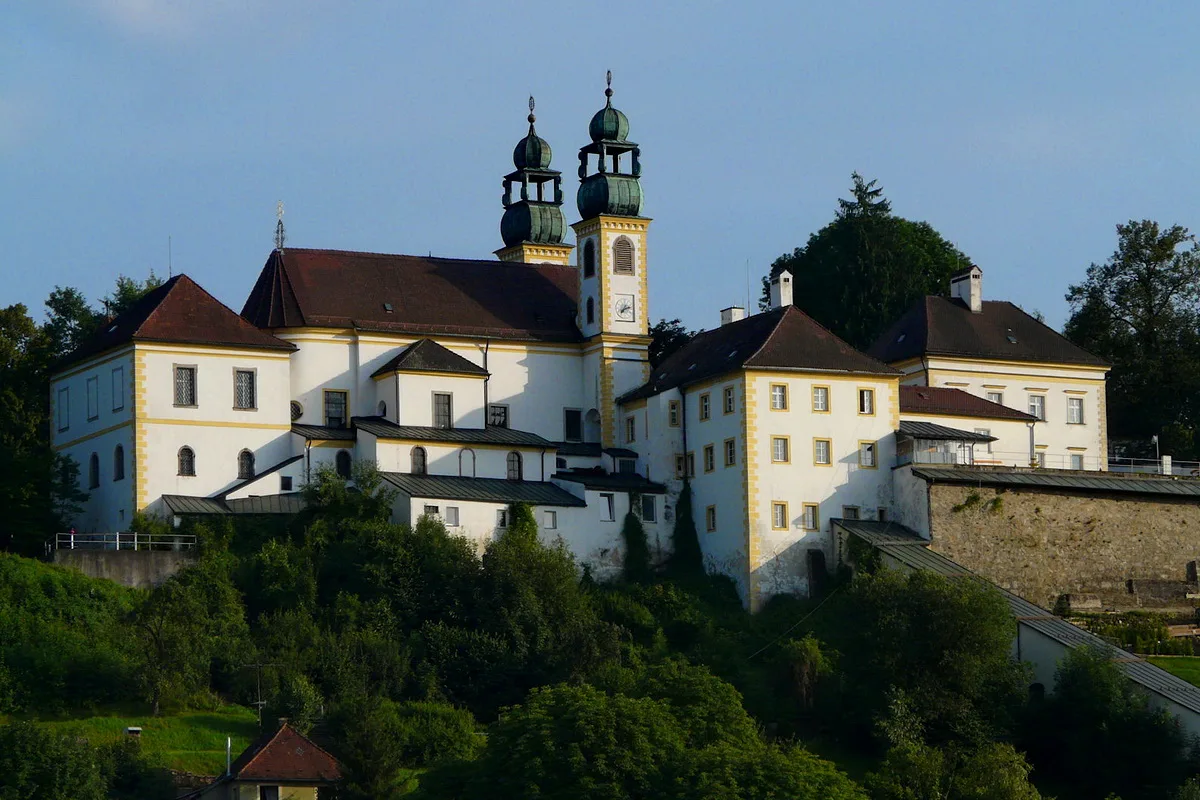
The Mariahilf pilgrimage church stands high above the Innstadt, the Inn-side district of Passau, and its two prominent towers make it a landmark visible from much of the lower town. The operator page describes the complex as a baroque pilgrimage church with an adjacent St. Paul monastery, and the traditional approach is the covered stairway of 321 steps entered from Neutorgraben. A suggested visit of about 45 to 60 minutes is enough to climb at an unhurried pace, look at the votive tablets, step inside the church and spend a few minutes at the view; that timing is a suggestion, not an official figure, and it assumes you are not combining the stop with a longer hill walk.
This guide focuses on the single question of how to visit Mariahilf: whether to climb the covered pilgrim stairway or arrive by road, what the interior actually contains, how the operator describes access, and how the stop fits a broader walk on the Mariahilf hill. Passau's wider landmark guides are useful if you are still deciding which churches, museums and viewpoints to prioritise.
What Mariahilf Is and Where It Stands
Mariahilf is a baroque pilgrimage church and former monastery complex on the Mariahilfberg, set above the Innstadt across the Inn from Passau's old town peninsula. The operator lists the address as Mariahilfberg 3 in Passau and gives a telephone contact for the pilgrimage church and cloister.
The monastery history is layered. Passau Tourism states that Mariahilf was a Capuchin monastery until 1803 and again from 1890, and that the Order of St. Paul has been located there since 2002.
Because it sits above the Innstadt rather than in the pedestrian core, Mariahilf works best as a deliberate uphill stop rather than something you pass on a flat old-town stroll. If you are still choosing which Passau landmarks to prioritise, the city's itineraries and travel guides give a broader overview of how the cathedral, fortress and churches compare.
Two Ways Up: The Pilgrim Stairway or the Road
The signature approach is the covered stairway, which Passau Tourism describes as a walkway with 321 steps leading up to the pilgrimage chapel. The entrance is on Neutorgraben, so if you want the traditional pilgrim route you begin from that street and climb under cover rather than in the open.
The Road of Emperors and Kings also notes the covered prayer staircase of 321 steps leading directly to the monastery, and frames the arrival point as a place with a broad view over what it calls the Italian side of Passau.
The alternative is to arrive by road and skip the climb, which suits anyone who does not want 321 steps or who is travelling with a group. Sources do not give precise road, bus or walking times to the church, so check current local transport information before you set out rather than relying on an old estimate.
The decision matters because the two approaches produce different visits. The stairway is the historical experience and the reason many people come; the road approach gets you to the church and the view with far less effort but bypasses the votive tablets entirely.
The Votive Tablets Along the Stairway
The covered walkway is not just a shortcut with a roof. Passau Tourism states that the walkway is adorned with numerous votive tablets, the painted thank-offerings left by pilgrims who attributed a recovery or deliverance to the Virgin Mary.
These tablets are the clearest evidence of how the site functioned as a pilgrimage destination rather than simply a scenic church. Read them as a record of individual vows and emergencies, which is why the stairway is worth climbing slowly instead of treating it as a fitness test.
Inside the Church: The Mariahilf Image and Its Cranach Original
The image venerated at the high altar is, according to Passau Tourism, actually a copy. The original was painted by Lucas Cranach and was a present for Leopold, Archduke of Austria and Prince Bishop of Passau, in 1611.
Before Leopold took the painting with him to his new domain as sovereign of Tyrol, the cathedral department head Marquard von Schwendi had a Passau-based painter named Pius make a copy, and that copy is what remained. Passau Tourism states the original is currently in the St. Jakob parish church in Innsbruck.
The copy's fame grew through Emperor Leopold I of Habsburg, who fled with his family and court to Passau in 1683 when the Turks surrounded Vienna and prayed daily before the image for the city's liberation. Passau Tourism records that Mary Help became the battle cry in the campaign that ended at the Kahlenberg, and the Passau image became the national image of the Habsburg family.
Knowing this changes what you look at inside. The high altarpiece is a working devotional object with a political afterlife in Habsburg history, not merely an old painting, and the Innsbruck connection is the detail most visitors miss.
Opening Hours and Admission: What Is Confirmed
Passau Tourism currently lists daily opening hours of 7 a.m. to 8 p.m. for the pilgrimage church. Treat that as the operator's published listing rather than a guarantee for any particular date, because hours can change seasonally or for services.
The operator page does not list an admission price, which is why this guide does not state that entry is free or quote a figure. Free entry may be implied by the absence of a price, but implication is not confirmation, so check the operator page or call ahead if knowing the cost matters to your planning.
Do not assume the whole complex is one ticketed attraction. The church and monastery are a religious site, not a museum with a single admission desk, so treat any paid element as something to verify separately rather than bundling it into your expectation for Mariahilf.
Accessibility: What the Operator Actually States
Passau Tourism describes the church as having limited accessibility for wheelchairs, notes disabled parking in the courtyard and mentions a public handicapped lavatory in the church. Those three details are the operator's own accessibility notes, and they stop short of claiming a fully step-free or barrier-free visit.
The practical reading is that arriving by road and using the courtyard parking is the more realistic option if you cannot manage the 321-step stairway, but you should not assume the church interior itself is fully wheelchair accessible. If you need detailed step-free routing, confirm it directly with the pilgrimage church or Passau Tourism before travelling, because no source in this guide provides a complete barrier-free route description.
The View Over the Innstadt
The payoff at the top is the outlook over the Innstadt, the Inn-side district below. The Road of Emperors and Kings describes the view from the monastery as looking over the so-called Italian side of Passau, a reference to the colour and character of that quarter.
Treat this as an orientation view rather than a competition against Passau's other panoramas. Sources do not rank the Mariahilf outlook against the fortress terrace or the river confluence, so judge it on what it shows you, namely the Innstadt and the river side from above.
If you are collecting viewpoints across the city, the best viewpoints in Passau guide helps you sequence the fortress terrace and other panoramas rather than doubling back across the rivers. Pairing Mariahilf with a second viewpoint on a different bank makes the most of a hill-based day.
No source in this guide confirms benches, cafés or other facilities on the hill beyond the church, so plan your rest stop accordingly. If you want a photograph of the Innstadt from above, the church forecourt is the reliable place to take it, and the best photo spots in Passau guide covers other framed views in the city.
Fitting Mariahilf Into a Mariahilf Hill Walk
A sensible way to build the day is to walk the Innstadt first, then climb the Neutorgraben stairway to Mariahilf, and return downhill on the opposite side or by road. This keeps the climb one-directional and avoids the anticlimax of walking back down the same covered steps.
Pairing Mariahilf with a slow wander through the lanes below makes the hill walk feel less like a single-objective climb. The hidden gems in Passau guide points to quiet corners and lesser-known lanes that fit naturally with the Innstadt side of a hill circuit.
Back in the old town, the Altes Rathaus Passau old town hall visitor guide explains the painted town hall and the square around it, which is a reasonable finish once you have come down from the hill. That gives the day a shape: hill in the morning, old town in the afternoon.
If you are mapping the city's landmarks against each other before you commit to a route, the Passau itineraries and city travel guides help you group the cathedral, fortress and riverfront into a sequence that matches your available time. Build the walk around the climb rather than the reverse, since the stairway is the one element you cannot shorten.
Practical Mistakes to Avoid
The first mistake is assuming step-free access all the way to the church. The stairway is 321 steps by the operator's own description, and the accessibility note of limited wheelchair access should be read literally.
The second is guessing at hours from an old blog or a memory. The published daily hours from 7 a.m. to 8 p.m. are the operator's current listing, but for a specific date you should confirm with the pilgrimage church or the tourist information office in the Rathausplatz rather than assuming the listing is fixed for your visit.
The third is treating Mariahilf as a ticketed museum. No admission price appears on the operator page, so budget for the possibility that the church operates on donations or shrine rules rather than a fixed ticket, and verify before building a paid attraction into your day.
Passau Tourism's own site carries the sight listings and tourist information contacts, while the Passau itineraries and city travel guides help you place the church within a broader plan.
Plan Your Visit to Mariahilf
Decide first whether the 321-step covered stairway is part of the plan or whether you will arrive by road. That single choice determines how much time you need, how much effort the visit costs and whether you experience the votive tablets that give the stairway its purpose.
Then confirm the two facts the operator does and does not fix. The published hours are daily 7 a.m. to 8 p.m., and no admission price is listed, so check directly with the pilgrimage church or Passau Tourism before you travel if either detail is critical.
Allow roughly 45 to 60 minutes as a suggested duration, more if you are walking the hill as a circuit. Combining the climb with the Innstadt lanes and an old-town finish gives you a coherent half day rather than an isolated uphill stop.
Frequently Asked Questions
How many steps are there to Mariahilf church in Passau?
The covered pilgrim stairway to Mariahilf has 321 steps according to Passau Tourism and the Road of Emperors and Kings. The entrance is on Neutorgraben, and the walkway is lined with votive tablets. You can avoid the steps entirely by arriving by road, though sources do not give travel times for that approach.
Is Mariahilf church in Passau free to enter?
The operator page does not list an admission price, but that is not the same thing as a confirmed free entry. No source in this guide states a ticket price or a definitive free-entry rule, so check with the pilgrimage church or Passau Tourism before relying on either assumption. Do not treat the absence of a listed price as a guarantee.
Is Mariahilf church wheelchair accessible?
Passau Tourism describes the church as having limited accessibility for wheelchairs, with disabled parking in the courtyard and a public handicapped lavatory in the church. No source here provides a complete step-free route or barrier-free guarantee, and the 321-step stairway is not an accessible approach. Confirm your specific needs directly with the operator before visiting.
What are the opening hours of Mariahilf church?
Passau Tourism currently lists daily opening hours of 7 a.m. to 8 p.m. for the pilgrimage church. These are the operator's published hours rather than a guarantee for a specific date, and religious sites can change access around services. Confirm the hours with the pilgrimage church or the tourist information office if your visit depends on them.
Why is the venerated image at Mariahilf a copy?
The original was painted by Lucas Cranach and given to Leopold, Archduke of Austria and Prince Bishop of Passau, in 1611. Before he took it to his new domain as sovereign of Tyrol, a Passau painter named Pius made a copy, and that copy stayed in Passau. Passau Tourism states the original is now in the St. Jakob parish church in Innsbruck.
How long should a visit to Mariahilf take?
A suggested visit of about 45 to 60 minutes covers the climb, the votive tablets on the stairway, the church interior and a few minutes at the view. This is a suggestion, not an official figure, and it assumes you are not continuing along the hill. Allow more time if you are combining Mariahilf with the Innstadt lanes or other Passau sights.
What can you see from Mariahilf above the Innstadt?
The outlook is over the Innstadt, the Inn-side district below the church, which the Road of Emperors and Kings describes as the Italian side of Passau. Sources do not rank this view against other Passau viewpoints, and no source confirms benches or facilities on the hill beyond the church, so treat it as an orientation view rather than a full visitor terrace.


