

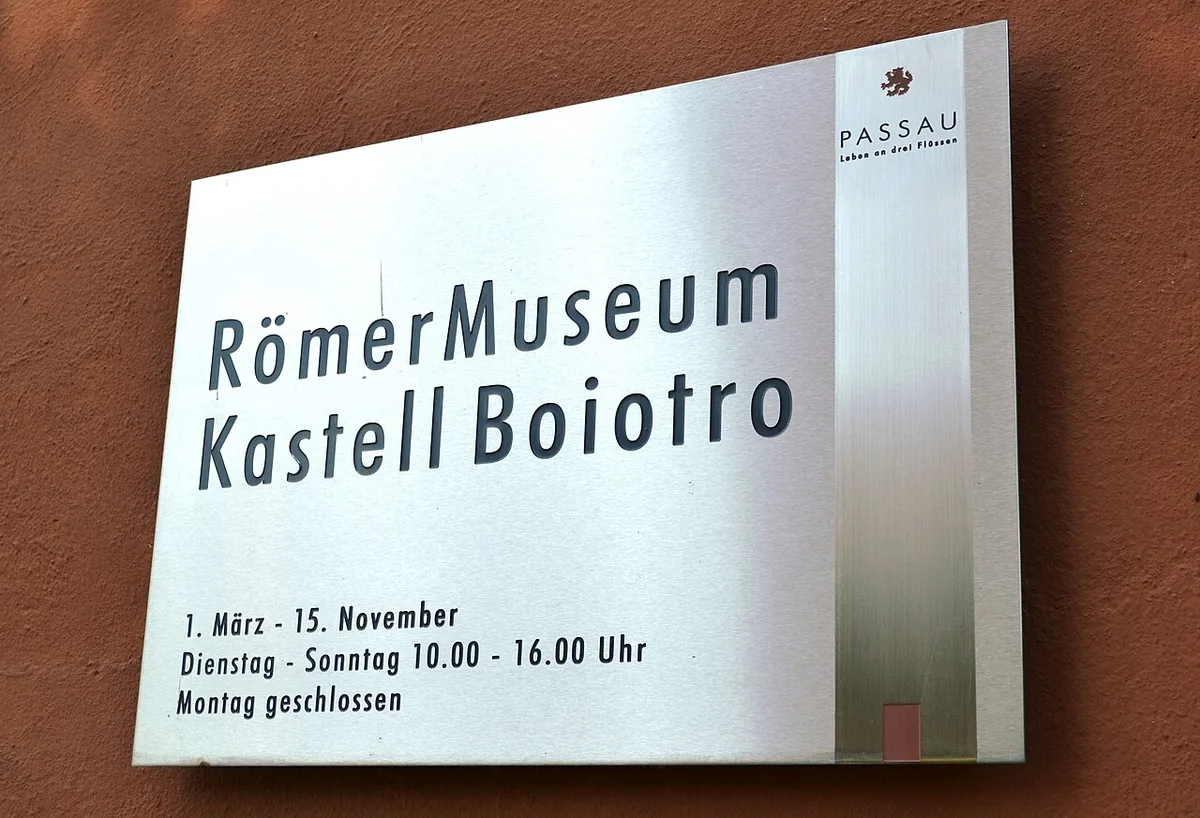
Most visitors meet Passau through its baroque skyline and the riverside view where the Danube, Inn and Ilz converge. Older, quieter evidence of the Roman frontier sits across the Inn in the Innstadt, where a small museum occupies a medieval craftsmen's house built on the foundations of a Late Roman fort. The museum itself describes the setting as hidden in the picturesque lanes of the Innstadt, with the exposed foundation extending across the full depth of the building's cellar and a lighting installation making the wall's construction phases legible.
Treat this as a focused stop rather than a half-day museum. A suggested allowance is around 45 to 60 minutes inside, plus extra time for the exposed masonry and the garden pillars where rebuilt tuff-and-brick supports stand; that figure is a suggestion, not official guidance, so adjust it to your own pace. Since the venue does not publish entry cost or current opening hours in the sources reviewed here, confirm both before you set out rather than assuming either.
Why the Kastell Boiotro Rewards a Detour into the Innstadt
The museum presents the Roman history of this frontier town at close range, and its setting is the point: a house from a later century standing on remains from a much earlier one, so the building itself becomes part of the exhibit. Anyone who has already walked the main Passau circuit will find a different layer of the city here, one tied to the river frontier and to the UNESCO Danube Limes rather than to prince-bishops.
For the wider context of the city's sights and how the Innstadt fits into a broader itinerary, the Passau: Landmark Visitor Guides collection is useful for deciding which cluster of sights to tackle first. Budget your time on the strength of that overview, then use the museum as a deliberate counterweight to the big-ticket stops.
A Medieval House Standing on Late Roman Foundations
The museum occupies a medieval craftsmen's house from the 12th century, and the excavated foundation extends across the entire depth of the building in the cellar, as the museum's own overview states. A lighting installation is used to make the different construction phases of the wall legible, which turns a dim basement into a readable archaeological sequence. Look for how the masonry changes rather than treating the cellar as one undifferentiated stretch of stone.
This is also the point where the UNESCO Danube Limes becomes visible rather than abstract, since the frontier heritage is embodied in the remains underfoot. The museum pairs its permanent exhibition with a Roman garden and family-oriented offerings, which gives the site a modest outdoor component alongside the indoor displays.
Reading the Fortress: Plan, Ditch, Walls and Corner Towers
According to the museum's account, traces of the fort were found by chance in autumn 1974 during construction work for a planned kindergarten on the Lederergasse 43 plot, and the area was then systematically excavated in the following years. The fort has the unusual shape, for Roman military installations, of a slightly irregular trapezoid with its long side parallel to the Inn. Its single gate sat roughly at the middle of the river-facing side, and the interior covered only about 1,500 square metres.
The defences reflect Late Antiquity rather than the earlier imperial model. Boiotro was surrounded by a trough-shaped defensive ditch about 8 metres wide, and the walls were massive: roughly 3.80 metres thick on the south side and between 2.50 and 2.80 metres elsewhere. Projecting corner towers with fan-shaped ground plans complete the picture.
The service rooms and troop quarters, probably reconstructed as two storeys, were arranged around an open courtyard and leaned against the inner face of the fort walls. They were supported by substantial pillars of tuff and brick, and some of these pillars have been re-erected at their original positions and are visible today in the museum garden. That garden detail is easy to overlook and is one of the most concrete things you can see.
Based on the excavated material and historical reasoning, the fort was probably built around 300 AD during a phase of consolidating the river frontiers, and it seems to have been held by a small troop contingent at least into the late 4th century. In the course of the 5th century it was put to a different use, with a storage building integrated into the south-east corner. All of these dimensions come from the museum's own published account of the castrum.
Inside the Collection: Funerary Monuments and a Wine Trader's Tombstone
The free audio guide for the Römermuseum Kastell Boiotro covers the museum's stations in English, with the funerary monuments treated as a numbered stop. According to that guide, the funerary monuments on display all come from Passau and its surroundings, which keeps the collection tightly tied to the local Roman landscape. A stone decorated with dolphins belonged to a larger burial monument; in 1981 it was recovered from the riverbed of the Inn together with the tombstone of Publius Tenatius Essimnus, a wine trader whose stone is displayed on the museum's upper floor. Two other stones were found at Rotthof, roughly 20 kilometres south of Passau, where a country estate supplied goods to Boiodurum.
The upper portions of those two monuments are built into the outer face of the southern wall of the Siebenschläfer, the Seven Sleepers church at Rotthof, and they show three and four deceased figures respectively. That total gave rise to the belief that they depicted seven Christian martyrs, and the style is known in German archaeology as the Fenstergucker relief, or window gawker relief. The original monument found in the Innstadt district carried the same kind of relief, with inscriptions that would have been engraved into a lower section.
Loading the audio guide before you arrive helps you match the objects in the cases to their find spots, and it works as a useful primer even if you prefer to read labels on site.
The UNESCO Danube Limes Context at This Site
Boiotro belongs to the chain of Late Roman river forts that makes the Danube Limes legible along the frontier, and this museum is where that heritage becomes physically visible in Passau. The museum notes that the fort sits close to the confluence of the Danube and the Inn, on the right bank of the Inn near the mouth of the Beiderwiesbach, which is exactly the kind of river-edge position such installations occupied. Reading the plan after seeing the exposed wall makes the strategic logic of the location easier to grasp.
The frontier story continues beyond the museum in the wider Passau area. The museum's own UNESCO pages link the site with the related fort at Batavis and the later Burgus at Haibach, so if the Roman thread interests you, treat the museum as the starting point and the landscape as the extension.
Guided Tours in German, English and Italian by Arrangement
The museum's programme page states that it offers guided tours and programmes for all age groups and interest profiles, and that tours can be adapted to specific needs, whether the group is a support school, a company outing, a family gathering, a seniors' group or pre-schoolers. All guided tours can be booked in German and English, and Italian-language tours can also be arranged. Use the enquiry route to state your language and group profile rather than assuming a fixed public slot.
The programme page also covers school programmes and training courses, so teachers and group organisers should approach it directly rather than relying on general city listings. Note that the museum does not state required advance notice periods or reservation rules in the material reviewed here, so ask about those specifically when you make contact.
How Long a Visit Takes: A Suggested Framework
Plan for around 45 to 60 minutes inside as a workable rule of thumb, an estimate rather than official guidance. The cellar sequence and the exhibition cases are the core, and the garden pillars reward a short additional loop. If you follow the audio guide station by station and read the tombstone inscriptions carefully, lean towards the upper end.
Bavaria's tourism board lists the Roman Museum Kastell Boiotro among ten Passau sights, noting only that it sits on the foundations of a Late Roman castle. Treat such listicles as orientation rather than as timing advice. A figure that circulates externally, claiming 600 exhibits illustrating 400 years of Roman rule, appears only in that listicle and is not corroborated by the museum's own pages, so do not build your time budget on it.
Practical Planning: What to Confirm Before You Go
The museum has not published current opening days, hours, entry cost or any reduced, family or group rates in the material reviewed here. Contact the museum directly or use the Passau tourism site to confirm the day's opening and whether you pay at the door, and check whether any combined arrangement applies before you assume one. Do not plan around a shared ticket with the Oberhausmuseum complex either, since that is not evidenced and the two sites sit on opposite sides of the river. For wider planning, see Passau on a Rainy Day.
Accessibility at the Boiotro site, along with parking and local transport specifics, is likewise outside what these sources support. If you need step-free access or a wheelchair-accessible route, raise it in your enquiry rather than relying on a general city accessibility page, because the museum's own architecture includes a cellar sequence and historic thresholds.
For general visitor information, including tourist information points and downloadable brochures, the city's tourism pages are the practical starting point. Use them to confirm seasonal variations before a trip, and treat any exact price or time you find elsewhere as unverified until the operator states it.
Pairing the Museum with the Innstadt and Other Passau Sights
Because the museum sits in the Innstadt, the natural pairing is the climb to the Pilgrimage Church Mariahilf, which rises high above the district with its baroque towers and the adjacent St. Paul monastery. Passau Tourism states that a covered stairway of 321 steps adorned with numerous votive tablets leads up to the pilgrimage chapel, with the entrance in the street of the Neutorgraben, and that the church is open to visitors daily. The climb makes a strong contrast to the low, enclosed Roman remains below.
If you want to compare how Passau presents its Roman layer against its castle collections, the Oberhaus Museum Passau visitor guide covers the Veste Oberhaus complex, whose exhibitions on medieval life and Passau's trading history sit above the town. Keep the two visits separate in your planning, since they are distinct sites with their own arrangements. Switching focus between the medieval and the Roman in one day works well if you give each its own slot.
Within the old town, the Altes Rathaus Passau and its flood-marked walls make a natural companion stop, and the old town hall area connects easily with the cathedral square. For days when weather turns, the options in this Passau on a rainy day guide help you keep the plan intact without wasting the afternoon. If you prefer to wander without a fixed list, the side lanes and overlooked corners collected in hidden gems in Passau pair neatly with an Innstadt morning.
Plan Your Visit
The Römermuseum Kastell Boiotro works best as a deliberate, compact stop: a medieval house, a readable Late Roman wall sequence, and a handful of funerary stones with real find histories. The fortress plan, the roughly 8-metre ditch, the thick south wall and the re-erected tuff-and-brick pillars give you something concrete to look for rather than a general impression of antiquity. Confirm opening times and entry conditions before travelling, since those details are not published in the sources reviewed here.
Build the rest of the day around the Innstadt and the old town, and use the city-level Passau: Itineraries and City Travel Guides hub to decide the order of stops. Check the museum's own pages for tour languages and programme options if you are bringing a group, and set aside a realistic hour on site rather than racing through.
Frequently Asked Questions
Where is the Römermuseum Kastell Boiotro in Passau?
It sits in the Innstadt, the district on the right bank of the Inn, in the picturesque lanes of that quarter. The fort remains were discovered in autumn 1974 during construction work on the Lederergasse 43 plot, close to where the Danube and Inn converge and near the mouth of the Beiderwiesbach. Use the museum's own site to confirm the address and current visitor arrangements before you set out.
What can you actually see inside the Boiotro museum?
The centrepiece is the excavated Late Roman fort foundation, which extends across the full depth of the building's cellar, with a lighting installation that makes the wall's construction phases readable. In the garden, some tuff-and-brick pillars have been rebuilt at their original positions. The collection includes funerary monuments from Passau and the surrounding area, among them the tombstone of Publius Tenatius Essimnus, a wine trader, displayed on the upper floor.
Are guided tours at Boiotro available in English?
Yes. The museum states that all guided tours can be booked in German and English, and that Italian-language tours can also be arranged. Tours are offered for all age groups and interest profiles and can be adapted to a group's specific needs. Check the programme page and ask about notice periods and group conditions, since the museum does not publish those details in the material reviewed here.
How long should I allow for a visit to the Roman fort museum?
As a suggestion rather than official guidance, allow roughly 45 to 60 minutes inside, plus a short extra loop for the garden pillars. Following the online audio guide station by station and reading the tombstone inscriptions will push you towards the longer end. This is a compact site, so it fits comfortably alongside the Mariahilf climb or an old-town walk.


