

St. Stephen's Cathedral stands at the highest point of Passau's Altstadt, its white towers and blue-green domes visible from the riverbanks below. The nave is free to enter during published opening hours, and one feature gives your visit a natural focal point: the organ, which Passau Tourism describes as the largest Catholic church organ in the world, with 17,974 pipes and 233 registers in five separate installations. As a suggestion rather than an official recommendation, allow about an hour for the building itself.
The Diocese of Passau notes that a church on this site is attested around the year 450 in the late antique city of Batavis, with the bishop's church documented from 730. The present baroque building followed a devastating fire in 1662. For wider trip planning, see Passau: Itineraries and City Travel Guides.
This guide covers the building and its interior, the organ as an architectural feature, free versus separately ticketed areas, opening hours, accessibility and how long to allow. The separate Passau organ concert at St. Stephen's tickets guide covers concert scheduling and tickets.
Why the Cathedral Looks the Way It Does
A church has stood on this site for a very long time. The Diocese of Passau notes that a church is attested in the late antique city of Batavis around the year 450, and the bishop's church is documented from 730. Between the 13th and 16th centuries a Gothic cathedral rose here, but the great fire of 1662 left no visible traces of the first four building periods above ground. Only the late Gothic east end survived in the exterior.
The Italian master Carlo Lurago was commissioned to carry out the baroque rebuild, incorporating the surviving Gothic parts, between 1668 and 1693. Giovanni Battista Carlone was responsible for the entire interior decoration, including the stucco work and the altar structures of the Italian high baroque. Carpoforo Tencalla painted the frescoes.
The result, according to the diocese, is the largest baroque church interior north of the Alps and the most significant Italian-influenced baroque church on German soil. The domed crossing and white facade set the tone from outside; the Gothic choir has been under restoration by a state workshop since 1928. Knowing this helps you read the building as two eras stitched together rather than a single style. For a related old-town landmark, see the Altes Rathaus Passau old town hall visitor guide.
Inside the Nave: Where to Look
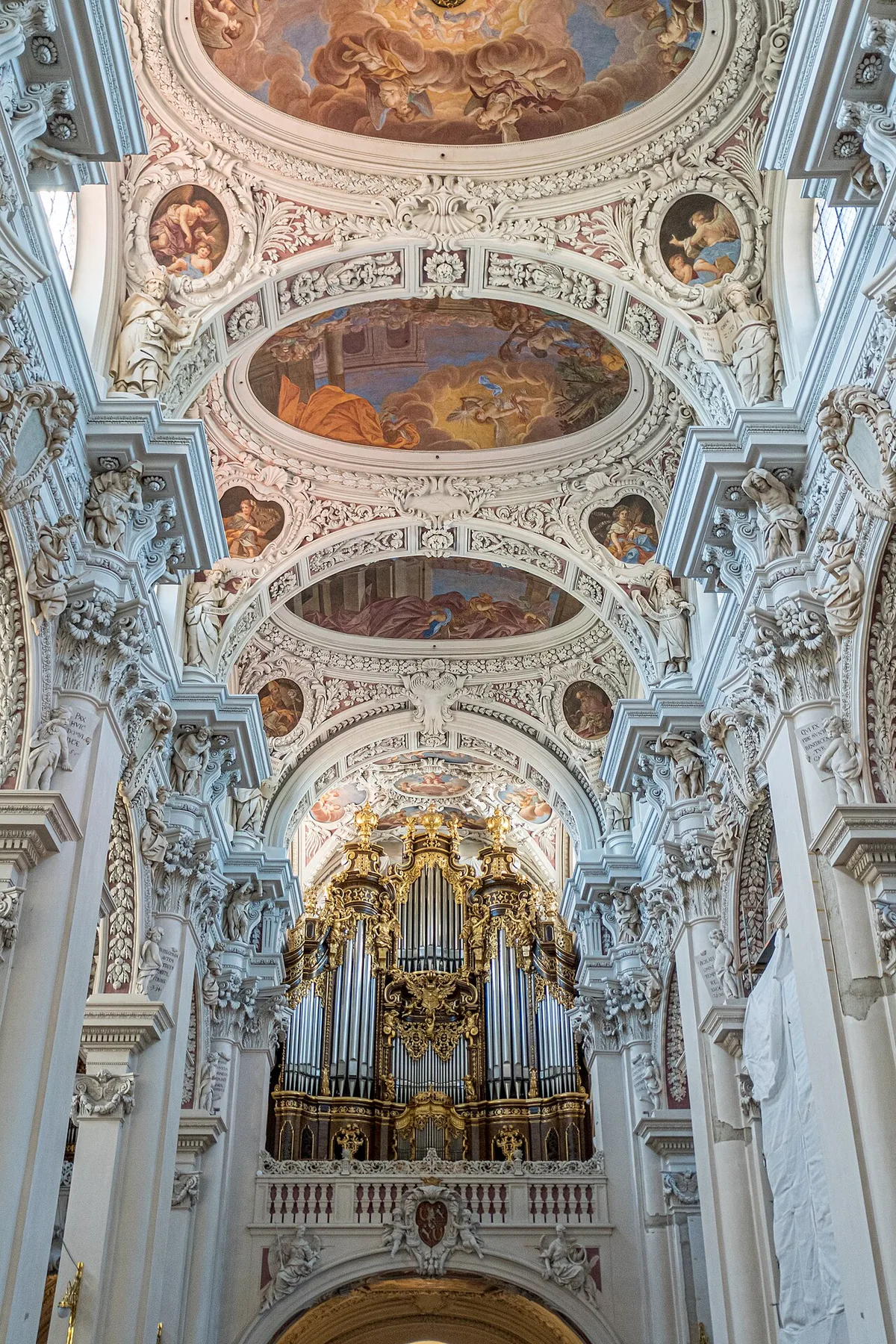
Once inside, look up first. Tencalla's ceiling frescoes cover the vault, and the baroque stucco frames them across the nave and aisles. The diocese notes that the ceiling vault was restored and returned to its colourful state after recent work. Allow your eyes to adjust before moving toward the sanctuary. Further visitor details appear in Dom St. Stephan | Bistum Passau.
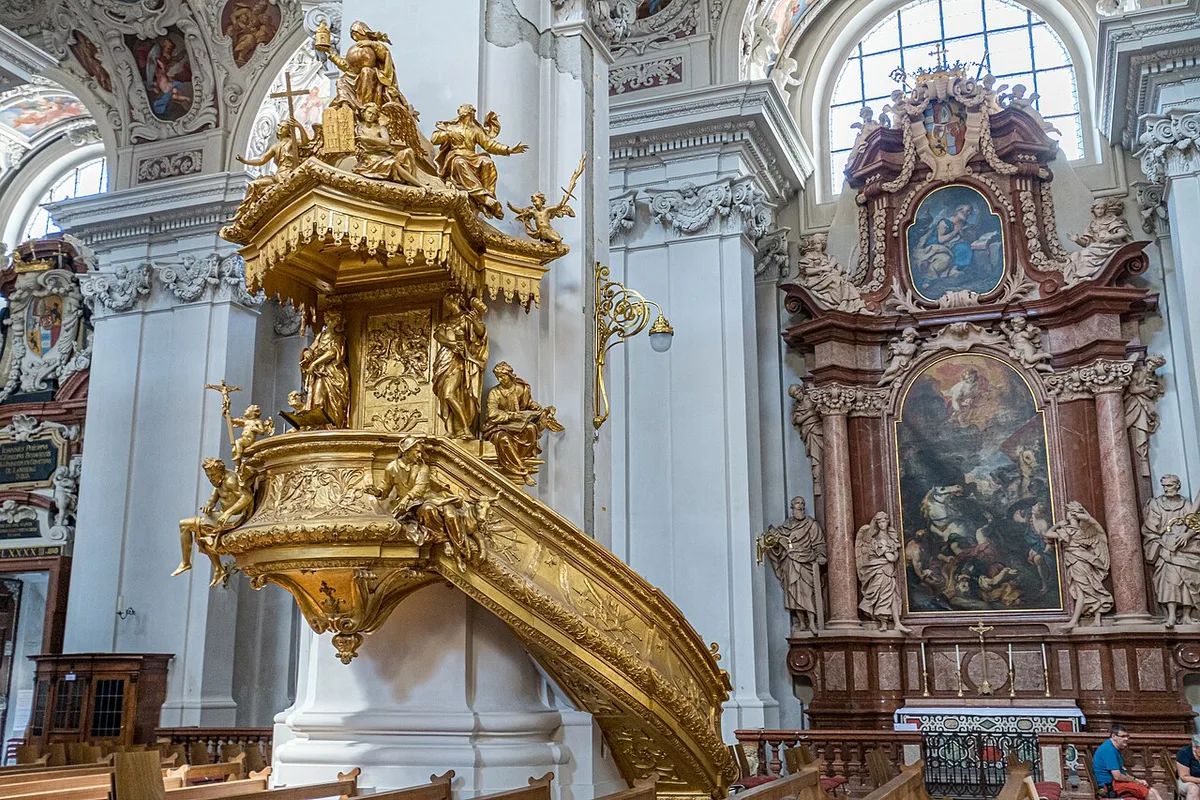
The gilded pulpit, made in Vienna in 1726, is a showpiece of the interior. Ten side altars line the nave, their altarpieces painted by notable German artists of the period. Josef Henselmann's modern high altar, depicting the stoning of St. Stephen, was created in 1952 and stands before the former Gothic window facade; he also made the people's altar in 1961.
Passau Tourism highlights the modern and monumental figurine high altar depicting the stoning of the cathedral's patron, positioned in front of the former Gothic window facade. The contrast between the 17th-century shell and the mid-20th-century altar is one of the building's more interesting tensions. Take a moment to compare the Gothic choir's proportions with the baroque nave.
The Organ as Architecture, Not Just Music
The organ is not a single instrument in one loft. Passau Tourism describes five spatially separated installations: the main organ at the main entrance, the epistle and gospel organs on the west galleries of the aisles, the choir organ at the chancel's entrance, and the Fernorgel in the attic. All five can be played together from one main key desk.
The Fernorgel is the most unusual. It sits directly above the Heiliggeist-Loch, a sound outlet installed within an illustration of the Holy Spirit in the nave's middle fresco, so its sound reaches the church through that opening rather than a visible facade. The largest pipe is over eleven metres long and weighs 306 kilogrammes, producing around 16 vibrations per second; the smallest pipes are six millimetres long.
With 17,974 pipes and 233 registers, the organ is described by Passau Tourism as the largest Catholic church organ in the world and the largest organ in Europe, though by pipe count alone it ranks fifth globally. The baroque casing of the main organ dates to 1731, and the epistle and gospel casings to 1715. Passau's organ-building firm Eisenbarth redesigned the instrument between 1978 and 1981 and remains responsible for its maintenance.
One important caveat for visitors: since 2023, the organ is being restored section by section and does not sound in its full extent at concerts. If hearing the complete instrument is your priority, check the current state of the restoration and the concert schedule before planning around it. Do not assume a full-organ experience on any given day.
Free Entry vs. the Separately Ticketed Treasury
The nave of the cathedral is free to enter, according to Passau Tourism. There is no general admission charge to walk in, look around and sit during the cathedral's published opening hours. This makes it one of the most accessible major sights in Passau for any budget.
The Domschatz treasury museum, by contrast, is a separately ticketed area. The cathedral's free entry does not cover the treasury or any other separately ticketed collection. Do not assume one ticket covers both; check the museum's own page for current admission details before you go.
This distinction matters when you are planning both time and budget. If you want to see the treasury, plan it as a separate stop with its own hours and admission, and verify those details directly with the operator. The cathedral's visitor information page is the right starting point for what is and is not included in free entry.
Opening Hours and Timing Your Visit
Passau Tourism publishes seasonal opening hours: April to October daily from 6:30 to 19:00, and November to March daily from 6:30 to 18:00. The cathedral is closed during organ concerts from 10:45 to 11:20. That mid-morning closure is easy to miss, so if you plan a late-morning visit, check whether a concert is scheduled that day.
Early morning is often the quietest time to see the interior, since the cathedral opens at 6:30 year-round. If you want to attend an organ concert, the Diocesan music office publishes the dates and prices; check there rather than relying on a general sightseeing page. As an active church, the cathedral may also be closed or partially restricted during services, so a quick check before you travel is worthwhile.
Accessibility and Entrance Choices
Passau Tourism notes that the cathedral has limited accessibility inside, with small thresholds at the main entrance. A barrier-free entrance is available at Steinweg with a mobile ramp. There are two public disabled parking spaces at the cathedral square in front of Domplatz 11, and a public handicapped lavatory nearby at Zengergasse, opened with a Euro key.
An induction loop is available, and audio guides are offered for guided tours. If you have specific access needs, contacting the cathedral or the tourist information office in advance is the most reliable way to confirm what will be available on your date. Do not assume the building is fully barrier-free beyond the Steinweg entrance and the features listed.
A Suggested Time Allowance
As a suggestion rather than an official recommendation, allow roughly an hour for the building itself. That is enough to walk the nave, look at the frescoes and side altars, and spend time with the organ and high altar without rushing. If you add the separately ticketed treasury or attend a concert, budget longer.
Your actual time will depend on whether a service or concert is in progress, how much you want to read, and whether you linger at the organ casing or the Gothic choir. The cathedral has no published official sightseeing duration.
Fitting the Cathedral into a Passau Day
Domplatz is a natural starting point for exploring the Altstadt. From the cathedral square, you can walk down to the river confluence viewpoints where the Danube, Inn and Ilz meet, or head toward the old town hall and its towers. The cathedral's elevated position means the walk back up involves some incline, so plan your route accordingly.
If you have time for a second major sight, the Veste Oberhaus fortress across the river offers panoramic views back toward the cathedral and the three rivers. Combining the cathedral with a walk along the riverbanks gives you both the interior and the cityscape. For a longer stay, the Passau landmarks hub lists further museums, galleries and guided tours.
Plan Your Visit
St. Stephen's Cathedral rewards a visit at any time of year, but the experience changes with the season and the schedule. Check the seasonal opening hours and the daily concert closure window before you set out, and confirm current details on the cathedral's official pages. The nave is free, the treasury is separate, and the organ's restoration means its full sound is not guaranteed.
Whether you have an hour or a full afternoon, the cathedral's position at the highest point of the Altstadt makes it an anchor for any walk through the old town. For a deeper Passau itinerary that combines the cathedral with other landmarks, the city guides and itineraries hub helps you sequence your day.
Frequently Asked Questions
Is St. Stephen's Cathedral in Passau free to enter?
Yes, the nave of the cathedral is free to enter according to Passau Tourism. There is no general admission charge to walk in during the published opening hours. The Domschatz treasury museum is a separately ticketed area, so do not assume one ticket covers both. Check the museum's own page for current admission details.
When can I hear the world's largest cathedral organ?
Organ concerts are scheduled by the Diocesan music office, which publishes the dates and prices. However, since 2023 the organ is being restored section by section and does not sound in its full extent at concerts. Check the Diocesan music office for current dates and the restoration status before planning around a concert.
How long should I spend at St. Stephen's Cathedral Passau?
As a suggestion rather than an official recommendation, allow about an hour for the building itself. That covers the nave, frescoes, side altars and the organ and high altar without rushing. If you add the separately ticketed treasury or attend a concert, budget more time.


