

Passau packs an unusual amount into a small area: baroque lanes, riverfront squares and a cathedral with the biggest cathedral organ in the world all sit within a tight, walkable old town. That compactness is why a two-day visit works so well. Most headline sights are within easy walking distance of each other, so the first day needs almost no transport planning. Budget a suggested 60 to 90 minutes for the cathedral on a first visit; that is our own pacing note, not an official figure.
One practical note before you commit: many streets are cobbled and uneven, some lanes are steep and steps lead down to the Inn river. Flat, comfortable shoes matter more here than in most German cities, especially if you plan to hike any of the surrounding hills. If you have mobility needs, the tourist office publishes a downloadable map of barrier-free routes and facilities for wheelchair users. Further visitor details appear in Passau Tourism | www.tourism.passau.de/en | Passau Tourism.
The plan below splits the visit into a walkable old-town day and a second day that earns its own loop, because the two halves of Passau pull in different directions. Treat our timing blocks as suggestions for pacing, not official guidance, and confirm the volatile details before you travel.
When to Go and How the Two Days Should Shift
Passau works year-round, but the main season runs from spring through fall, and the shoulder months are often the more comfortable choice for walking. If you prefer cooler temperatures, March to May and September onwards are the sweet spots, and you can match the trip to spring flowers or autumn colour. Expect occasional rainfall whenever you come, since the local vineyards depend on it, but showers here tend to pass quickly.
The sensible planning move is not to cancel a day but to swap the order of your two days. If the morning looks wet, put the indoor-heavy cathedral and museum blocks first and save the riverbank walk for later. A flexible two-day plan is far more useful than an hour-by-hour one, and it also lets you react if a museum or tower turns out to be on a shorter season than you expected.
Day 1 Morning: St. Stephen's Cathedral and the Organ
Start at the top of the old town, where the cathedral sits at its highest point. The building you see is the baroque rebuild by Italian architects Carlo Lurago and Giovanni Battista Carlone after the fire of 1662, and it is considered the largest baroque church interior north of the Alps and the most important Italian-style baroque church in Germany. Inside hangs the biggest cathedral organ in the world, with 17,974 pipes and 233 registers across five separate organ works, and the cathedral is open April to October daily from 6:30 a.m. to 7 p.m., and November to March daily from 6:30 a.m. to 6 p.m. For wider planning, see One Day in Passau. Further visitor details appear in St. Stephen's Cathedral Passau | Passau Tourism.
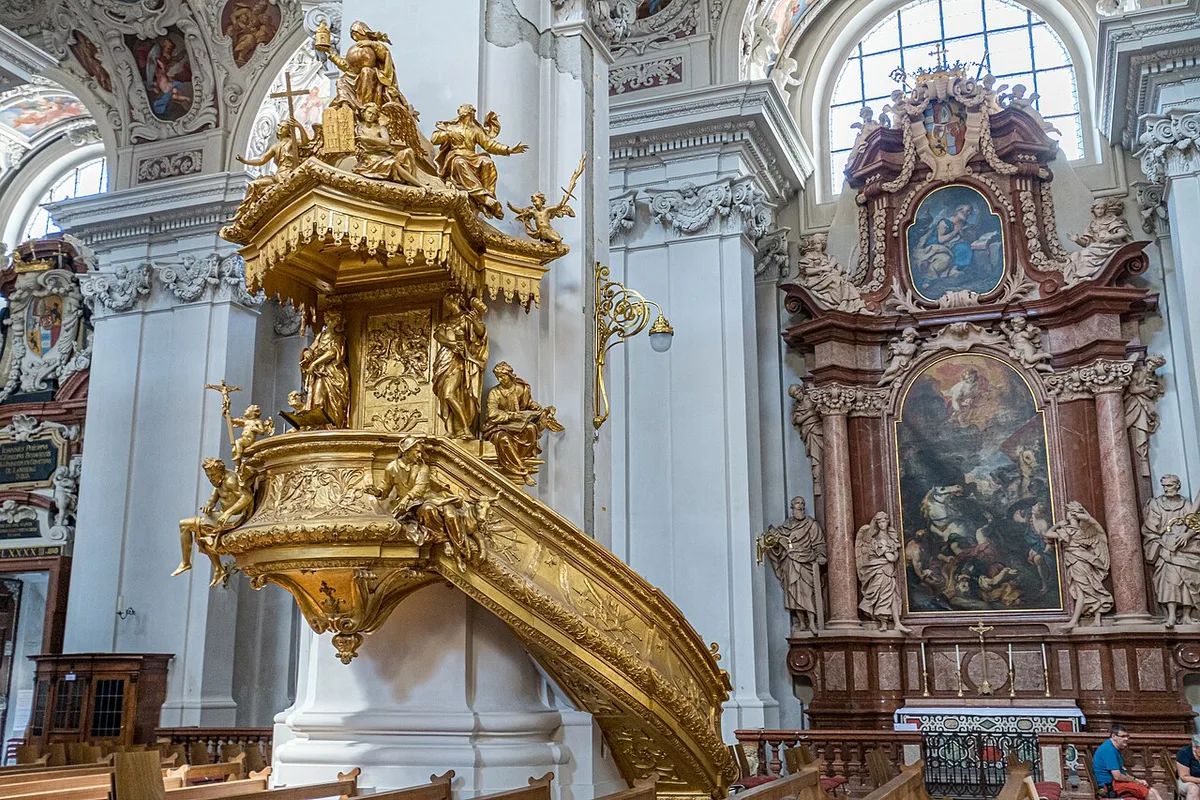
One status detail changes expectations: since 2023 the organ has been restored section by section, so concerts do not present it at full extent, and parts of the church can be behind scaffolding while work continues. The cathedral tourism source states this plainly, so check the diocese's cathedral music pages for current progress before you build a whole morning around the instrument.
Entry to the cathedral itself is free; you pay only if you attend a concert. For a wider look at which Passau collections charge separately and which are covered by sightseeing passes, see the guide to the best museums in Passau worth visiting before you commit to any combination ticket.
Day 1 Midday: The Noon Recital as a Fixed Anchor
The noon organ recital is the one fixed point that reshapes the middle of Day 1. On working days from May to October the cathedral hosts a midday concert, and the cathedral closes briefly during it, so you cannot wander in at will during that window. The tourism source lists the cathedral as closed during organ concerts from 10:45 a.m. to 11:20 a.m., which is worth noting precisely because it is the kind of detail that catches people out.
Because the noon slot falls inside the traditional lunch hour, smart visitors eat either early or late rather than queueing at exactly twelve. If you are not attending the recital, use the closure window to sit in a Domplatz café, which is a deliberate pause rather than a wasted hour. Keep the pause short in summer; the afternoon block is the longer walk.
Day 1 Afternoon: Town Hall, the Glockenspiel and Höllgasse
Walk downhill to the waterfront and the Old Town Hall, built in a highly decorative Venetian style and conveniently placed next to the river. The tourist office sits on the ground floor, which makes this the obvious place to pick up maps, the barrier-free route plan and the PassauRegioCard if you want discounted museum admissions. Marks on the building record the city's flood history, including the 1954 flood, when water levels rose to around 40 feet.
The town hall's glockenspiel is one of the largest in Bavaria, and it comes to life at set daytime hours with chimes and moving figures, so time your arrival around one of those slots if the mechanism interests you. Check the posted schedule on site rather than relying on a plan written months earlier, since the timing is the kind of detail that changes. From there, drift into the lanes.
Höllgasse is the street most people remember: crooked, cobbled and lined with medieval houses that appear to lean inward, and now a hub for painters, jewellers and craftspeople at work. Its name translates literally as Hell Street, a nod to how often the Danube has flooded it. Walk it slowly once, without a shopping goal, and then let the surrounding lanes take you where they will.
Day 1 Late Afternoon and Evening: Residenzplatz and Dinner
Wind down on Residenzplatz, the baroque square with grand facades and the Wittelsbach Fountain, built in 1903 to mark a centenary of Passau's place in Bavaria. From there it is a short step to the waterfront promenade, where boats come and go against the backdrop of the fortress on the hill. This is the lowest-effort hour of the day and deliberately so.
For dinner, expect a German-Austrian menu rather than anything sharply regional: Wiener schnitzel, spätzle with a sauce, roast pork, sausages and bread dumplings all show up regularly, and the city's position near the Austrian border explains the mix. If you head to a beer garden, note that the standard pour is the one-litre Mass, so a halbe may be the wiser first order. Bavaria brews have a long local history here, with several breweries operating in the city. Further visitor details appear in Insider’s Guide to Passau, Germany | Celebrity Cruises.
Day 2 Morning: Fortress, Shuttle and What the Ticket Covers
Day 2 starts with a directional decision rather than a list. Veste Oberhaus, the prince-bishops' stronghold above the city, is one of the largest surviving castle complexes in Europe, and the Oberhausmuseum inside it covers medieval life, Passau's trading history and a set of specialist collections including the Bohemian Forest Museum, the Historical Apothecary and a Fire Museum. These are separate exhibitions under one roof, not one ticket for every museum in Passau.
Know the accessibility shape of the site before you commit: the castle complex itself is not accessible for the disabled, though an elevator reaches the New Rampart viewpoint and the outer and inner baileys. The observation tower, exhibition rooms, St George's Chapel and the Linde Battery viewpoint have no disabled access, and there is no wheelchair-accessible toilet inside the castle. The museum's own listing notes that the shuttle bus and public buses are unsuitable for wheelchair users because of the high entry.
If you want the shuttle, the operator lists it as running according to museum opening times, daily on the half hour from Town Hall Square, with a museum entrance discount when you show your bus ticket. Confirm the current timetable before relying on it, and treat it as a time-saver rather than a given. The museum and the observation tower keep different seasons, so never assume one calendar covers both.
Day 2 Midday: The Inn Side and Mariahilf's 321 Steps
The alternative to the fortress is to cross to the Inn bank and climb to the Mariahilf pilgrimage church, a baroque complex whose covered stairway of 321 steps starts at Neutorgraben and is lined with votive tablets. The official tourism page describes the climb on the knees as a tradition and saying rather than an official requirement, so nobody is obliged to prove anything. The effort is rewarded with what is often described as the best view back at the so-called Italian side of Passau.
Balance the climb against what is actually inside: the church interior is simply decorated, with a magnificent gold high altar as the focal point, so the stairway and the viewpoint are the real draw. The venerated image at the altar is a copy of a painting by Lucas Cranach, made before the original left Passau. Access is limited for wheelchairs, but there is disabled parking in the courtyard and a public accessible lavatory at the church. The church is generally open daily from 7 a.m. to 8 p.m., according to the official tourism listing. Further visitor details appear in Pilgrimage Church "Mariahilf" in Passau | Passau Tourism.
Do not try to stack the fortress and the Mariahilf climb into a single morning. Each one has its own approach and its own hill, and the point of a two-day trip is that you can give each half of the city its own weather window. If time is short, pick the one whose view you care about more and treat the other as optional.
Day 2 Afternoon, Option A: A Danube River Cruise
If your legs need a break, a Danube boat cruise is the seated alternative to more walking. The Passau tourist board lists boat cruises and round trips among its organised activities, and these typically run as short loops rather than full-day passages. Book through the operator or the tourist office rather than assuming a departure from signs on the quay. Further visitor details appear in Passau Tourism | www.tourism.passau.de/en | Passau Tourism.
The trade-off is obvious: you trade ground covered for perspective gained. A river-level view explains the city's geography in a way no hillside panorama quite does, especially the way the old town sits on its narrow tongue of land. It also removes weather risk from the afternoon, which matters in a region known for quick showers.
Day 2 Afternoon, Option B: The Danube Cycle Path and the Ilz
Passau sits on the Danube Cycle Path, which is flat, scenic and well marked along the river, and a day trip gives plenty of time to ride a section without committing to a long stage. The greener and quieter alternative is a gentle walk along the Ilz, where herons and other water birds are regularly seen. Both options are easier on the knees than the fortress or the stairway.
Behind Veste Oberhaus the Donauleiten nature reserve runs from Passau towards Jochenstein, with trails through pine and oak forest towards the Ilz valley. That is a half-day undertaking at minimum, so treat it as the more committed version of Option B. If you want a shorter afternoon, the riverside promenade is not a compromise; it is simply a different scale.
Day 2 Late Afternoon: Dreiflüsseeck and the Schaiblingsturm
End the day at the Dreiflüsseeck, the eastern tip of the old town where the three rivers meet, walking the Inn bank past the striking Schaiblingsturm tower on the way. The Danube arrives from the west, the Inn from the south and the Ilz from the north, converging and continuing east as the Bavarian Danube. The confluence point is free to visit and needs no planning beyond timing it before dusk.
One reality check: the colour separation between the rivers is not guaranteed theatre. It varies with water levels, rainfall and season, and photographs are often more dramatic than the naked eye on the day. Go for the geography and the light, not for a guaranteed colour line.
Day 2 Evening: A Short Final Meal Before the Train
On the last evening, eat close to where you are staying rather than crossing the city for a specific address. The old town and the waterfront both have dense clusters of restaurants, cafés and beer gardens, and a shorter walk back is worth more than a slightly better menu. This is also the moment to buy any edible souvenirs, since Passau has a long chocolate-making tradition.
Build the evening around your onward departure rather than the other way round. If you are leaving early the next morning, keep the meal short and skip the second litre. A two-day trip that ends rested is a better return on the plan than one that ends at a station platform.
Accessibility and Getting Around Without a Car
Passau rewards walkers, and almost all headline sights sit within strolling distance of each other. The genuine constraints are the cobblestones, the steeper lanes and the steps leading down to the Inn, which appear on some guided walking routes. Comfortable flat shoes are not a stylistic choice here, they are the difference between a pleasant day and a painful one.
For wheelchair users the picture is mixed rather than hopeless. The tourist office produces a downloadable barrier-free routes and facilities map, the cathedral has a barrier-free entrance side with a mobile ramp, and the fortress has an elevator to key viewpoints even though much of it does not. The key planning question is which specific sights you want, because accessibility varies building by building.
What to Skip or Defer If You Only Have a Day and a Half
With less than two full days, the fortress versus Mariahilf decision becomes mandatory rather than optional. Choose the fortress if you want the museum and the panorama from above, and Mariahilf if you want the stairway and a view of the old town from across the water. Trying to do both is the most common way to finish a short Passau trip exhausted and behind schedule.
The second thing to cut is any second church interior. Passau has a remarkable number of them, but they blur together if you visit four in one afternoon, and the cathedral is the one with the true stand-out feature. If you have an extra day beyond two, spend it outside the city rather than adding a third loop through the old town; day trips from Passau are an easier win than a repeat walk.
If the trip stretches to three days, the third day is best used for a slower pace rather than more sights. Our 3 days in Passau itinerary shows how that extra day changes shape. If you are shortening instead, the one day in Passau itinerary covers the essential loop.
Plan Your Visit
Two days in Passau work because the city is compact on the first day and offers real choice on the second. Spend day one entirely on foot through the old town, anchoring the morning around the cathedral and adjusting lunch to the noon concert, then let the afternoon drift through the town hall lanes and Höllgasse. Day two is the decision day: fortress heights or Inn-side climb, river cruise or riverbank walk.
Before you travel, confirm the pieces that actually change: the cathedral organ concert pattern and restoration progress, the fortress museum and observation tower seasons, the shuttle timetable, and the opening hours of Mariahilf. The tourist office and the diocese publish all of these directly, and they are more reliable than a plan written in advance. Everything else in Passau you can decide on the day.
Frequently Asked Questions
Is two days enough for Passau?
Yes, two days is a sensible length for Passau because the old town is compact and most headline sights sit within walking distance of each other. One day covers the cathedral, town hall, Höllgasse and the riverfront comfortably. The second day is best spent on one of the hillside options, either the fortress or the Mariahilf pilgrimage church, plus a riverbank walk or a boat trip. Trying to add a third major sight to day two tends to be the point where the plan stops being enjoyable.
Can you visit Veste Oberhaus and Mariahilf on the same day?
It is possible in theory but rarely a good idea. Each involves its own climb, and the Mariahilf approach is a covered stairway of 321 steps from Neutorgraben, while the fortress sits on the hill across the river. Doing both back to back leaves little time for the museum interiors or a proper rest. If you only have one day for hills, pick the one whose viewpoint appeals more and keep the other for a future trip.
What should you do in Passau if it rains?
Rain is common here and showers usually pass quickly, so the best response is to reorder rather than cancel. Move the cathedral, the Oberhausmuseum and the town hall to the wet hours and save the Inn-side walk, the confluence viewpoint and the riverbank promenade for the dry window. Note that the cathedral can close briefly around the noon organ concert, so check the day's pattern if you are sheltering there. Indoor options cluster tightly enough that you rarely have to walk far between them.
Is Passau walkable without a car?
Yes, Passau is a very walkable city and a car is a hindrance in the old town rather than a help. The trade-offs are the cobblestones, the steeper lanes and the steps down to the Inn, which favour flat, comfortable shoes. A shuttle bus connects Town Hall Square with the fortress according to museum opening times, but the museum listing notes that it is not suitable for wheelchair users because of the high entry. If you have mobility needs, get the tourist office's barrier-free route map before you arrive.
Do you need to book the cathedral organ concert in advance?
For the cathedral organ concerts, seat reservations are not the standard model and tickets have typically been sold at the door rather than by advance booking. Schedules shift seasonally, so check the cathedral music calendar published by the diocese before you plan a day around a specific performance. Also factor in that the organ has been restored section by section since 2023 and does not sound at full extent at concerts, which is worth knowing before you build a trip around hearing it.
Sources
- Insider’s Guide to Passau, Germany | Celebrity Cruises
- Pilgrimage Church "Mariahilf" in Passau | Passau Tourism
- Museum Veste Oberhaus in Passau | Passau Tourism
- Passau in Bavaria, Germany: 10 Sights and Highlights
- Passau Tourism | www.tourism.passau.de/en | Passau Tourism
- St. Stephen's Cathedral Passau | Passau Tourism


