

Passau sits where the Danube, Inn and Ilz meet, and the old town occupies a narrow peninsula between two of them. That geography is why a single day works here: the cathedral, the lanes, the confluence viewpoint and the fortress all fall within a walkable core. A suggested full-day route of roughly three to four hours of walking plus stops is enough for the essential circuit. Passau: Itineraries and City Travel Guides maps the wider city, and this plan condenses it into one practical loop.
Two fixed points shape the day: a reported midday organ concert in the cathedral and the climb or shuttle up to Veste Oberhaus. Everything else is flexible and can be reordered around those anchors. Treat both as timing decisions to confirm with the organisers rather than guarantees.
This route assumes a full day on foot at a normal pace. If you start after midday, skip the fortress interiors and keep the old town and confluence, which is the honest trade-off. The next sections run in walking order from the Rathaus to the fortress.
Why Passau Works as a One-Day Stop
Passau's historic centre is compact enough to cross in minutes, which removes the usual transport planning from a one-day visit. The three rivers frame the peninsula and give the city its nickname, Dreiflüssestadt. Passau: Landmark Visitor Guides collects the individual sights if you want to branch out after the core loop.
The realistic scope for one day is the Altstadt, the cathedral, the confluence at the Dreiflüsseeck and either the fortress exterior or its paid museum complex. Trying to add several museums usually means rushing the lanes and the riverfront. Decide early whether your priority is views or collections.
That said, a compressed version leaves out real things: the Mariahilf pilgrimage church, the Roman fort museum and the Inn's south bank. Accepting those cuts is what makes the day relaxed instead of frantic. You can always return with a Passau old town walk focused only on the lanes and courtyards.
Start in the Altstadt: Rathaus and the Flood Lines
Begin at the Rathaus, the town hall whose façade combines Gothic, Baroque and Rococo layers and carries a clock tower with a carillon. The exterior is free to look at, and it makes an easy orientation point near the river. From here you can read the city's history on its walls before walking deeper into the lanes.
The high-water marks on the building record the floods that have hit Passau when the rivers rose together. One visitor account reports that the 2013 flood reached 12.85 metres, or about 42.2 feet, which it describes as among the worst in the city's history. That figure is a reported historical measurement rather than an official current gauge, so read the markings as history and check local displays for any present-day readings.
Those repeated floods also explain why Passau has a visible artist community. Ground-floor flats were cheap and easy to clear when water threatened, so artists moved in. It is worth knowing this before you walk Höllgasse, because the galleries there are not a themed quarter but a practical response to the river.
Give the Rathaus area fifteen to twenty minutes, then continue toward the cathedral. If the carillon happens to play while you are there, treat it as a bonus rather than something to schedule around, since melodies are not published as a fixed visitor timetable.
St Stephen's Cathedral and the Organ Timing Question
St. Stephen's Cathedral dominates the old town with its Baroque interior and its celebrated organ. A visitor guide describes the instrument as the largest cathedral organ outside the United States and the second-largest in the world. The St. Stephen's Cathedral Passau visitor guide covers the building's art and architecture in more depth than a single-day stop allows.
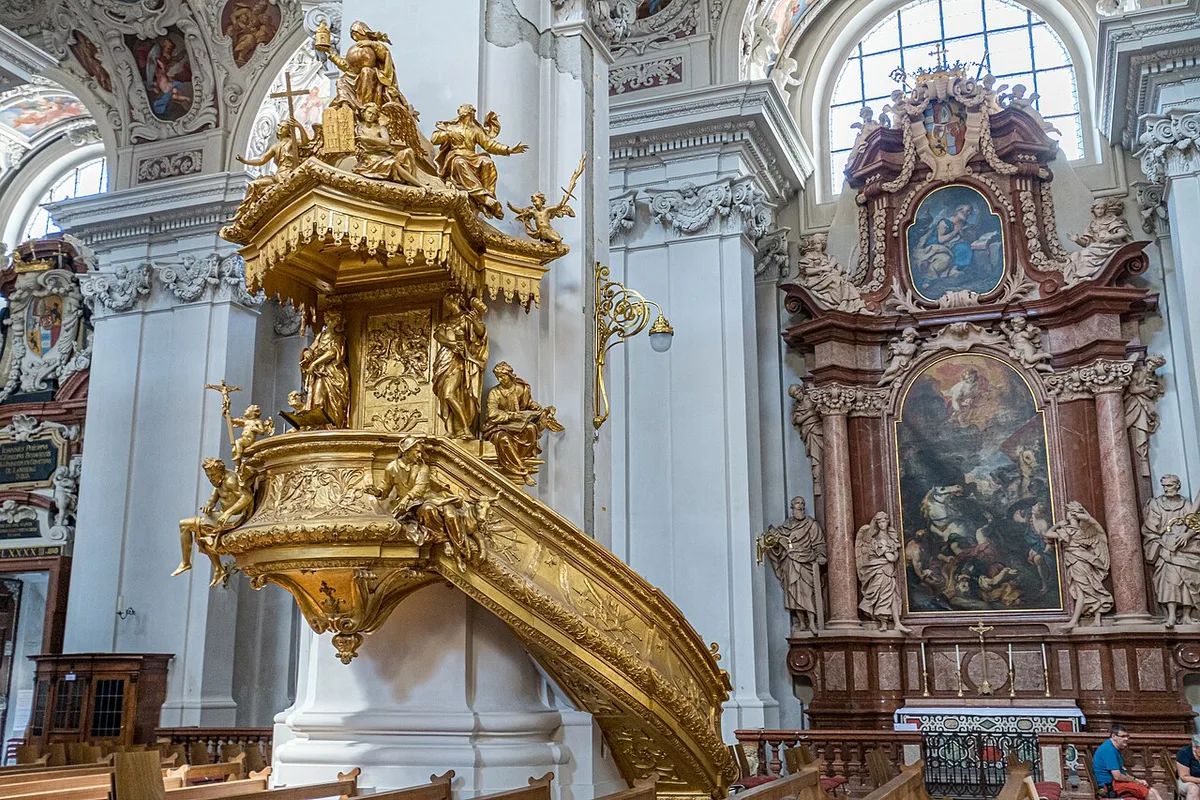
One traveller's report describes half-hour midday concerts running daily except Sundays and religious holidays, between May and October. That is a reported pattern, not a confirmed programme, and the source audit specifically flags cathedral organ days, times, season and admission as things to verify. Before you build your day around a concert, check the current schedule and any ticket requirement with the cathedral or the city tourist office.
Step inside even if the timing does not work, because the interior and the frescoed domes justify a look regardless of the organ. Allow around thirty minutes for the cathedral itself, more if a concert is running. If a concert is your priority, protect that slot and let the fortress flex around it.
Midday Eating Around the Old Town
For lunch, the Höllgasse area gives you the artist quarter and food in one stop. Königlich Bayrisch is a traditional Bavarian restaurant on this street with a beer garden that looks across the river and up toward the fortress. The distinction matters: here you look up at Veste Oberhaus, whereas the fortress terrace looks down over the city.
The fortress itself has a restaurant, Das Oberhaus, described as a traditional tavern with a terrace inside the walls and a view over the skyline. Choosing between the two is a genuine trade-off rather than a quality judgement. Pick the river-level beer garden if you want to see the fortress, and the fortress terrace if you want the panorama of the old town.
Neither restaurant publishes hours in the sources checked here, so confirm opening times and closing days before you walk there. If you are visiting around a public holiday, expect closures to matter, as one account of a Corpus Christi visit found much of the town shut. In that case, a bakery or a hotel restaurant is a safer midday bet.
Walking the Lanes: Theresienstrasse, Residenzplatz and Höllgasse
The Altstadt rewards slow wandering more than checklist ticking. Theresienstrasse is a long paved street lined with cafés and small shops, with the tower of St Mathäus church as a landmark. Residenzplatz, the main square, sits in front of the former prince-bishops' residence and holds the Wittelsbacherbrunnen fountain. Passau Altstadt is small enough that you will cross both without a map.
From Residenzplatz, work your way to Höllgasse, also called Artist's Alley, where painted cobblestones lead past galleries and artisan shops. The street sits at the edge of the old town near the water, which is exactly why its ground-floor spaces became attractive to artists. The Passau Glass Museum is at the eastern entrance to Höllgasse, so you can combine the lane with a museum visit if glass interests you.
The glass museum is a separate ticketed attraction and holds tens of thousands of pieces spanning several centuries, according to one visitor guide. It is not part of any fortress ticket, so treat it as an independent choice. If you only have one day, this is one of the more reasonable voluntary cuts.
Dreiflüsseeck and the Innkai
Walk to the Dreiflüsseeck, where the Danube, Inn and Ilz meet, and continue to the Ortspitze lookout at the tip of the point. The rivers carry different colours and densities, and one visitor found the effect subtler in person than in photographs. Go for the setting and the quiet rather than expecting a dramatic line in the water.
From there, the Innkai runs along the Inn toward the Marienbrücke and passes the medieval Schaiblingsturm, a thirteenth-century riverside tower. This is one of the nicest promenades in the city, but the path can be completely submerged when the Inn runs high. Check the water level before committing to the walk; if it is high, use the parallel streets instead and treat the flooded path as a photograph rather than a route.
The park and promenade near the Marienbrücke are also a good spot for a late-afternoon pause. The memorial for the victims of National Socialism stands along the Innpromenade and is worth a few quiet minutes. If you want a sunset view over the river, this stretch is the natural place to end the daylight hours.
Veste Oberhaus: Free Views Versus Paid Interiors
Veste Oberhaus is the hilltop fortress above the old town, originally built in the thirteenth century as a residence and stronghold for the prince-bishops of Passau. Today the complex holds a museum, a hostel, a restaurant and an open-air theatre. The Veste Oberhaus Passau fortress visitor guide explains what the individual attractions cover.
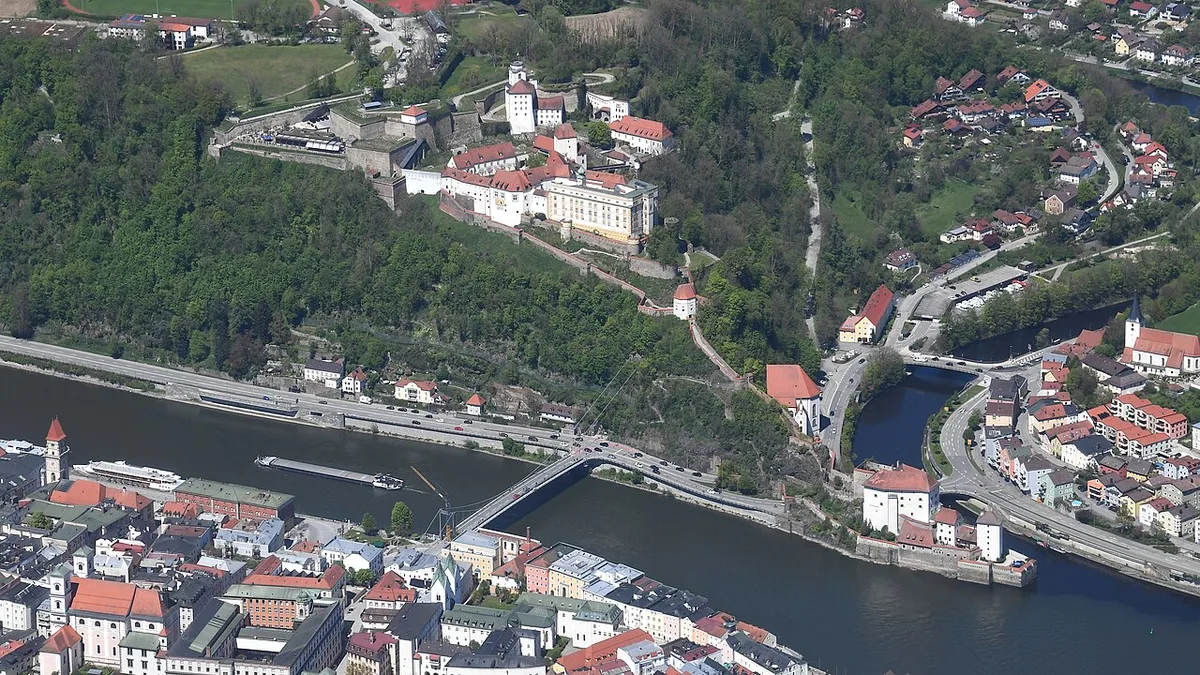
The key decision is free versus paid. The exterior and the viewpoints cost nothing, while the museum collections, exhibitions and any guided tours sit behind separate paid admission. One traveller advises skipping the interior if your time is limited, unless the Prince-Bishops and regional history genuinely interest you. Do not assume a single ticket covers every part of the complex; check the official site for what each ticket includes and what it costs.
You can reach the fortress on foot via a steep climb from the old town or by shuttle bus from the centre. Neither option has published schedules or walking times in the sources checked, so confirm the shuttle arrangements locally if you prefer not to climb. If you take the shuttle up, you can walk down through the lanes afterward.
Budget roughly an hour for the exterior and views, and considerably more if you add the museum. The restaurant terrace is a good place to end the afternoon if you skipped the beer garden at lunch. Pair the fortress with the cathedral and confluence and you have covered the three signature experiences of Passau.
Optional Swaps and Late-Start Cuts
If your pace is faster than expected, several smaller sights fit between the main stops. The Museum Moderner Kunst Wörlen covers modern and contemporary art, and the Römermuseum Kastell Boiotro traces the Roman fort that once guarded the Danube frontier. The Garten am Paulusbogen is a quiet garden near the former city gate with views toward the fortress and the river.
The Mariahilf Pilgrimage Church on the Inn's south bank is another option, reached by road or by a long covered stairway. It is a Rococo church with its own views back over the city, but it costs time and effort that a single day rarely has spare. If you are considering it, you are probably a candidate for a 3 days in Passau itinerary instead of a one-day sprint.
For a late start, cut the fortress interiors and any museum, keep the cathedral, the lanes and the confluence, and eat near Höllgasse. That version still delivers the essential Passau experience without rushing. If you enjoy comparing compact German city days, the one day in Dresden itinerary and the one day in Berlin itinerary show how other historic centres handle similar time pressure.
Plan Your Visit
A realistic one-day Passau plan runs Rathaus, cathedral, old town lanes, lunch near Höllgasse, the confluence and Innkai, then Veste Oberhaus for the late afternoon. Keep the reported midday organ concert and the fortress as your two anchors, and confirm both before you commit. Everything else can slide without ruining the day.
The main practical checks are the cathedral concert schedule, whether you want the fortress museum or only the views, and the water level on the Innkai path. None of these need booking far ahead, but all of them change how the day flows. Confirm them locally or with the city tourist office on the morning of your visit.
Frequently Asked Questions
Is one day enough to see Passau?
Yes, for the compact core. A single day covers the Altstadt, St Stephen's Cathedral, the Dreiflüsseeck and either the exterior or the interior of Veste Oberhaus. What it does not comfortably cover is the Mariahilf pilgrimage church, the Roman fort museum and the modern art museum at a relaxed pace. If those matter to you, plan a longer stay rather than sprinting.
What is the best walking order for Passau in one day?
Start at the Rathaus, continue to St Stephen's Cathedral, wander Theresienstrasse and Residenzplatz, then eat around Höllgasse. In the afternoon walk to the Dreiflüsseeck and along the Innkai, and finish at Veste Oberhaus for the views. This order keeps you moving downstream logically and puts the fortress climb at the end, when a rest and a view are most welcome.
Should you visit inside Veste Oberhaus or just the viewpoint?
The exterior and viewpoints are the part most one-day visitors come for, and the museum collections, exhibitions and tours are separate paid attractions. If you are short on time or not especially interested in the Prince-Bishops and regional history, the outside is enough. Check the official site for what each ticket includes before deciding.
Where should you eat in Passau with only one day?
Höllgasse has traditional Bavarian options including Königlich Bayrisch, whose beer garden looks up toward the fortress. The fortress itself has Das Oberhaus, with a terrace overlooking the city. The trade-off is the direction of the view: up at the fortress from the river, or down over the old town from the hill. Neither publishes opening hours in the sources checked, so confirm before you go, especially on public holidays.
Can you hear the organ in St Stephen's Cathedral on a day visit?
One traveller reports half-hour midday concerts on most days between May and October, excluding Sundays and religious holidays. That is a reported pattern rather than a confirmed programme, and it should not be treated as guaranteed. Check the current schedule with the cathedral or the city tourist office before planning your day around a concert.
Is the Innkai walk always possible?
No. The riverside footpath along the Inn can be completely submerged when the Inn runs high, according to a visitor guide. In normal conditions it is one of the loveliest walks in the city, linking the Dreiflüsseeck with the promenade near the Marienbrücke and the Schaiblingsturm. If water levels are high, use the parallel streets instead.


