

One detail shapes the whole plan: St Mary's Church holds an astronomical clock with an apostle rotation dating to 1472, and it is a working timepiece rather than a static exhibit, so timing your interior visit matters more than framing the shot. That single fact tells you how to structure a Rostock photo walk, because the city's best subjects divide into two groups: facades and streets you can photograph at any hour, and interiors that depend on doors being open.
Rostock's historic centre is compact enough to walk, and the waterfront sits at the northern edge of the same district, so one continuous route can cover gabled houses, brick Gothic churches, a busy shopping spine and harbor heritage. Treat the sequencing below as editorial suggestion, not an official trail; Rostock publishes visitor information through its tourist offices, but no designated photography path is described in that material.
Build the day around what you can control. As a rough planning figure, allow half a day for the old town and a second half-day if you add the harbor at a relaxed pace; that is an estimate you adjust once you see how long you linger, not an official timing. Public squares, streets and the waterfront promenade are open surfaces where you can photograph freely, while church interiors and any tower access depend on current arrangements.
Why Rostock Suits a Photo Walk
Rostock was a leading Hanseatic trading city, and the surviving architecture reflects that wealth in brick. Encircle Photos notes that the city's medieval landmarks, including monastic buildings, churches, fortified walls and city gates, largely date from the thirteenth century onward. For a photographer, that concentration means Gothic brick texture, stepped gables and carved detail recur within a short radius rather than being scattered across a modern sprawl.
The city is also a working port rather than a museum set-piece. German Sights describes Rostock as northern Germany's most important maritime city after Hamburg, combining Hanseatic heritage with the energy of a university town of around 16,000 students. German Sights also places the main urban centre roughly twelve kilometres south of the Baltic coast along the Warnow River, with Warnemünde at the river mouth. That geography gives you two distinct subject types in one municipality: quiet historic fabric and a functioning waterfront.
For a broader set of Rostock walks and city-level itineraries, including how the old town and waterfront connect, the Rostock city travel guide surface is the natural starting point.
Route Logic and Suggested Pacing
Sequence the walk by light type rather than by map efficiency. Brick facades, gables and carved stone read well in soft, even light, so the old town suits the earlier part of the day when streets are quieter and market activity is still building. Save the open harbor, with its cranes, masts and water reflections, for later when the light on the river is different and you are not carrying interior shots in your head.
A sensible order runs from the western pedestrian spine eastward into the market square, then to the churches, then down to the river. Start at Kröpeliner Tor at the western end of Kröpeliner Straße and walk the pedestrian street to University Square, continue to Neuer Markt, and only then move toward St Mary's and the Alter Markt area near St Peter's. The harbor follows naturally from there.
Treat any stated duration as a suggestion rather than an official figure. Photographers who work slowly at each facade spend far longer than casual walkers, and church interiors can absorb an hour on their own if the astronomical clock is on your list. Planning fewer stops well beats trying to tick off every name.
If the day needs to be split, put the old town on one half-day and the harbor plus eastern churches on another, which gives you a chance to return to a facade in different weather without abandoning the rest of the route. The dedicated Rostock harbor walk is useful if the waterfront rather than the old town is your priority.
Stop 1: Neuer Markt and the Gabled Houses
Neuer Markt is the heart of the historic centre, and its most photographed element is the row of six gabled houses numbered 11 to 16. Encircle Photos records that these houses were built across a span running from the Middle Ages into the nineteenth century and were rebuilt after heavy damage in the Second World War. Because they are public facades, you can work them at any hour without a ticket.
Within that row, the Rats Apotheke building at Neuer Markt 13 is the standout subject. The same source dates the Town Hall pharmacy's origins to 1260, which makes it a useful narrative anchor for a caption as well as a visual one. Look for the pharmacy lettering and the surrounding gable geometry as a tighter composition rather than trying to fit the whole row into one frame.
The Town Hall itself is an architectural contrast worth isolating. German Sights notes that the square is surrounded by colourfully restored merchants' houses and the distinctive pink town hall, and describes the baroque facade added in the eighteenth century as contrasting with the Gothic core, while the daily market continues the square's long trading tradition. Frame the facade straight-on for symmetry, then move off-axis to show how the baroque frontage sits against the older mass behind. Further visitor details appear in Rostock, Germany - travel information from German Sights.
Also on the square is the Sea Gull's Fountain, erected in 2001 with a gull on a long post and four water-god figures around it, according to Encircle Photos. It is a small, easy subject and a good foreground element when the square is busy, though on market days the stalls and crowds change your options considerably.
Stop 2: St Mary's Church and the Astronomical Clock
St Mary's Church is Rostock's most significant church, and its headline photographic subject is the astronomical clock of 1472. The Hanseatic League's tourism pages describe the church as a cross-shaped basilica with transept and nave of equal length, containing the astronomical clock with apostle rotation as well as a bronze baptismal font from 1290. Encircle Photos adds that the clock was restored in 1643, that the top half features a procession of apostles circling the figure of Christ daily at noon, and that the inner clockworks are original.
Interior light here is the real problem. Churches are dim, and hand-holding a long exposure in a crowded nave rarely works; a steady rest against a pew or a small tripod is the difference between a sharp clock and a smear. Set a high ISO rather than a slow shutter, and expect noise you can clean later.
Separate the church from ticketed collections in your planning. German Sights notes that the Cultural History Museum, housed in the former Holy Cross Monastery, holds the original astronomical clockwork from St Mary's Church alongside Hanseatic trade artefacts and ship models. That means the working clock you photograph in the church and the museum's mechanical collection are different visits with different access conditions, so do not assume one entry covers both.
Church interiors are active worship spaces. A private tour operator states that churches have limited opening hours and that during masses and special events only silent sightseeing is allowed. Check the parish's current arrangements before you travel and be prepared to photograph the exterior instead if the doors are shut for a service.
Stop 3: Kröpeliner Straße and University Square
Kröpeliner Straße is the pedestrian spine of the old town, running from Kröpeliner Tor toward Neuer Markt. Encircle Photos describes the street's brightly coloured, renovated row houses, many built by wealthy merchants in the fifteenth and sixteenth centuries, and notes that locals shorten the name to Kröpi. It is a good place for street-level detail: doorways, signage and the brick shoe sculpture outside a shoe shop that catches most photographers' eyes.
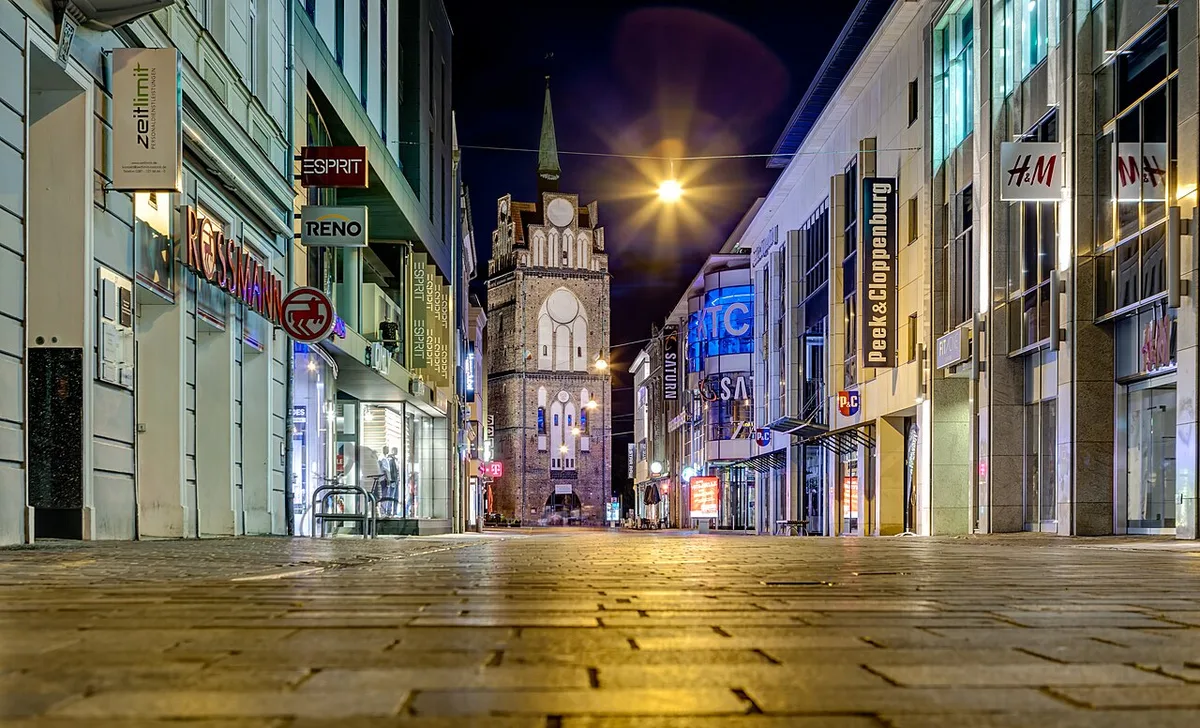
At the eastern end sits University Square, named for the university's main building. The Hanseatic League's tourism pages describe the square as taking its current name from that main building, long established since 1419, and note that the Fountain of Joy of Life has stood in the square's centre since 1980 and consists of twenty figures with eighteen large and small water jets. Further visitor details appear in City of Rostock Tourism.
Encircle Photos adds that the fountain sculptures were created by Jo Jastram and Reinhard Dietrich and that the university's neo-Renaissance main building carries the dates 1419, when the school was founded by Pope Martin V, and 1867. This square is where a wide lens earns its place: the fountain is broad and the university building needs distance, so step back toward the street and use the fountain figures as a foreground layer against the facade.
Stop 4: Kröpeliner Tor and the Surviving Defences
Kröpeliner Tor anchors the western end of the walk. Encircle Photos describes it as a brick Gothic gate built in 1270, expanded and restored several times since, and standing about 177 feet tall. During the Middle Ages Rostock was fortified by walls and more than twenty gates, so the surviving structures are the residue of a much larger system.
The Busch Tower is the other fragment worth seeking out, and the same source calls it all that remains of the original town defences. Reconstructed in 1825 on the foundation of an earlier tower, it sits behind the wall line near the Steintor area. It is a modest subject compared with the gate, so approach it as a detail shot of brick and roofline rather than a grand composition.
Steintor is the architectural outlier of the group. Encircle Photos records that it was built in 1577, is the only city gate in Rostock in the Dutch Renaissance style, is decorated with the city's coat of arms, and was reconstructed in the first half of the 1950s after wartime damage. Because it differs so sharply from the brick Gothic gates, it works well as a deliberate contrast frame in a sequence.
Stop 5: Petrikirche and the Alter Markt
St Peter's Church, or Petrikirche, is the route's one elevated viewpoint. German Sights describes it as an early fourteenth-century church whose 117-metre spire dominates the skyline, and states that the interior has Gothic vaults and is remarkably intact despite wartime damage. The same source also says the Petrikirche is in the Altstadt around a mile east of the modern city centre and advises wandering the cobbled streets of the Alter Markt neighbourhood, which it calls atmospheric.
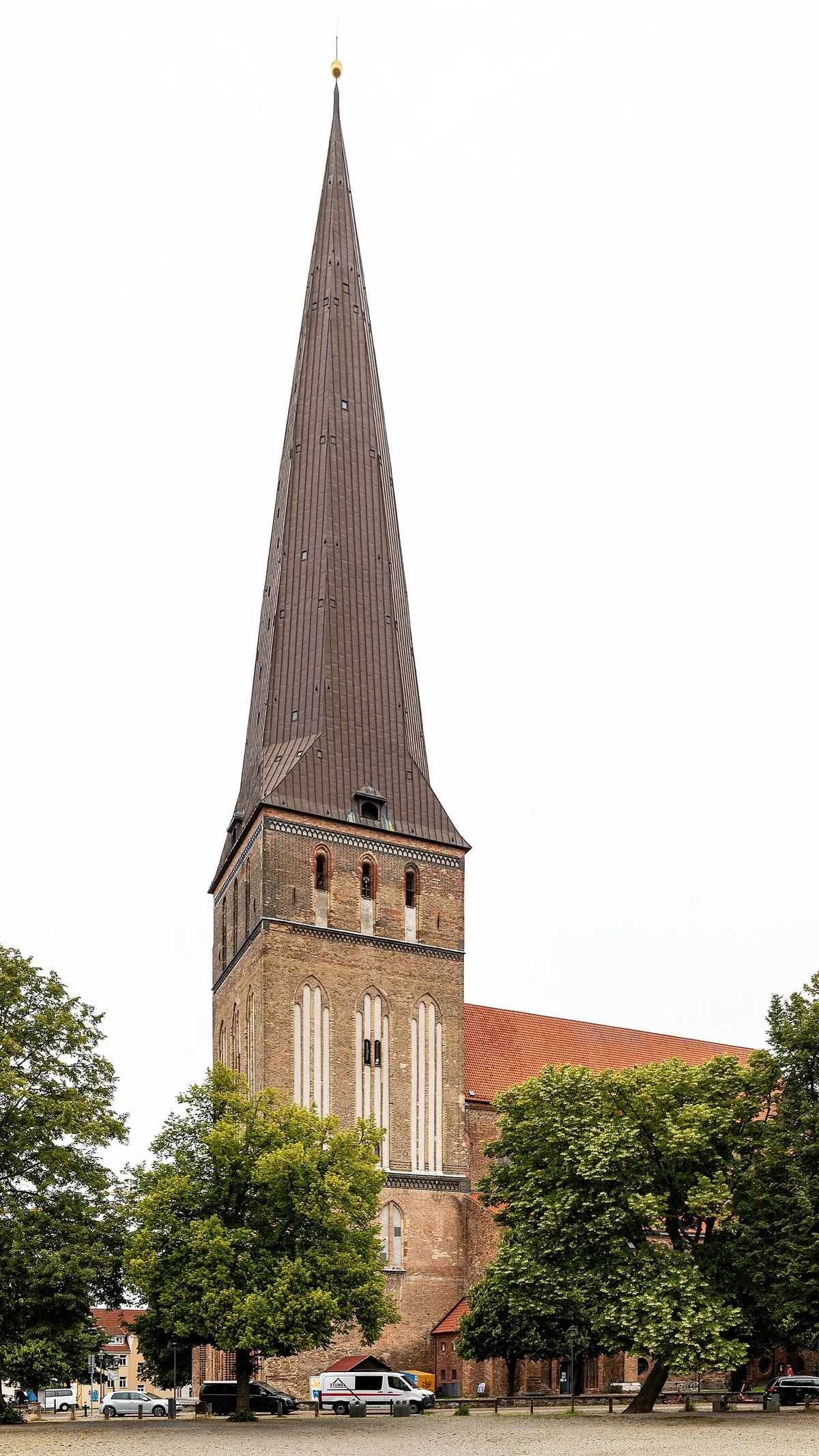
The tower and observation platform are a separate question from the church interior. German Sights explains that a lift takes visitors to a platform overlooking the harbour and medieval centre. Encircle Photos describes the same tower as a 380-foot spire with a lift beyond an observation deck of around 147 feet, while the Petrikirche's own association pages present a viewing platform with panoramic views in every direction. Because these details come from different sources, confirm current accessibility with the church before planning an ascent, and remember the platform and the church nave are different visits. Further visitor details appear in Petrikirche Rostock – der Förderverein der Petrikirche Rostock e.V..
Use any accessible platform for the overview shot that ties the whole walk together. From above you can show the relationship between the market square, the church spires and the river, which is exactly the geography that a ground-level route cannot express. If the tower is closed, the square itself still justifies the walk east.
Stop 6: The City Harbor on the Warnow
The city harbor on the Warnow is the route's industrial-heritage chapter. The Hanseatic League's tourism pages describe the harbor, with its museum and sailing harbour, as a popular promenade with restaurants, shops and large warehouses, note that all goods handling was concentrated here until the seaport opened in 1960, and highlight the wooden pedal crane from the eighteenth century and the bridge crane from the 1950s as witnesses to past handling technology.
These cranes suit a longer lens than the old town. Pedal crane and bridge crane are separate structures with space between them, and compressing that distance lets you layer lattice steel against masts and water. Reflections in the Warnow are an easy second subject when the harbor is calm.
Moorings change constantly, so treat any specific vessel as a bonus rather than a plan. Sailing ships, working boats and the occasional larger vessel all pass through, and the harbor's character is partly that it remains a functioning waterfront. Photograph what is there on the day rather than waiting for a particular ship.
Extending the Day to Warnemünde
Warnemünde is Rostock's seaside resort district at the mouth of the Warnow, and it is a different subject set entirely: lighthouse, canal, beach and piers rather than gables and cloisters. German Sights describes it as a former fishing village turned seaside resort with a 37-metre lighthouse, wide sandy beaches and rows of traditional captain's houses, and says the Old Stream canal lined with restaurants and historic fishing boats forms the picturesque centre of the district.
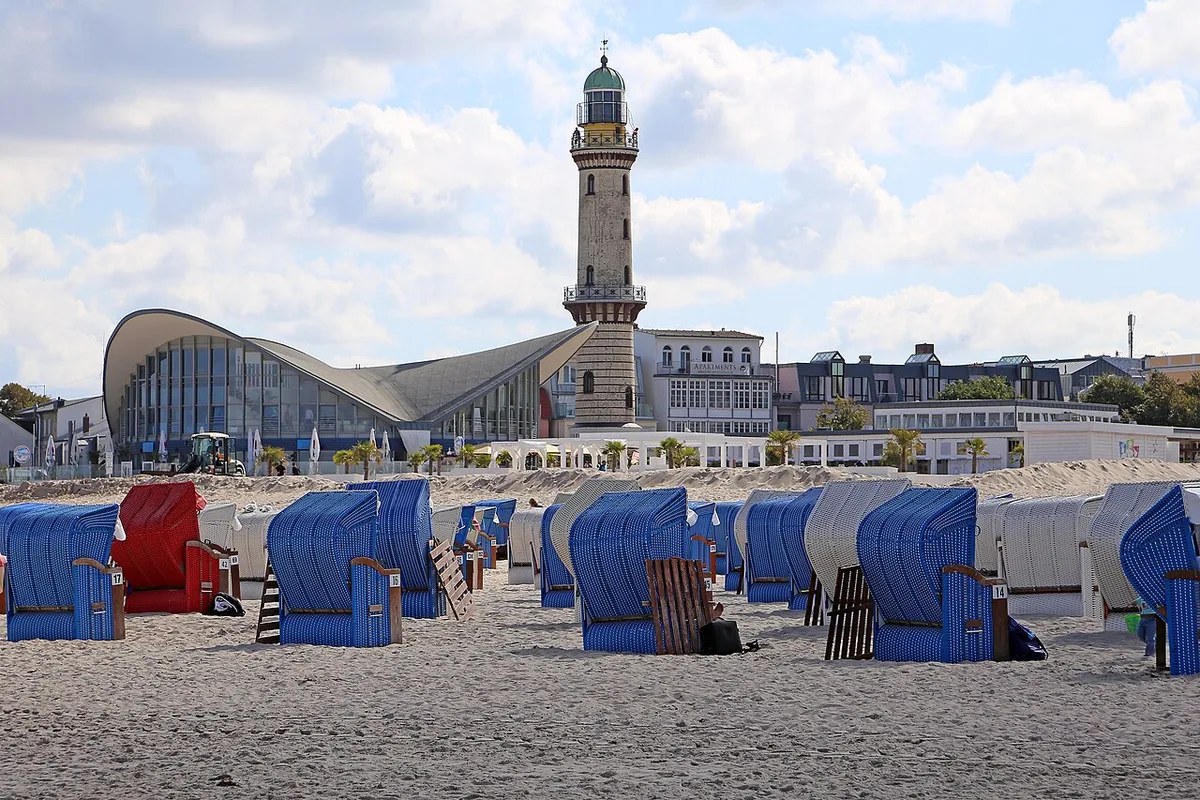
Treat Warnemünde as a second half-day, not an add-on to the old town walk. A cruise-port guide notes that the Old Stream canal connects to the larger Warnow River, that the area around the Warnemünde church and its tranquil square is called Kirchplatz, and that a walk from the cruise terminal reaches the lighthouse in around fifteen minutes. The canal's rhythm is slower, more horizontal, and much more exposed to wind than the city.
Weather at the coast does not follow the city. The same cruise-port guide advises visitors not to count on beach weather, warning that the Baltic in summer is often too chilly and windy for a proper beach day. That matters for photography as much as for swimming: sand, spray and lens changes in wind are practical problems, not just comfort ones, and the source also notes Warnemünde is visited by more than 180 ships annually, so expect the canal and lighthouse area to be busier when a large vessel is alongside.
Light and Weather Planning Without Fake Precision
Do not build your day around a promised golden hour. Published light and timing windows for photography are guesses dressed as data, and Baltic weather changes quickly enough to invalidate them before you leave your hotel. Instead, decide what each location needs and adapt when you see the sky. If sunset and viewpoints are your main interest rather than a brick-and-harbor route, Rostock's sunset viewpoint guide covers that angle separately.
Brick and carved stone benefit from flat, even light. Overcast conditions remove the hard shadows that break up a gable or a carved portal, which is why a grey morning in the old town is often more productive than a bright one. Save the markets and squares for when you want people in the frame rather than architecture alone.
The harbor and coast are the opposite case. Water, masts and steel read better with some directional light and some contrast, but wind at the coast is a genuine constraint rather than a stylistic one. City guidance for the region describes a maritime climate with mild winters, constant sea wind driving rapid weather changes, and above-average sunshine hours, updated in July 2026. Carry a cloth, keep lens changes short, and accept that some days will be about mood rather than clarity. Further visitor details appear in Willkommen in Rostock.
Check the forecast yourself on the morning of the walk and have a fallback. If the coast is unusable, the sheltered side streets and the church interiors absorb a bad-weather session far better than the exposed piers.
Crowds, Access and Quiet Alternatives
Neuer Markt changes character on market days. Encircle Photos records that a farmers market with produce, flowers and crafts runs on Saturdays on the square, which is good for colour and human interest but hard for clean architectural frames. If you want the gabled houses uncluttered, choose a different morning.
Churches set their own terms. The tour operator's note that churches have limited opening hours and allow only silent sightseeing during masses and special events is a reasonable summary of what to expect anywhere in the old town. Plan interiors as a flexible option and always have an outdoor alternative ready.
The quiet side streets repay wandering. The area around the Alter Markt and the lanes near St Nicholas give you brick detail and rooflines without the shopping-street traffic, and the Warnow riverside paths offer a calmer foreground than the market square. When a location is blocked, walk one street over instead of waiting for it to clear.
Gear and Etiquette for the Route
Two lenses cover almost everything here. A wide lens handles Neuer Markt, University Square and the fountain, where you need to include a lot of scene, while a moderate telephoto compresses the harbor cranes, masts and distant spires into usable compositions. A fast prime helps with dim church interiors more than any other single item in the bag.
Churches are active places of worship, not galleries. Keep shutter noise low, avoid flash during services, and do not set up a tripod across a nave when people are praying. Rostock's churches still host regular services and concerts, so check the current schedule rather than treating a quiet moment as permission.
General access rules, permits and any restrictions on equipment should be confirmed with the site or the tourist office rather than assumed. Rostock's city website and its two tourist information offices, in the centre at University Square and in Warnemünde near the station bridge, are the right starting points for questions about specific venues.
Practical Checklist Before You Go
Before the walk, check three things: current opening times for any church or tower you want to shoot inside, the market-day pattern at Neuer Markt, and the weather forecast for both the city and the coast. These are the variables that most often break a carefully planned route, and all three are published by the operators who control them.
Keep the sequence flexible and the timing loose. The old town rewards a slow morning, the harbor rewards a looser afternoon, and Warnemünde deserves its own separate half-day rather than being squeezed in. If a location is closed or crowded, move on and come back rather than burning the light on waiting.
If you want to extend beyond Rostock, the surrounding region offers strong subjects. The Rostock day-trips collection maps options such as Bad Doberan and Wismar, and a dedicated Rostock to Warnemünde day trip page handles the coastal leg in more detail than this route can.
Plan Your Visit
Rostock's photographic strength is its compactness. You can move from merchant gables to a working waterfront in one continuous walk, and the city's brick Gothic fabric gives you consistent material without travelling between districts. The route only works if you check the moving parts first, and the Rostock landmark visitor guides surface is the place to look for individual venues.
Confirm opening arrangements for any interior, accept that tower access and market activity are variable, and keep the harbor and Warnemünde as separate visits rather than cramming everything into one day. That way a closed door or a crowded square costs you one shot, not your whole plan.
Frequently Asked Questions
Can I photograph Rostock's old town and harbor in one walk?
Yes, in the sense that they are connected on foot and the distances are modest. The old town is compact, and the city harbor sits on the Warnow at the northern edge of the centre, so you can finish a market-square and church circuit and continue to the waterfront without transport. The real constraint is time rather than geography: a slow photographer will want to split the two across a morning and an afternoon, or across two half-days, to avoid rushing the facades and the cranes.
Which Rostock old town photo stops are free to visit?
Public streets, squares and the waterfront are open surfaces where you can photograph freely, which covers Neuer Markt and its gabled houses, the Town Hall exterior, Kröpeliner Straße, University Square with the Fountain of Joy of Life, and the surviving gates and wall tower. Interiors are a separate matter. Churches and any observation platform depend on current opening arrangements and whatever access conditions the operator sets, so check before you build a plan around shooting inside.
Where do you get an elevated view over Rostock?
The Petrikirche tower is the elevated view on this route. Published descriptions refer to a high observation platform overlooking the harbour and medieval centre, but whether it is accessible on your visit depends on current arrangements, so confirm with the church or the tourist information office rather than assuming. If it is closed, the Alter Markt area around the church still gives you good ground-level angles.
Is Warnemünde worth adding to a Rostock photo walk?
It is worth adding, but as its own half-day rather than an extension of the old town circuit. Warnemünde offers a completely different subject set: the lighthouse, the Old Stream canal with its fishing boats, the Teepott building, and the beach and piers. It is also far more exposed to wind and shifting coastal weather, and a cruise-port guide warns against counting on Baltic beach conditions even in summer. Build it as a separate outing with its own contingency.
Can you take photos inside St Mary's Church in Rostock?
The church is an active place of worship, and churches generally have limited opening hours, with silent sightseeing only during services and special events. The astronomical clock and the bronze baptismal font are the main interior subjects, and both need a steady hand and a high ISO rather than a flash. Because opening arrangements can change, check the parish or the Rostock tourist information office before you plan an interior visit.
What should you photograph at the Rostock city harbor?
The harbor's distinctive subjects are industrial-heritage rather than architectural. The wooden pedal crane from the eighteenth century and the bridge crane from the 1950s survive as evidence of the handling technology used before the modern seaport opened, and the promenade includes large warehouses alongside restaurants and shops. Masts, reflections and passing vessels add variety. A moderate telephoto is more useful than a wide lens here because the structures are spread out along the water.


