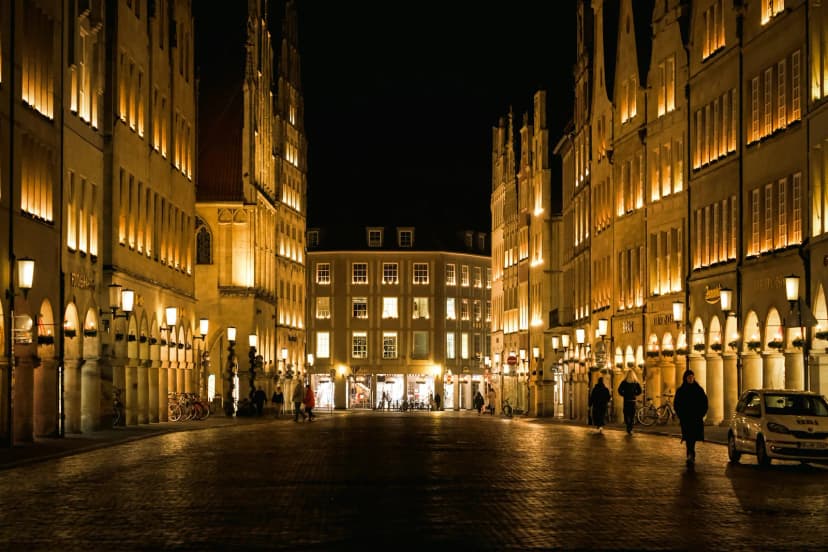
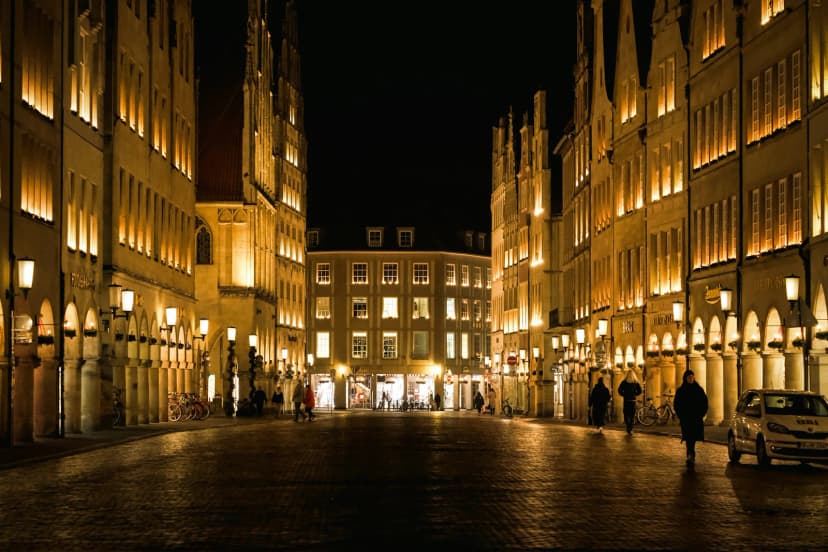
Münster's Altstadt rewards slow walking because the core sights sit close together. A published walk through the old town notes that from the Prinzipalmarkt you can easily reach many of Münster's sights on foot, and that the restored old town presents houses, churches and squares from different centuries. One sourced detail worth knowing before you start: St. Paul's Cathedral in its present form is essentially a work of the thirteenth century, as the same account states. A third overview of the Prinzipalmarkt confirms it is one of the city's must-see sights and appears on mapped walking tours of the centre.
This is an orientation plan, not an official tour or timetable. As a suggested estimate, a straightforward loop of the Prinzipalmarkt, the St. Lamberti exterior, Domplatz and the Promenade takes roughly two hours at an easy pace; interior visits are additional. Treat that figure as editorial advice rather than an official duration, and verify current visitor details before building a day around any single interior.
Why Münster's Altstadt Suits a Self-Guided Walk
The old town is compact, and the Prinzipalmarkt functions as both the traditional economic and political centre of Münster and the practical starting point for a walk. The same source describes the square with its characteristic gabled houses and arcades as the traditional economic and political centre of the city, and it notes that from here many sights are reachable on foot. That combination means you need sequencing rather than transport. For wider planning, see the Münster landmark visitor guides.
It also helps to know that the centre is busy with daily city life, not only with visitors. The same account says a large part of Münster's city life takes place on the Prinzipalmarkt: state guests are received, parties are celebrated, people stroll, shop and enjoy life. Treating it as a living centre rather than a stage set makes the walk more interesting and explains why the arcades can feel narrow at peak times.
Setting Up the Walk: Route Logic and Suggested Duration
The route works best as a single loop: Prinzipalmarkt, then St. Lamberti at the Roggenmarkt and Alter Fischmarkt junction, then Domplatz, then the car-free Promenade along the line of the former city walls. The order keeps you moving outward from the commercial heart and returns you through green space instead of retracing the busiest lanes. As a suggested estimate, allow about two hours for the public-space circuit without interior visits; this is editorial advice, not an official duration.
Two variables change the feel of the walk more than distance does. One is time of day, because the Prinzipalmarkt hosts a large share of the city's daily life. The other is what is happening on the Promenade, which the source describes as car-free and an important traffic axis for people on foot, by bike or on inline skates. Comfortable shoes and a predictable walking line matter more than speed.
Stop 1 — Prinzipalmarkt: Gabled Houses and Arcades
Start at the Prinzipalmarkt and walk one side of the arcades before crossing to view the facades. The source describes the square's characteristic gabled houses and arcades and places the historic town hall with its Peace Hall here. One attraction listing also includes the square among Münster's must-see sights, which is a reminder of how much the city's identity rests on this one ensemble. The arcade line provides a sheltered route along the shopfronts, while the open square is where the ensemble reads as a whole.
The square's history is tied to the Middle Ages, the Hanseatic League and old merchant families, some of whom still do business here, according to the same account. That continuity is the reason to look at the working city as well as the architecture. If you want to see the town hall's Peace Hall interior rather than its exterior, check separately whether it is open when you visit, since it is not open square space.
Stop 2 — St. Lamberti at Roggenmarkt and Alter Fischmarkt
St. Lamberti sits where Roggenmarkt and Alter Fischmarkt merge into the Prinzipalmarkt, so it fits naturally between the square and Domplatz. According to the same Altstadt walk, the hall church was built between 1375 and 1450. It owes its fame to the three cages at the top of the tower, where the bodies of three Anabaptist leaders hung in the middle of the sixteenth century. For a focused look at the tower, see the St. Lamberti Church Tower visitor guide.
Approach the tower as a documented historical marker rather than as spectacle. Because the church is an active city church, its interior may be in use for services; plan it as a stop you enter if conditions allow rather than as a guaranteed indoor visit. The exterior, the portal and the tower view can be appreciated from the surrounding lanes.
Stop 3 — Domplatz and St. Paul's Cathedral
Continue to Domplatz, the open square in front of St. Paul's Cathedral. The cathedral in its present form is essentially a work of the thirteenth century, as the source states, and Domplatz itself is public space, which makes it a useful pause between the tighter lanes around St. Lamberti and any interior visit. If the cathedral is your priority, start with the Münster Cathedral visitor guide.
Inside, the astronomical clock is described as a marvel of the late Middle Ages whose calendar goes back to the year 2071. The source states that the chimes and the Three Wise Men appear Monday to Saturday at 12 noon and on Sundays and public holidays at 12.30 pm. Because those are fixed daily moments rather than a continuous display, plan around the stated times or check current information with the cathedral or city tourism before you rely on them.
A few steps from the clock is the burial chapel of Clemens August Cardinal von Galen, the Lion of Münster, where Pope John Paul II prayed in 1987; a memorial stone still marks the visit, according to the source. The cathedral chamber is a separate treasury displaying art and culture from twelve centuries and is described as one of Europe's most important treasure chambers. Decide in advance whether you are visiting for the architecture, the clock, the chapel or the treasury, because these are different commitments.
Free Grounds Versus Paid Interiors
The squares and lanes on this walk are public space: the Prinzipalmarkt, Domplatz and the car-free Promenade can be walked without admission. Interiors are separate, and there is no single ticket covering the route. Entering the cathedral and visiting the cathedral chamber are distinct decisions, and the chamber's objects of goldsmithing and textile art are its own attraction rather than part of a combined church ticket. For one paid interior in detail, see the Cathedral Treasury and Cloister guide.
For practical planning, use the city pages for current openings and admission rather than a fixed itinerary. The cathedral chamber's twelve centuries of art and the town hall's Peace Hall are interiors with their own arrangements; treat each as a separate check. That approach prevents a plan from being built on an assumed combined ticket that does not exist.
Stop 4 — The Promenade: Lime Trees and the Old Wall Line
Where the city walls once stood, a green belt now encircles the old town, and the Promenade with its double-row avenue of lime trees is car-free. The source describes it as an important traffic axis for people on foot, by bike and on inline skates. Walking it after Domplatz gives the route a calm finish and shows how the old defensive line has been reused as public green space.
The Promenade also hosts a large flea market five times a year, running from Schlossplatz toward the Aasee between May and September, according to the source. On those weekends the belt will feel very different from a quiet weekday. Because the market is seasonal and recurring rather than permanent, check current dates if avoiding or catching it matters to your visit.
Reversing and Shortening the Route
Walking the circuit in reverse works if you arrive from the Promenade or the Aasee side, because you end at the Prinzipalmarkt rather than starting there. Beginning with Domplatz also suits early arrivals when the lanes around St. Lamberti are quieter. Keep the cluster in one loop instead of zig-zagging between Domplatz and the Prinzipalmarkt. For a compact version of the same ground, see the one day in Münster itinerary.
For a shorter visit, drop the full Promenade loop and stay with the Prinzipalmarkt, the St. Lamberti exterior and Domplatz. That version covers the defining stops in a compact triangle and leaves room for one interior instead of several. If you have a full day or more, the same streets connect easily to longer planning, such as the 3 Days in Münster itinerary.
Practical Notes for Walking the Altstadt
Surface and weather matter more than distance on this route. The arcades along the Prinzipalmarkt offer cover along the building line, while Domplatz and the Promenade are open to rain and sun. On a wet day, favour the arcaded side early; on a hot day, save the lime-tree belt for later. Münster's official city site confirms the weather-sensitivity of the route, listing a live webcam Prinzipalmarkt whose changing view shows how open the square and its arcade line can look hour to hour. Plan so you are not crossing open square space at the least comfortable point of the day.
If you are extending the trip, the old town feeds into broader city planning, and a dedicated cathedral guide is useful if that building is your priority. A rainy-day plan or a history-focused walk can reuse the same squares without repeating the same ground. For a weather-proof alternative, see Münster on a rainy day, and for context see A Peace of Westphalia Walk Through Münster.
Plan Your Visit
The most efficient version of this walk is a single loop: Prinzipalmarkt, St. Lamberti, Domplatz, then the Promenade and back toward the square. Keep the public spaces free and unhurried, and make separate, current checks for the cathedral chamber and the town hall's Peace Hall. A suggested two hours at an easy pace covers the essentials; add interior time only once you know the arrangements.
Before setting out, verify current visitor details on the city and cathedral pages, especially for the astronomical clock and any ticketed treasury. If you extend your stay, the same old town supports a fuller itinerary, and a focused cathedral guide helps if that building is your priority. Walking Münster's core works best when you leave room for the square to be a living city centre rather than a stop on a list.
Frequently Asked Questions
Do you need a guide for the Prinzipalmarkt and Altstadt walk in Münster?
No. The Prinzipalmarkt, Domplatz, the lanes around St. Lamberti and the Promenade are public space you can walk on your own, and source material notes that from the Prinzipalmarkt you can easily reach many of Münster's sights on foot. This route is an orientation suggestion rather than an official tour, so you can reorder, shorten or reverse it. For commentary and context, look for organised tours through the city's tourism information rather than assuming one runs at a fixed time.
How long does a self-guided walk through Münster's old town take?
As a suggested estimate, about two hours at an easy pace for the Prinzipalmarkt, St. Lamberti, Domplatz and the Promenade. That figure is a planning convenience, not an official duration, and it assumes limited interior time. Add extra time if you enter the cathedral, look for the town hall's Peace Hall or linger on the square. Group size, weather and how often you stop all shift the total.
Do you need a ticket for the Prinzipalmarkt or the cathedral?
The squares, arcades and the Promenade are open public space, so walking them carries no admission charge. Interiors are separate decisions, and the cathedral chamber is its own treasury rather than part of a single all-inclusive ticket for the route. Check current admission and access with the cathedral or the city's visitor information before you go.
What should you not miss between Domplatz and the Prinzipalmarkt?
The stretch between the two squares takes in St. Lamberti at the Roggenmarkt and Alter Fischmarkt junction, including the tower with the Anabaptist cages. Inside the cathedral, the astronomical clock and the burial chapel of Cardinal von Galen are the two features visitors most often single out. Both are interior elements, so confirm access before planning your day around them.
Where does the Promenade fit into a Münster old town walk?
The Promenade follows the line of the former city walls as a car-free green belt with a double row of lime trees. It works best as the closing loop after the Prinzipalmarkt, St. Lamberti and Domplatz. Remember that it is shared with cyclists and skaters, so keep a predictable line. A recurring flea market uses part of the route five times a year between May and September, which changes the atmosphere on those weekends.