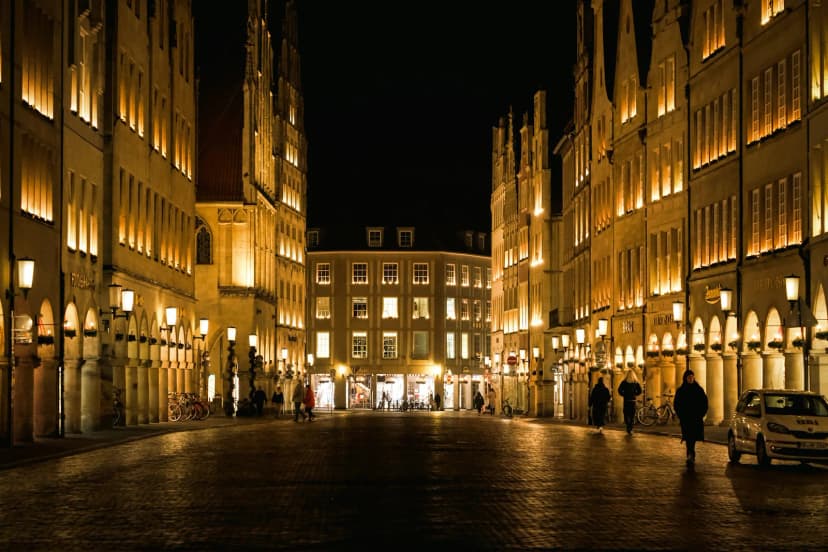
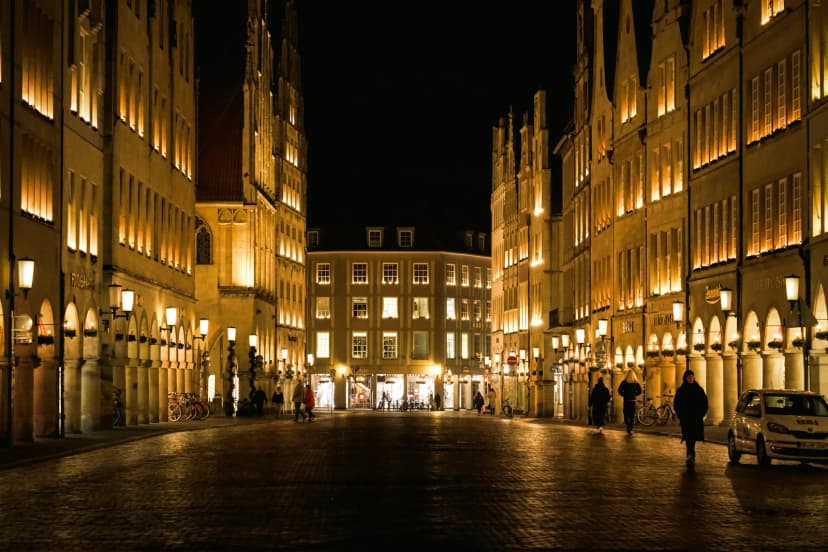
St. Lamberti anchors the northern end of Münster's Prinzipalmarkt, and its 90.5-metre tower is the silhouette that defines the square. A useful suggestion for planning is to allow roughly 30 to 45 minutes for the church interior plus time on the square; that is an editorial estimate, not an official duration. The three iron cages hanging near the top are the detail that makes the tower unmistakable.
One correction belongs up front: the sources consulted for this guide describe the church, its tower and its history, but they do not confirm that the tower itself can be climbed, and they say nothing about tower tickets, booking, a lift or stairs. Treat any climb as something to verify with the parish rather than assume. Everything below stays within what the cited sources actually state.
What St. Lamberti Is and Where It Stands
St. Lamberti is a late Gothic parish church on the Prinzipalmarkt, built between 1375 and 1525 and financed by local merchants as a marketplace and civic church rather than a purely episcopal project. It is dedicated to St. Lambert of Liège. Its address is Lambertikirchplatz 1 in Münster.
The setting is compact and easy to walk. The Lambertikirchplatz with its Lambertibrunnen fountain sits directly beside the church, the Old Fish Market and Salzstraße lie just east, and the Roggenmarkt is to the west. That clustering means you can cover several of Münster's historic anchors without long transfers. If you want structure for this quarter, a self-guided Prinzipalmarkt and Altstadt walk in Münster pairs the church with the surrounding lanes.
Practical positioning matters when you are deciding when to turn up. The Religiana listing records a bus stop within 100 metres, parking within 250 metres and a café within 500 metres, which indicates the church sits in the middle of the city rather than on its edge. Those distances are that source's figures, so treat them as indicative rather than a guarantee of any particular stop or car park.
The Building: Late Gothic Fabric in Baumberger Sandstone
Construction ran for roughly 150 years. The choir came first and was completed in 1422; the octagonal southern choir chapel with its own entrance followed in 1448; the nave, with its network and star vaults, was finished by 1525. The church was built from Baumberger sandstone, a local material that gives the facade its warm tone.
Inside, the design pushes the eye upward: slender pillars rise like tree trunks to meet the vaulting, a hallmark of the Westphalian late Gothic style. The three late Gothic portals are the main exterior detail at ground level, and the southwest portal carries a Tree of Jesse relief showing Christ's lineage. The original relief is now kept in a museum in Berlin, so the facade version is a replica.
Both a nineteenth-century restoration and post-Second World War repairs shaped what stands today. That matters for expectations: this is not an untouched medieval interior, and the restoration preserved historical integrity while introducing some modern elements. Reading the building as a layered object — medieval plan, nineteenth-century rebuilding, twentieth-century repair — makes a short visit considerably more interesting.
The Three Iron Cages and the Münster Rebellion
The cages on the tower held the bodies of the leaders of the Münster Rebellion. Jan van Leiden, Bernd Krechting and Bernd Knipperdolling were executed after the Anabaptist uprising, and their remains were displayed in the three iron baskets as a warning. Sources differ slightly on the year: the myCityQuest listing gives 1536, while Religiana places the execution after the Anabaptist riots of the 1530s. Treat it as an event of that decade rather than a single undisputed date.
The cages have a documented maintenance history that is easy to miss from the square. Religiana records that they were removed in 1881 during renovation work, reattached in 1898, and restored again in 1927. Knowing that sequence explains why the ironwork you see reads as a deliberate reinstatement rather than an uninterrupted medieval survival.
The cages are the detail that distinguishes a St. Lamberti photograph from any other church tower, and they read best against the sky from the Prinzipalmarkt itself, where the full height of the tower is visible. If you are hunting for the strongest angles in the city centre, Best photo spots in Münster covers the Prinzipalmarkt area alongside other viewpoints.
Why the Tower Looks Neo-Gothic, Not Medieval
The tower was not always 90.5 metres. It was raised gradually over the centuries and had reached roughly 50 metres by 1500, but structural problems and the need for repairs led to a complete rebuild in the late nineteenth century under the architect Hilger Hertel. The new tower was completed by 1898.
Hertel's design is neo-Gothic, with intricate stonework and an openwork spire that the myCityQuest source compares to the spire of Freiburg Minster and the towers of Cologne Cathedral. If you are expecting medieval masonry only, the detailing may surprise you — this is a nineteenth-century reimagining of a Gothic tower, and recognising that changes how you read the silhouette above the square.
The cage story and the tower rebuild are two separate layers of the same structure: the execution display dates to the sixteenth century, while the tower that now carries it was largely created in the nineteenth. Keeping them apart prevents the common mistake of assuming the cages were always mounted exactly as you see them today.
The Tower Keeper's Horn: An Evening Tradition to Verify
A tower keeper has blown a horn from St. Lamberti since 1379, originally to alert the city to fire or danger. The myCityQuest listing specifies every half hour from 9 PM to midnight, except on Tuesdays, and notes that Martje Thalmann became the first woman to hold the position in 2014.
Because the detailed half-hourly window and the Tuesday exception come from a single listing rather than an operator page, check locally before you plan an evening around it. The broader tradition — a watchman sounding a horn at night since 1379 — is the more widely repeated claim. If the timing holds, it is a good reason to return to the Prinzipalmarkt after dark rather than squeezing the church into a daytime walk.
What to Look For Inside
Interior highlights centre on sculpture and on the church's role in twentieth-century history. The sculptor Johann Kroeß created a series of statues between 1602 and 1609, including twelve apostles that once stood in the choir and were later destroyed. The southern choir chapel still houses statues of the four Latin Church Fathers: Ambrose, Augustine, Jerome and Pope Gregory the Great.
Clemens August Graf von Galen, later Bishop of Münster and a cardinal, served as parish priest here from 1929 to 1933 and preached against the Nazi euthanasia programme known as Aktion T4. Two of those sermons were delivered from this pulpit, which makes the interior historically significant well beyond its architecture. If you only have a few minutes, the chapel statues and that context are the two things worth prioritising.
The nave's network and star vaults are the other element to look up for, since the verticality of the space is the clearest expression of the late Gothic design. The interior was renovated after both the rebellion era and the Second World War, so expect a mix of restored fabric and modern intervention rather than a uniform period interior.
Practical Visiting: Hours, Location and Timing
The Religiana listing gives general church opening times of Monday to Saturday 08.00 to 18.45 and Sunday 09.30 to 19.00, with the address Lambertikirchplatz 1 in Münster. These are that source's published figures for the church rather than a live operator schedule, and they do not tell you anything about tower access. Confirm current hours with the parish before making a special trip, especially on Sundays and public holidays.
For a suggested visit, allow around 30 to 45 minutes for the church interior plus time on the square — this is an estimate, not an official duration, and any tower access would change it. Because the church sits inside the Prinzipalmarkt ensemble, the simplest way to see it is as one stop on a walking route rather than a standalone excursion.
The church's own website is the right place to check for any published visiting information, since a parish site is the authoritative source for access arrangements. Note that the evidence reviewed here contains no content from that page, so nothing in this guide should be read as confirming current opening, ticketing or entry rules on its authority.
Can You Climb the Tower? What the Sources Do Not Say
The sources consulted describe the tower's height, history and rebuild but do not confirm that visitors can climb it. There is no supported statement here about tower-climb tickets, booking, a lift, stairs, or tower-only opening hours, so none of that can be presented as fact. Claims to the contrary go beyond what the available evidence shows.
The practical way to resolve this is to contact the parish directly and ask specifically about tower access, whether it is guided or self-guided, and whether any restrictions apply. Ask separately about the church interior, because a confirmed church opening time does not automatically extend to the tower. Distinguishing those two answers is the difference between a wasted trip and a planned one.
Accessibility arrangements for the tower or church are not documented in the sources reviewed, so plan around uncertainty rather than assuming step-free access or a lift. If mobility matters to your visit, make it an explicit question when you contact the parish. The church remains worth seeing from the square regardless of whether any climb is possible.
Nearby Anchors on the Same Walk
The Prinzipalmarkt itself is the obvious next stop, and the arcaded street is the reason to linger after leaving the church. Lambertikirchplatz, the Old Fish Market, Salzstraße and Roggenmarkt all sit within a short walk, which makes this one of the densest historic clusters in Münster. You can see the main pieces in a single unhurried loop.
Two larger landmarks are close enough to combine with St. Lamberti. St. Paulus Dom, the city cathedral built between 1225 and 1264, is a short distance away and its astronomical clock and apostle series survived the war, while the Westphalian State Museum of Art and Cultural History offers an indoor counterpoint if the weather turns. Each has its own entry arrangements, so check them separately rather than assuming a shared ticket.
If you are planning more than this single stop, the city-level Münster: Itineraries and City Travel Guides surface helps you slot the church into a half-day or full-day route. The broader Münster: Landmark Visitor Guides collection is the place to check comparable landmarks before committing your time.
How the Tower Fits Into a Prinzipalmarkt Walk
St. Lamberti works best as the anchor of a Prinzipalmarkt circuit rather than a destination in itself. Start on the square to take in the 90.5-metre tower and the three iron cages, look at the portals and the Tree of Jesse relief at ground level, then step inside for the choir chapel statues and the nave vaulting. Build in a return after dark if you want to catch the tower keeper's horn.
The single most useful thing you can do before travelling is to confirm the details this guide cannot: whether any tower access exists, what the current church hours are, and what restrictions apply. The parish is the authority for all three. With those answers in hand, the rest of the visit — the square, the fountain, the Old Fish Market and the cathedral nearby — needs no further planning.
Frequently Asked Questions
Can you climb the St. Lamberti Church tower?
The sources reviewed describe the tower's height, history and nineteenth-century rebuild but do not confirm that visitors can climb it. Nothing in this guide should be taken as evidence of tower access, tickets, a lift or stairs. The reliable approach is to contact the parish directly and ask specifically about tower access, separate from general church opening.
Why are there three iron cages on the tower?
The cages held the bodies of the leaders of the Münster Rebellion. Jan van Leiden, Bernd Krechting and Bernd Knipperdolling were executed after the Anabaptist uprising, and their remains were displayed in the three baskets as a warning. Sources differ slightly on the year, placing the event in the 1530s. The cages were removed in 1881, reattached in 1898 and restored in 1927, so what you see today reflects a documented reinstatement rather than an uninterrupted medieval survival.
What are St. Lamberti's opening hours?
One listing gives general church times of Monday to Saturday 08.00 to 18.45 and Sunday 09.30 to 19.00, but those are that source's published figures rather than a live operator schedule, and they cover the church, not any tower access. Confirm current hours with the parish before making a special trip, particularly around Sundays and public holidays.
What is the tower keeper's horn tradition?
A tower keeper has blown a horn from St. Lamberti since 1379, originally to alert the city to fire or danger. One listing specifies every half hour from 9 PM to midnight except Tuesdays, and notes that Martje Thalmann became the first woman to hold the position in 2014. Because the detailed schedule comes from a single source, check locally if you plan an evening around it.
How tall is the St. Lamberti tower?
The tower reaches 90.5 metres. It was raised gradually over the centuries and had reached roughly 50 metres by 1500, but structural problems led to a complete rebuild in the late nineteenth century under the architect Hilger Hertel, finished by 1898 in a neo-Gothic style. The height you see today is therefore the product of that nineteenth-century reconstruction.
What is there to see inside St. Lamberti?
Inside you can see the late Gothic nave with its network and star vaults and slender pillars rising to the vaulting. The southern choir chapel houses statues of the four Latin Church Fathers, and the church is also significant as the parish where Clemens August Graf von Galen served from 1929 to 1933 before preaching against the Nazi euthanasia programme. A reasonable suggestion is 30 to 45 minutes, though that is an estimate rather than an official duration.