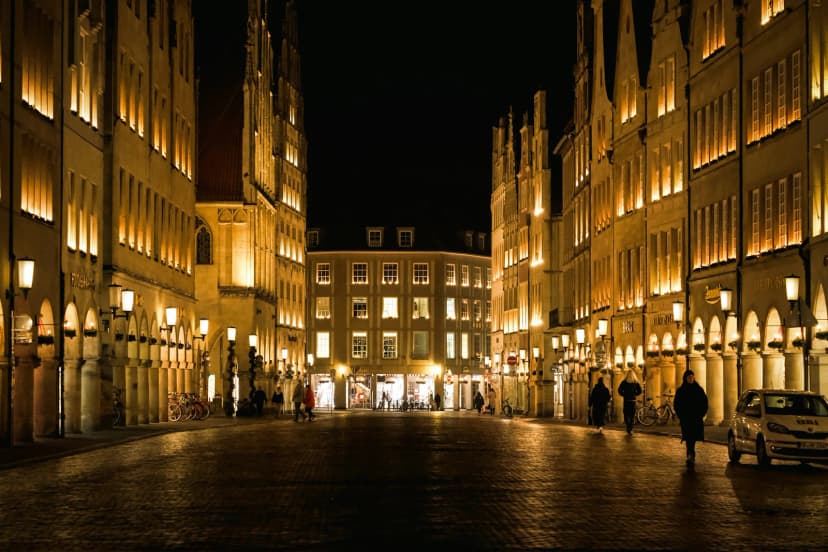
Münster's photogenic centre is compact enough to cover on foot in a single focused session, which is exactly why planning matters more here than stamina. The Prinzipalmarkt, the cathedral square and the Lamberti tower sit within a few minutes of each other, while the Schloss gardens and the Aasee lakeside open up a different, greener kind of frame. Deciding what to shoot first, and what to abandon when the weather turns, is the real work of a good Münster photo walk.
This guide treats each location as a compositional choice rather than a ranked entry: what you gain by standing in the arcade versus the square, or on the lake path versus the promenade. It also keeps free public grounds separate from paid or separately ticketed interiors, so you plan around access instead of assuming everything is open. One concrete anchor: Saint Lambert's Church lists opening times of Monday to Saturday 08.00 to 18.45 and Sunday 09.30 to 19.00 on Religiana, the religious-heritage source that publishes them, though church access can change for services and should be rechecked before you go.
A suggested half-day route through the Altstadt, followed by an hour or two at the Aasee if the light holds, covers most of what first-time visitors want without racing. Treat all timing and crowd guidance here as general advice rather than verified schedules. Check the city's own tourism pages and the individual venues before you commit to a fixed plan.
How the Main Photogenic Areas Fit Together
Central Münster is ringed by a car-free promenade shaded by rows of trees, and this ring is the simplest mental map for a photo walk. Inside it sit the Altstadt landmarks: the Prinzipalmarkt arcade, Domplatz with the cathedral, and Lambertikirchplatz with the Lamberti church tower. Outside the ring, the Schloss and its gardens sit to the north-west, with the Aasee beginning just beyond them.
That geography suggests a natural sequence: start in the arcade and squares while the Altstadt is your immediate subject, then move outward to the Schloss gardens and the lake as a second act. The promenade ring doubles as a rain contingency, since its tree cover is a usable shelter when a shower interrupts a walk. The Aasee path runs around the lake and is used by walkers and cyclists, so expect shared space rather than an empty set.
If you want a shorter structure, pick either the Altstadt or the lake and accept that you will miss the other. The Altstadt rewards tighter, denser frames with people and architecture in the same shot. The Aasee rewards wider views and reflections, and it is the better choice when you want breathing room rather than crowds. A full day lets you attempt both without rushing either.
Prinzipalmarkt and the Gabled Houses
The Prinzipalmarkt is the postcard view: a curving street of gabled houses with a continuous arcade running beneath them. It is also a rebuilt ensemble, reconstructed after the Second World War rather than surviving medieval fabric, and knowing that changes how you shoot it. You are photographing a deliberate urban scene, not a ruin, so a clean, orderly composition suits the subject better than a weathered one.
Standing inside the arcade gives you rhythm and repetition as the columns and arches recede, but it costs you the gable line above. Standing out in the street restores the gables and the curve of the facade, at the price of including more passers-by and street furniture. A middle position, just at the arcade edge, is a reasonable compromise when you want both structure and sky.
The street is busy with shoppers, cyclists and delivery traffic, and no composition guarantees an empty frame. Rather than waiting for a miracle gap, treat people as part of the scene and let a cyclist or a walking figure anchor the foreground. If you specifically want the architecture alone, the practical answer is to return at a quieter hour and accept that you are trading atmosphere for tidiness.
For the gabled facades themselves, a slight angle across the street often reads better than a straight-on wall, because the row curves away and the repetition of the gable shapes carries the eye. Watch the verticals on the taller houses and keep the camera level rather than tilting up, or the gables will converge. Small corrections at the moment of shooting save awkward work later.
St. Paulus Dom and Domplatz
The cathedral, St. Paulus Dom, faces a square rather than a wide plaza, which makes the classic full-frontal shot difficult without stepping back into traffic. The building combines Romanesque and Gothic elements and was heavily damaged in the Second World War, then rebuilt; the astronomical clock and other interior treasures survived. That history means the exterior you photograph and the interior you photograph are both reconstructions around surviving pieces, which is worth knowing before you judge the architecture.
From Domplatz, a vertical frame with the tower and the square's paving in the foreground gives the building context and scale. Closer in, you lose the tower but gain the detail of the portal and stonework, which is easier to read in a tight composition. Choosing between the two is really choosing between documenting a landmark and studying its surface.
Inside, the nave and the astronomical clock are the obvious subjects, and interiors are darker than they look to the eye, so expect to work with what light is there. Check current visiting arrangements and any photography guidance with the cathedral or the city's tourism pages before you travel, since worship and conservation can restrict access. Do not assume a specific opening window; verify it close to your date.
St. Lamberti and the Iron Cages
St. Lamberti closes the northern end of the Prinzipalmarkt, and its tower carries the three iron cages that give it its dark reputation. The church took roughly 150 years to build, from 1375 to 1525, and the cages were removed in 1881 during renovation, then reattached in 1898 and restored in 1927, according to Religiana. A tower detail from the Prinzipalmarkt end therefore gives you both the gable streetscape and the cages in one vertical frame.
If the tower detail is your priority, a longer focal length from further down the street compresses the cages against the gables and makes the story visible. Standing directly below loses the cages against the sky and flattens the relationship with the square. This is one of the clearest cases in Münster where moving back improves the photograph.
Visiting the church interior is a separate decision from photographing the tower exterior. Religiana lists opening times of Monday to Saturday 08.00 to 18.45 and Sunday 09.30 to 19.00, and notes the church is within 100 metres of a bus stop and 250 metres of parking. Treat those hours as subject to change for services and events, and confirm locally if a visit matters to your plan.
Historisches Rathaus and the Friedenssaal Setting
The Historisches Rathaus sits on the Prinzipalmarkt, and the Friedenssaal inside is where the Spanish-Dutch peace treaty was ratified on 15 May 1648, the first part of the Peace of Westphalia. Münster Marketing describes the city's lasting association with that date and the symbolism of peace that still shapes its public events. For a photographer, the square outside the town hall is often the more usable frame, because the interior is a historic room rather than a broad space.
Outside, the town hall facade and the surrounding gables give you a second, quieter version of the Prinzipalmarkt streetscape, with the historical weight of the building as the subject. Composing the facade with a slice of the arcade in the foreground ties it back to the street rather than isolating it. If you want the peace-history context rather than pure architecture, including a bit of the square and its paving does more than a tight crop of stone.
Interior visits and any photography conditions are set by the venue, not by this guide. Check the city and tourism pages for current access arrangements before you plan a shot list around the Friedenssaal. If interior access does not work out, the exterior and the square are still a worthwhile stop on the same walk.
Schloss Münster, Its Gardens and the Botanical Garden
The Schloss is a baroque palace that now houses the university, and it is surrounded by gardens that make an obvious green sequence after the Altstadt. Photographers who work in Münster name the castle, its surrounding gardens and the university's Botanical Garden as outdoor settings, alongside the Aasee and the Prinzipalmarkt, which confirms these as established locations rather than insider secrets.
Within this sequence, the palace facade itself gives a formal, symmetrical subject, while the Botanical Garden offers plant detail and colour that suits closer work. Rushing from one to the other in the same ten minutes tends to produce two mediocre sets of images; giving each a deliberate slice of time works better. If you only have one hour, pick the palace exterior and its immediate surroundings rather than trying to cover the whole green area.
Access arrangements vary between the palace, its gardens and the Botanical Garden, and between public grounds and any ticketed or separately managed collections. Do not assume a single ticket or a single opening pattern covers them all. Check the university and garden pages for current visiting information before you rely on a particular entrance or time.
The Aasee Lakeside
The Aasee, or Lake Aa, begins just outside the promenade ring and offers the wide, open counterpart to the Altstadt's dense streets. A path runs all the way around the lake and is shared by walkers and cyclists, and boats and pedalos operate on the water in season. For a photographer, the lake is where you go when you want horizon, reflection and space rather than facades.
A low position near the water line gives you reflections and a foreground of ripples, but it also puts more path and bank into the frame. Standing back and higher trades the reflection for a cleaner composition of the shoreline and the far bank. Which one works depends on whether the water or the landscape is your subject.
The lake is also the practical answer to a crowded Altstadt, since the path is long enough to absorb people without your frame filling up. That does not mean it is ever guaranteed empty, especially on fine weekends. Treat the lake as a change of scale and subject rather than a guaranteed quiet option.
Mühlenhof and the Allwetterzoo Area
Two further stops sit close to the lake: the Mühlenhof open-air museum and the Allwetterzoo with the Westfälisches Pferdemuseum inside it. Mühlenhof is a five-hectare site with 22 buildings illustrating rural life in the Münsterland, and it can be covered in an hour or less, which makes it a plausible add-on rather than a full day. The Horse Museum, by contrast, sits inside the zoo, and the zoo entrance is required to reach it, so the two stops are not equivalent in cost or commitment.
The practical question is whether either stop earns its place in a photography-focused day. Mühlenhof gives timber buildings and rural textures that the Altstadt does not, but it pulls you away from the lake and the city centre. The zoo area is a larger time commitment and is primarily a family attraction rather than a photographic one, though the Horse Museum adds a specific subject if Westphalian equestrian culture interests you.
Both sites publish their own opening hours and admission arrangements, which vary by season, so check their current pages rather than relying on older summaries. In particular, the zoo's pricing changes between summer and winter and has afternoon rates, so any figure you read from a past trip report is unreliable. Confirm current details on the operator's own site before deciding.
Giant Pool Balls and Modern Münster
The Giant Pool Balls on the Aasee are the city's best-known piece of public art and a deliberate contrast to the historic core. Third-party tour listings include them alongside the cathedral, the town hall, St. Lamberti and the Schloss, which shows how firmly they have entered the standard visitor circuit. Photographically they are a foreground object with a lake backdrop, and they suit a playful composition rather than a solemn one.
Beyond the balls, the harbour area and the Kreuzviertel show a different Münster of converted industrial space, independent coffee and evening life. That side of the city rewards looser, more observational shooting than the Altstadt's formal architecture. If your Altstadt frames feel repetitive by late afternoon, moving to the harbour district changes both the subject matter and your approach.
Balancing historic and contemporary frames in one day is a matter of sequencing rather than a rule. Many photographers find the historic core works earlier and the modern quarters later, but check your own light and energy rather than following a fixed timetable. The LWL-Museum für Kunst und Kultur on Domplatz is another option if you want an art-and-architecture stop, though its collections are ticketed and its interior access should be confirmed with the museum.
Weather and a Rain Plan
Münster is a city where rain is a planning assumption rather than an exception, and the promenade ring is the structural answer to it. It is a car-free path shaded by rows of trees on each side, so it offers cover and a route at the same time, and it is heavily used by walkers, runners and cyclists. Building a photo walk around the ring rather than across it makes a wet day far more workable.
The Prinzipalmarkt arcade is the other obvious shelter, since the covered walkway lets you shoot the street from under cover while the weather passes. Church interiors are a third option, but they are worship spaces with their own access conditions, so they work only when they are open and when photography is appropriate. None of these options guarantees dryness, and none should be treated as a fixed itinerary.
Wet weather can also be an opportunity: paving reflects, and grey light reduces harsh contrast on facades and stonework. If you accept the conditions rather than waiting them out, a rainy session in the arcade and along the promenade can produce a coherent set. Keep a dry cloth and a plan for your gear, and be realistic about how long you want to stay out.
Street and Detail Shooting Off the Main Route
Münster's centre is full of bicycles, and they are part of the city's visual identity rather than an obstacle to be avoided. Bicycles appear everywhere without being in the way, which is unusual for a city of its size and makes them a natural subject alongside the architecture. A frame that includes a rack, a rider or a parked bike says more about Münster than one that excludes them.
Small green squares and courtyards off the main streets are where the city's quieter character shows, and they suit close, patient work rather than wide views. Side streets around the Altstadt and the promenade ring are the easiest places to find them without a specific address. Treat them as incidental discoveries rather than destinations on a map.
Detail shooting also has the advantage of being weather-resistant: doorways, signage and shopfronts can be worked under an overhang while heavier rain passes. It is a useful fallback when a planned landmark frame is not going to happen. Keep the walk flexible enough to switch modes when the conditions change.
Half-Day Versus Full-Day Sequencing
A half-day walk should choose one subject area and commit to it. The Altstadt version covers the Prinzipalmarkt, Domplatz, Lambertikirchplatz and the town hall square, with the promenade as connective tissue and rain cover. The lakeside version covers the Schloss gardens, the Aasee path and the Giant Pool Balls, and gives you a very different set of images for the same amount of time.
A full day can combine both, but only if you accept a slower middle section. A reasonable shape is Altstadt in the first part of the day, a break, then the Schloss and lake afterwards, with the harbour or Kreuzviertel as an optional evening extension. The transition between the two halves takes time even though the distances are short, so build in slack.
Whichever length you choose, decide in advance which single frame matters most to you and protect the time for it. Everything else is a bonus. That discipline is what separates a productive photo walk from a walk with a camera.
Plan Your Münster Photo Walk
Münster's advantage for photographers is its scale: a rebuilt but coherent Altstadt, a car-free promenade ring that doubles as shelter, and a lake that changes the subject entirely within a short walk. The trade-off is that no single session covers everything well, so pick your frames and accept the omissions.
Before you travel, confirm the details that change: church and museum opening times, any ticketed interiors, and current conditions at the sites you care about. Religiana is the reference for St. Lamberti's published hours, while the city's own tourism pages and the individual venues are the places to check everything else. Treat all timing, light and crowd advice here as guidance to test on the day, not as a fixed schedule.
Frequently Asked Questions
Is the Dom free to photograph inside, and what do I need to check?
This guide does not confirm interior photography rules or admission for the cathedral, because those are set by the church itself and can vary by area and by day. Some travel listings show the cathedral as free to enter with broad daily hours, but those are third-party figures that can change, so verify with the cathedral or the city's tourism pages before you plan around them. Remember it is an active place of worship, so quiet and appropriate behaviour matter even when visiting is allowed.
When are St. Lamberti and other churches actually open for visitors?
Religiana, the religious-heritage source, lists St. Lamberti as open Monday to Saturday from 08.00 to 18.45 and Sunday from 09.30 to 19.00. Those hours can change for services, events and seasonal patterns, so confirm locally before a visit that depends on them. For other churches in Münster, check the individual parish or the city tourism pages rather than assuming the same pattern.
Can I photograph the Prinzipalmarkt without crowds?
No location in the centre is guaranteed empty, and the Prinzipalmarkt is a working street used by shoppers, cyclists and delivery traffic. Quieter conditions are generally more likely outside peak shopping periods and early in the day, but this guide treats that as general advice rather than a verified schedule. The more reliable approach is to accept people as part of the scene and use them in the composition rather than waiting for a clear frame.
Do I need a ticket for the Schloss gardens, Botanical Garden or Aasee?
The lake path and promenade are public routes, while the palace, gardens and Botanical Garden have their own access arrangements, and the botanical garden has been described as free to enter by travel sources. Because these can change, and because the palace now houses the university, check the relevant institution's page before you plan a session that depends on entering a particular area. Do not assume one ticket or one opening pattern covers the whole green sequence.
Should I add Mühlenhof or the zoo to a photo walk?
Both are close to the Aasee, but they change the character of the day. Mühlenhof is a five-hectare open-air site with 22 rural buildings and can be seen in about an hour, which makes it an easy add-on. The Horse Museum sits inside the Allwetterzoo, so visiting it requires the zoo entrance, and both venues publish their own hours and admission details, which you should check directly before deciding.