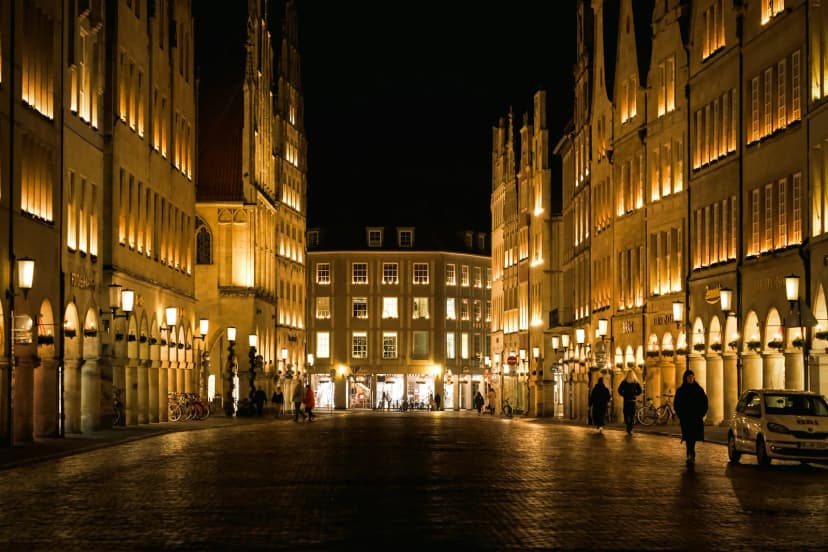
Münster's city harbour is the part of town many visitors miss. Since the mid-1990s it has developed from an industrial goods-handling area into a leisure and recreation district, and the granaries and warehouses along the quay now hold exhibition spaces and restaurants overlooking the harbour basin. The Stadt Münster city portal frames the wider city as somewhere with both historic sights and a young nightlife, which is a fair description of how the harbour sits next to the old town.
The core of a visit is simple: walk the promenade. The Kupi listing describes the Kreativkai as the epicentre of urban life in the district, with former port buildings turned into offices, galleries, nightclubs and cafés overlooking the water. It also notes that the harbour area itself is open public space while individual restaurants, cafés and clubs keep their own operating hours — an important distinction if you are planning around a specific venue.
This guide covers what the harbour district is, how to walk it, how to think about timing, and how to combine it with the Aasee and the old town. It stays away from fixed venue schedules because those change constantly, and points you to where to verify them instead.
What Münster's Stadthafen actually is
The Stadthafen is Münster's city harbour, and the part visitors mean is the Kreativkai, the converted quay along the Dortmund-Ems Canal and the Aa. The Johanniter guesthouse notes that since the mid-1990s the harbour has shifted from industrial goods handling into a leisure and recreation district, with granaries and warehouses transformed into exhibition spaces and restaurants with a view of the harbour basin. Numerous cultural and gastronomic establishments, event venues and office buildings have settled on the quay.
That description matters because it tells you what kind of place this is: a working waterfront turned cultural quarter, not a purpose-built attraction with a gate and a ticket desk. Preserved cranes and port infrastructure remain part of the landscape, according to the Kupi listing, so you get brick warehouses and industrial hardware rather than a polished marina. The venue mix runs from galleries and event spaces to restaurants and clubs, which is why the area works both as a daytime stroll and as a night out.
If you want a broader orientation to the city before you commit to an evening there, start with Münster: Landmark Visitor Guides and Münster: Itineraries and City Travel Guides. Both help you see how the harbour fits with the rest of a visit rather than treating it in isolation.
Walking the Kreativkai promenade
The straightforward approach is to walk the quay in one direction until the buildings thin out, then come back along the water. Because the district is compact, you do not need a route map; you need to notice when you have drifted away from the water and correct back toward it. The free part of this is the promenade and the quayside itself — the water, the cranes, the warehouse facades — while whatever is inside a gallery, venue or restaurant is that operator's business.
Daylight is best for looking at the architecture and the preserved port hardware. After dark the promenade is about lighting and company: the Kupi listing describes the area being transformed in the evening by bright lighting and opening clubs, making it a hub for the city's nightlife. Münster's tourism marketing goes further and calls the city harbour the city's nightlife boulevard, an exciting combination of art and culture and clubs where you can spend a nice evening with a refreshing drink.
Keep the scale in mind. The harbour is close to the centre and connected by paths along the waterfront, so it slots in as a couple of hours rather than a day out on its own. If you want the old town as a structured walk before heading west to the water, a Prinzipalmarkt and Altstadt walk in Münster covers it properly. If your evening is really about the city after dark rather than the harbour specifically, compare this walk with Things to do in Münster at night.
How long to allow, as a suggested itinerary
No official duration exists for this walk, so treat any figure as a planning aid rather than a rule. The Kupi listing, a third-party travel page, suggests roughly one to two hours for a quick introduction to the harbour and a short waterside walk, and at least three to four hours if you add dinner at a local restaurant or an evening at a bar. Those are that page's estimates, not an operator's or the city's, and your own pace will move them.
A workable compromise is to decide your exit before you arrive. If you are combining the harbour with the old town, keep the harbour to the shorter version and leave while it still feels like a stroll; if the harbour is your main evening, budget the longer version and let dinner set the pace. Adding the Aasee is what turns either option into a half or full day, since the lake sits close enough to continue on foot or by bike.
Food and drink without guessing
The harbour's dining scene is spread across the quay rather than concentrated in one building, and it ranges from terrace dining by the water to coffee stops and evening drinks. The Kupi listing notes that former port buildings now house restaurants and bars where you can dine on a terrace, grab a coffee, or watch the harbour from a table. Because individual venues keep their own hours, the sensible approach is to pick your table when you are hungry rather than committing in advance to a place you have not seen.
A sensible sequence is to treat the old town or the walk there as your earlier, lighter stop and the harbour as the later, more substantial one, so you are not doubling back. That also protects you if a particular café or kitchen is closed: you still have the water, and you still have the next option along the quay. Do not expect a shared ticket or a single operator across the district; each business sets its own terms, and some spaces on the Kreativkai are offices or event venues rather than places open to walk-in visitors.
Art, culture and the converted warehouses
The cultural draw at the harbour is the reuse itself: granaries and warehouses that now hold exhibition spaces, galleries and event venues alongside the restaurants and offices. That mix is exactly why the free-versus-paid distinction matters most here. The promenade, the quay and the waterside are public space you can walk for nothing; whatever is inside a gallery, venue or restaurant is that operator's business, with its own hours and its own conditions, and there is no single ticket covering the area.
If you want a proper art stop rather than a harbour gallery, the city's museum landscape is a separate decision and a separate visit. The LWL Museum for Art and Culture in Münster reopened in September 2014 after a long construction period and now houses a library, auditorium, bookshop and restaurant as well as its collections and temporary exhibitions, according to the architectural lighting publication darc. Check the museum's own pages for current opening times, admission and exhibition dates rather than relying on any guide, and if you want the details of that collection specifically, start with the LWL Museum für Kunst und Kultur guide.
Evening and summer atmosphere
After dark, the harbour's character changes. The Kupi listing describes the area as transformed in the evening by bright lighting and opening clubs, while the Johanniter description picks out warm summer evenings when people stroll the canal banks or relax with a drink. Münster's own tourism marketing labels the city harbour the city's nightlife boulevard, an exciting combination of art and culture and clubs where you can spend a nice evening with a refreshing drink.
What you should not do is build the evening around a fixed event, a sunset time or a beach-bar schedule; none of that is stable information and none of it is verified here. Build it around conditions instead: a warm evening makes the promenade the point, a cold or wet one pushes you indoors to whichever venue is open. Weekends bring more foot traffic, so if you want the architecture rather than the crowd, go earlier in the evening and let the atmosphere arrive after you. For the wider night-time picture, including the Prinzipalmarkt area, Things to do in Münster at night is the better reference.
Getting there and getting around
The harbour is close to the centre and lies along the waterfront, which makes walking and cycling the natural ways to reach it. The Kupi listing notes that bike paths run along the water and through the city toward the docks, and in a city this cycle-friendly, arriving on two wheels is often easier than dealing with parking near a busy waterfront. Ignore any precise walking time from the main station that you see quoted on third-party pages; that figure is unverified here, so plan your route with a live map instead.
Once you are at the water, the district is compact enough to cover on foot without a plan. If you are arriving by public transport, use the city's own journey planner or a current map application to check stops and connections on the day, because routes and timetables change. For orientation on the wider city, the official city portal is the reliable starting point for services and current notices.
Combining the harbour with the Aasee and the old town
The standard pairing is harbour plus Aasee, because the lake is nearby and can turn a short waterside stroll into a half or full day, particularly in good weather. The old town is the other obvious combination: the Hanseatic tourism pages describe Prinzipalmarkt as Münster's economic and political centre, with its characteristic gabled houses and colonnades and the historic town hall on the square. St. Lamberti's Church sits where the Roggenmarkt and Alter Fischmarkt lead to the Prinzipalmarkt, and the Hanseatic pages note the tower keeper's copper horn is heard every night except Tuesdays, on the half-hour between 9 p.m. and midnight.
If you want the old town as a structured walk rather than a wander, use a Prinzipalmarkt and Altstadt walk in Münster before heading west to the water. The city also rewards a looser look at its churches and squares; St. Lamberti's, for instance, is the late-Gothic church whose tower carries the three iron cages associated with the Anabaptist leaders executed in the sixteenth century, as described by Religiana. Check places of worship directly for current visiting arrangements, since they operate as active parishes.
Practical decision points
Weather decides more here than in most city walks, because the main attraction is an outdoor promenade. A wet evening is the moment to use the harbour's indoor venues rather than the quay, while a dry one rewards you for staying outside. The Kupi listing frames the area's summer character around people using the waterfront, and the Johanniter page also mentions people relaxing by the canal on warm evenings. Keep the plan reversible and you will not lose an evening to rain.
Choose your transport by how you want to end the night, not just how you want to arrive. Walking gives you the transition into the waterfront that makes this route interesting, while a bike lets you add the Aasee without a long return leg; driving is the least rewarding option on a busy weekend. Whatever you pick, resist over-scheduling. The harbour works best as a slow, flexible couple of hours rather than a timed circuit of stops.
Plan Your Visit
Treat this as a single evening with a clear shape: reach the water, walk the Kreativkai quay, and let the promenade set the pace. The waterside is free public space, the venues around it are individual businesses with their own hours, and the whole district is small enough that you can change plans mid-walk without losing anything. That flexibility is the point, not a compromise.
Decide before you go whether the harbour is your whole evening or one stop between the old town and the Aasee, and check current conditions on the city's own pages rather than trusting any fixed schedule you read elsewhere. The reward is a Münster that feels different from the postcard squares: converted warehouses, cranes left in place, and a waterfront that fills up as the light goes.
Frequently Asked Questions
What is the Kreativkai in Münster's harbour district?
The Kreativkai is the converted quay at Münster's city harbour where former granaries and warehouses have been turned into exhibition spaces, restaurants, event venues and offices. It is the core of the Stadthafen leisure district, which developed from an industrial goods-handling area into a recreation and culture quarter from the mid-1990s onward, according to the Johanniter guesthouse and the Kupi listing. Preserved cranes and port infrastructure remain part of the setting, and the promenade along the Dortmund-Ems Canal is the main place visitors walk.
Do you need tickets to visit Münster's Stadthafen?
No, the harbour area itself is public space, so walking the promenade and quay does not require a ticket. What you pay for depends on what you enter: galleries, event venues, restaurants, cafés and clubs are separate businesses that each set their own conditions and opening hours, as the Kupi listing notes. There is no single ticket covering the district, so check with an individual venue directly if you are planning around a specific exhibition or event.
How much time should you allow for the harbour walk?
There is no official duration, so treat figures as suggestions. The Kupi listing suggests roughly one to two hours for a quick waterside walk and at least three to four hours if you add dinner or a bar. Many visitors extend the trip further by continuing to the nearby Aasee, which can fill a half or full day in good weather.
Is Münster's harbour good in the evening?
Yes, the evening is when the harbour is busiest and most atmospheric. Münster's tourism marketing describes the city harbour as the city's nightlife boulevard, combining art and culture with clubs, and both the Johanniter page and the Kupi listing pick out warm summer evenings as the liveliest time on the quayside. Lighting and open venues change the feel after dark, but specific hours and events vary by business, so check individually rather than assuming a fixed schedule.
Can you combine the harbour with the Aasee?
Yes, and it is the most natural extension. The Aasee sits close to the harbour, and continuing there turns a short waterside stroll into a half or full day, especially in good weather, as the Kupi listing notes. You can walk or cycle between them using the paths along the water and through the city. Check current conditions on the city's own pages, since paths, events and lake facilities can change.