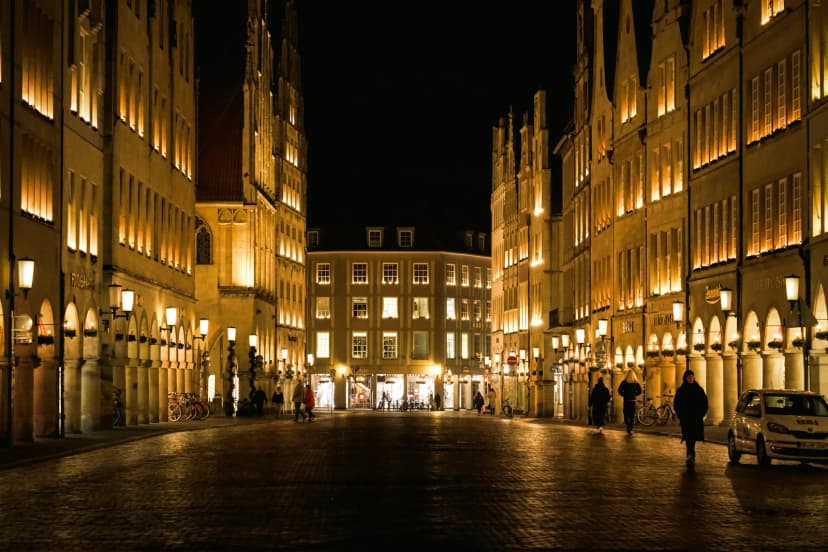
Münster is known for its restored old town, centred on the Prinzipalmarkt with its gabled houses, arcades and historic town hall where parts of the Peace of Westphalia were negotiated, according to an itinerary overview. The same overview notes the city has an extensive cycling path network and a scenic promenade around the old centre. For wider planning, see Münster city travel guides.
That compact core is why two days suits a first visit: one day indoors and civic, one day outdoors by the water. Treat everything below as suggested routing, not a fixed schedule, and confirm current opening hours and ticket details with each operator before you go.
Why Two Days Suits Münster
The centre is compact, but its highlights sit in different quarters: the Altstadt around the Prinzipalmarkt, the Schloss and university quarter, and the Aasee with its museums. Trying to cover all three in one day usually means treating the cathedral square as a photo stop and missing the museum decision entirely. For wider planning, see Münster landmark visitor guides.
A two-day split also gives you a weather buffer. Day one is urban and mostly indoors or in arcades; day two can be swapped between garden and lake depending on conditions. The city's cycling culture, noted in the itinerary overview, makes the water anchors easier if you ride rather than walk.
How to Split the Two Days
Give day one to the Altstadt and one museum of your choice. Give day two to the Schloss, the Botanical Garden and either the Aasee or the Stadthafen. That avoids zig-zagging between the centre and the lake twice. For wider planning, see Comparing Münster's Best Museums.
As an editorial suggestion rather than any official timing, one anchor per half-day with meals and pauses is a comfortable pace. Do not treat that as a guaranteed visiting duration for any single attraction, and avoid booking two timed museum slots on the same day.
Day 1 Morning: Prinzipalmarkt, Historic City Hall and St. Lamberti
Start at the Prinzipalmarkt, the historic principal marketplace with old buildings, shops and cafés. The itinerary overview notes the secular Gothic architecture results from post-war reconstruction and that the historic town hall is where parts of the Peace of Westphalia were negotiated.
St. Lamberti stands at the northern boundary of the Prinzipalmarkt. The overview describes it as a 14th-century Gothic church whose spire carries three iron cages linked to the Anabaptist rebellion of the 1530s. Church interiors are working religious spaces, so check the parish page for the day you visit rather than assuming a fixed window.
Day 1 Midday: Cathedral Square and the Market Question
Walk the short distance to St.-Paulus-Dom, described in the overview as a medieval Romanesque and Gothic cathedral dating in parts to the 1200s and home to a counter-clockwise astronomical clock. Treat the cathedral as an interior visit and the square as public space.
The Wochenmarkt on Domplatz is described in the overview as a bustling open-air market with around 150 stalls on Wednesdays and Saturdays. Because market days and stall counts are recurring and can change, confirm current arrangements with the city or organisers on the Münster city website before building lunch around it.
Day 1 Afternoon: Choose One Museum
This is the clear decision point. The Westphalian State Museum of Art and Cultural History, on Domplatz, holds collections from the early medieval period to contemporary work, including Westphalian Late Gothic pieces noted in the overview. The Pablo Picasso Art Museum concentrates on Picasso and his context.
Do not assume a single ticket covers several collections, and do not assume entry is free because a building looks civic. Ticket prices and any combined offers are published by each museum, so check the operator page for what you are buying and pick one rather than both.
Day 1 Evening: Stay in the Altstadt
Keep dinner within the Altstadt on night one. The overview lists Gasthaus Stuhlmacher, a traditional German restaurant by the historic city hall on Prinzipalmarkt, as a central option. Menus, kitchens and closing days change, so confirm details with the venue and book ahead if you want a specific table.
Staying central also keeps the evening walk short and makes day two's start easier. Nothing here depends on a particular venue being open, which is deliberate.
Day 2 Morning: Schloss Münster and the Botanical Garden
Begin north of the centre at Schloss Münster, described in the overview as a Baroque palace built in the 1760s and 1770s that now serves as a university building. Its grounds are the point of a morning visit: you can see the building from outside without treating it as a museum interior.
The Botanical Garden of the University of Münster sits directly beside the Schloss, which is why these belong in the same morning. The overview describes it as a teaching and research garden with glasshouses and its own opening arrangements, so confirm access with the garden before you set out.
Day 2 Midday: Natural History Museum or More Walking
The LWL Museum of Natural History with Planetarium sits near the Aasee rather than in the Altstadt. Choose it if your group includes children or you want geology, wildlife and a planetarium under one roof; skip it in good weather if you would rather stay outdoors.
Cap yourself at one collection per day unless something specific pulls you in. Museums vary in size, in whether they charge, and in what a ticket covers. If a third museum tempts you, that is usually a sign to protect day two's outdoor block instead.
Day 2 Afternoon: Aasee or Stadthafen
The Aasee gives you a promenade, open water and a long horizon; the Stadthafen gives you a compact urban waterfront lined with bars and restaurants with outdoor terraces, according to the overview. Pick the lake for a slow walk and the harbour for food and lingering. For wider planning, see Walking the Aasee Promenade in Münster.
The walk out to the water is the part first-time visitors most often underestimate, which is why it belongs at the end of the day rather than the middle. On foot, choose one waterfront and let it be the destination; by bike, either is easier to reach.
Day 2 Evening: Stadthafen Terraces and the Walk Back
If you chose the Stadthafen, stay for dinner. The overview lists HOCHSTAPLER, a modern bar-restaurant on the waterfront at Hafenweg, as a natural counterpart to the traditional Altstadt address of night one. Waterfront kitchens get busy in good weather, so decide early whether you are eating there or walking back.
The return walk to the centre is short enough to keep the evening flexible, and the promenade around the old centre gives you a pleasant route. Keeping your accommodation in the Altstadt makes this walk easy on both nights.
Wet-Weather Swap and Bike Versus Foot
If day two's outdoor block is rained out, move a reserve museum into that slot and push the Aasee or Stadthafen to the next clear morning. Because the water anchors are weather-dependent and the museums are not, the swap costs you little in geography.
On foot, two days in Münster is a walking trip with a compact radius: Altstadt, cathedral square, Schloss and gardens. By bike you gain range to the Aasee and the harbour and lose a little spontaneity. Neither choice is wrong; the trade-off is flexibility against reach, and the city's cycling culture makes the bike option unusually practical.
What to Cut with Less Time
Cut the second museum first, then the Botanical Garden, and keep the Prinzipalmarkt cluster, one museum and one waterfront. That preserves the two things people most often remember: the rebuilt arcaded square and the water.
If you are down to a single day, the One day in Münster itinerary already solves the historic core, so treat the waterfront as your bonus. If the trip is going well and you want a slower third day, the three-day Münster itinerary shows how the same geography stretches rather than repeats.
Plan Your Visit
Two days in Münster works when you accept the shape of the city: history and one museum on day one, gardens and water on day two. Keep the Altstadt as your base, decide your museums in advance, and let the waterfront be the reward rather than a task.
Confirm hours, tickets and market days with the operators, because those are the details most likely to change. If you want to compare collections before you commit, the best museums in Münster comparison can help you choose.
Frequently Asked Questions
Is Münster worth two days for a first visit?
Yes, if you want both the rebuilt Altstadt and the water rather than a single afternoon of sightseeing. One day covers the Prinzipalmarkt, the cathedral square and one museum comfortably; the second day lets you add the Schloss, the Botanical Garden and the Aasee or Stadthafen without rushing. Anyone with only a day should follow the one-day route instead and treat the waterfront as a bonus.
Should I choose the Westphalian State Museum or the Picasso museum?
Choose the Westphalian State Museum of Art and Cultural History for a broad regional sweep from the medieval period to contemporary work, and the Pablo Picasso Art Museum if you want depth on one artist. Pick one rather than both, because museum fatigue is the most common way a two-day plan falls apart. Check each operator for current opening days and what a ticket covers.
How do I avoid museum fatigue in Münster?
Cap yourself at one collection per day and put the outdoor blocks between them. Day one's museum follows the cathedral square; day two's follows the Schloss and gardens, or gets skipped entirely in good weather. If a second museum tempts you, treat that as a signal to protect your Aasee or Stadthafen time instead.
Should I stay near the Altstadt or the Stadthafen?
Stay in or near the Altstadt for a first visit. Both of the plan's evenings return there naturally, and the walk back from the Stadthafen is short and pleasant, so basing yourself in the centre keeps both nights simple. Remaining in Münster as the sole overnight base also avoids splitting a short break across towns.
What is a good rainy-day substitute in Münster?
Trade day two's outdoor block for an indoor collection and move the water to the next clear morning. The Schloss grounds and the Botanical Garden are the most weather-exposed stops, so confirm the garden's glasshouse arrangements with the university before relying on it in heavy rain. Do not book two timed museum slots on the same day as insurance.