
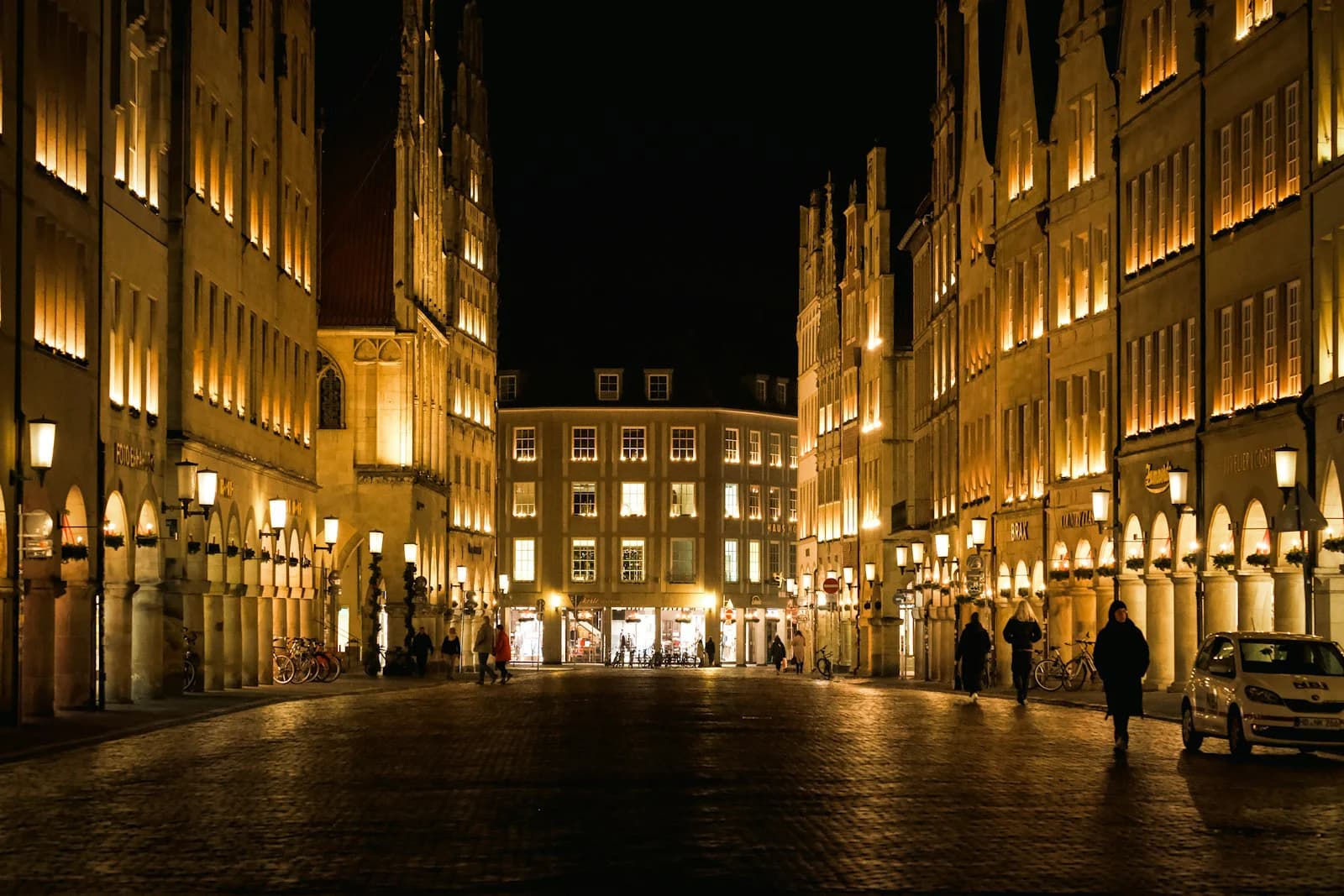
Three days suit Münster because the city splits neatly into three different shapes rather than one long loop. The Altstadt is compact enough to cover on foot in a single day, the Aasee belt sits just outside the promenade ring with the Schloss, the botanical garden and the museum cluster, and a moated castle such as Burg Hülshoff or Haus Rüschhaus works as a half-day excursion. As a rough suggestion rather than an official figure, allow about three to four hours of gentle walking for the core old town, and treat the castle day as the one where you leave the centre behind.
What three days in Münster actually covers
Day one stays inside the Altstadt and carries the historical weight: Prinzipalmarkt, the Historic City Hall and its Friedenssaal, St.-Paulus-Dom, St. Lamberti and the market square. Day two moves outward to the green belt along the Aasee, where the Schloss, the botanic garden and several very different museums sit close together. Day three is deliberately slower, pairing a moated-castle excursion in the Münsterland with neighbourhood time along Hammer Straße and an evening at the Stadthafen.
The logic is geographic, so you rarely waste time crossing the city twice. It also solves the museum question: Münster has enough collections to fill three days on their own, and picking one per day keeps the trip humane. If your time is tighter, the same ground compressed into a 2 days in Münster itinerary drops the castle excursion and the neighbourhood block first.
How to shape the three days before you arrive
Book anything with a fixed start time before you travel, and keep the rest flexible. The Friedenssaal is entered through the Historic City Hall rather than as a standalone room, and access can be tied to guided tours, so check the Stadt Münster tourism pages for how entry currently works. Museums and the open-air Mühlenhof publish their own opening times, and these shift seasonally, so verify them in the week you travel instead of trusting an older guide.
A visitor card concept exists in Münster, but inclusions, validity and partner attractions change, so read the current terms before buying rather than assuming a card covers the sites you have chosen. The car-free promenade ring is the single biggest routing constraint and the biggest convenience: it circles the Altstadt, so you can cross the old town on foot or by bike without traffic, and the flat centre means walking distances stay short. Keep the castle day for the trip that needs transport, and let the other two days stay on foot.
Day 1, morning: Prinzipalmarkt, the Historic City Hall and the Friedenssaal
Start on Prinzipalmarkt, the arcaded marketplace whose gabled houses were rebuilt in a deliberately old-meets-new style after the Second World War. Much of Münster was destroyed in the war, and the reconstruction kept the characteristic scale, the arcades and the gold shop lettering instead of modern signage, which is why the street reads as historic even though most of the fabric is post-war. Walk the full length slowly before the shops fill up.
The Friedenssaal inside the Historic City Hall is the reason this square matters in European history. On 15 May 1648 the Spanish-Dutch treaty was ratified here, the first part of the Peace of Westphalia, and the city still frames itself around that peace-making role. Expect carved wooden panelling and a wall of delegate portraits; check the city's own pages for current access arrangements before you build your morning around it.
If the peace history is what drew you here, a themed walk is a better use of the morning than hopscotching between plaques. The Münster history and Peace of Westphalia walk connects the town hall, the cathedral square and the surrounding streets into one narrative. Budget roughly ninety minutes for it and leave the rest of the morning open.
Day 1, midday: the cathedral, the astronomical clock and St. Lamberti
St.-Paulus-Dom anchors the Domplatz and is the city's most important Catholic church, built from the thirteenth century in a Romanesque-to-Gothic transition and heavily rebuilt after wartime damage. Its astronomical clock, dating from the sixteenth century, still runs and draws a small crowd when it chimes, and the cathedral is normally free to enter outside services. Opening status and hours are published by the cathedral itself, so check them rather than relying on any guide.
A short walk north brings you to St. Lamberti, the late Gothic church at the top of Prinzipalmarkt. Construction ran from 1375 to 1525, and three iron cages hang from the spire where the bodies of executed Anabaptist leaders were displayed after the 1530s uprising; the cages were taken down in 1881 and reattached in 1898. That detail makes the spire worth looking up at, and it also makes the church the most historically charged stop of the day.
Both churches are working parishes, so time your visit around services rather than treating them as attractions. Midday is a reasonable window for the cathedral clock, and the walk between the two takes a few minutes across the market square. Keep the pace easy here; the Domplatz cluster is where the afternoon begins.
Day 1, afternoon: choosing one museum in the Domplatz cluster
The museums around Domplatz are separate institutions with separate tickets, so a single pass does not unlock all of them. The LWL Museum für Kunst und Kultur holds more than a thousand years of art history, from medieval religious works to contemporary pieces, and reopened after a long renovation with a reworked interior and lighting scheme. Labels are available in English as well as German, which makes it the easiest pick for a mixed-interest group.
The Museum Pablo Picasso is the other obvious option on the square, with works by Picasso on one floor and his contemporaries on another; written descriptions there may be German-only, with an audio guide available. The LWL Museum of Natural History with Planetarium is a different animal entirely and belongs with the Aasee day rather than this one. Decide by interest, not by proximity, and accept that one of the three will have to wait.
The Stadtmuseum on Salzstraße is a lighter alternative and has a strong local-history remit, tracing the city from its foundation to the present. A free city museum is a sensible fallback if the big art museum feels like too much after a morning on your feet. Check current opening hours and any exhibition changes before setting out, and note that temporary shows rotate.
Day 1, evening: eating around the market square and the midweek market swap
The eating around Prinzipalmarkt and Domplatz runs from traditional Westphalian pubs to cafés with terraces on the square, and a few well-known addresses sit within a minute of the town hall. Reserve for dinner on weekends if you have a specific place in mind, since the centre is compact and popular. If you would rather keep it loose, the square has enough turnover that you can walk and choose.
The scheduling tip that changes the whole trip is the Domplatz market. Around 150 stalls sell produce, cheese, meat, bread, flowers and snacks on the square, and it runs on Wednesday and Saturday mornings according to the market organisers, though you should confirm current days and times before planning around it. If your three days include a Wednesday or Saturday, swap your mornings so you catch the market at its best and treat it as breakfast.
Day 2, morning: Schloss grounds and the botanical garden
The baroque Schloss on the western edge of the Altstadt was built in the eighteenth century and now belongs to the University of Münster, so it is a university building rather than a museum. That distinction matters: you can walk the grounds and the surrounding park, but the interior is not a visitor attraction. Treat the Schloss as scenery and a starting point, not as a scheduled stop.
Directly behind the palace sits the university's botanical garden, which is commonly reported as free to enter and holds thousands of plant species across an alpine section, an arboretum and glasshouses. Sources differ on how generous the collection feels on a short visit, so go for the calm rather than for spectacle. It is the easiest green break of the trip, and it sits within a few minutes of the Schloss.
A note on the Erbdrostenhof: the eighteenth-century noble court on Salzstraße is admired from outside, but it houses administration and offices and is not visitable as a museum. See it on a walk between the Altstadt and the Aasee rather than planning a stop. The combination of palace park, garden and this façade makes for an unhurried morning.
Day 2, midday: one museum on the Aasee belt
The Aasee belt concentrates several very different museums, and choosing one is the whole decision. The LWL Museum of Natural History with Planetarium suits families and the scientifically curious, with natural-history displays and a planetarium under the same roof. Sentruper Straße is the address shared by several of these sites, which is why the cluster feels like a campus rather than a street.
The Picasso museum, if you skipped it on day one, remains an option, but it sits back in the Altstadt rather than by the lake; combining it with the lake is inefficient. Whichever you choose, confirm opening hours and planetarium show times directly with the museum before travelling, since both vary by season and programme. Do not assume every museum in the complex shares a ticket.
Day 2, afternoon: the Aasee promenade, Mühlenhof and the zoo question
The Aasee is a long, narrow artificial lake with paths running its full length, plus boat rental and sailing on the water in season. Walking the entire circuit takes a couple of hours at an easy pace, so decide in advance whether you want the full loop or just the northern end near the centre. The banks are one of the city's main picnic and downtime spots, and the sculpture trail along the water gives the walk a rhythm.
The Mühlenhof open-air museum sits beside the lake and gathers historic rural buildings, including a bakery, a smithy and a mill, from the Münsterland region; the site covers roughly five hectares. A visit of about an hour is a reasonable suggestion, though the museum publishes its own seasonal opening times and admission arrangements, so check before you go. It pairs naturally with a lakeside walk rather than replacing it.
The zoo-and-Horse-Museum question is genuinely one decision, because the Westfälisches Pferdemuseum sits inside Allwetterzoo Münster and cannot be visited separately. If the horse collection is the point of the visit, you are effectively buying zoo entry, and families with small children should weigh that against spending the same afternoon at the lake and the open-air museum. Check the zoo's own site for current admission scope and opening times rather than relying on any published figure.
Day 2, evening: the Stadthafen waterfront
The Stadthafen on the Dortmund-Ems Canal is the former industrial harbour turned eating and nightlife district, with terraces along the water and a mix of converted warehouses and new buildings. It is busiest in the evening and quieter during the day, so plan it as a dinner stop rather than an afternoon attraction. The walk back into the centre is short enough to do on foot.
The Hot Jazz Club and the student-oriented bars around the harbour give the evening a second act if you still have energy. This is the part of Münster that feels least like the Altstadt, and it is worth seeing for exactly that contrast. If you would rather stay central, Prinzipalmarkt and the surrounding streets keep serving late.
Day 3, morning: the moated-castle day trip
Burg Hülshoff and Haus Rüschhaus make one excursion rather than two, about ten kilometres from the city and reachable by bike or by regional transport. Both are Wasserburgen, moat-defended castles, and both belonged to the von Droste-Hülshoff family; Burg Hülshoff is the birthplace of the poet Annette von Droste-Hülshoff and operates as a museum with an audio guide through its rooms and a garden. The grounds and gardens can differ in access from the interiors, so plan for the possibility that only part of the site is open.
This is the one site in the itinerary where you must verify status before travelling, because opening arrangements at Burg Hülshoff have varied and at least one listing has shown it as temporarily closed. Check the castle's own website for current opening days and which parts are accessible. Haus Rüschhaus has likewise been closed at times while its garden stayed open, so treat the gardens as the reliable element and the interiors as a bonus.
If you would rather not leave the city, the Münsterland has other moated castles within day-trip range, including Vischering Castle with its museum displays on medieval life. The distances involved mean a bike or a regional train works better than a car for a half-day, and a rental bike lets you combine two sites in a morning. Build in slack for the return leg either way.
Day 3, afternoon: Hammer Straße and the Südviertel
The Südviertel south of the centre is where the city feels lived-in rather than touristic, and Hammer Straße is its spine: bakeries, cafés, small shops and a scattering of bars. The square in front of St. Joseph's church hosts a rotating food truck on several days of the week, and the summer strawberry and asparagus stands are a German seasonal fixture. Go with an appetite and no fixed plan.
This block is also the answer to a rainy or low-energy afternoon, since it is a covered-in-cafés kind of neighbourhood rather than a sightseeing one. The Kreuzviertel and harbour sit nearby and can be stitched onto the same walk if you want a longer loop back toward the water. Give it two hours and let the itinerary loosen.
Day 3, evening: a low-key last evening
For the final evening, choose between three moods rather than trying to do all of them. A last harbour dinner keeps things simple, a slow lap of the Promenade gives you the car-free green ring at dusk, and the GOP Varieté Theatre offers a scheduled show if you want a fixed plan and a proper finale. Check the theatre's programme directly for what is actually playing during your dates.
The Promenade is the one piece of Münster you can use on any of the three days without adjusting your plan, and it is worth saving a stretch of it for the end. It follows the old wall line, is car-free and is used by walkers, runners and cyclists alike; pedestrians should keep to the outer path because the middle is for bikes. On a short trip, that is a fitting last hour.
Where to base yourself and how to get around
Base yourself inside or just outside the promenade ring if you can. The Altstadt is walkable end to end, the Schloss and botanical garden are a short walk west, and the Aasee begins just beyond the ring, so a central base removes most transport decisions from the trip. Staying near the main station is the other practical option, since the harbour and the canal are immediately east of it.
Cycling is the local default and rental or hotel bikes make the castle day and the lake circuit considerably easier. Many hotels in the centre offer bike hire as a guest perk, and the city has cycle lanes on most roads plus dedicated parking in the centre and at the station. If you are not confident on a bike, the flat terrain and short distances mean walking still works for days one and two.
For regional travel, Münster Hauptbahnhof is the hub, and the city sits on the Dortmund-Ems Canal in the Westphalia region northeast of Cologne and Düsseldorf. Confirm current timetables and ticket validity with the transport operator before you rely on a specific connection, including for the castle day. Do not treat any single timetable as fixed for your travel dates.
Practical planning: what to verify the week you travel
Opening hours are the single most volatile detail in this itinerary. Churches, museums, the Mühlenhof and the castle sites all publish their own schedules and all change them seasonally, so check each site's own page in the days before you leave rather than trusting a guidebook or an older blog post. The same applies to temporary exhibitions, which rotate and occasionally close whole wings of a museum.
Admission prices are deliberately absent from this plan, because museum, zoo and castle pricing changes and no current figure can be quoted reliably here. Check each operator's own site for what a ticket includes, since the zoo and the Horse Museum are a single entry and the Domplatz museums do not share a pass. If you are considering a visitor card, read its current terms and compare against the specific sites on your list before buying.
Finally, verify the details that are easy to get wrong: whether the Friedenssaal is open on your dates and how entry works, whether the market is running on the Wednesday or Saturday you have, and what is currently open at the castle. A fifteen-minute check across the city's official pages and the individual operators covers all of it. Leave the rest of the plan flexible enough to absorb a closure.
Plan Your Visit
Three days in Münster works because the city is compact, flat and easy to walk, and because the three days do genuinely different things. Keep the Altstadt for the history, the Aasee for the green and the museums, and the third day for the castle and the neighbourhood streets south of the centre.
The only firm rule is verification. Confirm opening hours, market days, castle access and ticket scope with the operators themselves in the week you travel, and treat every suggested duration in this plan as a suggestion rather than a published figure. Everything else you can decide on the day.
Frequently Asked Questions
Is three days enough for Münster?
Yes, three days covers the city comfortably and still leaves room for one excursion. One day handles the Altstadt, including Prinzipalmarkt, the Historic City Hall, St.-Paulus-Dom and St. Lamberti. A second day covers the Schloss grounds, the botanical garden and the Aasee museums. The third works best as a moated-castle day trip plus neighbourhood time along Hammer Straße and the harbour. If you cut to two days, drop the castle and the neighbourhood block first.
Is Münster worth visiting?
It is, particularly if you want a historic German city that is walkable rather than sprawling. Münster rebuilt its old town after wartime destruction in a deliberately traditional style, and the Prinzipalmarkt arcades read as genuinely historic. The Peace of Westphalia history gives the city a seriousness that distinguishes it from a purely picturesque old town, and the Aasee green belt gives the trip a second centre of gravity.
What should you do in Münster with kids?
The Aasee belt is the most reliable answer: the lake paths, the Mühlenhof open-air museum with its historic buildings, and the LWL Museum of Natural History with Planetarium all sit within a short distance of each other. The zoo is the big-ticket option, and the Horse Museum sits inside it, so a family visit to the museum means buying zoo entry. Check the zoo's own site for current opening times and what a ticket includes before deciding whether the combined visit is worth it.
Sources
- Startseite | Stadt Münster
- 3-Day Muenster Itinerary
- Visit Münster: 2026 Travel Guide for Münster, North Rhine-Westphalia | Expedia
- You HAVE to Visit Münster! | chris-crossing germany
- Saint Lambert's Church, Munster | Religiana
- LWL Museum, Germany – darc magazine
- The Timeless Tower of Münster | Trip.com Munster
- The Day of the Netherlands | Stadt Münster
- Things to do in Münster, Germany in 3 days


