
The Friedenssaal, or Hall of Peace, sits inside the Historic Town Hall on Münster's Prinzipalmarkt. It is the room where the Spanish-Dutch Peace Treaty was ratified in May 1648, and where the Thirty Years' War ended with the Peace of Westphalia in October of the same year. Visitor accounts describe it as a spectacular hall with preserved wood panelling. This guide covers what you see inside, how entry works and how long to allow.
One practical point up front: allow roughly twenty to thirty minutes inside the hall itself. That is a suggested duration, not an official figure, and it reflects the fact that the Friedenssaal is a single historic chamber rather than a museum complex. Most visitors pair it with the Prinzipalmarkt colonnades and St. Lamberti Church, so the town hall becomes one stop on a short city-centre circuit.
What and Where the Historic Town Hall Is
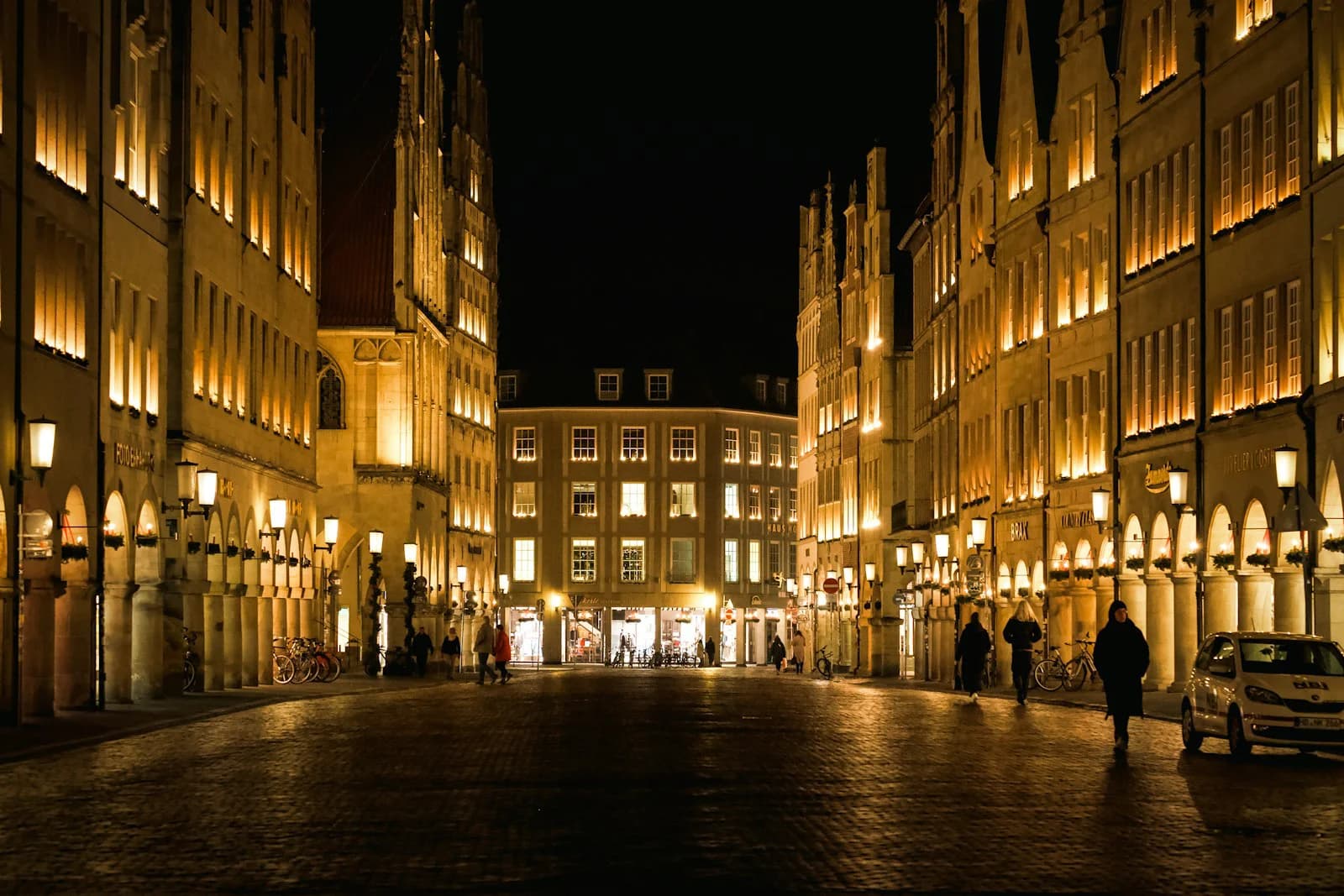
The Historisches Rathaus is a Gothic building standing on the Prinzipalmarkt, the elongated market square that most visitors treat as the centre of Münster. The Rathaus is described as one of the city's predominant landmarks alongside Münster Cathedral. The town hall sits at the northern stretch of the Prinzipalmarkt, close to St. Lamberti Church.
What you see today is largely a reconstruction. Allied bombing in the Second World War destroyed the Prinzipalmarkt and the town hall, and both were rebuilt in the 1950s to their original character from the mid-14th century. That postwar work is why a building described as medieval reads as crisp and complete rather than ruined. Knowing this changes how you look at the facade: you are seeing a careful twentieth-century reconstruction of a Gothic ensemble.
The Stadtweinhaus, the city's former wine store, stands immediately beside the Rathaus on the Prinzipalmarkt. Its external balcony was once used for important civic announcements, which underlines how tightly the town hall and the square were bound to city government. If you are already walking the colonnades, you pass both buildings without a detour.
What the Friedenssaal Is and Why 1648 Matters
The Friedenssaal is the historic chamber within the Rathaus where the Spanish-Dutch Peace Treaty was ratified in May 1648, ending the Eighty Years' War between Spain and the Dutch Republic. In October of the same year, the Thirty Years' War was concluded with the Peace of Westphalia, and the hall is associated with that settlement too. These are two distinct moments in 1648, not one event, and the room is the physical setting for both.
The city administration marks the significance of the May date directly. It notes that the first part of the Peace of Westphalia was ratified in the Peace Hall on 15 May 1648 through the Spanish-Dutch treaty, and that Münster and Westphalia have since been regarded as a symbol of the attempt at lasting peace among individual states. That framing is useful when you are standing in the room: the hall represents a diplomatic method as much as a single treaty.
Münster's role in the negotiations is also tied to the Haus der Niederlande, where peace talks between the Netherlands and Spain took place in a former guild house. That building now houses Dutch-language, literary, historical and political institutions, so the German-Dutch thread of 1648 runs through more than one address in the city centre. If the subject interests you, the town hall and the Haus der Niederlande make a coherent pair.
What You Actually See Inside the Peace Hall
The Friedenssaal has been preserved in its historic state, and the most striking elements are the original wood panelling and the seats. These furnishings were taken into storage during the Second World War and returned afterwards, which is the concrete reason the room looks as it does today rather than reading as a modern reconstruction. For a hall inside a rebuilt building, that survival of original interior fabric is the detail worth noticing.
Portraits of the key figures who brought the war to an end hang in the hall, alongside the panelling and a fireplace that features in visitor accounts of the room. Treat the room as a compact portrait gallery as well as a treaty chamber: the faces on the walls are the negotiating parties, not later civic dignitaries. Because the hall is small, the portraits and woodwork are close enough to read without rushing.
One claim worth setting aside before you go: sources state that visitors can sign the treaty themselves, but this is not accurate. The room offers the surviving interior and its historical associations. Anything beyond that should be confirmed with the operator rather than assumed from informal descriptions.
Free Grounds Versus the Booked Interior
The Prinzipalmarkt and the town hall's exterior can be seen without a slot: the gabled facades, the colonnades and the walk toward St. Lamberti are part of the open street. The Friedenssaal interior is a separate proposition and is entered on a visiting slot, so plan the exterior and the room as two different stops. If your time in Münster is short, you can still get the square and the building's setting even if you never step inside.
Booking a slot is the practical step to arrange in advance, and visitor accounts describe the hall as worth reserving rather than turning up for on impulse. The organiser does not publish a simple walk-in guarantee for the room, so the reliable approach is to check the Stadt Münster tourism pages for current visiting arrangements before you travel. Do not rely on a general assumption that the interior is always open, and do not treat a past visitor's experience as a standing rule.
The Münster Card is one entry route: sources state that cardholders can enter the Friedenssaal free of charge with the card. That is not the same as saying the hall is always free to everyone, so read it as one ticketing option among several rather than a blanket rule. If you are buying a card for other museums and transport anyway, it may cover this room as part of the package.
Entry Decisions: Cards, Slots and What to Verify
Because the hall is small and entered by slot, the decision is less about ticket price and more about fitting a fixed time into your day. Check the city's tourism pages for the current booking process and any fee that applies to a standard adult entry, since these details change and are published by the organiser rather than fixed in older visitor write-ups. The Münster Card, where it applies, is confirmed by visitor sources as a way into the hall at no extra charge.
The Münster Card also functions as a transport and museum pass, with sources describing unlimited public transport use and free or reduced entry at venues such as the Picasso museum and the LWL Museum of Art and Culture. If you plan more than one museum alongside the town hall, the card is worth comparing against individual tickets. Whether it saves money depends on what you actually visit, so list your intended stops before deciding.
Opening hours, closed days and holiday arrangements for the hall are not fixed here because they change and are set by the operator. Rather than guess, confirm the day's hours through the Stadt Münster tourism pages close to your visit date, and ask specifically about the Friedenssaal rather than the town hall in general. That distinction matters, because the building and the room may not follow the same schedule.
Putting the Hall in the Peace of Westphalia Story
Münster's claim to the peace story rests on the negotiations that ran through the 1640s and concluded in 1648. The city administration describes Münster and Westphalia as a symbol of the attempt to build lasting peace in a world of separate states, a framing that has been reused in modern German-Dutch commemorations. Standing in the hall, you are in the room where one part of that settlement was ratified.
Osnabrück's town hall holds the counterpart peace hall, and the two city halls share a European Heritage Label awarded in 2015 for their significance to European history. If you are travelling between the two cities, the pairing gives the treaty a geography rather than a single address. Within Münster, the Stadtmuseum picks up the city's longer history, including the Anabaptist episode that shaped its religious identity.
The Anabaptist rebellion of the 1530s is part of the same civic story and is still visible at St. Lamberti, where three iron cages hang on the tower. The cages were removed during nineteenth-century renovation and reattached later, and their presence is a reminder that Münster's Reformation history was violent as well as doctrinal. A short walk from the town hall brings you to the church and its tower.
Suggested Timing and Pairing with St. Lamberti
A suggested allowance of twenty to thirty minutes inside the Friedenssaal is realistic: it is one chamber, not a suite of galleries, and the content is dense but limited. Add time for the Prinzipalmarkt walk and the colonnades, which are the pleasure of the square itself. If you are also climbing St. Lamberti's tower or attending the cathedral's astronomical clock, build those in as separate stops with their own schedules.
St. Lamberti stands at the end of the Prinzipalmarkt, so the natural route is to walk the square, see the town hall, and finish at the church. The church is a late Gothic building modelled on Cologne Cathedral, and its opening times are published separately from the town hall's. Keep the two sets of hours distinct when planning, since neither automatically matches the other.
For the wider city, a landmarks overview helps you decide what else deserves a slot alongside the town hall. This Münster: Landmark Visitor Guides page groups the major sights so you can order them by interest rather than by geography alone. Pair it with a longer itinerary page if you are staying more than a day. For wider planning, see Münster city travel guides.
Sensible Add-Ons Around the Prinzipalmarkt
The Stadtmuseum Münster is a short walk away on Salzstrasse and covers the city's history from its foundation to the present, which gives context to the town hall and the Anabaptist period. It is described in visitor sources as free to enter, though you should confirm current arrangements with the museum before relying on that. For a history-focused day, the Stadtmuseum and the Friedenssaal complement each other well.
St. Paulus Dom sits a couple of minutes from the Prinzipalmarkt and is the city's other headline landmark, known especially for its sixteenth-century astronomical clock. A Münster Cathedral visitor guide is the right place to check its visiting arrangements before you build it into the same afternoon. If sacred architecture is the draw, the LWL Museum of Art and Culture on Domplatz covers a thousand years of art history across the square.
If you would rather spend the afternoon outside the old centre, the Kreuzviertel and the city harbour offer restaurants, converted warehouses and a very different side of Münster. The Münster Kreuzviertel and harbour is a reasonable counterweight to a morning of treaty history. Both are walkable or cyclable from the centre, and the city is famously easy to cross by bike.
Plan Your Visit
The Friedenssaal is a short, focused stop rather than a half-day museum, so plan it as one element of a Prinzipalmarkt walk that includes St. Lamberti and, if time allows, the cathedral. Book or confirm a visiting slot in advance, and check the Münster Card against your other planned stops before buying it. Verify the day's opening arrangements with the operator close to your travel date, since schedules change.
Allow roughly twenty to thirty minutes inside the hall, longer if you read the portraits and the room's detail carefully. Pair it with the Stadtmuseum for city history or the LWL Museum of Art and Culture on Domplatz if you want a fuller day. Because the hall is entered on a booked slot, treat it as a fixed point and arrange the rest of your afternoon around it.
Frequently Asked Questions
What is the Friedenssaal known for?
The Friedenssaal is the historic chamber inside Münster's town hall where the Spanish-Dutch Peace Treaty was ratified in May 1648, ending the Eighty Years' War. In October of the same year, the Peace of Westphalia concluded the Thirty Years' War, and the hall is associated with that settlement. It is known for its preserved wood panelling, returned from wartime storage, and for the portraits of the figures involved in the peace negotiations.
Do I need to book to visit the Peace Hall?
The interior is entered on a visiting slot rather than treated as open, walk-in space, so the practical step is to arrange your slot in advance through the city's tourism channels. Booking requirements and current arrangements are published by the organiser and can change, so confirm the process close to your visit date. The Prinzipalmarkt and the town hall exterior can be seen without a slot, so the square is available regardless.
How long should I spend in the Historic Town Hall and Peace Hall?
Allow roughly twenty to thirty minutes inside the Friedenssaal itself. It is a single historic room rather than a museum circuit, so the visit is short, and the extra time is for reading the panelling and portraits. Add separate time for the Prinzipalmarkt walk, St. Lamberti and the cathedral if you plan to see them in the same outing.
Can I enter the Friedenssaal with the Münster Card?
Sources state that cardholders can enter the Friedenssaal free of charge with the Münster Card, which makes it one entry route rather than a general statement that the hall is always free. The card is also described as covering public transport and other museums, so it is worth comparing against individual tickets based on what you intend to visit. Confirm current terms with the operator before buying.
What else is near the Historic Town Hall?
St. Lamberti Church stands at the end of the Prinzipalmarkt, a short walk from the town hall, and St. Paulus Dom is a couple of minutes away near Domplatz. The Stadtmuseum on Salzstrasse covers the city's history, and the LWL Museum of Art and Culture is on Domplatz. All are within the compact old centre, so they can be combined on foot.


