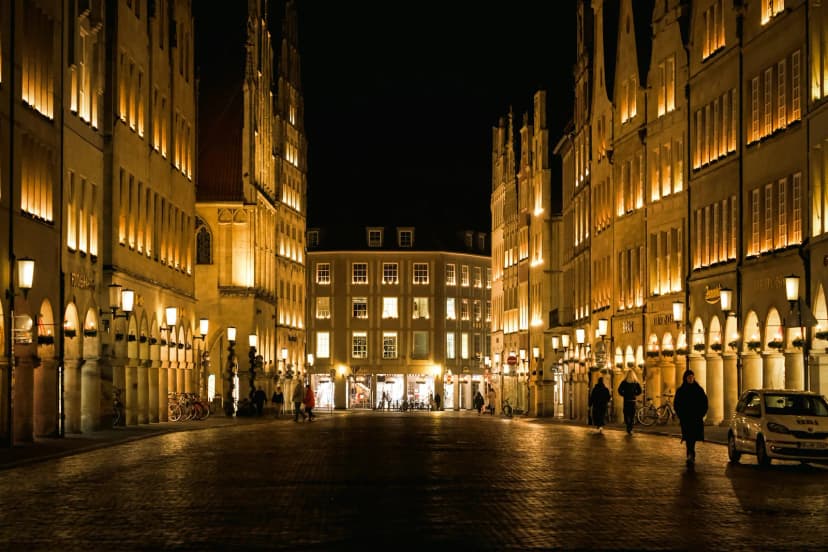
St. Paulus Dom is the cathedral of Münster and one of Westphalia's most significant medieval buildings. It is an active house of prayer first and a monument second, which shapes how you enter, where you may walk, and when sightseeing fits around services. The Diocese of Münster, the operator, publishes the practical information you need before you go.
A concrete first decision: the operator lists the cathedral as open from 6:30 to 19:00 on weekdays and the same 6:30 to 19:00 on Sundays and public holidays. Those long hours make an early stop realistic before most other Münster sights open, and they also mean a service can be in progress whenever you arrive. Check the current service schedule alongside the posted hours.
Why St. Paulus Dom Anchors a Münster Trip
Historic Germany describes St. Paulus Dom as a Romanesque-Gothic cathedral, largely rebuilt after World War II destruction, whose 13th-century cloister and treasury of medieval religious art survived the bombing. That combination explains why the building feels both monumental and layered: it is a thousand-year accumulation of building phases and artworks rather than a single-period monument.
The cathedral is also the natural start of an old-town walk. From Domplatz, the arcade-lined Prinzipalmarkt, St. Lambert's Church and the Rathaus with its Peace Hall sit within the compact historic centre. If you want to link the cathedral into a wider route, the Prinzipalmarkt and Altstadt walk in Münster picks up the nearby streets, and you can plan the full sequence through the city guides hub for Münster.
Because St. Paulus Dom is an active place of worship, it serves two audiences at once. Services, confession and private prayer take priority over tourism, and the operator publishes a visitor order that applies from the moment you step inside. Reading it before you arrive is a practical step that prevents awkward moments later.
Opening Hours: What the Operator States
The Diocese of Münster lists the cathedral's opening hours as 6:30 to 19:00 on weekdays and the same 6:30 to 19:00 on Sundays and public holidays. Those hours are aimed at worshippers and sightseers alike, which is why they start so early and run so late. Treat them as the cathedral's own hours only, not as hours for the museum, the treasury or any tower.
One practical consequence follows: because services and liturgical events take precedence, a time that is technically within opening hours may not be a good moment for sightseeing. The operator publishes the current service schedule and notices on its site, so check that page shortly before you go, particularly on Sundays and feast days.
The single most important timing decision is the noon window. Historic Germany reports that the astronomical clock of 1540 is associated with a daily noon event featuring figures that represent the Magi paying homage to the Virgin Mary. Plan to be inside shortly before noon if that is a priority, but keep a backup plan for the rest of your morning in case the moment does not unfold as expected.
Free Entry and the Treasury at the PAULUS Museum
The cathedral functions as a free place of worship and prayer, and the operator's visitor information covers entry for both worship and personal viewing without publishing an admission price for the church. No price should be assumed for the cathedral interior. If you encounter a charged entry, it belongs to a separate facility rather than the church itself.
The treasury is the important exception. The operator's news section announces a new home for the Domschatz at the PAULUS Museum, and the museum is listed separately from the cathedral in everything from tour booking to event listings. That separation means a cathedral visit and a treasury visit are two different stops with their own arrangements.
Because the cathedral publishes no ticket scope for the treasury, do not assume any single ticket covers both. Check the PAULUS Museum's own information for what is included, what a visit costs and when it is open, and treat any figure you find elsewhere as unverified until the museum confirms it. For the treasury, church art and cloister in more depth, the Münster Cathedral Treasury and cloister guide covers the collection side of the visit.
Access: The Barrier-Free Clock Portal and Induction Loop
The operator states that people with disabilities can enter the cathedral through the barrier-free clock portal, which has automatic door openings. It also states that an inductive hearing system, an induction loop, serves visitors with hearing aids in the nave. These are two specific, verifiable access features rather than general promises.
The operator's Domplatz parking notice, valid from 1 July 2023, mentions nine marked spaces for people with a severely disabled pass near the barrier-free clock portal and six more in the Post area. Those details sit inside a broader parking notice, so read the full notice and the site plan rather than relying on the headline. Anyone with a mobility aid should also factor in the cathedral floor itself, which is a working church rather than a flat museum gallery.
The operator also runs specially designated barrier-free guided tours alongside its standard public tours. Availability and timing for those change, so confirm with the cathedral administration rather than assuming a slot on your date. If a tour is essential to your visit, build the day around a confirmed booking instead of around a hoped-for walk-up place.
The 1540 Astronomical Clock
The astronomical clock dates from 1540 and is one of the cathedral's headline works. Historic Germany describes a daily noon event in which figures representing the Magi pay homage to the Virgin Mary. The operator publishes a page on the clock but does not promise visitors that the figures move on any given day, so treat the noon timing as a reported convention rather than a guaranteed show.
Position yourself with a clear view of the clock face before noon rather than arriving at the stroke of twelve, because the space around it fills quickly when a service or group is also in progress. If the figures do not move while you are there, the clock itself is still worth the detour: its dial rewards a slow look at the calendar, saints and astronomical indications around the face.
One useful decision is whether the clock justifies rearranging your day. If you are in Münster for several hours, timing a visit around noon costs little and adds a memorable anchor to the morning. If you have only a brief window, the clock is worth seeing but not worth abandoning a tight itinerary for.
The Cloister and the Cathedral's Medieval Art
The cloister has survived since the 13th century, making it one of the oldest continuous elements of the complex. Historic Germany notes that the cloister and the treasury of medieval religious art came through the wartime bombing, which is why the atmosphere there feels different from the rebuilt nave. Walk it slowly: the rhythm of the arcades and the surviving carved detail are the point.
Inside the church, the operator presents the building as a study in a thousand years of church history, with themed routes covering the architecture, the artworks and the spiritual life of the cathedral. Those self-guided routes are a good way to avoid drifting without direction. Allow more time than you think if you follow one properly.
The treasury material that once sat with the cathedral is now presented at the PAULUS Museum, so the medieval goldsmiths' work, reliquaries and liturgical objects belong to a separate museum stop. If your interest is objects rather than architecture, plan that visit as its own block rather than squeezing it into a cathedral hour. The Cathedral Treasury and cloister page explains what that collection involves.
Domplatz Market Days and Parking Conflicts
Historic Germany describes the Domplatz in front of the cathedral as hosting one of Germany's finest markets on Wednesday and Saturday mornings, drawing farmers and vendors from across Westphalia. Those are the days when the square is at its liveliest and also at its most congested. If your priority is a calm look at the cathedral facade, choose a different morning.
The operator's parking notice makes the trade-off explicit: a limited number of spaces on the area in front of the cathedral towers are reserved for worshippers during service times, weekdays 7 to 10 and Sundays and public holidays 7 to 14, and parking is not permitted there on market days. The notice is valid from 1 July 2023, so it reflects the arrangement the diocese publishes rather than a temporary alert. Read the full notice and the site plan before you drive in.
Practically, this means arriving by public transport or on foot removes a whole category of uncertainty. Münster has an unusually strong cycling culture, and the compact old town makes the cathedral easy to combine with nearby sights on foot. If you do drive, treat the market calendar as the decisive factor and check the operator's notice for the current arrangement before setting out.
How Long to Spend: A Suggested Budget
The cathedral publishes no official recommended duration, so any figure here is an editorial suggestion rather than guidance from the diocese. For a first-time visitor who wants to see the nave, the astronomical clock and the cloister, around one hour inside is a reasonable working estimate. Add time if you read slowly, take photographs or wait for the noon clock.
For a deeper visit, consider closer to two hours and split the time between the church and a separate treasury or museum stop. Because the treasury is now at the PAULUS Museum, that block has its own opening arrangements and should not be treated as an extension of the cathedral hour. If you only have a single day in the city, the One day in Münster itinerary shows what a realistic sequence looks like.
Consider the museum pairing as a choice rather than a default. The LWL Museum of Art and Culture in Münster holds medieval sculpture and Westphalian works that complement the cathedral's own art, so a visitor focused on religious art may prefer that over a second cathedral pass. Decide based on whether your interest is the building or the objects.
Etiquette and Guided Tours
The cathedral is primarily a house of prayer and worship, and the operator publishes a visitor order that applies from the moment you enter. That means quiet, appropriate dress and no touring during services. Photography, movement around the building and group behaviour are all governed by those rules.
The cathedral administration offers guided tours of St. Paulus Dom outside service times, led by trained cathedral guides, generally lasting around an hour according to the operator. It also publishes a range of themed tours, including barrier-free and interreligious formats. Whether a tour runs on your date depends on the schedule, so verify with the administration rather than assuming a place is available.
If you want a tour, booking ahead is the reliable route, because the operator does not publish a guarantee of walk-up places. Independent visitors can explore the cathedral themselves outside service times, which is often the simplest option for a short stop. Note that tour arrangements for the museum are handled separately from tour arrangements for the cathedral.
Pairing the Cathedral with Nearby Sights
The cathedral sits within easy walking distance of Münster's other headline sights, which makes it an efficient starting point for a half day. Historic Germany highlights the Peace Hall in the Rathaus, where the Peace of Westphalia was signed on 24 October 1648, and St. Lambert's Church with its famous iron cages. Both sit along or beside the Prinzipalmarkt.
A sensible order is the cathedral first, while it is quiet, then the Prinzipalmarkt and the Rathaus, then St. Lambert's Church. The Prinzipalmarkt and Altstadt walk in Münster gives that route structure without needing a guide. Keep the distances short and let the day absorb one or two stops properly rather than racing through five.
If you want a wider framework for choosing between Münster's churches, museums and squares, the Münster landmark guides collection sets out the individual sights. Use it to decide what earns a slot next to the cathedral rather than as a checklist to complete. The city rewards depth over coverage.
Plan Your Visit
St. Paulus Dom works best as a morning stop: the operator's hours begin at 6:30 and the cathedral is open until 19:00 every day, so an early visit buys you quiet before the tour groups and the market crowds arrive. Aim to be inside before noon if the astronomical clock matters to you, and treat the figures' movement as a possibility rather than a promise.
Before you travel, confirm three things on the operator's own pages: the current opening hours and service schedule, the treasury arrangements at the PAULUS Museum, and the parking rules for the Domplatz on market days. Those three checks resolve almost every practical uncertainty about a visit. Everything else, including how long you stay, is a judgement you can make on the day.
Frequently Asked Questions
Is Münster Cathedral free to enter?
The cathedral is an active place of worship, and the operator publishes visiting information for both prayer and personal viewing without listing an admission charge for the church itself. The treasury is a different matter: it is now housed at the PAULUS Museum, which is a separate institution with its own arrangements. Check the museum's own pages for what a visit there involves rather than assuming the cathedral and the collection share one entry.
What are the opening hours of St. Paulus Dom?
The Diocese of Münster lists the cathedral as open from 6:30 to 19:00 on weekdays and likewise from 6:30 to 19:00 on Sundays and public holidays. Those hours cover the cathedral only and do not extend to the museum, the treasury or any tower. Because services take precedence, check the operator's current service schedule before you plan a sightseeing stop, especially on Sundays and feast days.
What time does the astronomical clock run in Münster Cathedral?
The astronomical clock dates from 1540 and is associated with a noon event in which figures representing the Magi pay homage to the Virgin Mary. Whether the figures move on any given day is not something the available sources guarantee, and services can affect access to the area around the clock. Arrive a little before noon and keep your expectations flexible; the clock face itself repays a slow look regardless.
How long should I spend at Münster Cathedral?
There is no official recommended duration, so any figure is an editorial suggestion. Around an hour inside is realistic for the nave, the astronomical clock and the cloister at a steady pace. If you want to add the treasury at the PAULUS Museum or spend time with the cathedral's art-historical routes, plan closer to two hours and treat the museum as a separate stop with its own timing.
Is Münster Cathedral wheelchair accessible?
The operator states that visitors with disabilities can enter through the barrier-free clock portal, which has automatic door openings, and that an induction loop serves hearing-aid users in the nave. Marked accessible parking spaces are mentioned near that same portal and in the Post area. For barrier-free guided tours and any current changes, confirm directly with the cathedral administration before your visit.
Do I need to book a guided tour of the cathedral?
The cathedral administration runs guided tours outside service times with trained guides, and it also offers themed formats including barrier-free tours. Independent visiting is possible outside services, so a tour is optional rather than required. Because schedules change, contact the administration in advance if a specific date or language matters to you instead of relying on a place being available on arrival.
When is the market on Domplatz?
Historic Germany describes the Domplatz market as running on Wednesday and Saturday mornings, drawing vendors from across Westphalia. On those days the square is busy and the operator's parking notice states that parking is not permitted there on market days. If you want a quiet view of the cathedral facade, visit on a non-market morning and check the operator's current notice before driving.