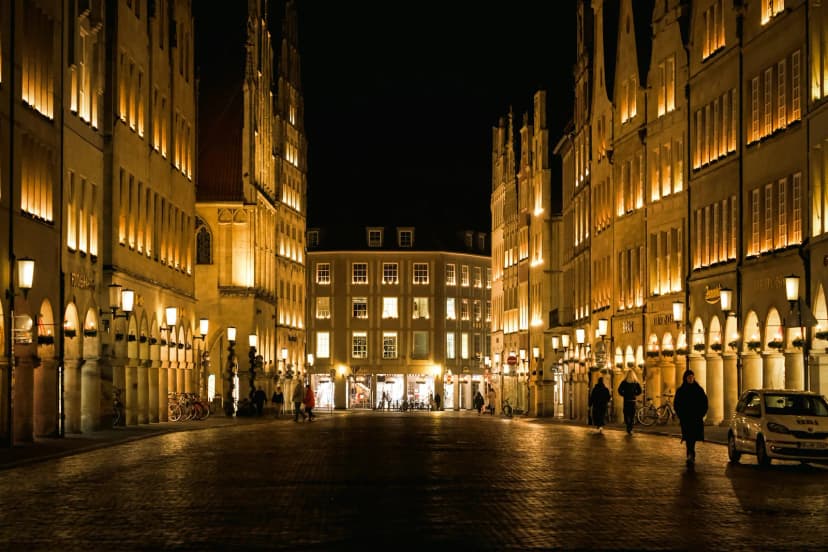
St.-Paulus-Dom anchors Münster's old town on the Domplatz, and the cathedral administration publishes opening hours of 6:30 to 19:00 on weekdays and on Sundays and public holidays. That basic access is the part you can count on. The treasury and a possible cloister visit are different questions that require a little homework before you commit an afternoon to them.
The cathedral's own news bulletin carries a headline about a new home for the Domschatz and frames the PAULUS Museum as bringing history and the present into conversation. The cathedral administration has not published a standalone treasury ticket with its own entry price and visiting slot, nor does it present a cloister as a separately visitable or ticketed element. Treat the museum as the announced route to treasury objects and check its current programme and admission terms directly before you plan around them.
What Is Actually Free at St.-Paulus-Dom
Entering the cathedral itself is free, and the cathedral administration publishes daily opening hours of 6:30 to 19:00 for both weekdays and Sundays and holidays. Those hours apply to the church interior, not to every building you might associate with the cathedral. If you want to confirm the day's hours, the operator's own page is the source to check rather than third-party listings.
This is a working cathedral, so the visit comes with a Domordnung, a visitor order that asks guests to respect services and prayer. Guided tours run outside service times and last one hour according to the cathedral administration. If a tour matters to you, treat that as the one organised element that is clearly described and bookable through the operator rather than assuming a self-guided treasury route.
Third-party listings show differing opening times and a free-entry flag, but those figures are aggregator data rather than operator-confirmed rules. Use them only as a rough signal and check the cathedral's own published hours before travelling. The distinction matters because service times and liturgical events can interrupt ordinary visiting.
The Domschatz and the PAULUS Museum: What the Operator Says
The cathedral's own news section carries a headline about a new home for the Domschatz, with the PAULUS Museum framing history and the present together. That is a statement about where the treasury is being presented, not a confirmed ticket product with published prices and visiting hours. Read it as context for how the collection is being repositioned rather than as proof of a walk-in treasury attraction.
The cathedral has also announced the opening exhibition ICH GEHE – ABER WOHIN? in the PAULUS Museum, running from 27 August 2026 to 30 May 2027, open Monday to Saturday from 12:00 to 18:00 and closed on public holidays. Because that schedule belongs to a specific exhibition and can change with the next programme, confirm it on the cathedral page before you build a day around it. Do not assume the same slot applies to every future display.
If your main interest is medieval sacred art, the free cathedral interior already delivers a great deal: the apostle series, altars and choir chapels survived the war and remain in place. For a broader museum comparison in Münster, use the city's museum landscape to decide whether the PAULUS Museum or a larger art collection deserves your limited time.
Why You Cannot Assume One Ticket
Nothing in the cathedral's published material states that a single admission covers the cathedral, the PAULUS Museum and any cloister together. Cathedrals and their attached collections are often administered separately, with different hours and different funding. Plan as if the free church visit and any museum visit are two decisions, and check each one separately.
That separation also applies to how you budget time. A free interior visit can fit into a short break, while a museum stop consumes a much larger block and may be limited to the announced afternoon opening window. Look at the current programme and decide which of the two you would actually cut if the day runs short.
What You See Inside the Cathedral for Free
St. Paul's Cathedral was built between 1225 and 1264, a period of transition between Romanesque and Gothic art, and was largely destroyed during the Second World War. The astronomical clock, the series of apostles, epitaphs, altars and choir chapels escaped destruction and were preserved; after the war the cathedral was rebuilt identically. That surviving fabric is the reason the interior rewards slow looking rather than a quick circuit. Further visitor details appear in Saint Lambert's Church, Munster | Religiana.
The astronomical clock, a sixteenth-century mechanism that tracks planets, lunar phases and displays moving figures, is the single feature most visitors come for. One travel account describes the figures parading every day at noon, but that is a reported tradition rather than a guaranteed daily performance, especially on days with services or maintenance. Treat the noon timing as a bonus if it happens, not the reason your schedule works.
Beyond the clock, the apostle series and the choir chapels are the pieces that give the interior its weight. Because they sit within the free visiting area, a treasury visit is not required to see them. If the museum turns out to be closed or your window is tight, the cathedral alone still justifies the stop.
Suggested Time Budget and Getting In
As a rough suggestion rather than an official figure, allow around 30 to 45 minutes for the cathedral interior at an unhurried pace. Adding a museum stop pushes that to roughly an hour and a half to two hours, depending on how much of the collection you read. Track your own interests rather than the clock and adjust from there.
For wheelchair users and visitors with limited mobility, the cathedral can be entered through the barrier-free clock portal with automatic doors, and there is an induction loop in the nave for hearing-aid users. Nine marked accessible parking spaces sit near that entrance, with six more in the Post area. These are the details worth confirming on the operator site if access is central to your visit.
Parking on the Domplatz is deliberately restricted: a limited number of spaces are reserved for service attendees during service windows on weekdays from 7 to 10 and on Sundays and public holidays from 7 to 14, and parking is not allowed there on market days. If you are driving, plan to park elsewhere in the centre and walk in. Cyclists and pedestrians have an easier time of it in this part of Münster.
Building It Into a Domplatz and Prinzipalmarkt Walk
The cathedral sits directly on the Domplatz, with the LWL Museum for Art and Culture a short step away across the square. That proximity makes a combined church-and-museum morning or afternoon practical without any transport. Check current exhibitions before deciding which museum building gets your slot. For wider planning, see Münster on a Rainy Day.
From the Domplatz it is a short walk to the Prinzipalmarkt and the historic town hall, and on to St. Lamberti with its three iron cages on the tower, where the bodies of Anabaptist leaders were displayed after the 1530s riots. The late-Gothic church, built between 1375 and 1525, keeps its own opening times, published as Monday to Saturday 08:00 to 18:45 and Sunday 09:30 to 19:00. It is a separate building with its own arrangements, so do not fold it into a cathedral ticket assumption. It works well as a second stop on the same walk. Further visitor details appear in Saint Lambert's Church, Munster | Religiana.
If time is tight, cut the museum rather than the cathedral. The free interior, the clock and the walk through the old centre deliver the strongest return per hour, and a rushed museum visit rarely satisfies anyone. A relaxed cathedral stop plus the Prinzipalmarkt is a complete half-day in Münster.
When Rain Changes the Plan
Münster's weather can turn quickly, and a cathedral visit is one of the most reliable indoor options in the centre. If rain sets in, the sheltered interior plus a museum or two keeps the day productive without any long walks. Build a wet-weather alternative before you leave the hotel rather than improvising in a downpour, and lean on the city's indoor itinerary if the forecast is poor.
Verify the Day Before You Go
The short version: the cathedral interior is the dependable, free part of the visit, and the Domschatz story is still tied to the PAULUS Museum rather than to a confirmed standalone treasury tour. Check the cathedral's news and opening-hours sections the day before you travel, because exhibition programmes and seasonal schedules are exactly the sort of thing that changes.
If the museum is open during your window and the current exhibition interests you, add it; if not, the cathedral, the clock and the old town around it stand on their own. Decide in that order and you will not lose an afternoon to a closed door or a guess about tickets, and you will have a clear sense of what your visit does and does not include.
Frequently Asked Questions
Is the Münster Cathedral Treasury included with cathedral entry?
The cathedral administration does not publish any statement that entry to the cathedral includes the Domschatz. The cathedral interior is free to enter, while the cathedral's own news bulletin announces a new home for the treasury inside the PAULUS Museum, a separate institution with its own exhibition programme. Check the cathedral page for the museum's current opening days and ticket terms before you count on seeing the treasury on the same stop.
Is there a cloister at Münster Cathedral you can visit?
The cathedral's own published material does not present a cloister as a separately visitable or ticketed element of the visit. If a cloister or cloister-like space is open on the day, it would be part of the ordinary church visit rather than a distinct attraction, and access can vary with services and events. Ask at the cathedral or check the operator site rather than planning a route around it.
What time do the figures move on the astronomical clock?
One travel account describes the figures on the sixteenth-century astronomical clock parading every day at noon, but this is a reported tradition rather than a guaranteed daily event, and services or maintenance can interrupt it. Do not build your day around that single moment. Plan your cathedral visit for a comfortable window and treat any figure movement as a bonus if it coincides with your arrival.
How long does a visit to St.-Paulus-Dom take?
As a suggested budget rather than an official figure, allow around 30 to 45 minutes for the interior at an easy pace, and closer to two hours if you add a museum stop nearby. Guided cathedral tours run for one hour according to the cathedral administration, so a tour plus your own looking time will run longer. Adjust to how much time you spend at the clock and the choir chapels.