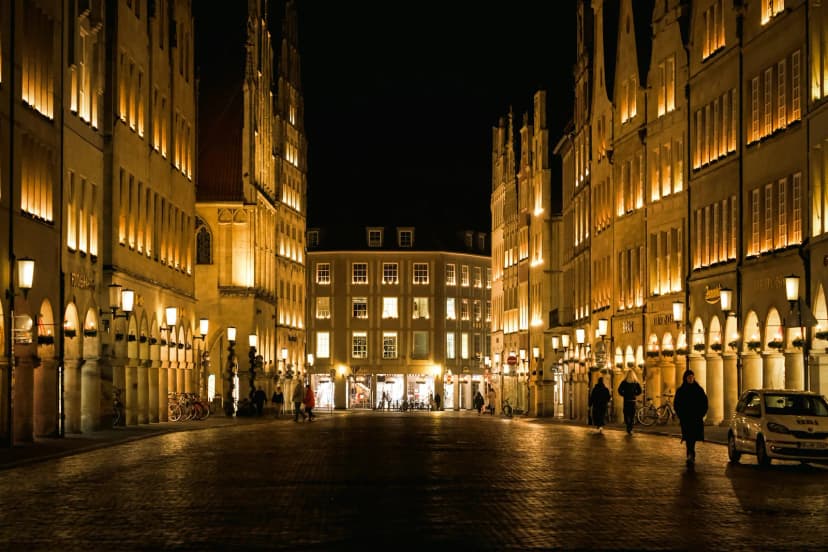
Münster handles rain better than most German cities because its historic core is small, walkable and unusually dense with indoor stops. The cathedral, St. Lamberti, the historic town hall and two major museums all sit within a few minutes of each other, so a wet day becomes a sequence of short hops rather than a slog. That compactness is the whole strategy: pick fewer stops, stay longer in each, and let the weather decide when you break for a café.
As an editorial suggestion rather than an official figure, allow around forty-five to sixty minutes inside the cathedral if you want to see the astronomical clock, the choir and the side chapels without rushing. This guide covers indoor options only, and it deliberately separates interiors you can simply walk into from collections that require a ticket. It also avoids quoting opening hours or prices, because those change and the organiser is the only reliable source. Before you set out, check the city's visitor pages and the individual site pages for the day you plan to visit.
Why Münster Works as an Indoor City When It Rains
The old town is ringed by a promenade rather than a busy road, which means you can cross from the station side to the cathedral quarter on foot without long exposed stretches. Between Domplatz, the Prinzipalmarkt and Lambertikirchplatz, the distances are short enough that a single umbrella covers most transfers. If the rain turns heavy, you are rarely more than a couple of minutes from a doorway.
The trade-off is that the most atmospheric parts of Münster are outdoors: the gabled Prinzipalmarkt facades and the market squares. On a wet day, treat those as brief connecting walks rather than destinations, and put your time into interiors. Churches are the obvious shelter, but remember that they are active places of worship, so you may find a service in progress and should step back rather than tour.
Münster's skyline is defined by its church spires, and the interiors behind them are the reason a rainy day here is not wasted. Saint Lambert's Church is a late Gothic building whose construction ran from 1375 to 1525, inspired by Cologne Cathedral and St. Vitus Cathedral in Prague, and it was restored in the later nineteenth century and again after wartime damage.
Münster Cathedral: The Anchor Stop
If you only commit to one interior, make it the cathedral on Domplatz. St. Paul's Cathedral was built between 1225 and 1264, in the transitional period between Romanesque and Gothic architecture, and although it was largely destroyed in the Second World War it was rebuilt identically. Its astronomical clock, the series of apostles, epitaphs, altars and choir chapels survived the destruction.
As an editorial suggestion rather than an official figure, allow around forty-five to sixty minutes inside if you want to see the clock, the choir and the side chapels without rushing. The astronomical clock is the detail most visitors come for, tracking planets, moon phases and moving figures, and it sits inside a church that has been a working Catholic cathedral for centuries.
The cathedral's fame makes it the busiest indoor stop in the city, and large groups can fill the nave quickly on wet afternoons. Arriving earlier in the day usually gives you a quieter visit and better light. Check the current visiting information before you go, since access can be affected by services and events.
St. Lamberti and the Prinzipalmarkt
St. Lamberti stands at the northern end of the Prinzipalmarkt, so it pairs naturally with a wet walk along the arcades. The late Gothic interior and the story of the three iron cages on the tower give the stop its weight: after the Anabaptist riots of the 1530s, the leaders of Münster were tortured and executed, and their bodies were hung in three iron baskets on the church tower. The baskets were removed in 1881 during renovation, reattached in 1898 and restored in 1927.
Treat this as a short shelter stop of maybe twenty to thirty minutes, again a suggestion rather than an official duration. Because it is an active parish church, entrance arrangements and access can vary, so do not assume you can simply walk in at any hour or that entry is always free.
The Prinzipalmarkt itself is the rebuilt heart of the city, and its gabled houses are best seen in a dry spell rather than in a downpour. Use it as the link between St. Lamberti and the town hall, and duck into the covered passages when the rain strengthens. The nearby Lambertikirchplatz gives you a second angle on the tower before you move on.
The Historic Town Hall and the Friedenssaal
The Friedenssaal inside the historic town hall is where the Peace of Westphalia story becomes concrete. On 15 May 1648, the first part of the Peace of Westphalia was ratified in the Peace Hall with the Spanish-Dutch treaty, which is why Münster and Westphalia are regarded as a symbol of the attempt to build lasting peace among individual states.
The decision here is straightforward: if the Eighty Years' War and the diplomacy of 1648 interest you, the Peace Hall is worth a proper stop. If you are mainly looking for dry space and have limited time, a quick look at the exterior and the Prinzipalmarkt setting may be enough. Either way, this is one of the few indoor stops in Münster where the room itself carries the history.
Check how the town hall is currently being presented for visitors before you plan around it, since civic buildings can change how rooms are used. The city's own pages are the right place to confirm what is open on your dates.
Choosing Between the City and Art Museums
Münster has two very different indoor options in the city centre: the Stadtmuseum, which tells the story of the city with historical objects and models, and the LWL-Museum für Kunst und Kultur, which covers the Middle Ages, the Old Masters, Modernism and Contemporary Art, plus temporary exhibitions. They sit close enough that you can decide on the day, but they suit different moods and energy levels.
The practical warning is not to assume that museums sharing a building, a complex or a sponsorship arrangement operate on one shared ticket. Check each museum's own information for what is included before you commit to a combined visit. If you want a direct comparison before you choose, a Best museums in Münster comparison is the faster route than reading two separate pages.
The LWL-Museum for Art and Culture reopened in September 2014 after a long construction period and now houses a library, auditorium, bookshop and restaurant alongside its galleries. That makes it a strong wet-afternoon choice if you want to combine art with a sit-down break. If your interest is narrower, the LWL Museum of Art and Culture Münster page covers the collection and visiting basics in more depth.
The Stadtmuseum is the better choice if you want the city's own narrative rather than art, and it works well as a shorter stop. Whichever you pick, check current exhibition and ticket information for your dates rather than relying on older summaries.
Other Dry Options in the Old Town
Beyond the headline sights, the old town holds smaller sacred spaces that work as short shelter stops. Überwasser Church, the Liebfrauen-Überwasser church, is a fourteenth-century Gothic hall church west of the centre, known for its tall, slender tower and its role as a major parish church. The Dominican Church is remembered for housing a recreation of Foucault's pendulum, blending a historic sacred space with science.
These locations remain active centres of worship, so check local parish schedules before you visit if you want to attend a service, and be prepared to leave quietly if one is underway. Do not treat any church as a guaranteed free indoor attraction, because entry policies vary and can change.
If you want more ideas in the same vein before you commit your route, the Münster: Landmark Visitor Guides hub collects the individual landmark pages in one place, which is useful when you are deciding which interior deserves your remaining time.
Building a Rainy-Day Route
Order the day by proximity rather than by importance. Start at the cathedral on Domplatz, cross to the Prinzipalmarkt for St. Lamberti, then walk the few minutes to the historic town hall, and finish with whichever museum matches your energy. On a wet day this gives you three short outdoor transfers instead of a long, exposed loop.
Build in buffer time rather than scheduling back-to-back stops. Churches may be closed for services, museums may have queues on wet weekends, and the pleasure of a rainy day in Münster comes from staying warm and unhurried. If a site turns out to be unavailable, the compact layout means a substitute is usually minutes away.
Know when to stop sightseeing and sit down. A museum restaurant or a café on the Prinzipalmarkt is a legitimate part of the plan, not a failure of it, especially if you are travelling with children or have already covered the cathedral and St. Lamberti. Fewer, deeper stops beat a checklist of ten sights in the rain.
If you are in the city for longer than a single wet day, a 3 days in Münster itinerary helps you spread the outdoor sights across the drier hours and keep the interiors for the wettest ones.
Practical Wet-Weather Decisions
Check current opening times before you go, for every site, on the day itself. Churches, the town hall and museums all publish their own arrangements, and the city's visitor pages at Stadt Münster are a good starting point for what is open in the old town.
Layer for unheated church interiors, which can feel cold even when the rain is mild, and carry a small umbrella rather than a large one for the open squares. Shoes that handle wet cobblestones matter more than waterproof trousers here, because the distances are short and the ground is the main obstacle.
One more indoor option worth knowing about is the Picasso Museum Münster, useful if you want a compact art stop rather than a large collection. The specific mistake to avoid is arriving at a church during a service or at a museum without confirming the day's arrangements; a five-minute check beforehand saves an hour of standing in the rain.
Plan Your Wet Day in Münster
A rainy day in Münster is a sequencing problem, and the answer is short transfers between warm interiors. Anchor the morning at the cathedral, pair St. Lamberti with the Prinzipalmarkt, decide honestly whether the Friedenssaal's history justifies the stop, and finish with a museum that matches your remaining energy. The city's compact old town makes this genuinely easy.
The only things you must verify yourself are the volatile ones: current opening times, current prices and whether a given room or church is accessible on your date. Check the organiser's own page for each site and keep the plan flexible enough to swap one interior for another.
Frequently Asked Questions
What can you do in Münster when it rains?
Focus on interiors: the cathedral on Domplatz, St. Lamberti by the Prinzipalmarkt, the Friedenssaal in the historic town hall, and the city or art museums. Because these sit within a short walk of each other, a wet day becomes a series of short, sheltered hops rather than a long route. Check each site's current visiting information on the day, since access can be affected by services and events.
Is Münster Cathedral free to enter?
Entry arrangements and any charges can change, so confirm on the cathedral's or the city's own pages before you visit rather than relying on older summaries. The same applies to other churches in the old town: they are active places of worship and policies vary. Treat any church as a possible rather than a guaranteed free interior.
How long do you need for the indoor sights in Münster's old town?
As an editorial suggestion, allow around forty-five to sixty minutes for the cathedral, twenty to thirty minutes for St. Lamberti, and a flexible block for the town hall or a museum. Adding buffer time matters more than compressing the list, because services and queues can interrupt a tight schedule. Fewer, deeper stops work better in the rain than a rushed circuit.
Is the Friedenssaal worth visiting on a wet day?
It is worth it if the Peace of Westphalia and the diplomacy of 1648 interest you, since the room itself carries that history. If you mainly want shelter and have limited time, the Prinzipalmarkt setting and a look at the town hall exterior may be enough. Confirm how the building is currently presented to visitors before you plan around it.
Which Münster museums are best for a rainy afternoon?
The Stadtmuseum suits a shorter, city-focused visit, while the LWL-Museum für Kunst und Kultur covers the Middle Ages through contemporary art and includes temporary exhibitions. The LWL-Museum reopened in September 2014 after a long construction period. They are close enough to decide on the day. Do not assume a shared ticket across museums sharing a building or complex; check each museum's own information for what is included.
What if you only have half a day in Münster and it is raining?
Choose the cathedral plus St. Lamberti and treat the Prinzipalmarkt as a short connecting walk. That combination gives you two substantial interiors and a manageable amount of outdoor exposure. If time remains, add one museum rather than trying to see everything, and check current opening times first.