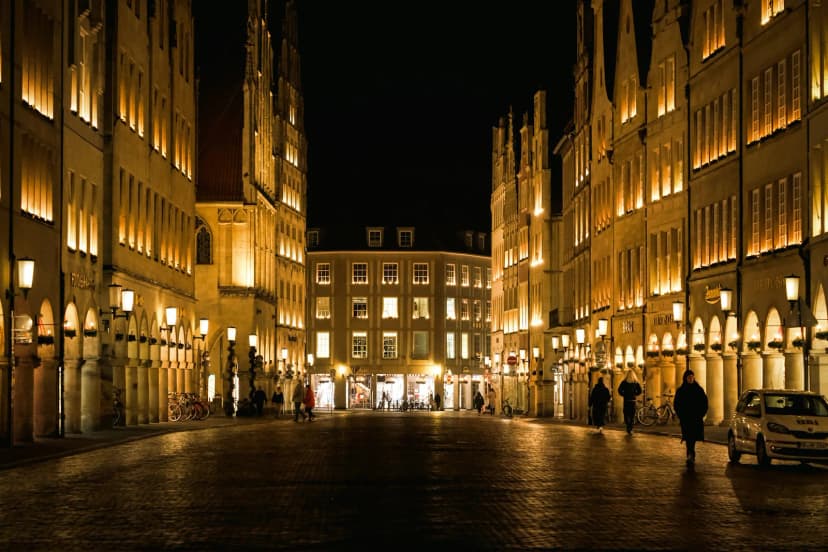
Münster fits a single day because its historic core is small, level and easy to read on foot. The Prinzipalmarkt, the Rathaus, the Dom and the Lambertikirche stand within minutes of one another. Saint Lambert's Church, for instance, was built over 150 years from 1375 to 1525, a late Gothic design inspired by Cologne Cathedral and St. Vitus Cathedral in Prague, according to the heritage register Religiana, and it was restored after the Second World War. The car-free promenade ring gives you a simple spine whenever you lose your bearings.
One planning caution shapes the day. Prices, opening hours and market schedules come from different operators, and older travel articles often quote figures that no longer apply. Military in Germany, writing about Münster's highlights, recommends checking the website for up-to-date opening hours and prices before committing to any ticketed interior. What follows is a walking order and a set of trade-offs, not a fixed timetable.
How Long You Need and How to Pace the Day
Our suggestion is to treat the Altstadt as a half-day loop and hold the rest of the day for one larger add-on. Walking the compact centre takes a few hours rather than a full morning if you keep moving, which leaves room afterwards for either a city museum or the Aasee. That split is our own recommendation, not an official figure, and it depends heavily on how long you linger inside churches and galleries.
Build in slack rather than stacking stops back to back. The walk from the Prinzipalmarkt up to the Schloss and gardens crosses the promenade, and the Aasee sits outside the ring entirely. If you fix only two anchor points, make them the Dom and the Schloss, then let everything else fill the gaps between them. A broader Münster landmark guide is useful for choosing which interiors deserve your remaining hours.
Stop 1: Prinzipalmarkt and the Historisches Rathaus
The Prinzipalmarkt is the obvious starting point, a gabled shopping street that is also a post-war reconstruction rather than medieval fabric. The original ensemble was destroyed in the Second World War and rebuilt afterwards, which changes how you read the architecture. Knowing that makes the street more interesting, not less, and it undercuts any assumption that you are looking at untouched centuries.
Inside the Historisches Rathaus, the Friedenssaal is the room where the Spanish-Dutch peace was ratified on 15 May 1648, the first part of the Peace of Westphalia. The City of Münster's own account of that date describes it as the moment Münster and Westphalia became a symbol of the attempt to build lasting peace among separate states. If the Thirty Years' War and the diplomacy that ended it interest you, the hall repays the detour; if you are mainly here for streetscapes, the Rathaus exterior and the square in front are enough.
Treat the Friedenssaal as a possible paid interior and check current admission and access before counting on going in. The hall sits inside a working city hall, so access can depend on opening windows rather than a continuous visitor schedule. Confirm details through the city rather than relying on older trip reports, which frequently quote admission figures that may no longer apply.
Stop 2: St.-Paulus-Dom and Domplatz
The Dom is a short walk from the Rathaus and is the strongest interior stop on the route. Construction began in the thirteenth century, replacing an earlier church, and much of the building had to be restored after wartime damage. The astronomical clock is the centrepiece: a sixteenth-century mechanism that tracks celestial movements and sets moving figures in motion. For wider planning, see Visiting St. Paulus Dom in Münster.
Check the cathedral's own published hours before building your day around a specific viewing, because church interiors close for services and schedules shift. If you want to see the clock perform, plan around midday and verify that the mechanism is still demonstrated on that day. A dedicated Münster Cathedral guide covers the building and its art in more depth.
Stop 3: Lambertikirche and the Iron Cages
At the northern end of the Prinzipalmarkt, the Lambertikirche closes the first arc of the walk. According to Religiana, the building was restored in the second half of the nineteenth century and again after the Second World War, and the three iron cages on the tower recall how, after the Anabaptist upheaval of the 1530s, executed leaders' bodies were displayed there. The cages were later taken down during renovation and reattached. For wider planning, see St. Lamberti Church Tower in Münster.
Expect the church to function as an active place of worship rather than a display, so services and parish use can interrupt sightseeing. Opening arrangements change often, and the safest approach is to check with the parish or the city's tourism pages on the day. Standing outside and reading the tower takes minutes; going in is a judgement call that depends on what is happening inside.
Midday Decision Point: the Wochenmarkt Outside the Dom
The weekly market on Domplatz is a reason to time your walk around midday rather than the early morning. It is a working street market, with produce, flowers and snacks spread across the square in front of the cathedral, and Military in Germany notes it draws a large number of vendors. Dogs are not permitted at the market, which matters if you are travelling with one.
Do not lock your day to a remembered market schedule, because market days and hours are published by the city and can change with seasons and holidays. Look up the current Wochenmarkt information in the week before you travel, and have a fallback lunch plan in the Altstadt if it turns out to be a non-market day. This is one stop where verifying beats assuming.
Stop 4: Schloss and the Botanical Garden
Cross the promenade to reach the Schloss, a baroque palace that now houses part of the university, and continue into the botanical garden within its grounds. Military in Germany notes the garden belongs to the university, is more than 200 years old and holds thousands of plant species along with several large greenhouses. Travellers report that the Schloss grounds and the garden are free to walk, while interiors elsewhere in the city are generally ticketed.
Do not assume the garden keeps fixed daily hours, and do not assume the palace and the garden share any entry arrangement. Gardens and glasshouses close at different times through the year and can shut for maintenance, so check the university's own pages rather than a blog post. Treat this as a pleasant open-air breather in the middle of a sight-heavy day rather than a destination in its own right.
Afternoon Branch A: the City Museums
If the weather turns or you would rather stay in the centre, the Stadtmuseum Münster is the natural history stop, using objects and models to tell the city's story from its foundation to the present. The City of Münster lists changing exhibitions there, so the show you read about online may already have closed. Check what is currently on before committing an afternoon to it.
The LWL-Museum für Kunst und Kultur is a separate institution with its own collection and ticket, spanning the Middle Ages through to contemporary art and hosting temporary exhibitions. It reopened in September 2014 after a long construction period, according to the design publication darc magazine. The two museums sit in the same compact area but are not a combined attraction, and a ticket for one does not cover the other.
Decide before you go in which of the two you actually want, because trying to do both properly in the same afternoon is unrealistic. Each publishes its own opening times and admission on its own site, and neither should be inferred from the other. If you are building a longer trip rather than a single day, a three days in Münster itinerary gives you room for both.
Afternoon Branch B: the Aasee, Mühlenhof and the Zoo
The Aasee sits just outside the promenade ring and turns a city day into something closer to a park day. You can walk or cycle the path around the water, and the lake is used for sailing and pedal boats in season. This is the branch to choose if you have already seen enough stone and want open space before the evening.
Two separate sites sit near the lake and both need checking before you commit. The Mühlenhof open-air museum assembles historic rural buildings from the Münsterland region on a compact site, while the Westfälisches Pferdemuseum is a horse museum located inside Allwetterzoo, meaning you cannot visit it without zoo admission. They are distinct attractions with distinct tickets, so plan them as two possible stops rather than one.
Neither the open-air museum nor the zoo publishes a price that stays stable year-round, and afternoon and seasonal rates differ, so look up current admission and hours on the operators' own pages. If your main interest is the horse museum, weigh whether paying full zoo admission for it makes sense. If the answer is no, walk the lake instead and save the museum for a trip when you want the whole zoo.
Getting Around: Walking, Cycling and the Promenade
The promenade is the single most useful orientation tool in Münster: a tree-lined, car-free ring around the old town that locals use constantly for running, dog-walking and cycling. Rather than treating it as a mandatory circuit of a set length, use it as a reference line and cut into the centre wherever a sign points toward something interesting. Signs along the route direct walkers toward the castle, the cathedral, the churches and the lake.
Cycling is genuinely how the city moves, and renting a bike for the afternoon is a reasonable way to reach the Aasee and the museums near it. The trade-off is that cycle traffic in the centre is dense and rules are enforced, so if you are not a confident urban cyclist, walking is the lower-stress choice. One long-term visitor to Münster describes the sheer volume of cyclists as both an environmental plus and something to watch for as a pedestrian.
Where to Eat and Where to Base Yourself
Eating well in Münster does not require a plan, but it helps to know which side of the centre you are on. The Altstadt and the streets around the market squares are where the busiest cafes and restaurants cluster, and the harbour area outside the ring has developed into the evening nightlife district with restaurants along the water. Students in Münster tend to eat in streets away from the old town, where full meals cost less.
For a base, staying inside or immediately beside the promenade ring puts the whole route within walking distance and removes the need to think about transport at all. Hotels near the station are convenient for arrivals and still close enough to walk in. Book on location rather than amenities if your priority is seeing the city in one day.
What to Cut First, and How to Extend
If the day runs short, cut in this order: the Aasee extension first, then one of the two museums, then the botanical garden. The Prinzipalmarkt, the Friedenssaal decision and the Dom are the parts that define a first visit to Münster, and they sit within a short walk of each other. Anything beyond the promenade costs travel time that a single day does not really have to spare.
If you do have a second day, the region around Münster holds several strong excursions, including moated castles, an archaeological museum devoted to Roman activity in the area, and peat-bog reserves with observation towers. Those are day trips in their own right rather than add-ons to an old-town walk. Keep them for a return visit rather than squeezing them in.
Plan Your Visit
A single day in Münster works because the city is compact, flat and organised around a car-free ring. Start on the Prinzipalmarkt, decide there whether the Friedenssaal interior matters to you, then walk to the Dom, the Lambertikirche and across to the Schloss and its garden. Hold the Aasee and the two city museums as the flexible part of the plan.
The one task that belongs on your pre-trip list is verification: check the cathedral and church opening arrangements, confirm whether the Wochenmarkt is running on your date, and look up admission and hours on each museum's own site rather than trusting older write-ups. Münster's sights are stable; its schedules are not.
Frequently Asked Questions
How long do you need for one day in Münster?
The compact old town can be covered on foot in a few hours, which leaves an afternoon free for one larger stop. Our suggestion is to treat the Prinzipalmarkt, the Rathaus, the Dom, the Lambertikirche and the Schloss as a half-day walking loop and then choose between the city museums or the Aasee for the rest of the day. That split is a planning suggestion, not an official figure, and it depends on how long you spend inside churches and galleries.
Is Münster worth visiting for one day?
Yes, if you want a walkable historic centre rather than a sprawling capital. The Prinzipalmarkt, the Rathaus with its peace hall, the cathedral and the Lambertikirche sit within minutes of each other, and the Schloss and botanical garden are a short walk beyond the promenade ring. The limitation is depth: with a single day you will choose one or two interiors rather than all of them.
Should you add the Aasee or Mühlenhof to a one-day itinerary?
Add the Aasee only if you want open space and are happy to walk or cycle outside the old town, because it sits beyond the promenade ring and eats into your remaining time. The Mühlenhof open-air museum is a separate site near the lake with its own admission, and the horse museum sits inside the zoo, so it requires zoo entry to visit. Check each operator's current hours and prices before deciding, since none of these are free interiors.