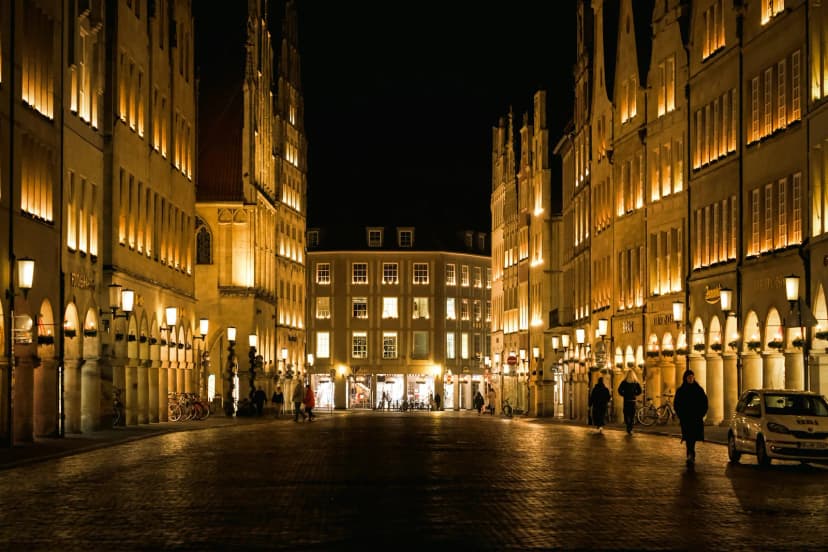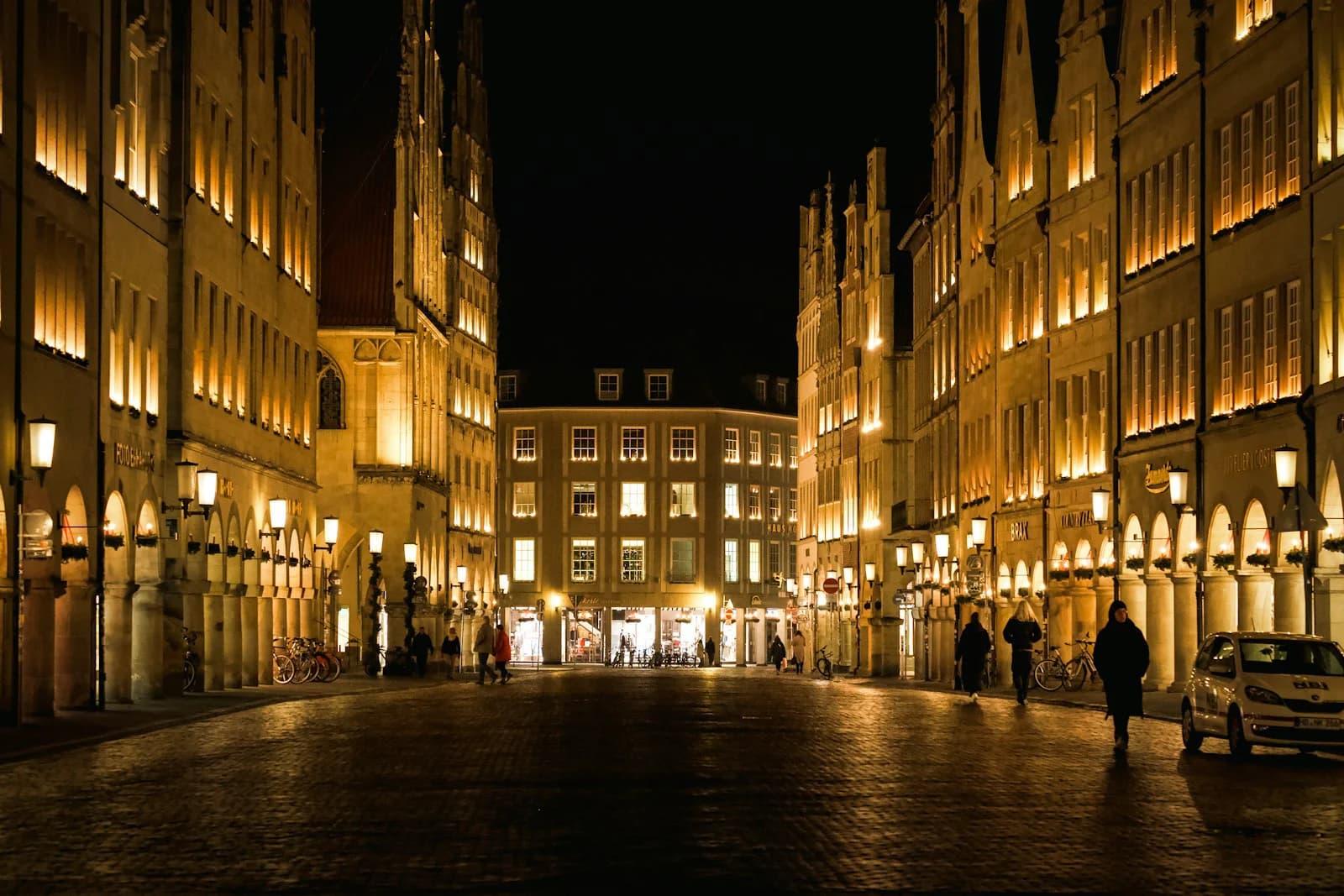
Münster concentrates its best-known sights in a small area: the arcaded Prinzipalmarkt, the Rathaus, and the Lambertikirche tower all sit within a few minutes of each other. That cluster is worth seeing, but it also means the crowds collect in roughly the same square kilometre. A quiet riverside stretch such as the Werse, a slow-flowing river that rises near Beckum and reaches the Ems after about sixty-seven kilometres, looks completely different from the postcard centre, and that contrast is the point. Further visitor details appear in Attractions and Places To See in the Münster Region - Top 20 | Komoot.
The starting decision for a hidden-gems day is not which sight to pick but what kind of visit you are prepared for. Münster mixes publicly accessible grounds, private property viewable only from outside, and ticketed interiors, and confusing those categories leads to disappointment.
This guide covers corners that are locally distinct rather than merely unfashionable: a moated castle on the city's edge, a mill and beer garden on the Werse, a protected bird reserve, and the old lanes inside the Promenade ring. It also flags two Droste-Hülshoff sites outside the city core, so you can judge the travel effort honestly. A Münster: Landmark Visitor Guides hub is a useful companion if you want each stop written up in more detail.
How to Tell Free Grounds From Ticketed Interiors
In Münster, the phrase "you can visit" hides at least three different arrangements. Some sites are open public ground where you can walk, sit and picnic without anyone checking anything. Others are private houses or working estates where the building is visible from a surrounding path but the property itself is off limits. A third group charges admission and may close on particular days or seasons.
Haus Vögeding is the clearest example of the middle case: a moated castle where only an outside tour is possible, although the meadow in front of the moat at the tower room lends itself to a picnic blanket. Treat any photographs you see of the tower and the water as views from outside, not interiors.
For anything with a ticket desk, do not assume that one payment covers every collection in the same building or complex. Some museums in Germany operate separate admissions for different floors, wings or partner collections, and Münster's institutions vary. The reliable approach is to check the operator's own website for the specific collection you want, then confirm the day's arrangements; the city's own site at stadt-muenster.de is a sensible starting point.
Haus Vögeding: A Moated Castle You View From Outside
Haus Vögeding lies outside the green gates of Münster, and its hidden location in the middle of open country makes it a surprising find for walkers and cyclists. A castle at this location was first mentioned in documents in 1353, when the house was donated to the Cappenberg monastery. What survives today is a fragment of a much larger property: the long farmhouse and a round tower are all that remain of what was probably a closed square farm complex surrounded by moats, built in the sixteenth century.
The ownership history explains the current situation neatly. From 1827 to 1939 the estate belonged to Baron Droste zu Hülshoff, then passed to a tenant farming family whose heirs still own it. That is why the visit is an outside tour: you look across the moat at private property rather than walking through it.
The realistic activity here is a picnic on the meadow beside the moat, which is the detail that makes the detour worthwhile. Bring what you need, because there is no facility cluster at the site itself. A suggested ninety minutes covers the approach, a slow look at the visible exterior and lunch on the grass; that timing is planning guidance, not an official figure.
Pleister Mill and the Werse: Scenery First, Beer Garden Second
The Pleister Mill combines two things visitors often conflate: a historic mill site on the Werse and a restaurant with a beer garden. Describing it as a mill with a beer garden and a stopping point on a river walk is fair; the scenery and the food are separate reasons to go, so treat the site as an outdoor highlight first and a table second. The mill is also a base for mini golf and canoeing on the river, which makes it a practical stop if you are travelling with children.
The Werse is a notably slow-flowing river that rises near Beckum and reaches the Ems after roughly sixty-seven kilometres, which is why paddling and gentle cycling suit it so well. A beautiful section of the Werse Cycle Path is entirely dedicated to cycling and hiking and is completely free of intersections, with frequent views of the water. Community ride reports describe it as well surfaced and lined with break benches, but those are user tips rather than verified current conditions.
A workable half-day is to cycle or walk a Werse stretch, then stop at the mill for coffee, cake or a meal before returning. Whether the beer garden is open depends on the season and the operator's current arrangements, so check ahead rather than assuming. If your priority is the river rather than the table, the path itself costs nothing and can be walked in either direction.
Rieselfelder Münster: A Bird Reserve, Not a City Park
The Rieselfelder sit just outside Münster and are a different category of green space entirely. They are a Natura 2000 protected area and bird reserve, created from former wastewater irrigation fields that were renatured between 1997 and 2000. That origin explains the flat, wet, open character of the landscape and the unusually rich habitat it now supports. Further visitor details appear in Attractions and Places To See in the Münster Region - Top 20 | Komoot.
The practical consequence is that you visit for observation rather than recreation. There are no lawns for ball games and no lakeside cafés, and the appeal is quiet looking and listening from the paths. Bring binoculars if you have them, and expect the experience to depend heavily on season and water levels rather than on any fixed attraction.
Because this is a protected reserve, stay on marked routes and keep noise low, especially in breeding season. If birdwatching is the main reason for your trip, check current access arrangements and any seasonal restrictions locally before travelling out. A suggested two hours on site suits a slow walk with stops; treat that as planning guidance only.
The Promenade Ring and the Kuhviertel Lanes
If you would rather not leave the centre, the Promenade is the in-town answer to the hidden-gems question. It is a 4.5-kilometre tree-lined ring following Münster's former fortifications, encircling the old town as a dedicated cycling and pedestrian path. Lime trees planted in the early nineteenth century shade the route, and the absence of motor traffic creates a peaceful green belt connecting parks, gardens and historic gates.
Inside the ring, the Kuhviertel is the neighbourhood to seek out for atmosphere rather than monuments. It is described as Münster's oldest quarter, named for the cattle once driven through its narrow lanes to market, and it largely escaped wartime destruction. That survival is why it preserves a medieval street pattern and half-timbered houses amid student pubs and traditional taverns.
Walking the Promenade and then cutting into the Kuhviertel works well as an evening loop, because you get the green belt first and the narrow lanes afterwards. It costs nothing and requires no booking, which makes it a good fallback when a ticketed sight is closed. If you are building a longer stay around this area, a 3 days in Münster itinerary can help you sequence it against the headline sights.
Kreuzviertel and the Harbour: A Different Local Axis
The Kreuzviertel and the harbour form a second quiet axis that steers clear of the Prinzipalmarkt entirely. Münster's port and waterfront is a lively area of art, culture, restaurants and clubs, while the Kreuzviertel beside it is the kind of residential quarter you explore for its everyday street life rather than for monuments. A Münster Kreuzviertel and Harbour Walk keeps both in a single route, which suits anyone who prefers a neighbourhood wander to a landmark checklist.
This is also where the urban canal scenery comes in. The Münster lock on the Dortmund-Ems Canal is a worthwhile stopover, and although the canal is not necessarily very busy, there is always something happening at the lock. The longer canal cycle path offers kilometres of distant views in the direction of Münster, so you can string the harbour together with a ride instead of doubling back through the centre.
Treat the quarter as a flexible half-day rather than a fixed circuit: wander the residential streets, follow the water, and stop when something looks interesting. It needs no ticket and no booking, which makes it a sensible pairing with a paid interior elsewhere in the city.
Hülshoff Castle and Haus Rüschhaus: Outside the City Core
Two of the most appealing historic sites near Münster are regularly miscounted as city sights, and that misjudgement costs visitors time. Hülshoff Castle is a well-preserved moated castle with origins in the eleventh century, and it is the birthplace of the poet Annette von Droste-Hülshoff. Haus Rüschhaus, the elegant farmhouse where she later lived, sits in its own baroque garden setting.
Both lie outside the compact city core, which changes the logistics rather than the appeal. Reaching them is a deliberate excursion rather than a stroll from the Prinzipalmarkt, and it is worth planning as such. If you have only a day in the city, they compete directly with the in-town alternatives above; if you have longer, they justify a separate outing.
The grounds, the museum and any literary exhibitions are run separately, so treat garden, house interior and exhibition as distinct things to verify. Hülshoff Castle welcomes families to explore its grounds and museum, but you should still check the operator's pages for the site you actually intend to enter. A one day in Münster itinerary is the better reference when you decide to keep everything inside the ring instead.
Timing Your Visit and the 2027 Skulptur Projekte
The outdoor corners in this guide are seasonal in a very practical sense. Community route notes treat spring and summer as generally ideal for outdoor activities around Münster, while the bird reserve rewards different species at different times. That is visitor opinion rather than a rule, so plan around the weather you actually get.
Skulptur Projekte is Münster's decade-scale sculpture exhibition, held every ten years since 1977. The next edition runs from June 13 to October 3, 2027, marking the fiftieth anniversary, and it places site-specific works in public spaces across the city. Several installations from earlier editions have remained permanently, quietly becoming part of the everyday streetscape. The dates matter for forward planning because the city will be busier during the exhibition.
For anything outside those fixed 2027 dates, resist planning around old listings. Opening arrangements for museums and gardens change, and a page that was accurate in one season may not describe the next. Confirm current details through the operator or the city before you travel, especially for anything ticketed.
Building a Quieter Day Without Overclaiming
A sensible structure is to pick one outlying site and one in-town area rather than collecting them all. Combine Haus Vögeding or the Rieselfelder with the Promenade and Kuhviertel, for example, and you get both a genuine excursion and an easy evening. Trying to add the Pleister Mill and the Droste-Hülshoff sites to the same day turns a relaxed outing into a route march.
Cycling makes the outlying stops much more realistic, which fits a city that has long prioritised two wheels over cars. The Promenade ring and the Werse Cycle Path both work as bike territory, and Komoot's regional collection lists them as highlights with user tips attached. Treat those tips as inspiration for route shaping rather than as verified current conditions.
If free days matter to your budget, the Promenade, the Werse riverside paths, the exterior of Haus Vögeding and the bird reserve all fall into the no-ticket category. Free things to do in Münster covers that ground in more depth if you want to build the whole day around it. Whatever you choose, keep one paid interior as an option rather than an obligation, and check its current terms before committing.
Plan Your Visit
Münster's quieter corners are alternatives rather than secrets, and they work best when you match the site to the effort you are willing to make. The Promenade and Kuhviertel ask almost nothing of you, the Werse and the Rieselfelder ask for a bike or a longer walk, and Haus Vögeding asks you to accept a view from outside. Choosing deliberately is what turns a list of places into a good day.
Before you go, verify anything that could have changed: seasonal openings, whether an interior is ticketed, and how a private estate can be viewed. The city's official pages and the operator's own site are the places to confirm, not an old listing or a community note. Start with the broader Münster collection if you want itineraries and landmark guides in one place, then narrow down to the specific corner you have chosen.
Frequently Asked Questions
What are the lesser-known sights in Münster away from the Prinzipalmarkt?
The most useful candidates are the moated Haus Vögeding on the edge of the city, the Pleister Mill and the slow Werse river, the Rieselfelder bird reserve, and the Promenade ring with the medieval lanes of the Kuhviertel inside it. Each sits in a different category: some are open public ground, one is private property viewable from outside, and the mill is a stopping point on a riverside route. Checking which category applies before you set out avoids wasted journeys.
Can you go inside Haus Vögeding?
No, the realistic visit is from outside. Haus Vögeding is private property today, and the surviving buildings are a long farmhouse and a round tower within a moated complex. What you can do is look across the water from the surrounding paths and picnic on the meadow near the moat. Treat any interior photographs you come across as views into a private place rather than an invitation to enter.
Is the Rieselfelder Münster worth visiting for birdwatching?
It is worth it if you want observation rather than recreation. The site is a Natura 2000 protected area and bird reserve created from former wastewater irrigation fields that were renatured between 1997 and 2000, which is why the habitat is unusually rich. There are no lawns, cafes or play areas, so bring binoculars and expect the experience to change with the season. Stay on marked routes and keep noise down, particularly during breeding periods.
Where can you walk or cycle in Münster without traffic?
The Promenade is the easiest answer inside the city: a tree-lined ring of roughly four and a half kilometres on the line of the former fortifications, reserved for pedestrians and cyclists. Further out, the Werse Cycle Path gives a stretch dedicated to cycling and hiking that is completely free of intersections. Community route reports describe good surfaces in places, but treat those as user impressions rather than verified current conditions.
Are Hülshoff Castle and Haus Rüschhaus inside Münster?
No, both sit outside the compact city core, so reaching them is a deliberate excursion rather than a walk from the Prinzipalmarkt. Hülshoff Castle is a moated castle with origins in the eleventh century and the birthplace of the poet Annette von Droste-Hülshoff, while Haus Rüschhaus is the farmhouse where she later lived, set in a baroque garden. Plan them as a separate outing and verify what is open on the operator's own pages.
When is Skulptur Projekte Münster happening next?
The next edition is scheduled for June 13 to October 3, 2027, following the exhibition's ten-year rhythm that began in 1977. It places site-specific works by international artists in public spaces across the city, and some pieces from earlier editions have stayed in place permanently. Because the event draws large numbers of visitors, it is worth arranging transport and accommodation early if your trip overlaps those dates.
Do you need tickets for Münster's quieter sights?
It depends on the site, which is why the free-grounds versus paid-interiors distinction matters here. The Promenade, the Werse paths, the exterior of Haus Vögeding and the Rieselfelder reserve do not involve a ticket desk in the usual sense. Museums and castle interiors are separate propositions, and you should not assume that one ticket covers every collection in a complex. Check the operator's current terms for whichever interior you plan to enter.