
Bamberg's UNESCO-listed old town is compact but not flat, and a walk through it is really a route rather than a checklist. One concrete detail to decide early: the Historical Museum in the Old Court at Domplatz 7 opens Tuesday to Sunday and on public holidays from 11:00 to 17:00, charges 8 euros for adults, and admits children and young people up to 18 free of charge. That makes it the most straightforwardly plannable museum stop on the hill.
This route links four anchors: the Domberg cathedral square, the Grüner Markt shopping core, the Obere Brücke and Altes Rathaus river crossing, and the Sandstraße side streets beyond. It is a suggestion, not an official itinerary, and no total walking distance is published for it. Walking the high ground first and spending the rest of the day on the flat is the single easiest way to keep your legs fresh.
Treat opening hours and prices below as sourced from 2026 operator pages, and confirm them again in the week you travel, because construction work affects more than one Domberg site. The Altes Rathaus in particular is undergoing extensive renovation, so plan the exterior rather than an interior visit. For wider planning, see Bamberg landmark visitor guides.
Why This Route Works: One Arc From the Cathedral Hill to the River
Bamberg tourist information describes the city in three parts: the hill town, the island town with Klein Venedig and the pedestrian zone, and the market gardeners' district. Those three parts sit at different elevations, and the hill town is the one that costs you energy. Starting there means every later leg is downhill or flat.
The route also groups the free public spaces together and leaves the separately ticketed interiors as deliberate decisions rather than accidents. Cathedral square, the Rose Garden and the monastery grounds cost nothing to walk through. The museums and the New Residence state rooms do not, and each charges on its own terms.
Orientation and Start Points: Cathedral Square or Maximiliansplatz
Cathedral Square and Maximiliansplatz are the two sensible starting anchors for a route of this kind, and both are described as central, easy to reach and close to the first highlights. Cathedral Square puts you straight into the Domberg ensemble of cathedral, Old Court and New Residence. Maximiliansplatz puts you in the flatter shopping core, which suits anyone who would rather climb later or not at all.
Starting uphill also solves a practical problem: after a Domberg morning, every remaining stop is below you, so tired legs are never asked to climb back. If you begin at Maximiliansplatz instead, reverse the whole order and accept a climb at the end. Both versions work as a route through the old town.
Suggested Duration: Quick Loop, Standard Half-Day, Extended Day
A published planning range for this kind of route gives 90 to 120 minutes for a quick and efficient pass, 2 to 4 hours for a standard relaxed walk, and 4 to 6 hours when you add one or two museums. Treat those figures as planning suggestions rather than an official timetable, because pace and breaks change everything. The route is designed so the key highlights appear early, which makes shortening it on the day realistic.
The quick version is the Domberg circuit plus the river crossing, with no interior visits. The standard version adds the Grüner Markt stretch and unhurried time on the bridge. The extended version adds one or two ticketed interiors, and it is the only version where opening hours genuinely constrain your day.
Leg 1 - Domberg: Cathedral Square, the Old Court and the Historical Museum
The Domberg is the dense part of the walk: the cathedral, the Old Court with its half-timbered buildings, and the New Residence all face the same square. The Historical Museum occupies the Old Court at Domplatz 7, so you can see the architecture from outside for nothing and decide at the door whether to go in. The city museums' site states that its current exhibitions include displays on the Old Court itself, on the Bamberg bourgeoisie, on Jewish life in Bamberg, and on astronomy and time measurement.
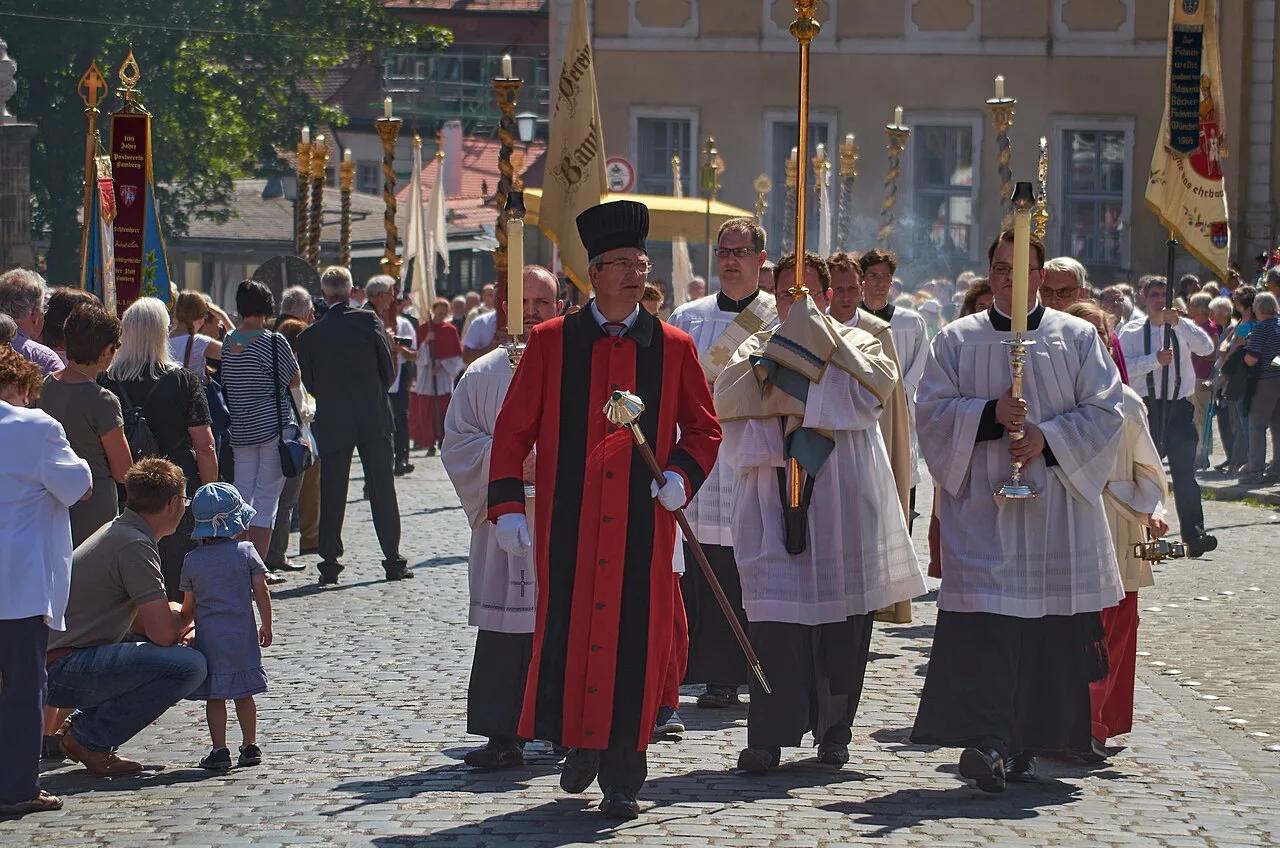
If you do go in, plan around the stated hours rather than around your own optimism: the museum opens Tuesday to Sunday and on public holidays from 11:00 to 17:00, and a last-minute ticket from 16:00 is sold at half price. Adult admission is 8 euros, with reduced tiers for groups of ten or more, seniors aged 65 and over, students aged 19 and over, and visitors with severe disabilities, while children and young people up to 18 enter free. Holders of the BambergCard also enter free, which is worth checking before you pay twice.
Do not assume one Domberg ticket covers the whole hill. The Historical Museum, the Diözesanmuseum, the New Residence state rooms and the cathedral are separate institutions with separate admissions, and the city museums describe the Domberg museums as a group rather than a single ticket. Budgeting for one combined ticket will leave you short.
Leg 2 - Downhill to the New Residence and the Free Rose Garden
Step across the square from the Old Court and you are at the New Residence, the former seat of the Bamberg prince-bishops. The Bavarian Palace Administration lists 2026 admission at 7 euros regular and 6 euros reduced, with a combination ticket covering the New Residence and Seehof Palace at 10 euros regular and 8 euros reduced. Children under 18 are admitted free of charge.
Two honest caveats belong here. The palace administration states that the Elector's Apartment and the Old German section of the State Gallery are not accessible until further notice due to renovation work, while the other state rooms can be visited without restriction. Tickets for the New Residence are available only at the cash desk on site, so online booking is not an option for this particular stop.
The Rose Garden itself is free to enter and is the best-value pause on this leg, with views back over the old town and a café beside it. October to March the residence opens 10 am to 4 pm and April to September 9 am to 6 pm, so check the operator's page for the month you visit rather than relying on a memory of summer hours.
Leg 3 - Diözesanmuseum and the Cathedral Treasure
The Diözesanmuseum grew out of the cathedral's old treasury and holds the medieval textiles that define its reputation, including the eleventh-century imperial cloaks associated with Henry II and Kunigunde. Its rooms occupy the chapter house built by Balthasar Neumann, and the cloister displays sculpture from the cathedral's Prince's Portal and Adam's Gate. If you care about the cathedral treasure specifically, this is the collection that holds it.
Opening hours are unusual and worth planning around: the museum's own site lists Monday, Tuesday, Thursday, Friday and Saturday from 10:00 to 17:00, Sunday from 13:00 to 17:00, and Wednesday closed. A third-party listing shows slightly different Sunday hours, so confirm on the museum's own opening-times page before building your day around it. The museum states that both the cathedral and the museum are barrier-free, with step-free entrances reached from the west side of the cathedral.
Treat the Diözesanmuseum as its own ticket, separate from the Historical Museum and from the New Residence. If your time is short, the cloister and the treasury are the core of the visit; the temporary exhibitions change and can be skipped without losing the thread.
Leg 4 - Grüner Markt and the Pedestrian Core
Leaving the Domberg, the walk drops into the pedestrian zone around Grüner Markt, which Bamberg tourist information treats as the middle of the island town. This stretch is flat, busy and largely commercial, and it works as a reset rather than a sight. It is also where you can buy supplies or sit down without committing to a museum.
The market square and the surrounding lanes are the practical half of the route: shops, food and street-level orientation. If you took the quick 90-minute version, this is where you feel the difference between a straight line to the river and an afternoon that keeps unfolding. Nothing here needs a ticket.
Leg 5 - Obere Brücke and the Altes Rathaus: Treat the Interior as Uncertain
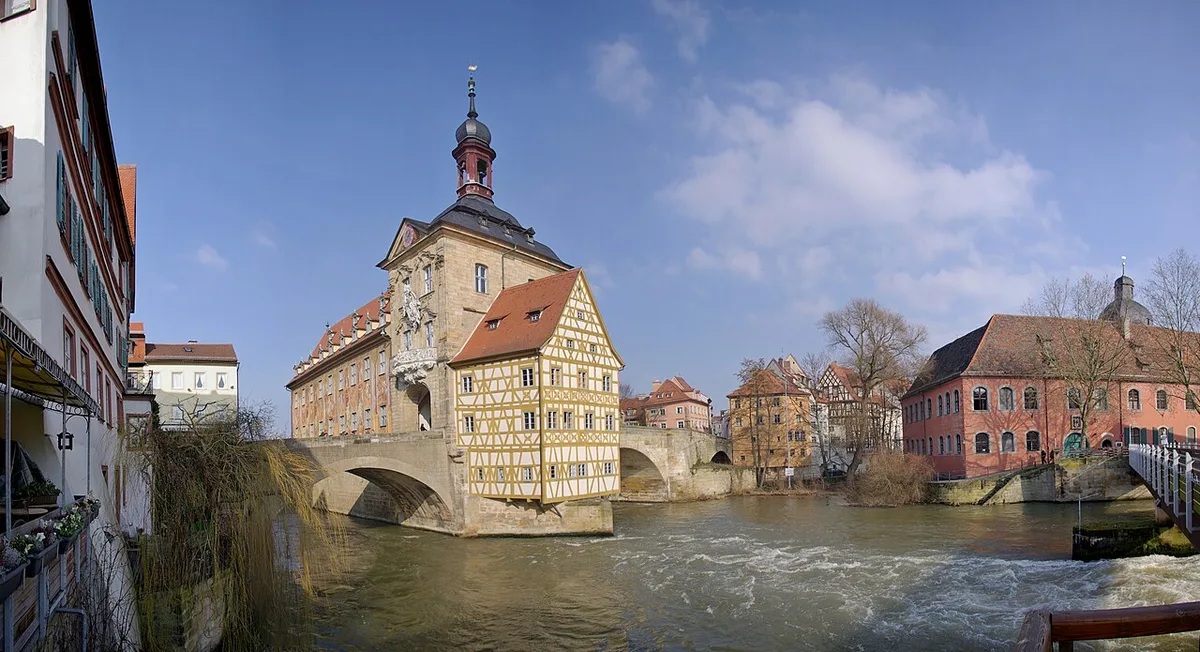
The Altes Rathaus on its artificial island in the Regnitz is the image most visitors come for, and the Obere Brücke approach gives you the classic view from both banks. This is a photo stop with real substance, and it costs nothing to look. The city museums state that the building is currently undergoing extensive renovation, so plan the exterior rather than an interior visit.
The porcelain collection that was long housed at the old town hall has moved with the renovation. Until 21 June 2026 a small selection of the Ludwig Collection was displayed at the New Residence under the title Courtly Encounters, which means the address at Obere Brücke 1 should not be treated as a guaranteed gallery visit. If porcelain is the reason for your stop, check the current status with the city museums before you go.
Nearby, the riverside lanes of Klein Venedig give the route its calmest stretch. If you want to extend along the water rather than double back, a separate walk along the Regnitz makes a natural companion to this one.
Leg 6 - Sandstraße Side Streets and the Beer Heritage Finish
Beyond the bridge, Sandstraße and its neighbouring lanes carry the everyday, lived-in side of the old town, with small shops and a long association with brewing. Franconia's brewing concentration is the background context; Bamberg tourist information frames the city's beer culture as brewing in its most artisanal form, enjoyed in traditional brewery inns. This stretch is atmosphere rather than an attraction, and the right approach is to walk without a target.
Older accounts of the city's beer culture are useful for understanding how deeply brewing shaped these streets, but they often quote prices and opening hours that are years old, so do not treat their figures as current. Check a brewery or pub directly on the day if a specific stop matters to you.
Optional Uphill Add-On: St. Michael's Monastery and Its Always-Open Grounds
St. Michael's Monastery sits on Michaelsberg above the old town and is the one add-on that genuinely changes the shape of your day, because it means climbing. The former Benedictine complex, founded around 1015 on the initiative of Emperor Henry II, is owned by the Bamberg Civic Hospital Foundation and includes a baroque terraced garden, a vineyard and a terrace with a panorama back over the city. The foundation states that the gardens, monastery courtyard and observation deck are accessible at all times, which is a real advantage if a museum day has already eaten your hours.
The church is a different matter. Bamberg tourism states that it is currently open only Friday to Sunday and on public holidays from 11 am to 4 pm, and that renovation work will continue in the church and across the entire site over the coming years. If your schedule only allows a weekday, the grounds are still worth the climb even when the church is shut.
You can reach the complex on foot via the Panoramaweg along Aufseßstraße and Benediktinerweg, or via Maienbrunnen, and on weekdays city bus line 910 runs from the ZOB to the Klinikum Michelsberg stop. Parking on the grounds is only available in the evening and at weekends for restaurant visitors, so walking is the simpler choice. A dedicated walk page covers the cathedral hill in more detail if you want to split the climb from the rest of this route. For wider planning, see A Domberg Bamberg Walk.
Where the Walking Gets Hard: Hills, Cobblestones and Honest Pacing
The climb to the Domberg is the leg that hurts, and the add-on to St. Michael's Monastery is the optional second one. Everything else on this route is either flat or descending, which is why the ordering matters more than the individual stops. Cobblestones run throughout the old town and are the other thing to plan for, especially in wet weather, and the route guide itself advises comfortable shoes.
Accessibility is stated at institution level rather than for the route as a whole: the cathedral and Diözesanmuseum report step-free access via the west side of the cathedral, but that says nothing about the cobbled lanes between stops. Plan each transfer separately if accessibility is a deciding factor.
Museum Combinations: Why No Single Ticket Covers the Domberg Museums
The Domberg looks like one museum quarter but is run by more than one organisation with different ticketing, which is why no combined Domberg ticket exists. The Historical Museum runs on the city museums' pricing, the New Residence operates under the Bavarian Palace Administration with a separate combination ticket that pairs it with Seehof Palace, and the Diözesanmuseum sits under the archdiocese. Each ticket applies only to its own institution.
The practical consequence is that you should pick your interiors deliberately rather than assuming one payment unlocks the hill. If you want the cathedral treasure, go to the Diözesanmuseum. If you want the city's history in the building where the bishops once governed, go to the Historical Museum. If you want princely interiors and a free rose garden, the New Residence is the stop.
Two Workable Shortened Versions: Rain and Family
In rain, cut the route to the Domberg and the river crossing, and use one interior as shelter rather than trying to cover ground. The Historical Museum covers the Domberg and the river crossing sits between the bridge and the island. The route is designed so that the highlights come early and the rest can be shortened or paused without losing your bearings.
With children, the flatter version works better: start at Maximiliansplatz, walk the pedestrian core to the bridge, and treat the climb to the Domberg as an optional extension. Children and young people up to 18 enter the Historical Museum free, so a short museum stop costs nothing extra for them. If you have more than one day in the city, a two-day itinerary lets you split the hill and the island instead of compressing both. For wider planning, see 2 Days in Bamberg.
Plan Your Visit
Build the day around the hill first and the river second, and the route largely takes care of itself. Decide before you start which ticketed interiors you actually want, because none of them share a ticket and each has its own hours. The free spaces, from cathedral square to the Rose Garden to the monastery grounds, fill in everything between.
Hours, prices and renovation status change, and several Domberg sites are currently affected by construction. Confirm the Historical Museum, the New Residence, the Diözesanmuseum and St. Michael's on the operators' own pages in the week you travel. That five-minute check is the difference between a walk that flows and one that ends at a locked door.
Frequently Asked Questions
How long does a self-guided Bamberg old town walk take?
Published planning ranges for a route of this kind suggest 90 to 120 minutes for a quick pass, 2 to 4 hours for a relaxed walk, and 4 to 6 hours if you add one or two museums. Those are suggestions rather than official figures, and your own pace, breaks and photo stops will decide the real number. If you only have a morning, do the Domberg and the river crossing and leave the pedestrian core for another time.
What is the best order to walk Bamberg's old town?
Start on the Domberg and work downhill towards the river island and the Grüner Markt pedestrian core. The cathedral hill is the only sustained climb on the route, so putting it first means every later leg is flat or descending. If you would rather avoid the climb entirely, start at Maximiliansplatz and reverse the order, accepting that the hill becomes an optional extension at the end.
Is Bamberg walkable in one day, and how does that change the route?
The old town is compact and the stops sit close together, so a single day is enough for the route as described. What a single day cannot absorb is every interior: the Historical Museum, the New Residence, the Diözesanmuseum and the cathedral are separate institutions with separate admissions and different hours. Pick one or two interiors, or split the hill and the island across two days and walk more slowly.
Which Bamberg old town sights are free and which need a ticket?
Cathedral square, the Old Court's exterior, the Rose Garden, and St. Michael's monastery gardens, courtyard and observation deck are free public spaces. The Historical Museum, the New Residence state rooms and the Diözesanmuseum are separately ticketed, and no single ticket covers all the Domberg museums. The Altes Rathaus is under extensive renovation, so treat its interior as unavailable and plan the exterior view instead.
Can I visit the Altes Rathaus and the Ludwig Collection on the same walk?
Do not plan on it. The Altes Rathaus is undergoing extensive renovation, and the porcelain collection that was long housed there has been shown only as a small selection at the New Residence, under the title Courtly Encounters, until 21 June 2026. Anyone building a walk around a porcelain visit should check the current status with the city museums beforehand rather than assuming the old town hall interior is open.
What should I check before setting out on the walk?
Confirm the current opening hours and admission rules for whichever interiors you plan to enter, since several Domberg sites are affected by renovation work. St. Michael's Church has limited weekly hours even though its grounds are always accessible, and the New Residence sells tickets only at the on-site cash desk. Check the operators' own pages in the week you travel, because third-party listings often lag behind.
Sources
- Bamberg Tourismus
- Self-Guided Walking Tour of Bamberg, Germany for Groups
- Informationen zum Historischen Museum Bamberg | museum.bamberg - Museen der Stadt Bamberg
- Englisch - Museen der Stadt Bamberg
- Startseite
- DiözesanMuseum Bamberg (Diocesan Museum Bamberg) - Museen in Bayern
- St. Michael's Monastery - Bamberg Tourismus
- General information
- Bavarian Palace Administration | Palaces | Bamberg New Residence
- Bavarian Palace Administration | New Residence in Bamberg | Tourist information | Admission charges
- Bayerische Schlösserverwaltung | Neue Residenz Bamberg | Besucher-Information | Eintrittspreise


