

Passau empties out in the late afternoon. Day-trippers head back to their coaches and river ships, the museums and the fortress close, and the old town becomes a much quieter place to walk. That shift is the reason an evening here feels different from a daytime sightseeing stop, and it is worth planning around rather than treating as dead time.
The single most concrete evening option is the organ concert in St. Stephen's Cathedral. On one Thursday each month from May to October, the cathedral holds an evening organ concert at 7:30 p.m., with tickets sold from 6:30 p.m. at the Dominnenhof; adults pay 12 EUR and reduced tickets cost 6 EUR. That makes a Thursday night in season the strongest reason to be in Passau after dark.
Everything else in the evening is looser: churches with late published hours, promenades along two rivers, and squares that are free to walk through at any hour. This guide separates what is confirmed from what is not, so you can build an evening that works even if a concert is not running.
Anchor the Evening at St. Stephen's Cathedral
St. Stephen's is the building that gives Passau its evening identity. Passau Tourism describes it as the key Baroque church north of the Alps, rebuilt after the 1662 fire by Carlo Lurago and Giovanni Battista Carlone, with an interior that holds the world's largest cathedral organ: 17,974 pipes and 233 registers across five separate organ installations. Knowing that scale matters, because the sound is the point of an evening visit rather than the architecture alone.
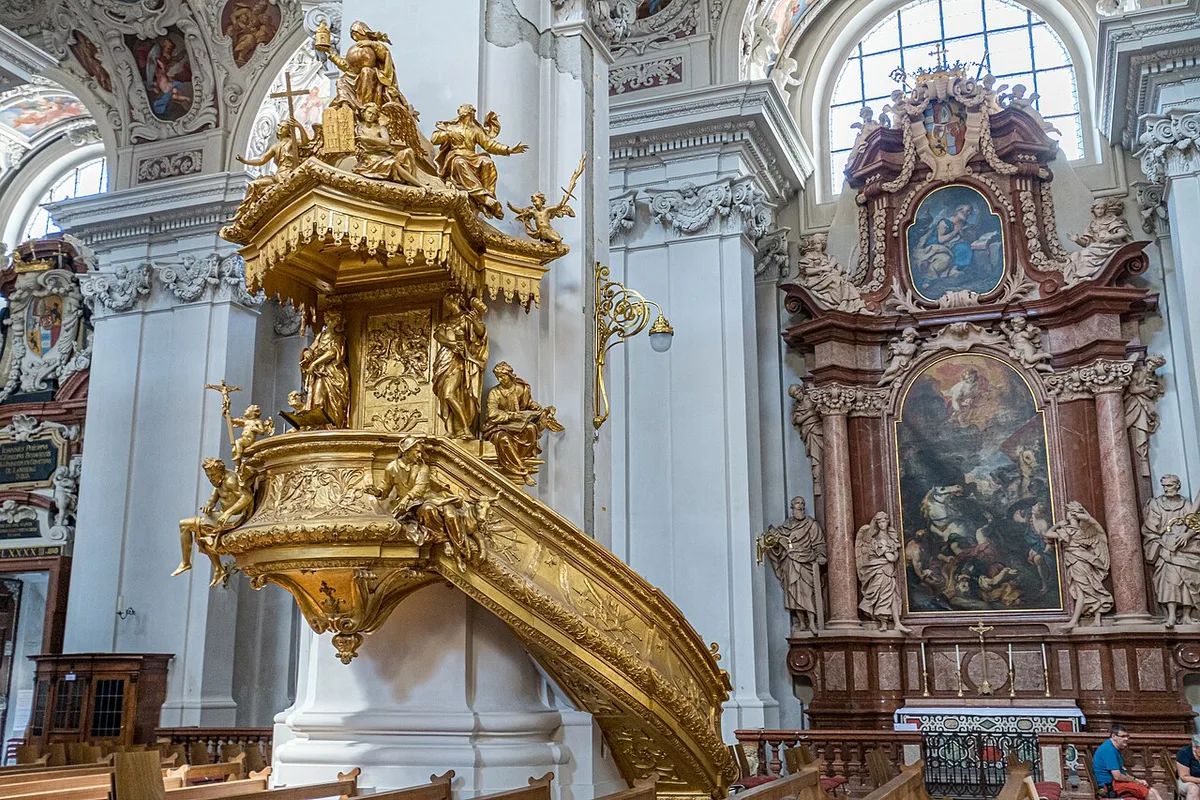
One caveat changes expectations. The same source states that since 2023 the organ has been restored section by section and does not sound in its full extent at concerts, so you will hear a partial instrument rather than the complete five-part installation. A visitor who knows this in advance is not disappointed; a visitor expecting the full 17,974 pipes may be. If the complete organ is the reason for your trip, check the cathedral music pages for the current restoration status before you book travel.
For the wider church interior, Passau Tourism publishes opening hours of 6:30 a.m. to 6 p.m. from November to March and 6:30 a.m. to 7 p.m. from April to October. Those hours cover the evening concert slot in summer and the early evening in winter, but they do not make the cathedral a late-night space. Treat a visit as a late-afternoon or early-evening stop, not a midnight one.
Choosing Your Organ Concert Slot: Noon or Thursday Evening
Passau runs two distinct organ concert formats, and they are not interchangeable. The noon concerts take place on working days from May to October, run about half an hour, and cost 6 EUR for adults and 3 EUR reduced. They suit a daytime itinerary and leave your evening free. The evening concerts run once a month on a Thursday at 7:30 p.m. during the same season, last roughly an hour, and cost 12 EUR for adults and 6 EUR reduced.
If your visit does not line up with the monthly Thursday, the noon concert is the realistic substitute rather than a lesser version of the same event. There is also an Advent format: Wednesday to Saturday at noon, which replaces the summer schedule later in the year. Because the monthly Thursday dates are published by the diocese rather than fixed by a simple rule, confirm the specific date before you build an evening around it.
One practical detail matters if you are coming specifically for the evening concert: tickets are sold from 6:30 p.m. at the Dominnenhof, entry to the cathedral is from 6:45 p.m., and reservations are not possible. There are no group discounts. Arriving early is therefore about securing a seat, not about beating a queue for a reserved place.
Cathedral and Mariahilf Opening Hours After Dark
The Mariahilf pilgrimage church is the one church in Passau whose published hours genuinely reach into the evening. Passau Tourism lists it as open daily from 7 a.m. to 8 p.m. That is late enough to make it a real evening option rather than a daytime stop, and it is the exception rather than the rule among Passau's churches.
Mariahilf sits high above the Innstadt, and the approach is part of the decision. A covered stairway of 321 steps leads up from the Neutorgraben, adorned with votive tablets, and the reward is a view back over the so-called Italian side of Passau. The climb is not trivial and the church has only limited wheelchair accessibility, so judge whether a late-evening ascent suits your group before committing to it.
For everything else, assume churches are daytime places. Published opening hours for the cathedral stop at 6 p.m. or 7 p.m. depending on the season, and no source in this guide confirms that other Passau churches stay open later. If a specific church matters to you, check its own page or ask at the tourist information office on Rathausplatz rather than arriving after dark and hoping.
Rivers and Promenades: The Inn, the Danube and the Confluence
The rivers are the most reliable evening activity in Passau because they never close. The Innpromenade runs along the Inn past the Schaiblingsturm tower toward the confluence at the eastern tip of the old town, while the Donaulände follows the Danube on the northern side of the centre. Both are free public paths, and both are more interesting for their movement and viewpoint than for any particular attraction along the way.
The confluence at the Dreiflüsseeck is the natural endpoint of an evening walk. The Inn arrives from the south with a visibly faster, often differently coloured current, and it meets the Danube and the Ilz at the tip of the old town. The meeting line is the thing to look at; the practical value of the spot is that it gives your walk a destination rather than an arbitrary turning point.
What you should not assume is that the promenades are lit, patrolled or signed for night use. No source in this guide states anything about illumination, safety patrols or surface conditions after dark on the Inn or Danube banks. Walk where you can see, bring your own light in winter, and skip any stretch that looks unlit or uninviting. If you want a wider choice of riverside and old-town viewpoints, the best photo spots in Passau are worth checking before you set a route.
Old Town Squares at Night: Domplatz, Residenzplatz and the Rathaus Area
The old town squares are the easiest part of Passau to build an evening around, because they are public space with no ticket and no closing time. Domplatz in front of the cathedral, Residenzplatz with the Wittelsbach Fountain, and the Rathausplatz with the Old Town Hall form a compact triangle you can walk in well under half an hour at a normal pace. They work as a route, not as individual destinations.
Residenzplatz is the most architecturally interesting of the three: a Baroque square with grand façades and the Wittelsbach Fountain, built in 1903 to mark a century of Passau belonging to Bavaria. In the evening you are looking at façades and proportions rather than interiors, since the cathedral museum and the New Residence are daytime collections. That is not a downgrade; it is simply a different way of seeing the same square.
No source in this guide confirms which squares, churches or landmarks are illuminated after dark, so do not plan an evening around lighting. Walk the squares because they are pleasant and free, and treat any illumination you find as a bonus. If lighting specifically matters to your trip, ask at the tourist information office whether any seasonal illumination is running, since such programmes change year to year.
The narrow lanes connecting these squares, including Höllgasse with its artists' studios and galleries, are also walkable at night, but they are quiet and lightly trafficked once the shops close. For a fuller picture of how these streets fit together in daylight, the old town walk is the better planning reference, and you can then reuse the same route after dark with lower expectations of what will be open.
Where to Drink: What the Evidence Supports and How to Choose
Passau has bars, and Passau Tourismus maintains a dedicated bars section within its Eat & Drink pages, which is the sensible starting point because it is maintained by the city's own tourism organisation. Beyond that directory, the third-party listings that rank Passau bars and clubs are thin, based on very few reviews, and do not support naming a specific venue as where locals drink. Treating a handful of listings as a local scene would be guesswork.
A more honest approach is to choose by criteria rather than by name. Decide whether you want a riverside terrace, a cellar bar in the old town, or a place within a short walk of your accommodation, then check current listings for your shortlisted area and confirm opening hours directly with the venue. Urban bar districts in German cities can be busy on weekends and dead on Mondays, and Passau is small enough that a wrong guess costs you a walk, not a wasted evening.
If a lively late-evening bar scene is a priority for your trip, it is worth being straightforward about Passau's scale. This is a small city with a substantial student population and a tourism-driven season; nightlife will be concentrated in a compact area of the old town rather than spread across districts. A larger German city will give you more choice, which is a reason to adjust expectations rather than avoid Passau.
What Closes in the Late Afternoon and What That Means for Your Plan
Most of Passau's ticketed attractions shut before dinner. The Oberhausmuseum, for example, is open Monday to Friday 9 a.m. to 5 p.m. and weekends and holidays 10 a.m. to 6 p.m. between mid-March and mid-November, with a shorter winter window around the Christmas period. That pattern applies across the museum and fortress sites, so afternoon is your last realistic chance to see them.
If you wanted to combine the fortress with an evening in the old town, note that the complex itself is not accessible for disabled visitors, the shuttle bus and public bus are not wheelchair suitable because of high entry, and there is no wheelchair-accessible toilet in the castle. An assisting person is recommended. Those constraints are worth knowing before you plan a late-afternoon fortress visit as the opening act of an evening.
Once you have accepted that the ticketed sights close, the evening plan writes itself: church or concert first, squares and rivers second, bar or dinner third. Passau's old town is compact enough that all three stages sit within walking distance of each other, which is the main practical advantage of spending an evening here rather than in a larger, more spread-out city.
Sample Evening Plans for One or Two Nights
With one night, keep it simple. Spend the late afternoon in the old town, take a look at the cathedral interior before it closes, and walk Domplatz and Residenzplatz while there is still light. Then head to the rivers for the walk to the Dreiflüsseeck, watch the confluence, and finish with dinner or a drink back in the old town. The whole loop is short and does not require transport.
If your single night falls on the monthly Thursday concert date in season, reverse the order: walk the rivers first while it is light, then be at the Dominnenhof for 6:30 p.m. ticket sales so you can hear the organ at 7:30 p.m. and finish the evening in the old town afterward. If you have two nights, give one evening to the concert and squares and the other to the Mariahilf climb and the Innstadt side, which is a different part of town with a different view.
If you are in Passau for longer, this evening route slots into a broader stay easily; a fuller 3 days in Passau itinerary can hold the daytime sights while leaving the evenings free for exactly this kind of low-key walking. And if you enjoy comparing evening cities, Dresden at night is a useful contrast, with a very different scale of architecture and nightlife to plan around.
Plan Your Passau Evening
An evening in Passau is best understood as three separate things: a possible organ concert, a set of churches and squares you can walk freely, and a riverside route that never closes. The concert is the only element with a fixed time and a published price, and it is also the only one that requires you to check a date in advance, because the monthly Thursday schedule varies.
Everything else is flexible, which is both the appeal and the limitation. Do not count on illumination, do not count on museums, and do not count on a specific bar being open unless you have checked. If you confirm the concert date and the Mariahilf opening hours in advance, you already have the two anchors that make a Passau evening work.
For the individual landmarks that make up the old town, the Passau: Landmark Visitor Guides collection is a useful companion when you are deciding which buildings are worth a daylight visit rather than an evening one. Plan the ticketed sights for daytime, keep the evening for walking and listening, and Passau rewards the trade-off.
Frequently Asked Questions
Are there evening organ concerts in Passau?
Yes, on one Thursday evening per month from May to October, St. Stephen's Cathedral holds an organ concert at 7:30 p.m. Tickets are sold from 6:30 p.m. at the Dominnenhof, entry is from 6:45 p.m., and reservations are not possible. Because the dates are set individually rather than by a fixed weekly rule, check the diocese's cathedral music pages for the current month before planning your trip around it. Note that the organ is being restored section by section and does not sound in its full extent at concerts, so expect a partial instrument rather than all five organ installations together.
Can I visit churches and squares in Passau after dark?
Two things are reliably open in the evening. The Mariahilf pilgrimage church publishes daily opening hours of 7 a.m. to 8 p.m., and the public squares and riverside promenades have no closing time at all, so Domplatz, Residenzplatz, the Rathaus area and the Inn and Danube banks are walkable whenever you like. What is not documented is which of these places are illuminated after dark, so plan to walk them for the atmosphere and treat any lighting as a bonus rather than a reason to go.
Is it worth walking the rivers in Passau at night?
The riverside promenades are established public walking routes and are the most natural evening activity in Passau, ending at the confluence where the Inn, Danube and Ilz meet. That said, no official source confirms illumination, patrols or surface conditions on these paths after dark, so the sensible approach is to walk only where you can see clearly, carry your own light outside summer, and turn back on any stretch that feels unlit or deserted. The old town itself is compact and easy to navigate on foot after dinner.
Where do locals drink in Passau?
That specific question cannot be answered honestly from published information. Passau Tourismus maintains a bars section within its Eat & Drink pages, which is the right place to start because the city's own tourism organisation updates it, but the third-party rankings of Passau bars and clubs rest on very few reviews and do not establish where residents actually drink. Instead of following a name, pick an area such as the old town or the riverside, then confirm opening hours with the venue directly.
What is open in Passau in the evening?
In the evening, churches with late published hours, public squares, the old town lanes and the riverside promenades remain open, while the ticketed attractions close in the late afternoon. The Oberhausmuseum, for example, closes at 5 p.m. on weekdays and 6 p.m. at weekends during the main season, with a shorter winter window. Restaurants and bars operate in the evening but their hours vary by venue and season, so check individual listings rather than assuming a fixed city-wide schedule.


