Mainz squeezes an unusual amount of photographic material into a walkable core: a Romanesque cathedral on a market square, a sandstone palace facing the Rhine, half-timbered lanes behind it and Roman masonry on the citadel hill above. A suggested duration for a photo-focused half day is around three to four hours, which is enough to shoot the main exterior subjects once and revisit one of them. Since the evidence for a photography guide is mostly descriptive rather than prescriptive, treat the angles below as starting points rather than guaranteed shots.
How to Structure a Photo Walk in Mainz
Rather than chasing every sight, pick one theme per outing: sandstone and squares, river light, or Roman stone. A theme keeps you in one part of the centre long enough to watch how a facade changes as people move through it, and it stops the walk turning into a checklist. The old town is compact and easy to cross on foot, so a theme costs you little in coverage. If you want a structured sequence of viewpoints rather than a loose route, a self-guided walking route through the old town gives you an order to follow without committing to a fixed schedule.
Build in slack. Streets fill with shoppers, market stalls and café seating at predictable but not fixed times, and a frame you liked on the way out may be blocked on the way back. If a square is crowded, shoot details instead: doorways, facade sculpture, fountain figures or the paving patterns between chairs. Photographers who plan a second pass through the same square usually get a cleaner composition than those who shoot it once.
Cathedral Square: The Romanesque Bulk and Its Setting
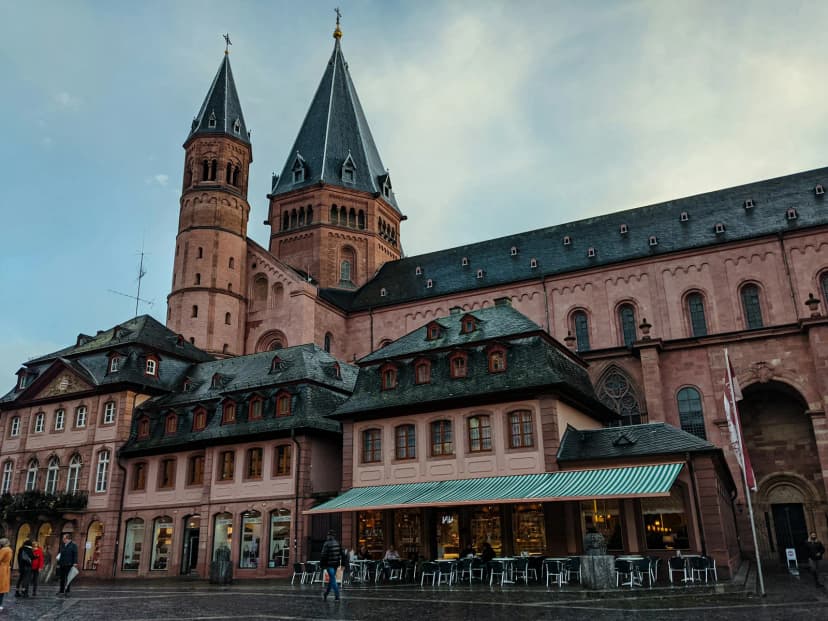
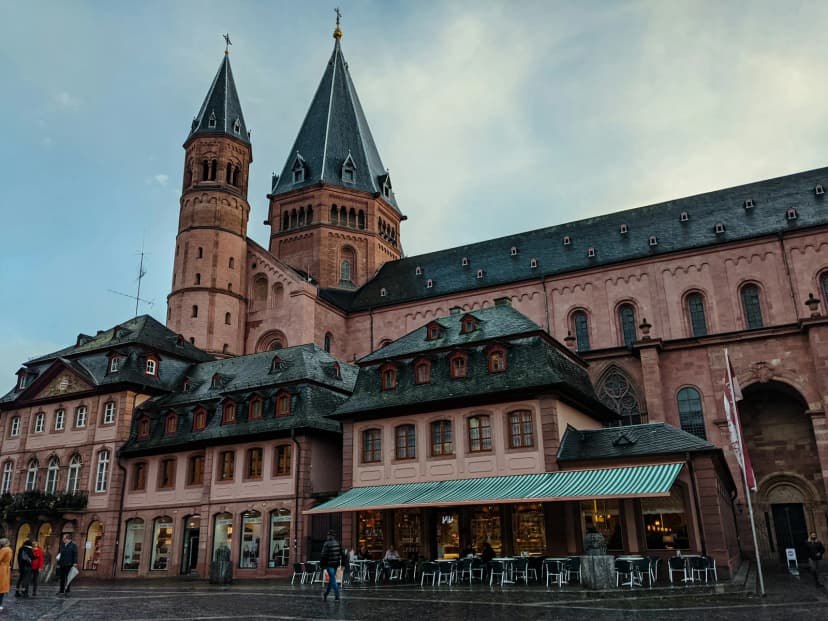
Mainz Cathedral, formally the Cathedral of St Martin, is a three-aisled Romanesque pillar basilica and one of Germany's imperial cathedrals, begun in the late tenth century under Archbishop Willigis. Its red sandstone mass, paired choirs and six towers make it the city's dominant silhouette, which is why it reads well from a distance as well as from the square itself. For full facades you generally need to step back off the square or find a longer sightline along an adjacent street.
The square around the cathedral is a working public space, with the market fountain and the eastern side of the cathedral framing much of the activity. Compose with the square, not against it: café chairs, bicycles and pedestrians are part of the scene, and trying to exclude them usually costs you the architecture. Whether interior photography is permitted, and when the cathedral is open, are questions only the cathedral administration can answer, so check directly before planning an interior set.
Electoral Palace: A Late Renaissance Facade on the Rhine
The Electoral Palace is a striking sandstone building that stretches more than 75 metres along the riverfront and is described by Mainz Tourismus as an outstanding example of the German late Renaissance. Construction began in the early seventeenth century under Elector Johann Schweikhard von Kronberg and proceeded in several phases, with later restoration after wartime damage. That long, red-sandstone front is the reason it works as a photographic subject: you can shoot it as a single wide elevation or crop into the ornamental detailing.
The palace sits beside two late Baroque neighbours, the former Teutonic Order House and the New Arsenal, and it is exactly that contrast that rewards a frame containing more than one building. Shooting the trio together shows how differently the eras treated a facade, which is more informative than another isolated shot of the palace alone. Note that the palace is a venue for cultural events, so treat the exterior as the reliable subject and verify any interior access separately.
Rhine Promenade: Working Reflections and River Traffic
The Rhine promenade is the stretch where Mainz turns toward the water, popular with locals for walking and watching boats pass. For photographs, the value is in movement: cargo barges, passenger boats and shifting water texture give you a subject that changes without you moving your feet. Reflections on the promenade work best when the river is calm, but wind and passing vessels will break the surface, so treat a clean reflection as a possibility rather than a plan.
The promenade is also a good place to shoot the city rather than the river, looking back at towers and rooftops across the water or along the bank. Because it is an open public path, it fits between other stops without a booking, unlike the ticketed interiors elsewhere in this guide. The city and regional tourism boards publish current information about riverside events and facilities if you want to know what else is happening along the bank while you are there.
Altstadt Lanes: Half-Timber, Squares and Texture
The Altstadt is the part of Mainz built for wandering, with narrow lanes, half-timbered houses, small squares and shopfronts that give you texture subjects between the big landmarks. Kirschgarten, a small square framed by historic houses, and the Augustinerstrasse area are the kind of places where a short lens and patience beat a wide sweep. Rather than hunting for a definitive lane, pick a direction and shoot what the street offers: painted shutters, hanging signs, worn thresholds and narrow gaps between buildings.
Old-town streets are residential and commercial rather than staged for visitors, so photograph doorways and courtyards from public ground and be ready to move on if a space is private or occupied. Market activity in the cathedral square area can fill the lanes with people and stalls, which changes both the light and the composition, but the city does not publish a fixed photographic schedule for it, so simply observe what is happening on the day. If you want the lanes quieter, aim for the parts of the day when shops and cafés are least busy and adjust from there.
Roman Remains: The Drususstein and the Citadel Grounds
The Drususstein is a masonry block of Roman origin, close to 20 metres high, standing on the grounds of the citadel in Mainz. It was originally cased in marble, and researchers broadly accept it as the surviving structure of a cenotaph raised in 9 BC by Roman troops in honour of the general Drusus. That combination of scale and setting makes it the city's most substantial Roman subject for a photograph.
The monument sits on citadel grounds rather than on an open public street, so do not assume you can walk right up to it or photograph it from any angle you like. Treat it as a subject to be confirmed on site, and if the grounds are closed or the block is screened, the citadel area itself still offers broader views over the city. For openings, access arrangements or guided options, ask the city's tourism service rather than relying on older travel write-ups.
Interiors: The Gutenberg Museum's Interim Home
The Gutenberg Museum left its long-standing Liebfrauenplatz building when the Schellbau location closed in early October 2024 to make way for a new building, and since late November 2024 the collection has been shown as the interim exhibition "Gutenberg Museum MOVED" at the Natural History Museum, Reichklarastraße 1. Mainz Tourismus lists the exhibition address as Reichklarastraße 1, 55116 Mainz, so that is the location to plan around rather than the old square. It remains an interim arrangement while the new building is planned, and no return date is published.
For photographers, the interim exhibition offers interior material the streets cannot: historic printing presses, the walk-in treasure chamber with two copies of the 42-line Gutenberg Bible, and interactive displays that let visitors photograph themselves against a historical printing-workshop backdrop. The museum's programme lists printing demonstrations on the historic press as a regular event, so check the museum's own programme for the days and times that apply to your visit. Current opening hours and admission are published by the museum and the city; the venue has also announced short-notice closures for maintenance and staff training, so verify before travelling.
Nearby Interior Option: The Dommuseum
The Episcopal Cathedral and Diocesan Museum on Domstraße is a separate institution with its own ticket and its own historic rooms, including Staufen vaulted halls, a two-storey late Gothic cloister and the cathedral treasury in the former St Nicholas Chapel. Founded in 1925, it holds art and liturgical objects connected to the cathedral and the wider diocese, which makes it a useful contrast to the printing history on the other side of the centre. Its programme includes guided tours in English and formats aimed at families.
Do not fold the museum into a cathedral visit: it is a distinct venue with its own admission and its own opening arrangements, and nothing indicates a shared ticket with the cathedral itself. Check the museum's site for current hours, admission and tour dates before you build an interior shoot around it. If your priority is exterior architecture, the cloister and halls are a bonus rather than a substitute for the square outside.
Another Interior: The Mainz State Museum
The Mainz State Museum, in the Golden-Ross-Kaserne complex near the centre, is one of Germany's oldest museums and combines a Baroque building, a modern glass and steel wing and the former electoral stables. Its collections run from prehistory and the Roman period through the Middle Ages, Renaissance and Baroque to modern art, with Roman stone monuments among the holdings. For photography that means varied interior architecture alongside exhibit material, which is a different proposition from a single-subject museum.
The State Museum publishes its own opening times, listed by the German National Tourist Board as Tuesday from 10am to 8pm and Wednesday to Sunday from 10am to 5pm, but hours can change seasonally, so confirm on the museum's website before you go. It is separately ticketed from the cathedral and the Dommuseum, and there is no reason to assume one ticket covers the others. Plan it as a wet-weather alternative to the street subjects rather than as part of the same route.
Practical Boundaries for Photographers
Separate what is reliably open from what needs checking. Public streets, squares and the riverbank promenade are exterior subjects you can photograph without a booking, while cathedral interiors, palace interiors, museums and the citadel grounds all involve someone else's rules. Assuming free entry, permitted interior photography or open doors is the most common way a photo plan fails in a city like this.
Light and weather are the other variables you cannot book. The city's own tourism service and the municipal site are the places to confirm practical details such as visitor information points and city cards, and each venue answers for its own interior policy. Build in a fallback subject for every location: if a square is in shadow, switch to texture; if the river is grey, shoot the bank instead of the water.
Etiquette matters more than gear here. Churches and museums in Mainz are active religious and cultural spaces, so keep tripods and flash out unless a venue says otherwise, and avoid photographing people who have not agreed to it. If a building is in use for a service or an event, come back later rather than working around the congregation.
A Suggested Half Day and How to Pace It
As a suggestion rather than an official itinerary, allow around three to four hours for a photo-focused half day covering the cathedral square, the palace frontage, the promenade and one pass through the Altstadt. That is enough time to shoot each subject once and revisit one of them, which is realistic if you are not queuing for a museum. A photo walk is not the same as a full sightseeing day: you are trading coverage for repetition and detail.
If you want to add an interior, the Gutenberg Museum's interim exhibition is a natural extension of the city-centre walk because it sits at Reichklarastraße 1, close to the rest of the route. If you would rather have more days in the city, compare a one day in Mainz itinerary against a 2 days in Mainz itinerary and decide how much you want beyond photographs. Either way, leaving one subject for a second visit usually produces better images than adding a fifth location to a single afternoon.
Plan Your Visit
Mainz rewards photographers who accept its limits: the architecture is public and close together, but the interiors are governed by venues with their own rules, tickets and calendars. Start with the cathedral square, work toward the palace and the Rhine, then use the Altstadt and the citadel as your second layer of subjects. Confirm anything you plan to shoot indoors directly with the venue on the day, and keep a street-level backup in mind.
If you photograph city architecture regularly, a Dresden photography guide makes an interesting comparison with Mainz: both cities mix rebuilt historic cores with river settings, but the scale and the dominant material are different. Use the same discipline here that you would there, prioritising public viewpoints and checking interior access before you travel rather than after you arrive.
Frequently Asked Questions
Where are the best photo spots in Mainz?
Treat this as a list of subjects rather than a ranking. The cathedral square gives you the city's dominant Romanesque silhouette with a working public space around it; the Electoral Palace offers a long late Renaissance sandstone frontage beside the Rhine; the promenade provides river movement and reflections; and the Altstadt lanes supply half-timbered houses and small squares such as Kirschgarten. The Drususstein on the citadel grounds is the strongest Roman subject, but its setting is on citadel grounds rather than an open street, so check access on site instead of assuming you can walk up to it.
Can you photograph inside Mainz Cathedral?
That is not something to assume either way. The cathedral is an active place of worship with its own visitor arrangements, and no general rule on interior photography or on entry conditions can be taken as confirmed here. Check with the cathedral directly before planning an interior set, and if the answer is unclear or the building is in use, shoot the exterior and the surrounding square, which are public and reliable subjects.
Where is the Gutenberg Museum now?
The museum's former location at Liebfrauenplatz closed in early October 2024 to make way for a new building, and since late November 2024 the collection has been presented as the interim exhibition "Gutenberg Museum MOVED" at the Natural History Museum on Reichklarastraße 1 in Mainz. It is an interim arrangement while the new building is planned, and the museum has not published a return date. Check the museum's own site for current opening times and any short-notice closures before you go.
What Roman remains can you see in Mainz?
The clearest Roman subject described in the city's source material is the Drususstein, a masonry block close to 20 metres high on the grounds of the citadel, which was originally cased in marble and is widely accepted as the remnant of a cenotaph raised in 9 BC in honour of the general Drusus. Because it stands on citadel grounds, do not assume free access or the ability to walk among ruins. Ask the city's tourism service about current access before planning a visit around it.
How long do you need for a photo walk in Mainz?
A suggested duration is around three to four hours for a photo-focused half day covering the cathedral square, the palace frontage, the Rhine promenade and one pass through the Altstadt. That is an estimate for shooting rather than an official figure, and it assumes you are not queuing for a museum. If you want to add the Gutenberg Museum's interim exhibition or the Dommuseum, budget extra time and check each venue's current hours in advance.
Do you need tickets for the museums mentioned here?
Assume that each interior is separately managed and separately ticketed. The Dommuseum and the Mainz State Museum are distinct institutions with their own admission and opening arrangements, and nothing indicates that one ticket covers both, or that either is included with a visit to the cathedral itself. The Gutenberg Museum also publishes its own admission information for the interim exhibition. Confirm current arrangements on each venue's own site before you travel rather than relying on general descriptions of the city.
Sources
- Mainz Tourismus: Mainz Tourismus
- Startseite | Landeshauptstadt Mainz
- Electoral Palace: Mainz Tourismus
- The Mainz State Museum is the perfect destination for a fun and informative day out. - Germany Travel
- 57 Sights in Mainz, Germany (with Map and Images) | Visit Sights
- Gutenberg Museum: Mainz Tourismus
- Regular dates | Gutenberg-Museum
- Bischöfliches Dom- und Diözesanmuseum Mainz
- Mainz Cathedral