The tourist information point at Markt 17 (Domplatz) by the cathedral square is open Monday to Saturday from 10 to 18 and closed on Sundays and public holidays, according to the city's tourism board, which makes it a useful stop while it is open if you want a paper map or current leaflets. Note that this is the tourism office's posted schedule; it says nothing about the opening times of the sights you are going to see.
The useful shape for two days is not the same landmarks twice. Day one stays dense and central, covering the cathedral, the market square and the Chagall windows in St. Stephan's Church. Day two opens outward toward the citadel, the Roman Theatre, the Stadt Park and the Rhine promenade, where the walking is longer but the pace is easier. Travellers with only one day should look at a one day in Mainz itinerary instead, because fitting both shapes into one day means cutting something. For wider planning, see Mainz city travel guides.
Why Two Days Suits Mainz
Mainz is not a city of headline monuments hidden behind turnstiles. Much of what visitors enjoy is free to wander: the cathedral square, the old town lanes, the riverfront and the green spaces around the citadel. Paid interiors exist, but they are the exception rather than the whole trip, which is why two days feels generous here rather than rushed. The cathedral alone, dedicated to St. Martin and St. Stephen with construction beginning in the tenth century, is the kind of building people return to on a second pass. For wider planning, see Mainz landmark visitor guides.
The layout helps. Central sights sit close enough together that walking is the default strategy, and public transport is best treated as a fallback for a specific leg rather than the backbone of the plan. If you want one day built entirely around the old town, the Mainz old town walking route works as a standalone half-day, and you can attach it to either day of this plan.
Getting Around and Arriving
Mainz Hauptbahnhof is close enough to the old town that you can walk in, and the station connects the city with Frankfurt, Cologne, Koblenz and the wider Rhine Valley by rail, while Frankfurt Airport is a practical arrival point for a first or last stop on a German itinerary. Because timetables and platform changes move, check current connections on the operator or city journey planner rather than trusting a saved screenshot.
Once you are in the centre, walking handles almost everything. Buses, trams and S-Bahn services exist and are useful for the return leg from the city park or for a heavy-luggage arrival, but they are not needed to reach the cathedral, the market square or the riverfront. If you prefer one vehicle-free day, build day one entirely on foot and keep transport credit for day two.
Day 1 Morning: Cathedral, Marktplatz and the Marktbrunnen
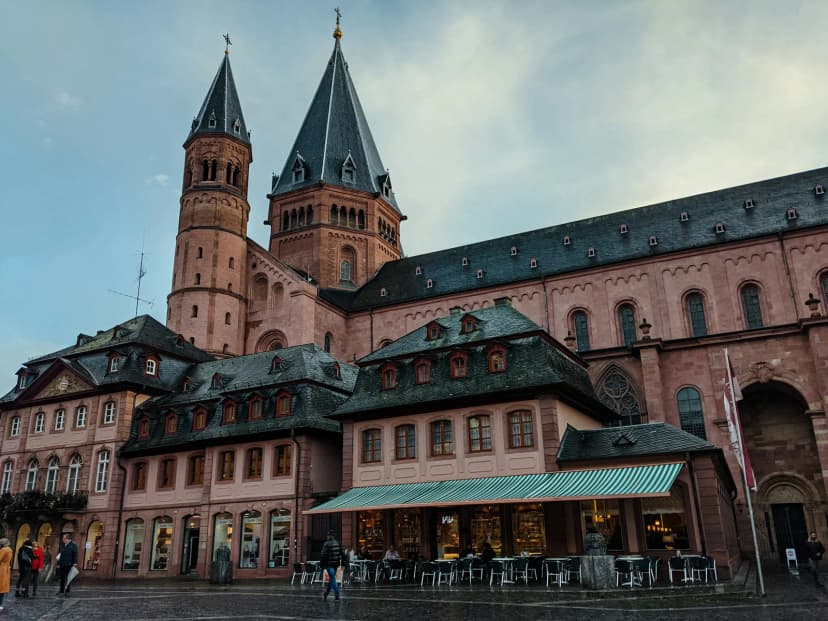
Start at Mainz Cathedral, officially the Cathedral of St. Martin and St. Stephen. The pale reddish sandstone and six towers make it the orientation point for the whole old town, and the inner courtyard is a quiet pause behind the heavier Romanesque architecture. Do not assume the whole building is free to enter or that every area is open; check the cathedral's own notices for current visiting arrangements.
Step out into the reconstructed market square beside the cathedral and slow down deliberately. Cafés, pastry shops and restaurants spill across the space, and the Marktbrunnen fountain in the same square carries detailed Renaissance carving worth a few minutes. In good weather this is one of the most pleasant places in the city to sit with a drink and let the morning run long, which is a legitimate use of a two-day trip.
Behind the cathedral on Liebfrauenplatz, look for the Nagelsäule. Visitor accounts describe it as a column from the First World War, when locals hammered nails into the wood as part of a fundraising effort. It is a small stop, but it adds a different layer to the square than the church architecture around it, and it costs nothing to see.
Day 1 Afternoon: Chagall Windows and the Old Town Lanes
St. Stephan's Church looks understated from the street, and that is the point. Inside, the blue stained-glass windows created by Marc Chagall change the whole atmosphere, and the effect is strongest when daylight comes through them. Rely on the latest news for the current opening hours of the church to make sure you can see the Chagall windows.
From St. Stephan's, stop trying to hit specific addresses in the old town and simply follow the lanes. Narrow streets open unexpectedly into small squares, medieval façades sit beside wine taverns, and students and locals use the same spaces as visitors. This is the part of Mainz that feels lived in rather than staged, and it is best experienced without a strict schedule.
The Fastnachtsbrunnen fountain reflects Mainz's carnival identity, which visitor accounts describe as deeply tied to the city's identity even outside carnival season. It is a quick look rather than a long stop, and it explains a side of Mainz that the cathedral and the Roman ruins do not. Pair it with the surrounding lanes rather than treating it as a destination in itself.
Day 1 Evening: Eating and Drinking Around the Cathedral Square
For the evening, resist the urge to chase a fixed restaurant route and stay near the cathedral square and the old town lanes. The area around Marktplatz am Dom has cafés, pastry shops and restaurants with outdoor seating, and the wine taverns in the Altstadt pour local Riesling in a setting that is part of the city's daily life. Pick by atmosphere and menu rather than by a saved address.
If you want one local reference point, the Augustinerkeller in the old town appears in visitor accounts as a traditional option, and the Happy Baker is mentioned for lighter meals. Treat both as starting suggestions rather than reservations, since opening days and kitchen hours change. Check the venue directly on the day before making it the anchor of your evening.
Day 2 Morning: Citadel, Roman Theatre and Stadt Park
Begin day two at the Citadel, which in visitor accounts reads more like a park with historic military buildings scattered through it than a single monument, with some structures hosting exhibitions and cultural events. A terrace nearby overlooks the Roman Theatre and the wider skyline, and on a clear morning you can pick out the cathedral towers from here, which makes it a good first orientation stop.
The Roman Theatre of Mainz sits just below, and it explains why the city mattered so much along the Rhine in antiquity. You cannot walk through every part of the ruins, but the preserved remains still communicate the original scale. From the theatre it is an easy walk onward into the city park, so treat the three as one connected loop rather than separate outings.
Stadt Park combines ordinary green space with small animal enclosures, gardens and walking paths, and visitor accounts describe it as free to enter and easy to spend longer in than planned. This is the natural place to absorb the slower rhythm of Mainz before heading back toward the river.
Day 2 Afternoon: Rheinpromenade and the River
Walk the Rheinpromenade along the Adenauer-Ufer stretch, where the city opens onto the river and locals gather in the evening. The medieval Holzturm sits near this riverside area and pairs naturally with a promenade walk rather than a separate trip. There is no ticket and no fixed route, so you can make the stretch as short or as long as your energy allows.
This is the day to be honest about fatigue. If the citadel, the park and the riverfront have already filled the morning, cut the promenade short and sit with a glass of Riesling instead of pressing on. A two-day plan should bend around weather and energy, not force you through a route that stops being enjoyable.
Where the Gutenberg Museum Fits
The Gutenberg Museum is the one major sight with a real planning question attached. Visitor accounts from late 2024 describe it as temporarily moved into the Natural History Museum building at Reichklarastraße 1 while its original home is renovated, and the same account notes that you buy the Gutenberg Museum ticket itself rather than a combined ticket with the Natural History Museum. Treat this as a visitor report rather than an operator statement, and verify the current location and ticket scope before you go.
The same visitor account suggests allowing about an hour and highlights the treasury with original copies of the Gutenberg Bible. Printing demonstrations have been part of the experience, but do not build your timing around a specific demonstration slot, because schedules change and staffing can shift them. Buy tickets on site or check the museum's current channels rather than relying on an old price or time you read somewhere.
If the museum matters to you, put it on day one afternoon and move the old town wander later. If it does not, skip it without guilt and give the time to the riverfront, because the city's free outdoor sights are the stronger draw for many visitors. Either way, this decision should come before you decide on any savings card.
Is the mainzcardplus Worth It for Two Days?
The mainzcardplus is described by the city's tourism board as a card with numerous benefits, including free admission to Mainz museums and a city tour, and it is sold with or without a public transport ticket. That scope matters: it is a savings card with defined inclusions, not a universal pass covering everything in the city. Read the current inclusion list before buying, since participating museums and tour terms can change.
For a two-day visit, the decision is simple arithmetic with one unknown. Count how many paid interiors you will actually enter, add the city tour if you want a guided introduction, and compare that to the card price at the time of your trip. If you are mainly walking, sitting in squares and drinking wine, the card is unlikely to pay for itself.
Buy the version without transport if you plan to walk, and consider the transport-inclusive version only if you know you will make several journeys beyond the centre. Because prices and inclusions are volatile, check the tourism board's current page or ask at the tourist information point before committing. This is a decision to make on arrival, not one to lock in months ahead.
Where to Eat in the Old Town and Around the Cathedral
The most reliable eating strategy in Mainz is proximity. The cathedral square and the surrounding Altstadt lanes hold a dense cluster of cafés, wine taverns and restaurants, so you can decide on the day based on what is open and how hungry you are. Outdoor terraces around Marktplatz am Dom are the obvious choice when the weather cooperates.
Local Riesling is the natural drink, and the wine taverns in the old town pour it in a setting that feels closer to daily Mainz life than to a tourist strip. For a fuller meal, traditional German cooking is well represented in the old town, and lighter options exist for breakfast and lunch. Names and prices shift, so confirm hours and menus directly before you go.
Adding a Rhine or Rheingau Excursion Without Overloading Two Days
The honest trade-off is that a full Rheingau excursion and a complete two-day Mainz plan compete for the same hours. Visitor accounts list a wine tasting at Schloss Johannisberg as an option, but it requires travelling well out of the city to Geisenheim and back. If the vineyards are the priority, consider extending your stay or replacing day two rather than squeezing both into two days.
If you do want a day outside the city, pick one destination and build the day around it instead of stacking multiple stops. Rail connections from Mainz make several Rhine towns reachable, and a focused day trip beats a frantic one. Compare options on the Mainz day trips by train page and check current train times before you commit.
Where to Base Yourself and What to Do in Bad Weather
Base yourself in or near the Altstadt if you want to walk everywhere, because the whole day-one plan depends on being able to step out and be among the sights. Staying near the Hauptbahnhof is practical for early trains but it adds a walk or a short ride to every start. Either works if you accept the trade-off honestly.
Rain changes the plan more than cold does. When the weather turns, swap the riverfront and the park for the cathedral interior, the Gutenberg Museum and the old town's covered corners, and let the wine taverns carry the afternoon. The city's tourism board also lists guided city tours that work as a rainy-day indoor-ish alternative; check current availability while the tourist information point is open.
If you have a third day, the extra time is best spent on a slower version of what you already have rather than on more landmarks. A 3 days in Mainz itinerary can absorb a proper excursion and a longer riverside afternoon. A two-day trip should stay focused, and comparing it with a 2 days in Berlin itinerary or a 2 days in Dresden itinerary is only useful for calibrating how much ground a German city break actually covers.
Plan Your Visit
Two days in Mainz works because the city does not demand much from you. Day one stays central and dense, day two stretches toward the citadel, the park and the Rhine, and the mainzcardplus decision waits until you know which interiors you actually want. Verify the Gutenberg Museum's current location and ticket scope, confirm church hours, and treat the rest as a sequence of good options rather than a fixed route.
Use the tourist information point at Markt 17 while it is open if you want current maps and leaflets, and check the city's own website for anything that changes week to week. Beyond that, the best preparation is simply deciding how much walking you want and leaving room for a long sit in the cathedral square.
Frequently Asked Questions
Is Mainz worth visiting for two days?
Yes, particularly for travellers who prefer a slower city with wine culture and layered history over a headline-attraction checklist. Mainz is compact, much of what visitors enjoy is free to wander, and the old town, cathedral square and Rhine promenade connect naturally on foot. It suits people who like walking, local wine taverns and a relaxed pace rather than a packed schedule.
How much time do you need in Mainz?
Two days is a comfortable amount for the central sights plus one open-air day around the citadel, the Roman Theatre, the Stadt Park and the riverfront. One day covers the cathedral, the market square and the old town but leaves no room for the green loop or a proper riverside afternoon. Add a third day only if you want an excursion outside the city.
What is the best way to get around Mainz for two days?
Walk. The central sights sit close together, and public transport is best treated as a fallback for specific legs such as returning from the city park or arriving with heavy luggage. Mainz Hauptbahnhof is close enough to the old town to walk in, and it connects the city with Frankfurt, Cologne, Koblenz and the Rhine Valley by rail. Check current connections rather than relying on memorised details.
Is the mainzcardplus worth buying for a two-day trip?
Only if you will enter enough paid interiors or take a city tour to offset the price. The tourism board describes the card as including free entry to Mainz museums and a city tour among its benefits, and it is sold with or without public transport. Read the current inclusion list and compare it with your own plans; if you mainly walk and sit in squares, it is unlikely to pay for itself.
What should I know about visiting the Gutenberg Museum?
Visitor reports from late 2024 describe the museum as temporarily housed in the Natural History Museum building at Reichklarastraße 1 during renovation, with a separate Gutenberg Museum ticket rather than a combined ticket with the Natural History Museum. The same account suggests about an hour and highlights the Gutenberg Bible treasury. Because this is a visitor account, confirm the current location and ticket scope with the museum before you go.
Where should you eat in Mainz's old town?
The cathedral square and the surrounding old town lanes hold a dense cluster of cafés, wine taverns and restaurants, so proximity is the most reliable strategy. Look for terraces around Marktplatz am Dom in good weather and wine taverns in the lanes for local Riesling. Confirm current opening days and menus directly, since these change.