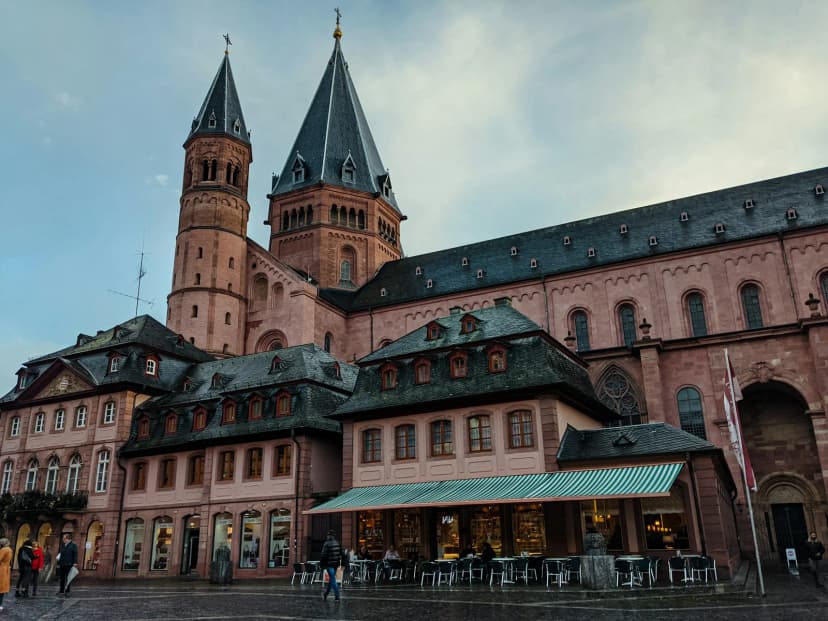
Mainz old town rewards walkers precisely because it is small and legible: the cathedral rises over its market squares, Augustinerstrasse runs as the busy spine, and the Kirschgarten pocket sits a short stroll away. The Rhine closes the picture on the northern edge, with the Electoral Palace holding the riverbank. A self-guided route here is less about covering ground than about choosing where to slow down.
One useful concrete anchor: Mainz Tourismus keeps its tourist information at Markt 17 on Domplatz, directly beside the cathedral squares, so the start of any old-town wander is easy to find. From there the route unfolds west and north, and you can decide at each stage whether to continue or turn back. Treat the whole thing as a suggestion you adapt to your own pace.
That compactness also means you can walk the core without committing to a fixed timetable. The stages below are a sequence, not a marked trail, so you can reorder them, cut the Rhine leg, or fold the walk into a wider Mainz: Itineraries and City Travel Guides plan. Set aside a half day for the full sweep and you will rarely feel rushed.
Why Mainz Old Town Suits a Self-Guided Walk
Mainz old town is a walkable cluster rather than a sprawl, with the cathedral, market squares and shopping streets packed into a few connected blocks. That density means you spend your time looking rather than navigating. It also means a wrong turn costs you minutes, not an afternoon.
The old town has been gradually restored since the 1980s, and much of its half-timbering was exposed during that work. Rheinhessen's Romantic Cities walk describes the old town as the beating heart of the city, with the cathedral as its centrepiece and Augustinerstrasse as its main artery. That framing is a good mental map before you set off.
Because the route is short on distance and long on detail, it suits travellers who prefer to stand still and read a facade rather than tick off stops. If you want a full-day structure around the same streets, the one day in Mainz itinerary approach pairs the old town with the wider city; the walk below stays deliberately narrow.
Route Overview: Four Anchors in Order
The four anchors form a loose arc: the cathedral and its market squares first, Augustinerstrasse second, the Kirschgarten third, and the Rhine side near the Electoral Palace last. That order keeps the busiest, most monumental spaces at the start, when you have fresh attention for detail. It also ends at the river, where the light is best in late afternoon.
The sequence is a suggestion, not a signed route, and no source describes these four places as one official marked trail. Walk it backwards, skip the last leg, or repeat a favourite square without breaking anything. The only real constraint is orientation: keep the cathedral tower in view and you can always re-find your position.
Gutenbergplatz sits between the market area and the shopping streets and works well as a hinge between stages. From there, the Rhine leg is general orientation rather than a mapped promenade: the Electoral Palace is described as directly on the riverbank, so head roughly north and downhill toward the water. If you want a dedicated riverside plan instead, the Mainz Rhine promenade visitor guide covers that ground separately.
Stage 1: St Martin's Cathedral and the Market Squares
St Martin's Cathedral is the red sandstone landmark that has stood over the city for more than a thousand years and dominates the skyline more than any other building. Fires, wars and rebuilding shaped it repeatedly, and the Romantic Cities walk quotes guide Renate Michel on the Mainz character reflected in that stubbornness. Give yourself time to circle the building rather than only facing the main approach.
The cathedral squares around it carry the daily life of the city: fountains, columns and brightly coloured houses that almost disappear behind market stalls on market days. That is a scene worth planning around, because a market morning and a quiet weekday afternoon feel like two different places. Check the city's current information before you go if the market itself is a priority.
Walking the squares and the exterior is free and open to everyone, but entering the cathedral and visiting any associated museum collection are separate questions with their own access arrangements. Do not assume one ticket covers the cathedral, the Cathedral and Diocesan Museum and everything else nearby. Verify current access and any admission details with the operator before your visit.
Stage 2: Augustinerstrasse and the Augustinerkirche
Augustinerstrasse is the cheerful, lively spine of the old town, full of small shops and cafes, and the Romantic Cities walk calls it the cathedral's main artery. The pleasure here is slow: order something, sit, and watch the street work. It is also the easiest stage to stretch or shorten depending on your appetite.
Look up as you walk: the street is lined with grand Gründerzeit townhouses, and the baroque Augustinerkirche hides a white-and-gold Rococo interior with paintings worth the detour. The church interior is the calm counterpoint to the street outside, which makes it a natural pause between the market bustle and the Kirschgarten. Step inside only when it is open to visitors, and respect any signage.
This is the stage where a break decision matters most. Stopping early keeps your energy for the Kirschgarten and the river; stopping late means the wine bars become the finale rather than an interruption. Either works, but choose deliberately instead of drifting into a second coffee you did not plan for.
Stage 3: Kirschgarten and Its Half-Timbered Square
The Kirschgarten is the pocket most visitors remember: cobbled ground, half-timbered houses with white render, dark red beams and grey slate gabled roofs, all packed into one small square. The Romantic Cities walk calls it a real jewel of the old town. It is small enough to miss if you are moving quickly, so slow down deliberately.
History explains why this pocket survived: the walk notes that this section was largely undamaged by the 1945 bombing, while roughly 80 per cent of the city was destroyed on 27 February that year. The contrast with the rest of Mainz is the reason to linger rather than photograph and leave. It is also why the square feels older than its surroundings.
The oldest half-timbered house in Mainz, the Gothic Haus zum Aschaffenberg, dates to the middle of the 15th century, and the walk notes that Johannes Gutenberg lived in Mainz at the same time. That detail connects the square to the city's printing story without needing a museum visit. If you want the museum side of Gutenberg's legacy, plan it separately rather than squeezing it in here.
Stage 4: Down to the Rhine and the Electoral Palace
The final leg is orientation rather than a mapped route: head toward the river and look for the Electoral Palace, which the Romantic Cities walk describes as one of the most striking buildings in the city and directly located on the banks of the Rhine. No official promenade stage for this walk is published, so treat the riverbank as a general direction. Follow the water rather than a fixed line.
This is a good place to end if you want the walk to finish on open ground with a sense of arrival. The riverside setting gives you a natural full stop after the denser old-town streets. If the river itself is your priority, use the Mainz Rhine Promenade Guide for that portion and keep this walk as the old-town approach.
Do not expect every building along the riverbank to be publicly enterable; palace and museum interiors are separate, ticketed questions. Check each venue's own information for current access rather than assuming a single pass covers the area. The walk itself is about the approach and the exterior views.
Wine Bars and Breaks Along the Way
Mainz's wine-bar culture is part of the old town's character: the Romantic Cities walk describes friendly chatter and laughter through the winding streets and quotes guide Renate Michel on the city's Roman-era tolerance, since legionaries arrived from many countries and brought wine with them. A stop fits the walk naturally. The question is when to take it.
Early in the walk, a wine bar becomes a pleasant pause and a chance to rest your feet before the Kirschgarten. Late in the walk, it becomes the ending, which suits an afternoon start that finishes by the river. Both are reasonable; decide before you set out so the stop serves the route rather than derailing it.
No walking guide can tell you which bar is open on the day you visit, so treat any specific name as a starting point, not a guarantee. Look for places that are clearly trading, check posted signs, and ask at the tourist information on Markt 17 if you want a current recommendation. That keeps the wine stop flexible.
Historical Context in Two Minutes
The story of Mainz starts in 13 BC with a Roman legionary camp, which is the origin point the Romantic Cities walk uses to open the city's history. That Roman foundation shapes how the old town sits in the landscape even today. Keep it in mind when you notice how the streets bend around the cathedral.
Johannes Gutenberg, the inventor of modern letterpress printing, lived in Mainz at the same time the Haus zum Aschaffenberg was built, and the city's identity as a printing centre grew from there. That is why Gutenbergplatz and the Gutenberg Museum sit so naturally in an old-town walk. The museum is a separate visit with its own arrangements, so plan it as its own stop.
Between the Roman camp, the medieval cathedral and the Gutenberg era, the old town compresses two thousand years into a short stroll. That density is the argument for walking it slowly rather than racing between highlights. Pick two stories to follow and let the rest be context.
Pacing the Walk: Suggested Durations
A comfortable suggestion is to allow roughly half a day for the full cathedral-to-Rhine sequence with one proper break, though this is an editorial estimate rather than an official figure. The route is short in distance but dense in detail, so time disappears at the cathedral squares and the Kirschgarten. If you only have two hours, do the cathedral and market squares and stop there.
Splitting the walk over two outings works well because the stages fall into two natural halves: the cathedral, market and Augustinerstrasse on one outing, the Kirschgarten and the Rhine side on the other. That also lets you choose different times of day for each half. A market morning followed by a river evening is a strong combination.
Lunch logic matters more than distance here. Eating near Augustinerstrasse keeps you central and ready for the Kirschgarten, while eating near the river turns the meal into the end of the walk. If you are building a longer stay, the 2 days in Mainz itinerary and the 3 days in Mainz itinerary both give room to spread these stages out.
Practicalities: Starting Point and What to Check
Start at Markt 17 on Domplatz, where Mainz Tourismus runs its tourist information and store; the location puts you directly beside the cathedral squares. Staff there can confirm current city maps and what is happening on the day you visit. That is also the sensible place to ask about combined offers.
Mainz Tourismus describes the mainzcardplus as a card giving flexible exploration with numerous benefits, including free entry to Mainz museums and a city tour, available with or without a public transport ticket. Whether it saves you money depends on how many paid interiors you actually plan to enter. Check the current inclusions and conditions before buying, since they can change.
The city's own site is the best source for service information such as public toilets, webcams and current notices, all of which matter on a walking day. Check it before you leave rather than hunting for facilities mid-route. Market days change the feel of the cathedral squares most, so factor that into your timing if you want the stalls or want to avoid them.
Variations: Short Loop Versus Full Sweep
The short version stays within the cathedral and market area plus Augustinerstrasse, and works well if you have limited time or poor weather. You still get the monumental core and the liveliest street without committing to the walk north. It also pairs neatly with a museum visit afterwards.
The full sweep adds the Kirschgarten and the Rhine-side orientation near the Electoral Palace, and is the version to choose on a clear day. The extra leg is not long, but it changes the character of the outing from city centre to river edge. If you have the time, the full version is the more satisfying walk.
You can also reverse the order and start at the river, finishing at the cathedral as the light fades. That suits travellers arriving from the Rhine side of town. Whichever direction you choose, keep the sequence legible and let one anchor lead naturally to the next.
What to Skip and How to Combine With Museums
Save the larger museum visits for a separate outing: the Gutenberg-Museum, the Cathedral and Diocesan Museum, the Landesmuseum Mainz and the Stadthistorisches Museum Mainz each have their own focus and their own ticketing. None of them can be absorbed properly in the middle of a walking route. Walking the exterior route is free, but interiors and collections are paid visits to plan separately.
If printing history is your priority, make the Gutenberg Museum its own half day rather than a detour, and build the walk around the remaining stages. If church art interests you more, the Cathedral and Diocesan Museum deserves the same treatment. Deciding this in advance is what keeps the walk from turning into a rushed museum crawl.
Use the Mainz: Landmark Visitor Guides hub to check individual venues before committing your time, since opening arrangements and exhibitions change. That way the walk stays the spine of your day and the museums become deliberate additions. It is a cleaner plan than trying to do everything at once.
Plan Your Mainz Old Town Walk
The strength of this route is that it asks very little of you logistically: start near the cathedral, follow the arc through Augustinerstrasse and the Kirschgarten, and finish by the Rhine if the day allows. Nothing here is a marked trail, so the only commitment is the sequence you choose. A half day is enough to do it well.
Before you go, confirm current access for any interior you want to enter, from the cathedral to the museums, and check what is happening in the city on your dates. Verify the details that change, and leave the rest to the walk itself. Mainz old town rewards the traveller who looks up.
Frequently Asked Questions
How long does the Mainz old town walking route take?
As a suggestion rather than an official figure, allow roughly half a day for the full cathedral-to-Rhine sequence with one proper break. The route is short in distance but dense in detail, and the cathedral squares and the Kirschgarten are where time disappears fastest. If you only have a couple of hours, do the cathedral and market squares plus Augustinerstrasse and leave the river leg for another outing.
Is there an official marked walking route through Mainz old town?
No. The cathedral, the market squares, Augustinerstrasse, the Kirschgarten and the Rhine-side area are described individually as places of interest, but no source presents them as one official signposted trail. Treat this itinerary as a self-guided suggestion that you can reorder or shorten. The Rhine leg in particular is general orientation rather than a mapped promenade stage.
What is the best starting point for a Mainz old town walk?
Markt 17 on Domplatz is the practical starting point, because Mainz Tourismus keeps its tourist information and store there, directly beside the cathedral squares. From that spot you can set off into the market area and continue west toward Augustinerstrasse without any further navigation. It is also the obvious place to ask about current city maps and what is happening on your visit day.
Do I need tickets to walk the route or to enter the cathedral?
Walking the streets, squares and exteriors is free and open to everyone. Entering the cathedral and visiting any museum or collection are separate matters with their own access arrangements, and you should not assume one ticket covers everything nearby. Check current access details with the cathedral or the relevant museum before your visit rather than relying on general assumptions.
Where can I stop for wine along the walk?
Wine bars are part of the old town's character and appear throughout the winding streets, so a stop fits naturally somewhere along the route. Deciding whether to stop early or late is the real choice: early gives you a rest before the Kirschgarten, late turns the wine bar into the finish near the river. Specific venues open and close over time, so check what is trading on the day or ask at the tourist information.