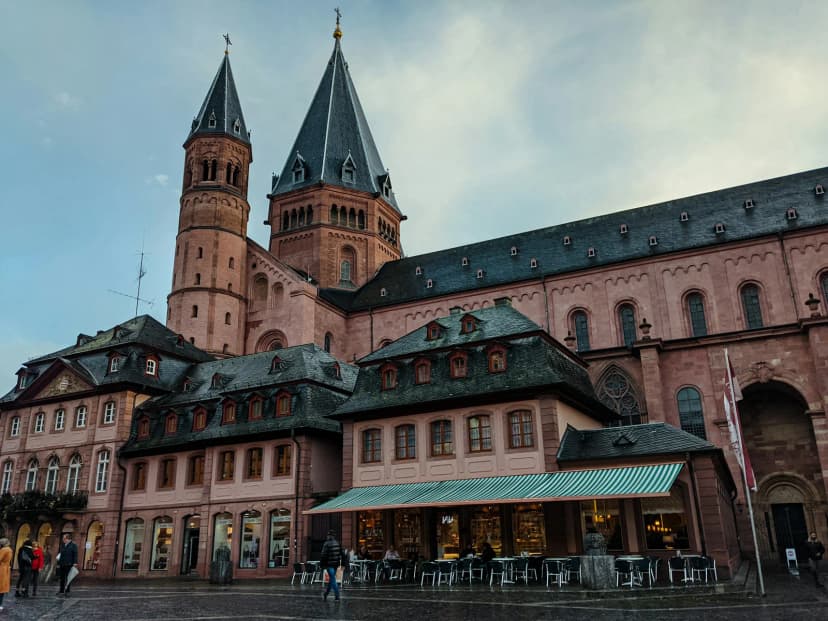
Mainz works well as a one-day stop because the sights that matter to most first-time visitors sit within a short walk of each other in the old centre. You can begin at the market square, loop through the cathedral and the half-timbered lanes, then finish along the Rhine. The catch is that the Gutenberg Museum is not currently in its historic building opposite the cathedral, so a plan built on an old map will send you to the wrong door.
Treat the sequence below as a suggestion rather than a schedule. Durations are deliberately loose so you can stretch the cathedral cloisters and cut the shopping streets, or reverse the loop if the weather turns. Anyone wanting to compare how much a second or third day adds can browse the wider set of Mainz: Itineraries and City Travel Guides before locking in dates.
Before You Start: Tourist Info, Maps and the Mainzcardplus
The tourist information office sits at Markt 17 on the edge of the cathedral square, which makes it a sensible first stop for a paper map and current local notices. Mainz Tourismus lists opening times of Monday to Saturday from 10 to 18, closed on Sundays and public holidays, but confirm those before you travel since they can change seasonally. Staff there can also tell you whether any route in the centre is affected by works on the day.
If you plan to add several museums or a guided walk, the mainzcardplus is worth pricing against your actual list. The tourism board describes it as giving free entry to Mainz museums and a city tour, with or without a public transport ticket, but it does not name every venue covered. Check the current list of participating sites before buying, because a card only saves money if it matches what you intend to visit.
Two things are worth settling the night before: whether the Gutenberg Museum is still operating from its temporary home, and whether anything you want to see requires a timed slot. The city's own site covers civic notices and the museum project, while the tourism board handles visitor-facing bookings and guided tours. Neither is a substitute for checking the museum's own page on the day you go.
Morning: Marktplatz and the Market Square
Start at the Marktplatz, the central square where a sandstone column found in Bavaria now stands as the focal point of the weekly market. An independent walking itinerary reports that market days are Tuesdays, Fridays and Saturdays, running about 7am to 2pm, and notes that vendors generally expect cash. Because those days are limited, the market is a timing constraint to plan around rather than a guaranteed lunch stop.
Even outside market hours the square is worth fifteen minutes for the reconstructed facades on one side and the cathedral rising on the other. This is the natural place to orient yourself, since almost everything else on a one-day route radiates from here. If you arrive before the tourist office opens, walk the square first and come back for maps later.
St. Martin's Cathedral: What to See and What to Skip
The cathedral is free to enter, and one detailed guide suggests allowing at least 45 minutes to explore it properly. Treat that as a workable time budget rather than an official recommendation; a quick loop past the nave and the tombs of the archbishops takes less, while the Late Gothic cloisters can absorb considerably more. The building has burned repeatedly since its consecration in the eleventh century, which is part of why the surviving fabric reads as a patchwork of periods.
On a single-day visit, the Cathedral Museum is the easiest thing to cut. The same itinerary recommends skipping it to protect your schedule, and that logic holds if you still have the old town, the river and the museum ahead of you. Save it for a longer stay, when the diocesan collections deserve their own unhurried hour.
Entry to the cathedral is free, but that says nothing about the museum's separate arrangements, its own ticket or its hours. Do not assume one admission covers both. Check the cathedral's own notices when you arrive if the museum matters to you.
Nail Column and Liebfrauenplatz
Leaving the cathedral by the main entrance, pause at the Nail Column on Liebfrauenplatz. It was erected during the First World War as part of a war-nailing fundraiser, in which donors paid to hammer a nail into the oak shaft according to a design approved in advance. Three smaller limestone pillars around it carry allegorical figures representing Bravery, Unity and Charity.
This stop takes minutes, not an hour, and it works best as a hinge between the cathedral and the lanes behind it. Read the plaque rather than walking past, because the object is easy to mistake for ordinary public art. If you are running late, this is the first thing to compress rather than delete.
Kirschgarten and Augustinerstrasse: Old Town in One Stroll
From Liebfrauenplatz, head into the old town and let the route carry you through the Kirschgarten, the small square with a sandstone fountain at its centre and half-timbered houses along the sides. The building most visitors photograph, Haus zum Aschaffenberg at Kirschgarten 28, dates to the fifteenth century and is described as the oldest surviving house in the city. If you prefer a self-guided framework with more detail on the lanes themselves, a dedicated Mainz old town walking route can be used alongside this itinerary.
Continue along Augustinerstrasse, which functions as the spine of the old town. There is little to tick off here beyond looking at buildings, so give yourself permission to wander without a target. On the way, step inside St. Augustine's Church, whose interior was remodelled in the Rococo style in the late eighteenth century on a Gothic shell.
An independent guide reports that the church is open to visitors Monday to Saturday, but church access is frequently adjusted for services, so check the door notice rather than relying on a printed plan. A short respectful look is usually enough on a one-day schedule. Anyone building a deeper church-and-museum itinerary should look at the Mainz: Landmark Visitor Guides hub to decide what earns a slower visit.
Lunch: Working Around the Market Days
By midday you are roughly in the middle of the old town, which is the most flexible place to eat. If it is a Tuesday, Friday or Saturday and you are there before the market closes, the Marktplatz stalls are the simplest option; carry cash, since small vendors often do not take cards. The independent itinerary that documents those market days also notes that cash is expected, which is worth planning for.
On other days, Augustinerstrasse and the surrounding lanes are lined with places to eat, and walking a stretch of it lets you judge by menu and seating rather than by a list that may be out of date. Aim for something quick if you want the afternoon intact. Nothing on a one-day route requires a reservation, but a popular table at peak lunch hour can cost you half an hour of waiting.
If you would rather not gamble on lunch at all, eat a larger breakfast and treat the middle of the day as a coffee and pastry stop instead. That keeps the market as a bonus rather than a dependency. It also leaves more room for the Rhine stretch later, when you may want to sit down.
Rhine Promenade: From Old Town to the River
Follow Holzstrasse east until you reach the water; you will know you are heading the right way if you pass the tall painted Gothic Holzturm tower. Turning north along the river brings you toward the Gutenberg Museum, with fountains, monuments and viewpoints spread along the path. This is the most pleasant way to close the day when the weather cooperates.
If it is raining or windy, retrace the centre instead and approach the museum through the streets. The choice matters more than it sounds: the promenade is exposed, and a wet riverfront walk is a poor use of a short afternoon. Decide at the Holzturm rather than committing earlier.
Allow more time than you think for this stretch if you like photographing the water. It is also the easiest part of the day to cut entirely if you are running behind. If you are weighing Mainz against another German city for a limited trip, comparing it with a one day in Dresden itinerary shows how differently a compact centre can be structured.
Gutenberg Museum at Reichklarastraße 1
The museum has temporarily moved from its historic building opposite the cathedral, which has been in use since the 1920s and is being renovated. The expectation reported by an independent itinerary is that the work runs until about 2029, and that is not a confirmed official date, so check the museum's own pages before you travel. Until then, the collection is shown at Reichklarastraße 1 under the title Gutenberg-Museum MOVED.
The reason to go is the treasure vault holding two original Gutenberg Bibles, which sit within the permanent exhibition. Signing up for a guided tour is one way to see them more closely and to hear how the printing process worked, but tour availability changes, so ask at the desk or book ahead if it matters to you. Because the museum is compact, it fits neatly into the end of a one-day route rather than the middle.
The relocated address is the single detail most likely to break a plan copied from an older guide, so build your walking order around it from the start. Check current opening times with the museum rather than assuming, since a temporary site can operate differently from the historic one. The city's own site carries information on the wider museum project if you want to understand what is being built.
If One Day Is Not Enough: Evening and Second-Day Options
Mainz sits at the edge of the Rheingau, and Riesling and Spätburgunder from the surrounding vineyards are the local specialities. An evening tasting is a natural extension if you are staying overnight, but availability, group size and pricing vary by operator, so book through a provider you can verify rather than a listing you cannot. If you are driving, treat the tasting as the reason not to drive.
Adding a second day lets you spread out what a single day compresses, including the Cathedral Museum and the museums covered by the mainzcardplus. A 2 days in Mainz itinerary suited to a slower pace is a more realistic match if you want time in the riverfront neighbourhoods too. With three days, you can also add a half-day outside the city without rushing the centre.
For a longer stay, a 3 days in Mainz itinerary can absorb a wine-region excursion alongside the landmarks. Train-based Mainz day trips to Rhine and Rheingau towns are easy to arrange, but check schedules and connections yourself rather than trusting a fixed list. That pattern of pairing a compact city day with a regional outing is common across Germany, much as a one day in Berlin itinerary pairs a single district with a wider city.
Plan Your Visit
A workable skeleton for one day looks like this: market square and tourist info first thing, cathedral with about 45 minutes set aside, the Nail Column and Kirschgarten next, lunch in the old town, then the Rhine Promenade north to the Gutenberg Museum at Reichklarastraße 1. Shift the blocks to fit the day of the week, since the market only runs on certain days, and treat every duration here as a budget you set rather than a fixed timetable. If you want the wider picture of what the city offers before finalising, start from the Mainz: Itineraries and City Travel Guides page.
Frequently Asked Questions
Is one day in Mainz enough time?
For the central sights, yes. The Marktplatz, cathedral, old town and Rhine Promenade sit close together and can be covered on foot in a single day, with the Gutenberg Museum as the natural finish. What you will not fit is a deep look at every museum and church, or a proper excursion into the surrounding wine region, so a second day helps if those matter to you.
Is the Gutenberg Museum still next to the cathedral?
No. The historic building opposite the cathedral has been in use since the 1920s and is being renovated, so the museum is currently operating from a temporary location. The expectation reported is that renovation work runs until about 2029, but that is not a confirmed official date. Check the museum's own information for its current site before you plan your walking order.
Is Mainz Cathedral free to enter, and how long should you spend there?
The cathedral is free to enter, and one detailed guide suggests allowing at least 45 minutes. That is a suggested time budget rather than an official recommendation. The cloisters and the tombs of the archbishops reward a slower visit, but on a one-day schedule a shorter look is reasonable. The Cathedral Museum is separate and can be skipped if time is tight.
What can you do in Mainz for free?
Walking the Marktplatz, the old town lanes, the Kirschgarten and the Rhine Promenade costs nothing, and the cathedral is free to enter. Browsing the weekly market is also free, though the market operates on limited days. Paid attractions such as the Gutenberg Museum and other collections require admission, and prices change, so check the venue directly.
Should you visit the Cathedral Museum on a one-day trip?
It is the easiest thing to cut. With one day, the time is usually better spent in the cathedral itself and in the old town, and one detailed itinerary recommends skipping the museum for exactly that reason. Save it for a longer stay, when the diocesan collections can have their own unhurried slot.