Mainz is small enough that a good evening rarely needs a plan more complicated than a riverside walk and a wine tavern. The Rhine sits at the edge of the centre, the old town sits behind it, and the Neustadt sits on the other side of the main station axis, so the whole night fits inside one walkable triangle. What you cannot assume is that everything stays open late, or that the trams and buses run as often after midnight as they do at dinner time.
This guide is deliberately split between what costs nothing and what does not. Streets, squares, the promenade and church exteriors are public space; wine taverns, bars, clubs and museums are businesses and institutions with their own opening times and their own tickets. The city's own tourism board treats the Rhine banks, the old town, the Neustadt, wine culture and the Gutenberg Museum as headline reasons to visit, which is a useful starting point for an evening.
Why Mainz Works as an Evening City
The Rhine-Hesse region around Mainz is Germany's largest wine-growing area, and the city treats wine as everyday culture rather than a special-occasion treat. That matters at night because it produces a dense layer of Weinstuben, wine bars and small kitchens instead of a single entertainment strip. You can eat and drink in the Altstadt, walk ten minutes, and do it again in the Neustadt without touching a vehicle.
The trade-off is scale. Mainz has no district that stays loud until dawn in the way a much larger city might, so anyone expecting endless clubs will likely be disappointed and better served by treating the evening as a long dinner with a walk attached. If you want a comparison point for how another German city organises a night out around walks, opera and a bar district, our guide to Dresden at night shows a very different shape of evening.
Mainz also rewards people who accept that the best parts of the evening are unregulated. The market square in front of the cathedral, the lanes behind it and the riverside path have no admission and no schedule. To understand how these pieces fit together across a whole day rather than one night, start with the city-level overview at Mainz.
Start With the Light: The Rhine Promenade
The single best orientation move on your first evening is to walk the Rhine. A promenade runs along the bank from the Zollhafen to the Winterhafen without any traffic crossing your path, and the two harbour areas have both been redeveloped in recent years. Mainz's own tourism material lists the banks of the Rhine and the promenade among its headline highlights, which is why this is where locals head when the weather is decent.
Budget roughly an hour for the stretch between the two ports if you walk at a normal pace and stop occasionally. That figure comes from a local university guide written for conference visitors, not from the city, so treat it as a planning estimate rather than an official distance or timing. If you want the marina in the frame, the Zollhafen end has waterside places to sit, while the Winterhafen end looks across to where the Main meets the Rhine.
Two practical points. First, no source confirms a closing time or curfew for the promenade, so plan around your own comfort and the weather rather than an assumed closing hour. Second, the path is a public walkway, not a lit attraction with a switch-on time; nobody publishes a schedule for riverside lighting, so do not build an evening around the promise of an illuminated panorama. For a fuller picture of the route, its landmarks and what to expect on the ground, use the Mainz Rhine promenade visitor guide.
Two Different Evenings: Altstadt and Neustadt
The old town is where you go for tradition. Mainz's wine culture is expressed most directly in small Weinstuben, and a university-published selection lists a long run of them inside the Altstadt, including Bluhm, Hof Ehrenfels, Am Holztor, Hottum, Ladendorf, Lösch, Michel, Rote Kopf, Schreiner and Wilhelmi. That list was compiled from local research rather than an official ranking and makes no claim to be complete, so use it as a shortlist and confirm current opening days yourself.
The Neustadt gives you the modern version of the same night. The same source groups Geberts, Hahnenhof, Landenberger, Laurenz, Kurfürst and Willichs as Neustadt wine addresses, and notes that Landenberger is the only winery actually inside the city centre. The neighbourhood is the city's most populous district and mixes long-established residents, students and newcomers, which is exactly why the bar scene feels less formal than the Altstadt.
Choose between them by mood rather than distance, because the walk between the two is short. If you want a wooden table, regional Riesling and a menu that has not changed for years, stay in the Altstadt. If you want craft beer, a converted industrial building or a sharp little bar with tapas, cross into the Neustadt. Our Mainz: Landmark Visitor Guides hub is the sensible next stop once you have picked which cluster suits you.
The Neustadt Late Cluster: Schon Schön, Café Blumen and 3SEIN
One corner of the Neustadt does a lot of the evening work. Three venues sit together at the junction of Große Bleiche and Flachsmarktstraße and are described locally as a kind of trinity. The Kulturclub schon schön operates as a living-room club with live music, mostly indie rock, folk, psychedelic rock, garage punk and jazz, and themed parties on most evenings, which makes it the most likely place to find a crowd on a random weeknight.
Next door, Café Blumen covers the daytime-to-evening handover with coffee, tea, cake and hearty food from 11 am, so it works as a late-afternoon stop before the night begins rather than a late-night destination. The third venue, Salon 3SEIN, is described as a stylish bar for drinks and tapas with indoor and outdoor seating depending on the weather. What none of this tells you is what time any of them closes on the night you visit, so check their own channels on the day.
Further into the neighbourhood you will find a spread of smaller bars, including the pub Teilchen und Beschleuniger, the rustic Krokodil at Sömmeringplatz and the Neustadt Apotheke at Frauenlobplatz, all named in the same local round-up. That gives you a fallback if the main cluster is full or quiet. The honest planning advice is to pick two options per night rather than one, because a single closed door should not end your evening.
A Serious Cocktail Stop: Spiritus
Spiritus Cocktailbar is the most technically minded drink stop in the city and is described as working on a personalised model: you tell the bartender which flavours you like and which base spirit you want, and the drink is built in front of you. The bar keeps a selection of roughly 300 different spirits, including its own infusions, blends and herbal extracts, and the whole thing sits inside the original half-timbered structure of a listed building.
The one piece of operational advice attached to it is explicit: if in doubt, make a reservation. That reflects its standing in the Falstaff Bar Guide and the reality of a small room with a slow, made-to-order service model. Treat a weekend visit as something to arrange ahead rather than something to turn up for, and confirm the current booking method directly with the bar.
Budget-wise, no current price list is published in the sources used here, so plan on a premium cocktail price band and check the menu when you arrive. This is a good candidate for the last stop of the night rather than the first, because the drinks are the point and the pace is deliberate.
Walking the Altstadt After Dark Without False Expectations
The classic old-town loop starts behind the cathedral on its southern side, where Schöfferstraße opens into a knot of narrow lanes with small specialist shops, cafés and traditional wine taverns. From there a short detour reaches Kirschgarten, the square framed by half-timbered houses that appears on every postcard. The city's tourism board treats the old town, its narrow lanes and its historic buildings as one of the eleven highlights of a visit.
From Schillerplatz you can climb the Gaustraße, which competes with Augustinerstraße for the title of the city's most charming street. It is lined with cafés, bars, restaurants, boutiques, bookshops and art studios, and it has a genuine oddity: at roughly a ten per cent incline it carries what is described as Germany's steepest tram route without assistance. If you are photographing the lanes, squares and towers, the Mainz photography guide covers where the light and the angles actually work, including Mainz Cathedral.
Be realistic about what the old town delivers after dark. Nobody in the available sources confirms a lighting scheme, an illumination schedule or which façades are lit, so do not plan the evening around a light show that may not exist. What you can rely on is atmosphere, food and drink, and the fact that the streets are compact enough that a wrong turn costs you five minutes.
Free Evening Anchors: Squares, Fountains and Church Exteriors
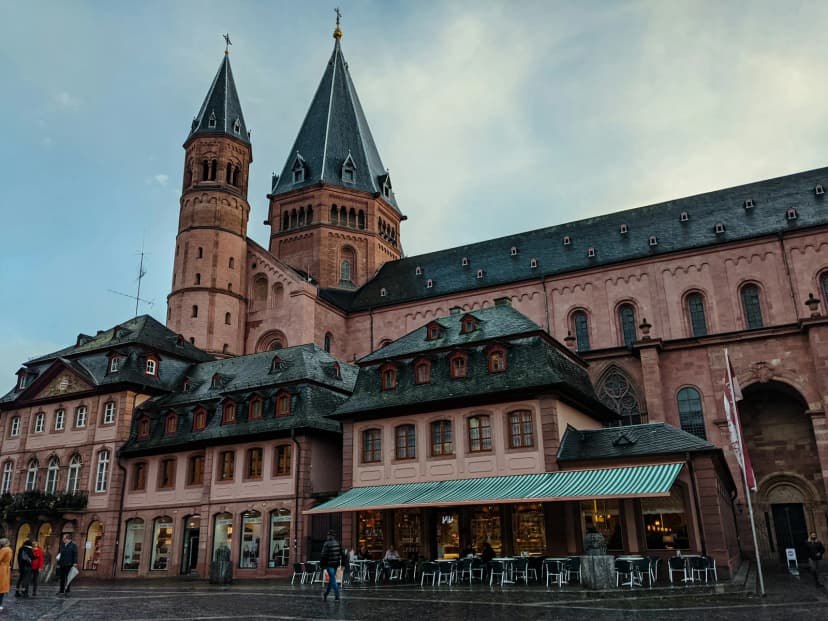
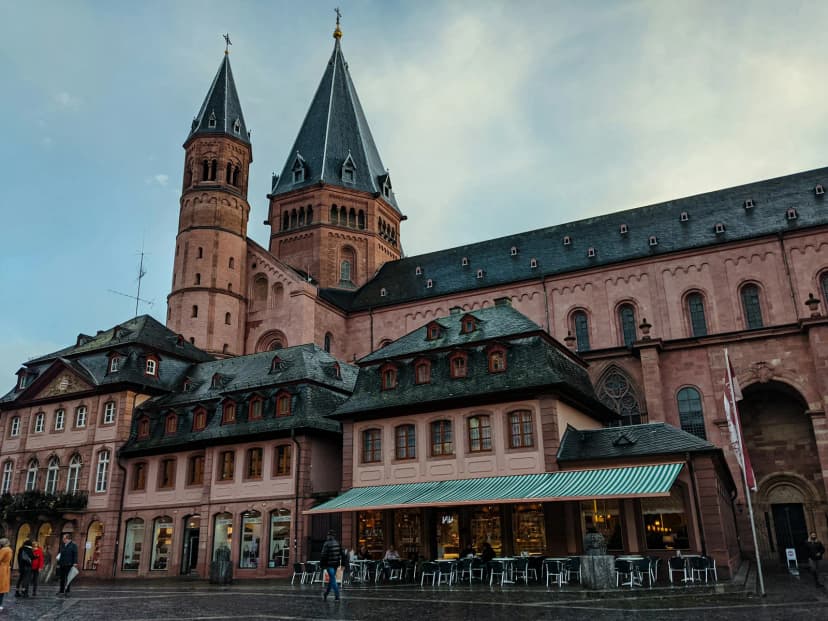
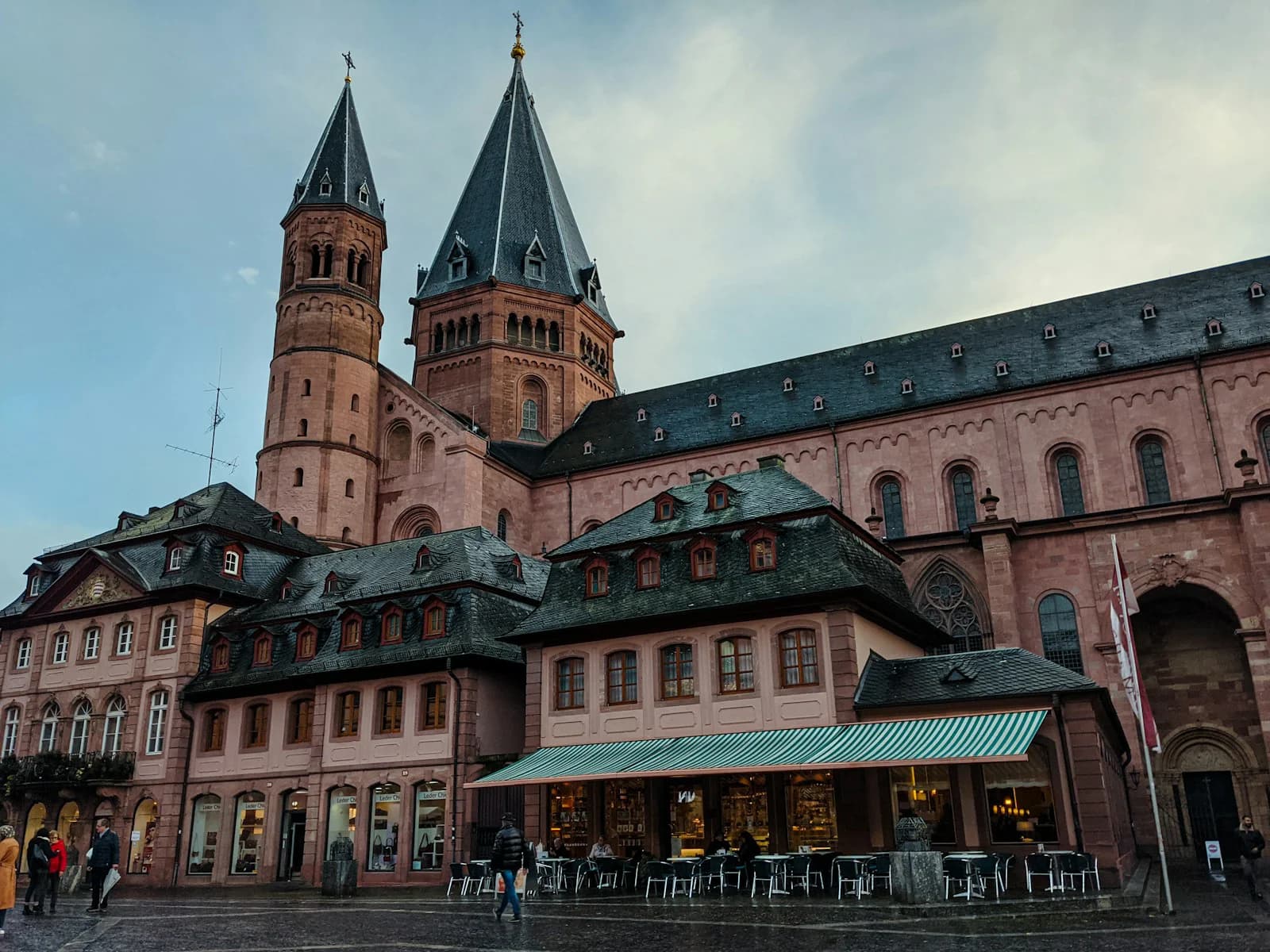
The cathedral square and the market area in front of it are free, central and busy, which makes them the natural meeting point before dinner. The cathedral itself is the city's defining landmark, a Romanesque structure begun in the tenth century under Archbishop Willigis with six towers and a red sandstone exterior. Its interior keeps its own visitor hours and may be closed to tourists during services, so check before you plan an evening look inside rather than assuming the doors are open.
Schillerplatz holds the Fastnachtsbrunnen, the carnival fountain completed in 1967 by the artist Peter Paul Etz, standing nine metres tall with more than two hundred bronze figures drawn from Mainz's carnival tradition. It is a piece of public sculpture in an open square, so it costs nothing and never closes. Treat it as a two-minute stop rather than a destination, and pair it with the surrounding baroque mansions that line the square.
St. Stephan is the other free exterior worth the climb, up the Stephansberg in the old town. Its fame rests on the stained-glass windows that Marc Chagall and, after his death, his student Charles Marq created for the church, an overwhelming bath of blue with biblical motifs. The windows only reveal themselves properly inside and in daylight, so this is a daytime or late-afternoon stop rather than a night-time one.
When a Museum Still Fits: The Gutenberg Museum's Interim Home
The Gutenberg Museum is the one major museum that can plausibly slot into the end of an afternoon before an evening out, but only if you know where it is. After decades at Liebfrauenplatz the old building closed in early October 2024 for reconstruction, and since the end of November 2024 the collection has been shown as the interim exhibition Gutenberg Museum MOVED at the Natural History Museum Mainz on Reichklarastraße 1. Anyone planning to visit the old site will find a construction project instead.
The interim exhibition still delivers the two things most people come for: original Gutenberg Bibles, shown in a walk-in treasure chamber, and working demonstrations of early printing. Printing demonstrations run for about fifteen minutes, every hour on the hour from 10 am to 5 pm Monday to Wednesday and Friday to Sunday, and until 7 pm on Thursdays, with the cost included in museum admission. Those times come from the museum's own regular-dates page and can change, so verify on the day.
Separate ticketing matters here. The one-hour public museum tour, which includes a printing-press demonstration and a viewing of the original Bibles in the vault, is listed at 14 euros, 12 euros reduced, with children up to and including eight free, and admission is charged on top of that; it requires advance registration. Family Saturday is a distinct offer with its own small workshop fee, and the interim exhibition sits inside a different museum building, so do not assume one ticket or one complex covers everything. Confirm scope, prices and dates on the museum's own pages before you go.
Getting Back: Regional Tickets, Checked Timetables and a Fallback
Mainz's public transport is run as buses, trams and trains converging on Hauptbahnhof, with single tickets, day passes and group tickets sold at machines and on vehicles. Mainz Tourismus sells the mainzcardplus with or without a public transport ticket, and its listed benefits include free entry to Mainz museums plus a city tour, which makes it worth pricing against your own plans rather than buying reflexively.
What no available source confirms is the late-night frequency, last departure or route of any specific tram or bus. Do not take a line number or a departure time from a guide, including this one. Check the operator's live timetable, the official city app, or the screens at your stop on the evening itself, and note the last connection back before you settle into a second drink.
Build in a fallback. The old town, Neustadt and Hauptbahnhof sit close enough together that walking is realistic for most people, and taxis and ride-hailing are an option if the timetable fails you. If you are weighing a full day against an evening, the one day in Mainz itinerary is useful for matching what you see in daylight with what you return to after dark.
A Suggested Evening, and What to Confirm First
Here is one shape of an evening, offered as a suggestion rather than a schedule. Start on the Rhine promenade while there is still light, walking the traffic-free stretch between the Zollhafen and the Winterhafen at an easy pace. Move into the Altstadt as the light goes, take a table at a Weinstube for regional wine and a proper meal, then walk to the Neustadt for a bar or the Kulturclub if there is music on. Finish with a cocktail at Spiritus if you booked ahead, or a short walk back through the market square if you did not.
None of the times in that plan are fixed by anyone. Venues in Mainz change their opening days, close for private events and adjust for weather, and the same goes for any club night. Check the venue's own website or social channel on the day you go, and check transport separately, because those two decisions come from different sources and one does not update the other.
If you have a second evening, invert the order: eat early in the Neustadt, then walk the riverside in the dark and finish in the Altstadt. Two shorter and slower nights suit Mainz better than one crammed one, which is the same conclusion our 2 days in Mainz itinerary reaches for the daytime.
Plan Your Mainz Evening
The reliable version of a Mainz night is simple: a riverside walk, a wine tavern in the Altstadt or Neustadt, and a last drink somewhere small. The parts you cannot confirm in advance are the ones worth verifying yourself on the day. Check venue opening times, check your specific tram or bus connection, and do not count on illumination, closing hours or late services that nobody publishes.
If you are staying longer, look at the wider city plans before you commit your evenings to a fixed order. The Mainz travel hub collects the itineraries, landmark guides and practical pages that sit alongside this one, and it is the fastest way to see whether your evening should be built around the Rhine, the museums or the wine neighbourhoods.
Frequently Asked Questions
Is Mainz old town illuminated at night?
No official source confirms a scheduled illumination of the old town, so you should not plan an evening around one. The lanes, squares and cathedral square are public streets that stay open, and some shop and restaurant windows light them after dark, but that is ordinary street lighting rather than a light show. If a seasonal lighting event is running while you are in Mainz, it will be announced by Mainz Tourismus or the city, so check those channels during your stay.
Are there free things to do in Mainz at night?
Yes. The Rhine promenade between the Zollhafen and the Winterhafen is a public, traffic-free walk, the cathedral square and market area are open public space, and Schillerplatz with the Fastnachtsbrunnen costs nothing to see. Church exteriors such as St. Stephan are also free to look at from outside even when the interior is closed. Interiors, museums, bars and wine taverns are separate, paid and time-limited, so plan the free parts as your walk and the paid parts as your stops.
Can you walk the Rhine promenade at night?
The promenade is a public riverside path rather than a ticketed attraction, and no closing time or curfew is published for it. The stretch from the Zollhafen to the Winterhafen takes roughly an hour at an easy walking pace, according to a local university guide, which is an estimate rather than an official figure. Treat it as an unlit riverside walk after dark: go with company if you can, take the weather seriously, and rely on your own judgement rather than an assumed schedule.
Do you need to book bars or wine taverns in Mainz in advance?
For most Weinstuben and neighbourhood bars, walking in is normal, but Spiritus Cocktailbar is explicitly described as a place where you should reserve if in doubt, which fits its small room and made-to-order drinks. Weekends, festival periods and large groups make booking sensible everywhere. The only way to know for a specific date is to contact the venue directly, since opening days and reservation policies change and are not published in one central place.