Two days in Lübeck suits a city whose headline sights cluster on one walkable island. The Old Town is a UNESCO World Heritage site, the station sits just across the water, and the distances between the main monuments are short. Treat the route below as a suggestion and adapt it to your arrival time.
One sourced detail frames the whole visit: the official tourism site describes the Altstadtinsel as a UNESCO World Heritage site since 1987, notes seven church towers shaping the skyline, and counts roughly 90 surviving passages and courtyards. Those three facts explain why two days works here: distances are short, but the detail is dense. The same site publishes the events calendar, the safest place to confirm what is running during your stay.
Why Two Days Suits Lübeck
One day covers the Old Town's greatest hits if you keep moving; two days let you enter buildings instead of photographing them. One traveller's account notes that even one day in Lübeck reveals quite a bit, while the same writer suggests one to two full days for the main attractions. That range is the honest answer: two days is comfortable, not mandatory.
Lübeck also works as a base rather than a stopover, because it sits close enough to Hamburg and the Baltic coast to allow a half-day escape. If you only have one day, compress the plan below and drop the day trip. If you have three, a 3 days in Lübeck itinerary lets you add a second excursion and unhurried museum time.
Day 1 Morning: Holsten Gate to Market Square
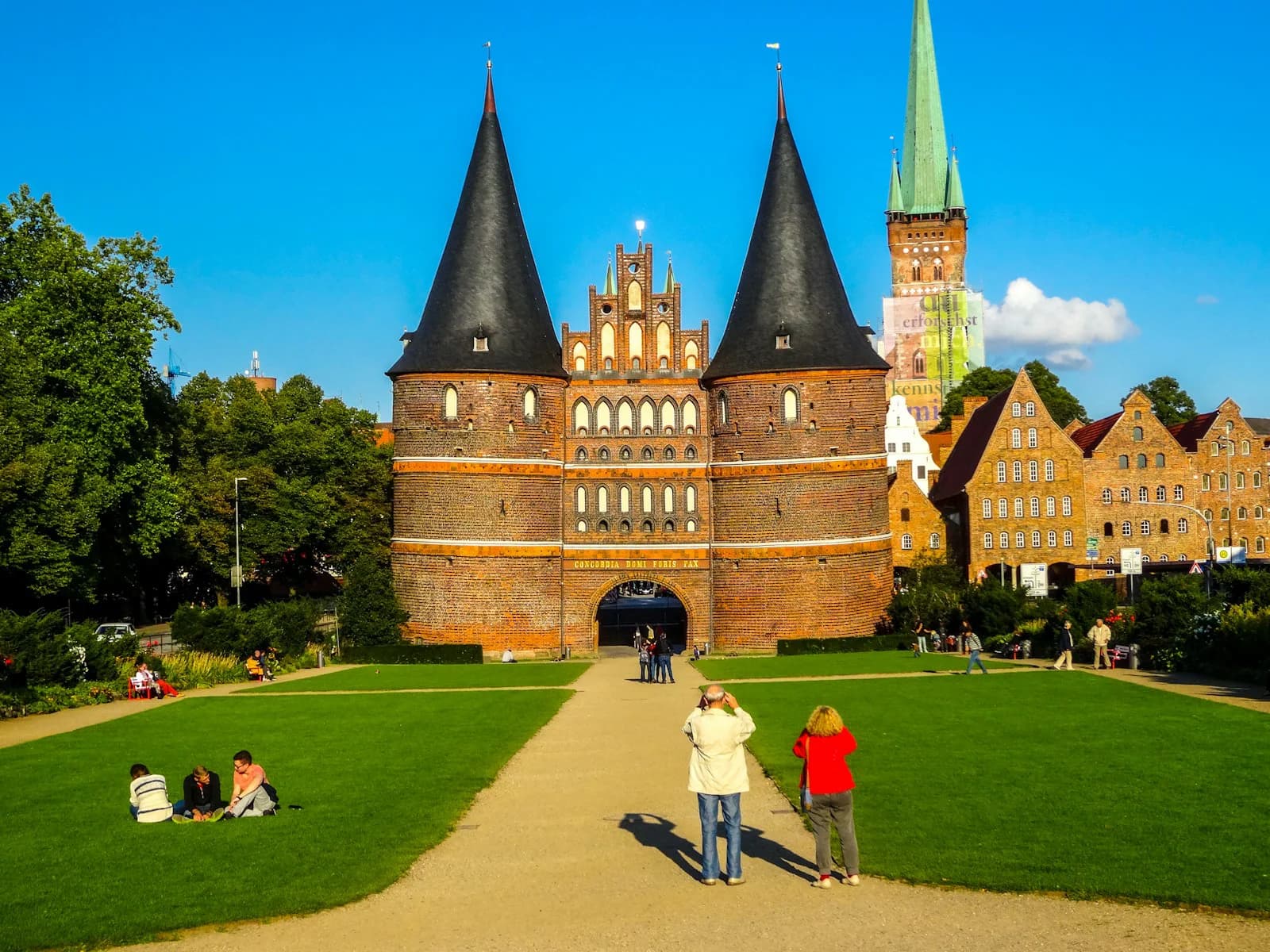
Start at the Holsten Gate, the red-brick landmark that once formed part of the city fortifications and now stands alone. Walk around it rather than straight through: the walls facing away from the Old Town are thicker than those facing inward, a reminder that this was a defensive structure built on marshy ground. The gate is the natural orientation point for the whole island.
From there, head along Holstenstraße into the Market Square and the Town Hall, a working civic building with a striking dark brick facade. Because it still functions as a town hall, interior access normally depends on joining a guided tour rather than wandering in. The tourism office can confirm current tour arrangements and language options.
The Holsten Gate contains a small museum about the city's trade and defence history. One traveller's verdict is that it is not the strongest museum in Lübeck, so if your time is tight, treat the gate as an exterior first and decide about the interior later. Entry is ticketed, and you should check the current price and opening status on site or with the operator before planning around it.
Day 1 Midday: Choosing Among the Brick Churches
Lübeck's skyline is defined by the spires of the city's medieval brick churches, among them the Cathedral, St. Mary's, St. Jacob's, St. Peter's, and St. Giles. Trying to properly enter all of them in one day turns the afternoon into a queue. Pick two, and let the others be exterior stops as you pass.
St. Mary's is often singled out as the model for dozens of later brick churches in the region, and its interior includes a celebrated astronomical clock. St. Jacob's is notable because it survived the Second World War largely undamaged, so its fittings are original rather than restored. St. Giles' sits close to the St. Annen Museum, which makes it an easy add-on rather than a separate trip.
St. Peter's is a different proposition: its interior was not restored to its former state after wartime damage, and its main draw is the tower view rather than the church itself. If you want the panorama, treat the climb as a viewpoint decision and check access and any lift status on the day. Church opening hours, service times, and tower access vary, so confirm locally instead of assuming a fixed schedule.
Each church has its own entry arrangements, and not all are free to enter. This is the biggest planning mistake in Lübeck: assuming that one ticket, one pass, or one church covers the group. If you only have time for one interior, choose based on interest rather than prestige, whether that is architecture, maritime history, or a specific artwork.
Day 1 Afternoon: Hospital, Waterfront, and Courtyards
The Heiligen-Geist-Hospital, completed in the thirteenth century and described as one of the oldest social institutions still in use, sits on the main route through the Old Town. Its church and Long House are the historical heart of the complex, but public access has not always been available: one recent visitor found the Long House closed, possibly for restoration. Check current access before you build your afternoon around it.
Continue to the Salzspeicher, the sixteenth- and seventeenth-century riverfront warehouses that recall Lübeck's role in the salt trade. They are best seen from the water side, where the row of gabled fronts reads as a single composition. This is a free exterior stop, and it is one of the most photogenic on the island.
Then make a deliberate detour into the passages and courtyards, known locally as Gänge und Höfe. The tourism site counts roughly ninety surviving examples, and they are easy to walk past because many entrances look like ordinary doorways off the main streets. Plan at least one specific courtyard rather than hoping to stumble into them, and remember that these are largely residential spaces: keep voices low and respect private doors.
Day 1 Evening: Marzipan and the Trave
Café Niederegger is the obvious evening stop for anyone curious about Lübeck marzipan, and its layout is part of the experience: the building spreads across three floors, with a shop, a café, and a small marzipan museum. Knowing that in advance saves confusion at the door, especially when the ground floor is busy.
Afterwards, walk a stretch of the Trave and the waterfront rather than heading straight back inland. The river is what made the city's trading wealth possible, and the evening light over the water is the reward for a day spent on foot. If you want a drink with a maritime atmosphere, Schiffergesellschaft occupies a former seafarers' guildhall, though menus and hours should be checked directly.
Day 2 Morning: One Big Museum, Chosen Deliberately
Day two should belong to one museum, not four. The European Hansemuseum explains the Hanseatic League and Lübeck's central role in it, using immersive exhibits and medieval objects. It suits anyone who has been seeing Hanseatic references everywhere and wants the full context; booking ahead is sensible if you know you are going.
The St. Annen Museum offers a different payoff: sacred art from the thirteenth to sixteenth centuries plus household objects showing how Lübeck residents lived in later centuries. If art and period rooms appeal more than trade networks, choose Behnhaus Drägerhaus instead, where two historic houses hold nineteenth-century paintings and furnished rooms. It is effectively part museum, part historic home tour.
If you have any interest in modern German politics, the Willy Brandt House is a compact addition, and one recent account notes that entry has been free. Because that status can change, verify it with the museum before you go rather than assuming it. Whatever you choose, leave the afternoon free rather than stacking a second paid interior on top.
Ticketing is where Lübeck catches people out. Several museums belong to the same museum family, and one visitor reports that showing a ticket from one can get you a reduced ticket at another in the same group; a day pass is also promoted for multi-museum visits. None of that means a single ticket unlocks every collection, so ask at the first museum what your ticket actually covers.
Day 2 Afternoon: Day Trip or Deeper Old Town
The cleanest day-trip choice is Travemünde, Lübeck's own Baltic seaside district, which keeps travel simple because it belongs to the same city. The alternative is a nearby Hanseatic town, which gives you a second historic centre but costs more travel time in both directions, and that trade-off usually decides it.
Hamburg is the other option: one traveller notes that Lübeck is less than an hour from Hamburg by train, which makes the reverse trip feasible too. If northern Germany is your focus, a 2 days in Berlin itinerary comparison may be more useful. For Lübeck itself, the question is whether you want sea air or another old town.
If you would rather stay put, spend the afternoon on the side streets. Hüxstraße and Fleischhauerstraße are the local answer for independent shops and cafés, away from the main axes of Breite Straße and Königstraße. For a photogenic finish, the stretch of An der Mauer near the Krähenteich pond is lined with irregular historic houses.
Practical Notes on Walking, Tickets, and Timing
The Old Town is walkable from the main station, which is the single most useful logistical fact for a two-day visit. One traveller advises using the station storage lockers if you are arriving or leaving by train and want to explore before check-in, because the cobblestones are hard on wheeled luggage. Buses also connect the station area with the centre if walking is not appealing.
Build your day around free exteriors and paid interiors, and decide the paid ones in advance. Free things to do in Lübeck include the gate exterior, the waterfront, the courtyards, and the main streets, and these fill a day comfortably on their own. Once you know which two interiors matter most, check current prices, opening days, and any closure notices directly with each operator.
If you arrive late on day one, treat the evening as a single loop from the gate to the Market Square and back along the Trave. Move the churches and the museum to day two and drop the day trip. It is better to see three things properly than to sprint through eight.
Winter, Summer, and What to Cut
Summer brings long evenings and mild weather, which suits the walking-heavy plan above. Winter is colder and darker, but the Christmas market season is the reason many people come. Christmas market dates change every year, so confirm them through the tourism office calendar.
With only one and a half usable days, cut in this order: the day trip first, then any second museum, then the tower climb. Keep the Old Town loop, one church, and one paid interior. That combination gives you the sense of the city without turning the visit into a schedule.
Plan Your Visit
Two days in Lübeck is a comfortable fit for the Old Town, one strong museum, and a short excursion, provided you accept that you will not enter everything. Walk the island first, look at the landmarks before paying for interiors, and let the courtyards and waterfront carry the atmosphere.
Before you travel, confirm current opening days, prices, and access on the official tourism site or with each museum, church, or café directly. Those are the details that change; the layout and the walking distances do not.
Frequently Asked Questions
Is two days enough for Lübeck?
Yes for the Old Town's main sights plus one or two museums, which is the realistic ceiling for a two-day visit. One day is enough for the island's highlights at a brisk pace, while two days add breathing room and allow a short excursion. If you want multiple museums and a full day trip, add a third day rather than compressing everything.
Should you day-trip from Lübeck or stay both nights?
Stay both nights if the Old Town is the point of the trip, because evenings on the island are part of the experience and the station is close enough to make arrival and departure easy. A day trip works best as a half-day on your second afternoon, either to the Baltic seaside district or to a nearby Hanseatic town.
Which Lübeck museums are worth your limited time?
The European Hansemuseum is the strongest choice for first-time visitors who want the Hanseatic context, while the St. Annen Museum and Behnhaus Drägerhaus suit travellers more interested in art and period rooms. The Willy Brandt House is a compact alternative for political history. Pick one, check its current opening days and ticket scope directly, and do not assume a single ticket covers every collection.
Which Lübeck church should you visit if you only have time for one?
St. Mary's is the usual first choice because of its architectural influence and its astronomical clock, and St. Jacob's appeals to anyone who values original wartime-surviving fittings. St. Peter's is really a tower viewpoint rather than a church interior experience. Opening hours and access arrangements differ between the churches, so confirm them locally.
Do Lübeck museums share one ticket?
Not across the board. Several museums belong to the same museum family and may offer reduced entry on a ticket from another in the group, and a day pass is promoted for multi-museum visits, but a single ticket does not mean every collection in a complex is included. Ask at the first museum what your ticket actually covers.