
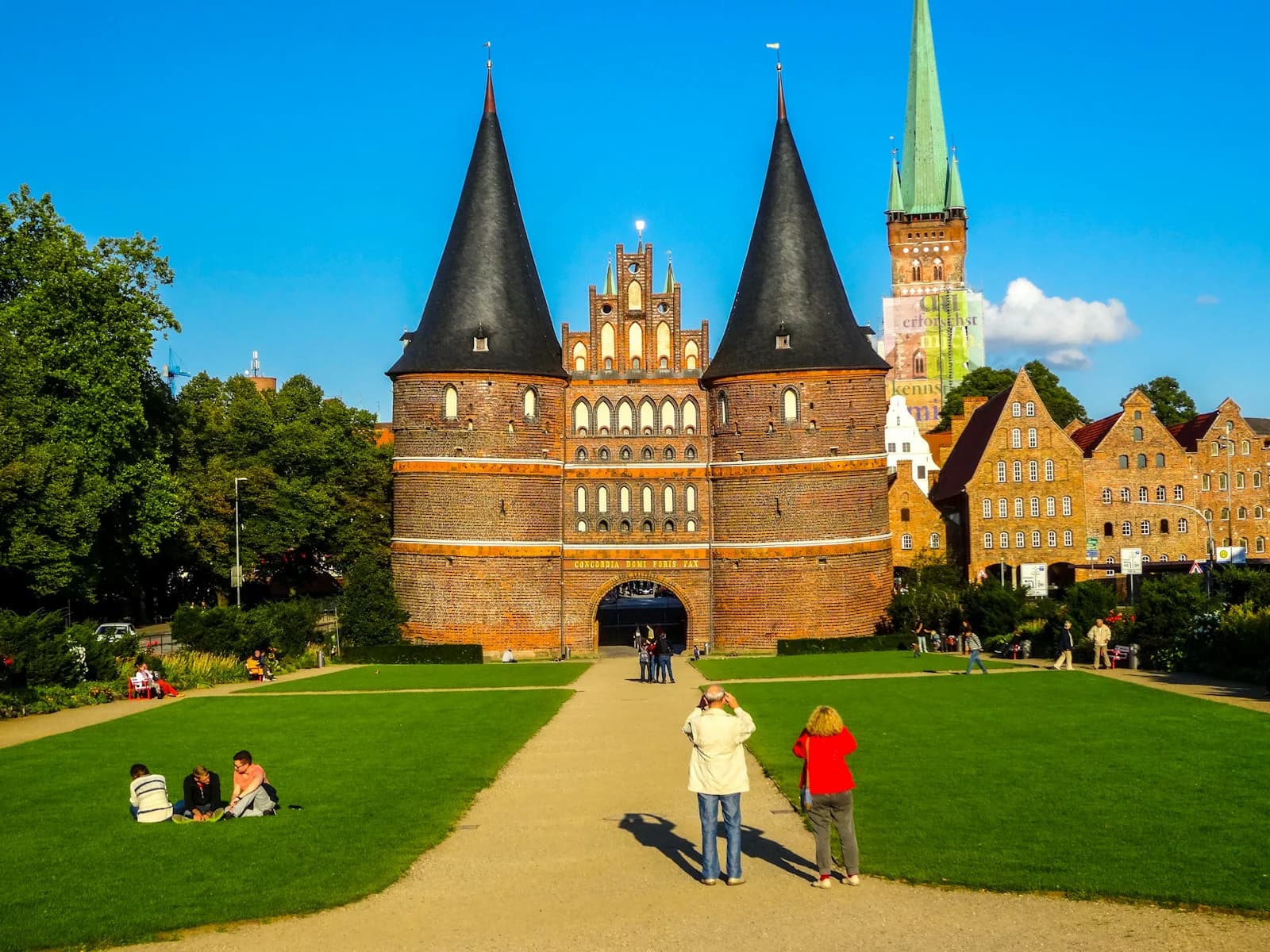
Lübeck's historic centre sits on an island wrapped by the River Trave, and that geography is what makes a single day work so well. The city's official tourism site counts seven church towers shaping the skyline, roughly ninety winding passages and courtyards, and a UNESCO World Heritage listing dated 1987, all packed into a compact, walkable core. Plan on a slow loop of roughly six to eight hours rather than a sprint, because the distance between stops is short but the detail is dense.
The route below is one suggestion, built for a walking pace, a central start and no car. It assumes you arrive by late morning and finish near the water at dusk, and it deliberately leaves out anything that would force you to rush. If you are weighing whether this deserves one day or more, a 2 days in Lübeck itinerary lets you add the museums and the Hansemuseum properly, while a 3 days in Lübeck itinerary opens up the surrounding region.
One planning warning up front: almost everything below is a landmark whose exterior is free to look at, while interiors, towers and collections are separate visits with their own conditions. Rather than quoting admission figures or opening times that change, this guide tells you where to check and which decisions you actually have to make on the day.
How to Structure Your Day on the Island
A simple structure is to enter from the western gate side, work north and then east through the market and church quarter, and finish back at the water. This keeps you moving in one direction instead of zig-zagging across the same lanes, and it means the two surviving city gates frame the day at the start and the northern edge. The whole island is walkable end to end, so the limiting factor is not distance but how long you linger.
Because the distances are short, resist the temptation to stack every sight. The city's own count of roughly ninety courtyards and seven church towers suggests how easily a day can disappear; choosing two or three interiors and letting the rest stay exterior is usually the more enjoyable trade. Save the deeper museum visits for a longer stay and treat this day as an orientation.
Morning: The Holstentor Gates and the Salzspeicher
Start at the Holstentor, the late-Gothic twin-towered gate that remains one of the remnants of the city fortifications and the most photographed symbol of the Hanseatic city. It was built in 1464, its twin towers stand slightly crooked against the lawn, and the surrounding open ground costs nothing and takes perhaps twenty minutes at an unhurried pace.
The gate houses a museum on Lübeck's history, which is a separate, ticketed interior rather than part of the free approach. If you want to go in, check the official city tourism site for current opening days and admission conditions before you build your morning around it. Many visitors find the outside sufficient on a one-day schedule, but the collection is the logical choice if Hanseatic trade is your main interest.
A short walk along the river brings you to the Salzspeicher, the row of Renaissance salt warehouses built between 1579 and 1745 in brick. They stored the salt that underpinned part of Lübeck's wealth, and their stepped gables are best seen from the water side. This is a look-and-photograph stop rather than an interior visit, and it pairs naturally with the gate before you head into the island.
Late Morning: Burgtor, Burgkloster and the Northern Edge
Walk north to the Burgtor, Lübeck's oldest surviving city gate, which once belonged to a network of four gates protecting the town. It is one of only two gates still standing, the other being the Holstentor, and it marks the point where the medieval fortification story begins. The setting is quieter than the western approach, which makes it a good place to slow down before the market gets busy.
The adjacent Burgkloster area is where the city's origins are usually explained, and the tourism board frames it as the place where it all began. Treat the complex as a context stop: read the panels, take in the brickwork, and decide whether an interior visit fits your remaining hours. If you have already spent time inside the Holstentor Museum, keeping this one to the exterior is a reasonable compression.
Midday: The Rathaus and the Markt
The Rathaus is one of the largest medieval town halls in Germany, with construction that began around 1230 and continued over centuries, which is why the facade mixes styles. Its dark brick screen and arcade face the market square, and the exterior is free to admire at any time. This is the natural midpoint of the walk and a good place to sit, eat and re-plan the afternoon.
Interior tours of the Rathaus are offered, but they are conducted in German, which is a real constraint if you do not follow the language. If that matters to you, skip the tour and put the time into a church or a courtyard instead. Otherwise, ask at the tourist information point on Holstentorplatz what is running on your date, since schedules vary through the year.
Midday: St. Mary's Church and the Devil's Stone
Marienkirche stands at the highest point of the Old Town and is described as the first major Brick Gothic church, a prototype that influenced buildings across northern Europe. Its vaulted ceiling is among the tallest brick vaults anywhere, and the interior scale is the reason many visitors rate it above the other churches. Churches in Lübeck are working religious buildings, so check locally before planning a visit around a service or a concert.
Two details inside repay attention: the Danse Macabre stained glass installed in the 1950s to replace windows destroyed in the war, and the shattered bells that fell in a 1942 air raid and were left where they landed as a memorial. Both are specific, documented elements rather than general atmosphere. Outside, look for the Devil's Stone with its small bronze devil figure, added in 1999, and the legend that the devil helped build the church believing it was a wine bar.
Lunch: Schiffergesellschaft or a Market-Area Meal
For a sit-down lunch with atmosphere, the Schiffergesellschaft is the obvious candidate: it began as the meeting hall of the seamen's guild and became a restaurant in 1868, and the wooden booths and hanging model ships still carry that maritime character. It is a popular address, so arriving early or asking about a table when you pass is the practical approach rather than assuming you can walk in at peak time. Confirm current service times and whether booking is possible directly with the restaurant.
If you would rather not commit to a long lunch, the lanes around the market support quicker options, leaving more daylight for the courtyards and the tower. The trade-off is straightforward: a proper sit-down meal costs you an hour of sightseeing, while a fast lunch buys you a slower afternoon. Either way, keep the meal inside the island so you are not crossing water to eat.
Afternoon: The Gänge and Courtyards
The courtyards and passages, known locally as Gänge und Höfe, are what most distinguishes a Lübeck walk from any other old town. The city counts roughly ninety of them surviving today, tucked behind houses and reached through narrow openings that are easy to miss. Some are private residential property and some are open, which means the etiquette matters: keep your voice down, do not photograph through windows, and turn back if a gate or sign suggests you should.
Approach them as lived-in neighbourhoods rather than attractions, and the experience improves immediately. A good strategy is to wander without a fixed list and accept that you will find two or three rather than all of them. If courtyard-hunting is a priority, the tourist information office on Holstentorplatz can point you to currently accessible examples, which is safer than relying on any printed list.
Afternoon: Heiligen-Geist-Hospital
The Heiligen-Geist-Hospital was built in 1286 as a charitable foundation funded by merchants and councillors for the poor, sick and elderly, making it one of the oldest surviving hospitals in Europe. Inside, one of the tiny living quarters that remained in use until the 1970s can still be seen, which is the detail that makes the building's purpose concrete rather than abstract. In the run-up to Christmas the same hall hosts an arts and crafts market, which changes the visiting experience entirely.
Entry to parts of the hospital has been described as free of charge from Tuesday to Sunday, but this is exactly the kind of arrangement that can change with restoration work and seasonal events. Verify the current days and any entry conditions with the city tourism office before you make it a fixed stop, and approach this as a detail to confirm rather than a guaranteed opening. If the timing does not work, the exterior and the surrounding street are still worth the detour.
Afternoon: St. Peter's Tower and the Seven-Spire View
St. Peter's Church is no longer an active parish church; it was damaged in the Second World War and has since been restored as an exhibition and events space. The main reason to go is the tower, which offers the classic panorama over the Old Town and its seven spires, the silhouette the city is known for. A lift has normally carried visitors up, but availability has varied, and climbing the stairs on foot is a serious effort.
Because tower access, lift operation and any renovation work are the most volatile elements of a Lübeck day, check on arrival rather than planning around last year's information. If the tower is unavailable, the view from the Holstentor side of the river gives you the gate and warehouses in one frame instead. Decide on the spot whether the climb fits your energy and your remaining daylight.
Late Afternoon: Marzipan and the Niederegger Story
Marzipan is not a souvenir sideline in Lübeck; it is part of the city's identity, and Niederegger is the name most closely tied to it. The family business has been producing marzipan since 1806 and runs a small museum alongside its shop. That makes it a reasonable late-afternoon stop when your legs are tired and the light is going.
Treat shop and museum opening times as things to confirm on the day, especially outside the main season and around public holidays. If the shop is closed, marzipan still appears on dessert menus across the Old Town, so you will not leave without tasting it. The point is the culture around the product, not a single address.
Optional Add-On: The Trave and the Museumshafen
If your legs are still willing, the water gives you a different reading of the island, with the old town seen from the river rather than from inside its lanes. The Museumshafen is the home harbour of more than twenty maintained traditional sailing ships, which makes it a worthwhile wander even if you never board anything. A boat trip is optional and weather-dependent, so treat operators and departure times as something to arrange locally.
The harbour also sits close to the station side of the city, which makes it a sensible final stop if you are returning by train in the evening. Check departure information on the day rather than relying on a fixed plan. If the weather turns, the harbour is quick to see and easy to abandon.
What to Skip If Your Day Is Short, Late or Rainy
If you arrive after midday, cut the northern loop first: the Burgtor and Burgkloster are the most expendable stops and the furthest from the core. Keep the Holstentor, the market, St. Mary's and one set of courtyards, and you will still have seen the essential shape of the island. Trying to force the full circuit into four hours produces a rushed walk and very little memory of any single place.
On a wet day, the interiors take priority, since churches, the Holstentor Museum and the hospital give you shelter between short outdoor hops. That is also the day to consider a boat trip only if conditions are genuinely fine, because a cold, exposed deck is not a good substitute for a dry museum. Whatever you cut, keep the market square in the middle of the day so you always have somewhere to sit and warm up.
Evening Wind-Down and Getting Around
Finish the day with a slow loop back toward the water rather than a second checklist of sights. The island is small, and the second pass through lanes you already know is usually where the details register, from brickwork to the low doorways of the courtyards. A quiet dinner inside the old town, or a drink near the harbour, closes the day without further travel.
Lübeck is compact enough that the day stays on foot, with the station and the Holstentorplatz information point both within walking distance of the old town. If you want to combine the city with the coast, Travemünde is reachable as an extension. For anything involving buses, regional trains or ferries, the Lübeck city transport guide is the place to check practical details rather than guessing at connections.
Plan Your Visit
One day in Lübeck is enough to walk the UNESCO island from gate to gate and come away with a clear sense of the Hanseatic city, provided you accept that the museums and towers are choices rather than obligations. Pick two interiors at most, leave room for the courtyards, and let the short distances do the work for you. If you are coming from Hamburg, this is a comfortable day trip rather than a tight connection exercise.
The single most useful habit for this itinerary is to verify the volatile details on the day: church and tower access, hospital visiting days, museum interiors and shop hours are all things the city publishes and updates. Start at the tourist information point on Holstentorplatz, ask what is open, and build the loop from there. If you are comparing German city breaks, the one day in Berlin itinerary and the one day in Dresden itinerary show how differently a single day plays out in larger, more spread-out historic centres.
Frequently Asked Questions
Is one day enough to see Lübeck's Old Town?
Yes for the main outdoor landmarks. The Old Town island is compact and walkable end to end, so a single day comfortably covers the Holstentor, the Salzspeicher, the Burgtor, the market square and Rathaus exterior, St. Mary's, a few courtyards and the harbour. What a single day does not cover well is the museum interiors, which is why many visitors keep the Holstentor Museum or the European Hansemuseum for a second visit rather than squeezing everything in.
Can you walk the whole Old Town island in a day?
Yes, and walking is the sensible way to do it. The distances between the gates, the market and the church quarter are short, and the courtyards are found precisely by wandering rather than by following a vehicle route. Plan for a slow loop of about six to eight hours with breaks, and be ready to drop the northern edge of the island if you start late.
Are Lübeck's courtyards free to visit?
Looking into the courtyards costs nothing, but they are not a uniform attraction. Roughly ninety survive behind houses and passageways, some are private residential property and others are open to passers-by, so behaviour matters more than ticketing. Walk quietly, avoid photographing into windows, and respect any gate or sign that indicates a courtyard is not for visitors; ask at the tourist information office if you want current guidance on which are accessible.
What is the Holstentor and do you need a ticket to see it?
The Holstentor is the late-Gothic twin-towered gate built in 1464 that survives from Lübeck's city fortifications and is the city's best-known symbol. Seeing it from the outside, along with the lawns and the riverbank around it, costs nothing and takes only a short stop. The history museum inside the gate is a separate, ticketed interior with its own opening arrangements, so check the official city tourism pages before you plan your morning around going in.
Where do you get the best view over Lübeck?
The tower of St. Peter's Church is the classic viewpoint, looking across the Old Town and its seven-spire silhouette. Access arrangements, including whether a lift is running, have varied in the past, and climbing on foot is strenuous, so confirm the current situation locally on the day you visit. If the tower is unavailable, the riverbank near the Holstentor gives you a lower but reliable view of the gate and the salt warehouses together.
What should you eat in Lübeck besides marzipan?
The Schiffergesellschaft is the historically distinctive choice: it began as the seamen's guild meeting hall and became a restaurant in 1868, with wooden booths and a maritime interior. Northern German dishes dominate, and marzipan still turns up in desserts. It is a busy address, so arriving early or checking directly with the restaurant about a table is more reliable than assuming you can walk in at peak dinner time.


