Lübeck's historic centre occupies an island in the Trave, and the preserved medieval town was inscribed as a UNESCO World Heritage site in 1987, according to the city's official tourism site. That matters for a budget trip because the designation covers the urban fabric itself rather than one ticketed monument, so you can spend hours crossing bridges, reading brick facades and watching the water without buying admission.
The honest trade-off is that a free day is mostly an exterior day, and a sensible self-guided plan runs about three to four hours at an easy pace, which is an editorial suggestion rather than an official schedule. Several church interiors, the tower at St. Peter's, the Holstentor museum and the larger museums charge entry. This guide flags where the free walking framework ends so you can decide which exceptions deserve your budget.
Why the Old Town Island Suits a Free Day
The Old Town island is compact and largely flat, which makes it realistic to cover on foot rather than buying transport tickets. The official tourism site describes the Altstadtinsel as surrounded by water, with seven church towers shaping the silhouette and around 90 passages and courtyards still to discover. Treat those figures as the organiser's own count rather than a measured route plan.
Distances inside the island are short enough that you can improvise, but the surface is cobbled almost everywhere. Wear shoes with a firm sole and expect to pause for uneven paving, especially in the narrow lanes behind the main streets. If you want a broader city overview before committing to a route, the Lübeck city guides page is a sensible starting point.
Holstentor and the Salt Warehouses: Free Exteriors, Paid Museum
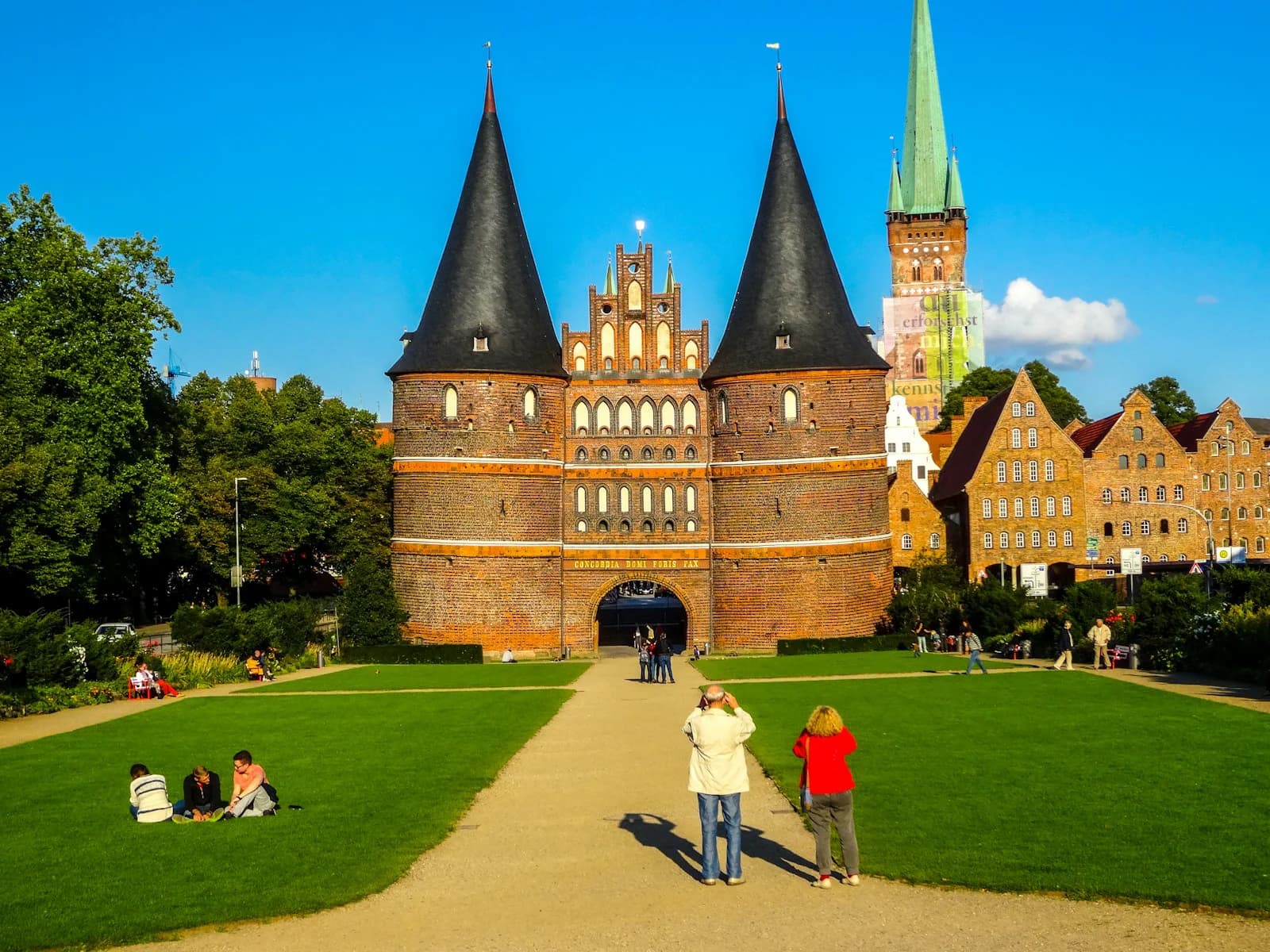
The Holstentor is the first landmark most visitors see, standing on the approach from the main station, and its exterior is free to walk around. Travel writer Claire Hiscott notes that the gate leans because it was built on marshy ground and the weight of its massive walls caused it to shift over the centuries. The gate houses a museum about the city's history, so the building is free to admire but not free to enter.
A few metres away along the riverbank stand the Salzspeicher, the brick salt warehouses built between the late 16th and early 18th centuries, according to listings that date them to between 1579 and 1745. They make a useful teaching pair with the gate because they show Brick Renaissance rather than Brick Gothic, and the contrast is visible without paying anything. Standing on the Holstentorplatz side, you can compare the two styles in a single view.
Crossing onto the Island: Puppenbrücke, Market Square and Town Hall
Most walkers enter from the west, crossing the Puppenbrücke, named for the allegorical statues on its balustrade. The figures you see on the bridge are copies, and the originals are kept at the St. Annen Museum quarter, which is worth knowing if you want to see the real carvings later. From there you are on the island and the market square is a short walk inland.
Lübeck's Town Hall and market square began in the 13th century and the building has been extended in almost every century since, so what you see is a mixture of styles rather than a single period. It remains a working town hall, so the exterior and the square are free while the interior is normally seen on a guided tour. Treat the square as a free orientation point rather than a free museum.
Breite Straße and Königstraße are the two main arteries and carry most of the landmarks, but the parallel lanes reward a detour. Hüxstraße and Fleischhauerstraße are lined with independent shops and cafés rather than chains, and browsing costs nothing. For more of this quieter side of the city, see the Hidden Gems in Lübeck guide.
Reading the Skyline: Five Churches, Seven Spires
Lübeck is known for five main churches whose towers create the famous seven-spire skyline: the cathedral, St. Mary's, St. Jacob's, St. Peter's and St. Giles'. The city's official tourism site counts five Gothic churches, and History Hit records that St. Mary's took around a century to complete before its consecration in 1350. You can walk between all five exteriors and read their brickwork for free.
The reason five large churches existed in a town of this size was money: Hanseatic Lübeck was wealthy enough that different groups and professions built and maintained their own churches. St. Mary's is often described as a model for many later brick churches around the Baltic, so its exterior is worth more than a glance even if you skip the interior. Budget travellers should plan the skyline as the free part and treat interiors as separate decisions.
St. Peter's is the exception many people pay for because its tower has a viewing platform, and the church interior itself is usually free to enter during opening hours. History Hit notes that St. Mary's charges a modest entry, with the money used for restoration, while other churches may be free or may have limited access depending on services and events. Check each church's own website on the day rather than relying on a general guide, because opening arrangements change.
Courtyards and Passages: Free to Walk, but People Live There
The courtyards and passages are Lübeck's most distinctive free experience and also the one that needs the most care. Medieval building land inside the wall was scarce, so merchants built small houses at the back of their plots and reached them through narrow openings in the street frontage. The result is a network of tiny lanes and green courtyards that you can walk through without a ticket.
Sources differ on how many survive: the city's tourism site says around 90, while travel accounts commonly cite about 80, so phrase it as roughly 80 to 90. Füchtingshof and Glandorps Gang on Glockengießerstraße are among the better-known examples, mentioned by travel blog Travelita, and more courtyards can be found near Engelswisch and Engelsgrube. Some are open to the public during the day and others are closed, so read the entrance before walking in.
These are residential addresses, not open-air museums. Keep your voice down, avoid photographing through windows or into doorways, and walk through rather than settling in with a picnic. If you want a deeper explanation of the history, guided theme tours on the courtyards are available for a fee, but the walk itself is free if you follow the etiquette.
The Obertrave Riverside and the Malerwinkel View
The Obertrave boulevard runs along the Trave from near the Holstentor toward Effengrube and looks back at the salt warehouses from the water side. Travel blog Finally Lost notes that residents are still allowed to hang laundry between the trees here, which is a small living detail rather than a staged attraction. Cafés line parts of the route, but sitting on a bench and watching the water costs nothing.
Further round, the Malerwinkel or painters' corner gives the classic view of the old town reflected in the water, and it is reachable on foot from the riverside path. Boats also pass through this stretch, so you can see the same architecture from below without hiring anything. For a different kind of free pause, the Lübeck parks and gardens page covers green spaces that work well as a break from the cobbles.
St. Annen Quarter, the Cathedral and the Mill Pond
The area behind the mill pond and crow pond, between the cathedral and the Museumsquartier St. Annen, is one of the most rewarding free detours. The cathedral is one of the longest brick churches in the world and its exterior can be studied from Mühlendamm and from the water's edge. Walk around to the pond side for the reflection view of the spires, which is a free photograph rather than a paid viewpoint.
The Museumsquartier combines the St. Annen Museum inside former priory walls with a modern art gallery, and the two do not necessarily share a single ticket. Check the current exhibition and admission arrangements on the museum's own site before you go. Outside the walls, the lanes and squares around the quarter are free to wander and often quiet.
The photo stop at An der Mauer, near the Krähenteich, is lined with higgledy-piggledy historic houses and costs nothing but a short walk, as travel blog Tall Girl Big World notes. The originals of the Puppenbrücke figures are kept at the St. Annen Museum quarter, so if you want to see both the copies and the originals, that is a paid stop rather than part of the free route.
Splitting Free from Paid: A Decision Framework
Think of the city in two layers rather than a list of free and paid attractions. Layer one is the public realm: streets, squares, bridges, riversides, church exteriors, courtyards and the Holstentor and salt warehouse facades. Layer two is everything behind a door: church interiors, the St. Peter's tower, the Holstentor museum, the European Hansemuseum and the art museums.
If you pay for one thing, the tower at St. Peter's is the most common choice because it gives you the whole skyline at once, but it is weather-dependent and the lift has been out of service at times. Church interiors are usually cheap and the money often supports restoration, so they are a reasonable second spend. For current prices and opening times, check each attraction's own website rather than a blog, because charges and schedules change.
The Buddenbrookhaus has been reported as temporarily closed for a major renovation, with exhibitions moved elsewhere during the works. Do not plan around a reopening date you have seen in an old article; confirm the current status with the museum or the tourist office. For a wider view of what each landmark offers, the Lübeck landmark visitor guides hub collects the individual visitor pages in one place.
Practical Constraints for a Free Day
Cobblestones are the main physical constraint: they are uneven, they are everywhere inside the island, and they are hard on thin-soled shoes. The island is small enough that you can loop back to a café or a bench when you need a break, but it is not step-free in the old lanes. Plan shorter distances than you would on a modern city grid.
Lübeck's main station is within walking distance of the Old Town, and the station has lockers if you are visiting for the day and do not want to drag luggage over the cobbles, as travel blog Tall Girl Big World notes. Walking is the default way to move between the free sights, and buses also connect the station area with the centre. Check current timetables and ticket options locally rather than relying on dated route lists.
Respect for residents matters more here than at a monument. Courtyards, the Obertrave and the lanes around An der Mauer are lived-in streets, so keep noise down, do not block doorways for photographs, and move on when you have looked. That etiquette is what keeps these places open to walkers at all.
A Free Walking Route for Half a Day Versus a Full Day
For half a day, start at the Holstentor, walk the salt warehouses and the Obertrave, cross the Puppenbrücke onto the island, loop through the market square and the Town Hall exterior, then pick two or three church exteriors and one courtyard before returning to the station. That covers the headline free sights without rushing, and it leaves the paid interiors for another visit. Allow roughly three to four hours at an easy pace, treated as a suggestion rather than an official duration.
A full day adds the St. Annen quarter, the cathedral and mill pond, the An der Mauer photo stop, more courtyards and a longer stretch of the riverside, plus time for one paid exception such as the St. Peter's tower. The trade-off is energy rather than distance: the island is compact but the stops are dense, so a full day on cobbles is tiring. If you want a structured version, compare the one day in Lübeck itinerary with the 2 days in Lübeck itinerary and choose the length that matches your stamina.
Plan Your Free Day in Lübeck
Lübeck rewards a budget traveller because the World Heritage designation covers the whole Old Town island, so the streets, courtyards and riversides are the main event. Build your day around exteriors, use the market square and the Obertrave as free anchors, and decide in advance whether one paid tower or church interior is worth it to you. The rest can wait for a return visit.
Before you travel, confirm current opening times, admission charges and any renovation closures on the official tourism site and on each attraction's own page, because those details change. If you want to see how this free day fits into a longer trip, the Lübeck city guides section covers options from a single day upward.
Frequently Asked Questions
Is Lübeck's Old Town free to walk around?
Yes. The Old Town island is a public place and the UNESCO World Heritage site covers the preserved medieval town itself, so you can walk the streets, squares, bridges and riversides without paying. The free experience is mainly the exteriors and the public realm: the Holstentor and salt warehouse facades, the market square, the Town Hall exterior, church exteriors, courtyards and the Obertrave. Individual interiors and towers are separate decisions and often charge entry, so check each site's own information before you go if a particular interior matters to you.
Can you walk through Lübeck's courtyards and passages for free?
The courtyards and passages are free to walk through when they are open, and the city's tourism site counts roughly 90 surviving examples, while other accounts say about 80, so treat the number as approximate. Füchtingshof and Glandorps Gang on Glockengießerstraße are among the best-known, and more can be found near Engelswisch and Engelsgrube. These are residential addresses rather than attractions, so keep quiet, avoid photographing into windows or doorways, and walk through rather than lingering.
Which sights in Lübeck cost money?
The main paid exceptions are church interiors, church towers with viewing platforms, the Holstentor museum, the European Hansemuseum and the city's art museums. Admission charges and opening times change, and some sites close seasonally or for renovation, so check the attraction's own website or the official tourism site rather than relying on a blog. If you want to pay for one thing, a tower view is the most efficient way to see the whole skyline at once, but it depends on the weather and on lift availability on the day.