
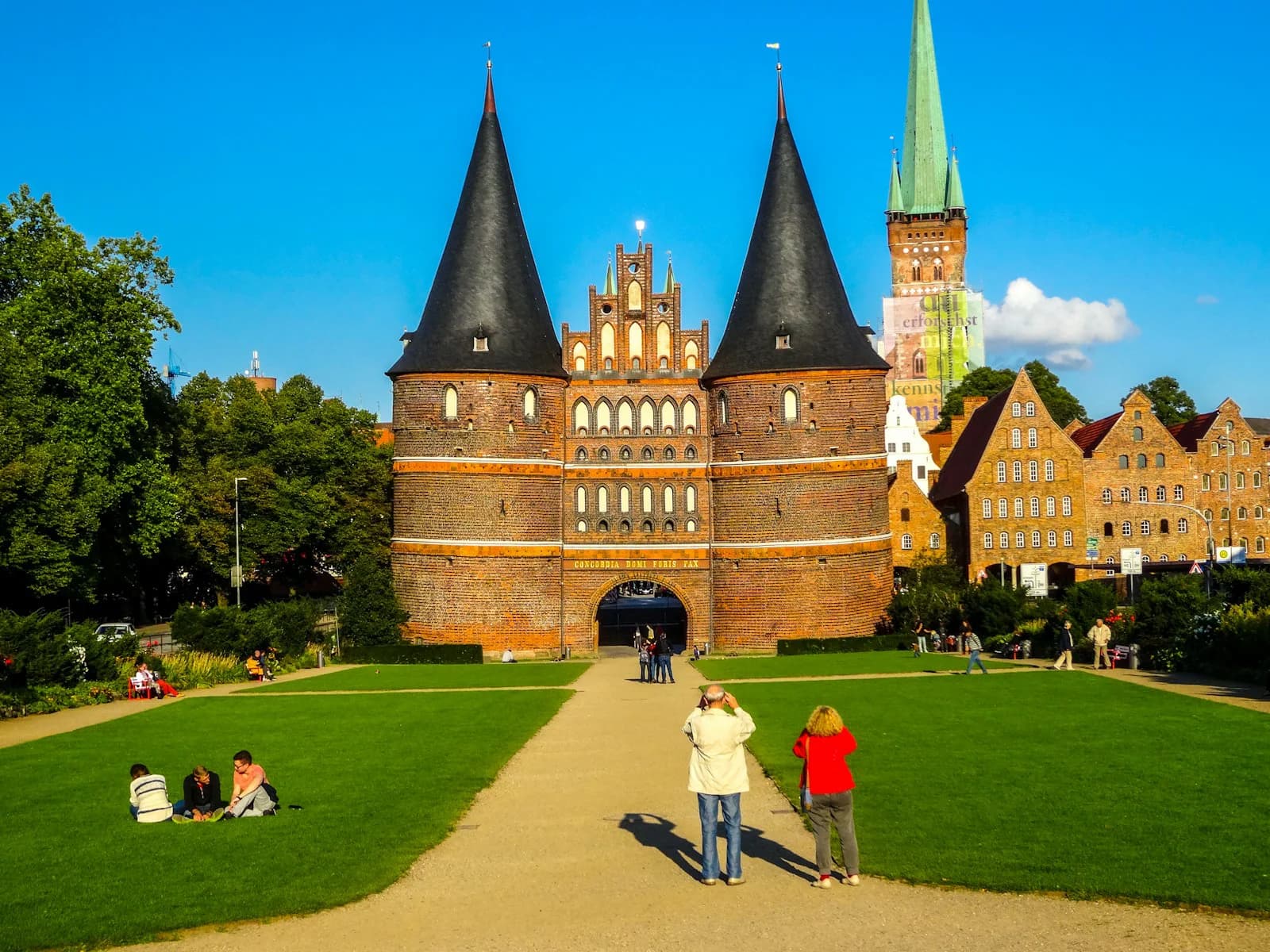
Lübeck's most famous sight is the Holstentor, but the city's quieter appeal lies behind its brick facades. The tourism board counts roughly 90 winding passages and courtyards still standing, a network it describes as hidden green oases within the UNESCO-listed Old Town island. Treat that number as approximate and fluid: entrances open and close with renovation and residents' preferences, so what matters is knowing where to look and how to walk through politely.
A travel guide describes around 80 of these inhabited alleys and courtyards as open to the public for a relaxed stroll through the Old Town, down from roughly 180 historically. That gap matters: some passages are living residential space rather than visitor attractions, and a closed gate is not a personal rejection. Plan to walk through quietly, keep voices low, and never photograph through windows or into private courtyards.
Why Lübeck's Hidden Side Is the Old Town Itself
Lübeck's Old Town sits on an island ringed by the River Trave, which means the hidden corners are not out in the suburbs but inside the same few square kilometres as the churches and town hall. The tourism board describes the Altstadt as a water-ringed island of treasures and counts seven church towers shaping the skyline. That compactness is an advantage: you can pair a famous sight with a quiet passage on the same short walk.
The practical consequence is that hidden gems in Lübeck are dispersed rather than clustered on one street. A traveler blog notes the favorite northern alleys and the harder-to-find southern courtyards sit at opposite ends of the island. Pick one direction per outing rather than trying to collect them all, and you will spend more time looking than backtracking. If you only have half a day, choose either the northern cluster or the south-western cluster and accept that the rest waits.
For orientation across the island, the city's official tourism pages list sights, events, and booking options in one place, which is the safest first stop if you want to confirm what is currently open. Decide your walking direction from a map before you leave your hotel rather than mid-street. That single decision prevents the most common mistake in Lübeck, which is crisscrossing the island chasing a checklist.
Alleys and Courtyards 101: Gang Versus Hof
In Lübeck, a Gang is a narrow passage running from the street into a block's interior, while a Hof is the courtyard at the end of it, often ringed by small former booths and houses. The two words appear constantly on street signs and maps, so reading them correctly saves confusion when you are hunting an address. A guide notes these small houses once housed a large share of the population, rented out by wealthy merchants in their backyards, which is why they feel miniature rather than grand.
Many entrances are unremarkable, and that is the point: some passages begin as a door in a facade or a narrow opening rather than an obvious archway. A traveler blog describes exactly this in the north of the city, where the passages had to be accessed through doors or holes in the facade rather than through grand gates. If you walk past a plain door with an old nameplate beside it, slow down and look up; the alley name is often the only clue.
Etiquette matters because these are homes, not sets. Walk through, look, and leave; do not sit on steps, lean on doorways, or treat a resident's window box as a backdrop for a long shoot. If a gate is closed or chained, that is a clear signal, and the next alley is usually a few minutes away. Some courtyards are gated or restricted for residents, so a closed entrance is normal rather than a failure of your planning.
Northern Cluster: Petersilienstrasse and Hellgrüner Gang
Start this walk near the northern edge of the Old Town, where the passages feel tighter and quieter than the shopping streets south of them. A traveler blog names Petersilienstrasse and Hellgrüner Gang as its favorite northern alleys, noting they had to be reached through doors or gaps in facades rather than through wide archways. Expect a short detour rather than a full afternoon, and go slowly because the reward is the change in scale, not a monument.
Pair this cluster with the Burgtor, the northern city gate, which a guide describes as older than the Holstentor and one of only two remaining city gates. The gate has an underpass that leads into the Old Town, making it a natural entry point rather than a separate sight to tick off. Walk through the underpass, and the alley streets begin almost immediately; do the reverse at the end of your loop, and you exit without retracing the whole island.
Budget-wise, this is a free walk: streets, gates, and public passages cost nothing to enter. The paid experiences in Lübeck sit elsewhere, inside museums, church interiors, and ticketed collections, each with its own admission rather than a shared pass. Do not assume that a courtyard beside a museum is part of that museum, and check the operator's own page before planning around any interior.
South-Western Cluster and the Hard-to-Find Courtyards
On the other side of the island, the passages tend to be shorter and the courtyards more enclosed, which makes them feel more like discoveries. A traveler blog describes the Höveln Gang as hard to find but a lovely little escape once located. Treat the search as part of the experience: if you find it on the second pass rather than the first, the walk has done its job.
For the named courtyards, a guide lists Dunkelgrüner Gang, Von-Höveln-Gang, Kalandsgang, Haasenhof, Glandorps Hof, and Füchtingshof as among the best-known, all part of the UNESCO World Heritage Site's living urban culture. The names themselves are your map key: Gang means passage, Hof means courtyard, and the prefix usually refers to a family or a colour. Mark two or three on your phone before you start rather than trying to read them all on the move.
Because these courtyards are residential, treat signage as authoritative and never assume a courtyard is open just because a guidebook lists it. If a gate is closed, note it and move on; the next one is usually within a few minutes' walk. The point of the southern cluster is atmosphere, not completion, so a walk with two successful courtyards is a good walk.
Canal-Side Walk Toward the Schulgarten
Between the Old Town and the canal, a path runs along the water with long views back toward the brick skyline. A traveler blog describes walking along the canal toward the Schulgarten and passing a graffiti wall along the way, adding that the artwork was not to their personal taste even though the views of the Old Town from the canal park were lovely. Take that as an honest trade-off rather than a warning: the walk is worth it for the water and the skyline, and the wall is a passing feature, not the destination.
A guide notes you can walk all the way around the Old Town along the River Trave, with paths on both sides and many bridges to cross. That makes this stretch flexible: you can do a short out-and-back toward the garden or fold it into a longer loop. If you want the widest choice of quiet corners, this is also where a second or third day pays off, since a rushed visit leaves little room for a slow canal wander.
For planning the rest of your day around this walk, a one-day framework helps you decide what to drop rather than what to add. If the canal is your priority, put it early while your energy is high and let the museum interiors wait for another trip. The walk is free, which makes it a low-risk choice when your schedule shifts.
The Schulgarten: A Free Garden by the Canal
The Schulgarten is a small botanical garden near the canal that a traveler blog describes as free to visit, with a terrace beneath a magnolia tree that locals favor. It notes the garden was especially lovely in spring, with cherry blossoms and tulips. Because it is a garden rather than a ticketed attraction, treat it as a slow stop: sit, look, and leave without trying to turn it into a sight.
As with any small public garden, seasonal condition varies, and a spring visit looks very different from a late-autumn one. If you are planning around plants or blossoms, check the city's official tourism pages for current information rather than relying on a blog written in a different season. The free-access claim refers to the garden itself; any adjacent museum or building would have its own separate admission.
Combine the garden with the canal walk rather than visiting it alone, since it sits naturally at the end of that path. A slow stop here fits well into a longer stay, and if you are building out several days, grouping free stops like this one keeps your budget focused on the interiors you actually care about.
Free Grounds Versus Paid Interiors
Lübeck rewards walkers because so much of what makes the city memorable is outside: streets, bridges, courtyards, gates, and canal paths. A guide notes the Old Town is enclosed by water and connected by bridges, which means you can spend a full day on foot without buying a single ticket. Treat that as your baseline and spend money only where an interior genuinely interests you, such as a specific museum collection or a church you want to see from inside.
The important distinction is that free grounds do not imply free interiors. A courtyard next to a museum, a churchyard beside a nave, or a garden beside an exhibition each has its own access rules, and one ticket rarely covers a whole complex. Check the specific operator's page for the building you intend to enter rather than assuming a single pass, and do not plan around any admission figure that is not published by that operator.
If your budget is the priority, build the day around the free layer first and add interiors only where they matter to you. A dedicated guide to zero-cost options helps you see how much of the city falls into that category before you commit to anything ticketed.
Where Hidden Gems Fit in a Longer Stay
The quiet corners need unhurried time, which is why they rarely appear on a rushed day trip. One well-regarded guide suggests staying at least one night so you can eat, walk in the evening, and wake up without rushing, with two to three days as an ideal range for most travelers. That matches how the alleys work: the first pass orients you, and the second pass is when you actually notice the doors.
If you are weighing a single day against a longer stay, a one day in Lübeck itinerary covers the headline sights, while a 3 days in Lübeck itinerary leaves room for the canal walk, the garden, and a second courtyard cluster. Choose based on how much walking you want rather than on a count of sights. The suggested durations below are planning aids, not official schedules.
Seen as suggestions, a plausible split is a half-day for the Holstentor and the main streets, a second half-day for one courtyard cluster, and a slow two-hour block for the canal and the garden. Adjust to your own pace; the point is to leave gaps rather than fill them. And if you want a structured frame for those gaps, the landmark guides hub is the place to check what each building actually involves before you commit.
Day-Trip Contrast: Coast and Countryside
When you want a change from brick and water, the Baltic coast is the obvious contrast. A guide notes Lübeck sits roughly 18 kilometres from the Baltic and that the city can serve as a base for exploring the surrounding region. Consider keeping one day loose for a coastal or countryside excursion rather than locking every hour in the city.
A traveler blog mentions Timmendorfer Strand, a Baltic beach resort, as a possible outing from Lübeck. Rather than relying on any single travel time, check the current rail or road connection on the day you intend to travel. Beach conditions, chair rentals, and seasonal facilities vary, so confirm details at the resort or with the local operator if a specific amenity matters to you.
Inland, Schleswig-Holstein offers lake and small-town alternatives that are easy to reach from the city. That flexibility is another argument for a two-night stay: it turns one rushed excursion into a calm day out and back. Keep the return leg simple so the contrast does not become the most tiring part of the trip.
Common Mistakes to Avoid
The first mistake is treating courtyards as photo sets. These are inhabited spaces, and residents notice a camera pointed at their windows; shoot the architecture, not the people, and move on after a minute or two. The second is expecting every passage to be open, which leads to frustration when a gate is chained or a corridor is closed for work.
The third is trying to cover the whole island in one sweep. A guide's map of the top things to do shows how spread out even the headline sights are, and the alleys sit between them in residential blocks rather than along a single route. Choose one or two clusters per outing and accept that a return visit will show you more than a longer march.
Finally, do not assume free access extends to interiors. Gardens, courtyards, and streets are one category; churches, museums, and exhibitions are another, each with its own rules. When in doubt, check the operator's own page before you go, and treat any secondhand figure as a starting point for verification rather than a fact.
Plan Your Visit with Hidden Gems in Mind
Lübeck's hidden gems are not a secret list but a way of moving through the city: one cluster at a time, quietly, with time left over for the canal and the garden. Start with the free layer of streets, gates, courtyards, and paths, then add interiors only where you genuinely want to go inside. Check the official tourism pages for current information before you travel, since access to residential courtyards and gardens can change.
If you are building an itinerary, use the city guides and day-by-day frameworks as scaffolding rather than a schedule, and leave at least one unscheduled afternoon. That slack is where the quiet corners actually happen. Bring comfortable shoes, keep your voice low in residential passages, and let one good courtyard be enough for a single walk. For related planning, see Lübeck Brewery Guide: Beer Culture and Where to Taste.
Frequently Asked Questions
Are Lübeck's alleys and courtyards free to visit?
Walking through public passages and courtyards costs nothing; they are part of the city's streetscape rather than ticketed attractions. Some are gated or restricted because they are residential, so a closed entrance is normal. If you want to enter a museum, church interior, or exhibition nearby, that is a separate paid visit with its own admission rules, so check the operator's own page before you plan around it.
Which courtyards are the easiest to find?
The best-known named courtyards, including Haasenhof, Glandorps Hof, and Füchtingshof, are the ones most likely to appear on city maps and in guidebooks, which makes them easier to locate than unnamed passages. Northern passages such as Petersilienstrasse and Hellgrüner Gang are also commonly described as favorites. Even so, some entrances are plain doors in a facade rather than archways, so plan on a little searching and accept that the hunt is part of the experience.
Is the Schulgarten in Lübeck worth visiting?
The Schulgarten is a small botanical garden near the canal, described as free to visit and popular with locals, with a terrace and seasonal plantings. It is a slow stop rather than a major sight, and it pairs naturally with a canal-side walk that offers water views of the Old Town. If blossoms matter to you, check current conditions with the city's tourism pages, since the garden's appeal changes with the season.


