
One concrete starting point: the Brügmanngarten in Travemünde, at Am Brügmanngarten 2, is described by the city's visitor service as a green space with outdoor chess, a stage and seats, and its listing states it is always accessible. That is the clearest official signal in this set of sources that a Lübeck garden is open ground rather than a ticketed attraction.
Most visitors treat Lübeck as an indoor city of churches, museums and the Holstentor gate, all packed onto a compact island. That circuit works, but it makes a full day of sightseeing far more tiring than it needs to be, given how much of the city's green space wraps directly around the Old Town rather than sitting out in the suburbs.
The important distinction before you plan anything is between free outdoor grounds and separate, ticketed interiors. Gardens and parkland are public space; churches and museums nearby have their own admissions and opening times. This guide keeps those two categories apart so you know what you are walking into.
Why Lübeck's Green Side Is Easy to Miss
The UNESCO World Heritage listing covers the medieval Old Town, and the standard pitch leans hard on brick architecture, the seven towers and the Hanseatic trading past. That framing is accurate, and it is exactly what pushes the parks to the bottom of most itineraries. With only a few hours, the gate-and-church route is genuinely the sensible choice.
The Old Town island is small and dense, and nearly every headline sight sits inside it. Walking between them means cobblestones, crowds and limited shade at midday. Green space is what breaks that up, and most of it lies within a short walk of the island's edge rather than out in a distant suburb.
Terminology matters here too. Some places described as gardens are formal planted areas, some are community growing projects, and some are really squares or courtyards with beds and benches. Knowing which you are heading for changes what you pack and how long you stay. If your priority is simply keeping costs down, the broader free-things list is a useful companion to this one. For wider planning, see Free Things to Do in Lübeck.
The city's own visitor service treats playgrounds, sports pitches and green open spaces as part of what families can use here, which is a useful reminder that this is everyday public infrastructure rather than a curated attraction.
The Wallanlagen: A Fortification Ring Turned Walking Belt
The Wallanlagen are the most practical green space for a visitor, because they encircle the Old Town island instead of sitting at one end of it. They began as defensive earthworks protecting the Hanseatic city and now serve as a recreation area used by residents and visitors alike. Walking them means following the line of the old ramparts rather than cutting through the middle of town.
The character is closer to mature parkland than to a municipal lawn: tall beeches, uneven ground and stretches where vegetation has quietly reclaimed older structures. You pass the small, easily overlooked Kaisertor on the way round. Because the ring is continuous, you can join or leave it at almost any point.
Two consequences follow. First, the ring is the best place to walk if you want distance without leaving the centre. Second, the surface is mixed, so if you need smooth, predictable paths, plan a shorter stretch rather than committing to the full loop.
Koberg's Bürgergärten and Übergangsgarten
Directly in front of the Heiligen-Geist-Hospital on Koberg, a garden project was created in 2023, according to the regional tourism board's garden feature. Around 200 raised beds hold vegetables, herbs and flowers, producing a dense block of colour in front of the hospital facade. Seats are placed between the beds, and a sandbox for children sits among them.
The framing matters. This is a community-oriented project that has evolved since it was established, not a fixed attraction with a gate, a ticket desk and published visiting hours. Treat it as a public square with intensive planting rather than a destination you schedule.
The setting is the reason to include it. Koberg is on the northern edge of the Old Town, on the way between the Jakob quarter and the ring, so it slots into a walk without a detour. Combine it with the hospital and St. Jakobi rather than treating it as a standalone stop.
The Schulgarten at Falkenwiese
The Schulgarten near Falkenwiese does two jobs at once. It introduces schoolchildren to plants, and it also runs a botanical garden with themed beds, as described in the regional tourism garden feature. Expect a teaching garden rather than landscaped parkland, with labelled planting and seasonal variation doing most of the work.
Reaching it means leaving the Old Town island, crossing towards Falkenwiese and the historic open-air swimming site. That crossing is why this garden pairs naturally with a half-day on the eastern side rather than with the gate-and-market circuit. Budget more time for the walk than for the garden itself.
The same feature mentions a pavilion with reading material and a small café building, and their availability depends on the season and on staffing. Because opening arrangements for the buildings are not published as fixed daily hours in the sources used here, confirm current access through the operator before making a special trip for them.
Drägerpark and Stadtpark: Views Back at the Old Town
Drägerpark sits on the Trave side and gives you something the island cannot: a view back at the Old Town from across the water. The regional tourism garden feature names it specifically for that outlook, so treat the reward as perspective rather than facilities. It works best as the final stretch of a riverside walk rather than as a place to spend an afternoon.
Continue on and you reach the Stadtpark, which occupies a different register entirely. The same feature describes it in the St. Gertrud area, a broad park laid out in the Gründerzeit period, with imposing villas along its edge as its defining feature. Benches under mature copper beeches and silver maples are the point of coming.
Because these two lie outside the island, the order in which you visit them matters more than the distance between them. If your time is tight, pick one: Drägerpark for the Old Town view, Stadtpark for a longer, quieter walk among period architecture.
Brügmanngarten in Travemünde
Travemünde is a separate Baltic seaside resort on Lübeck's coast, not a neighbourhood you stumble into from the Old Town. Its Brügmanngarten is a green space with a lawn for picnics, outdoor chess, seating and a stage where spa concerts are held regularly, and the official listing describes it as always accessible and gives the address as Am Brügmanngarten 2.
The combination of garden and event venue is what makes it more than a patch of grass, and it is also the reason to check ahead. Concert programming is not fixed year-round, so if a performance is part of your plan, look at the resort's own tourism site or the visitor information before you travel out.
Treat Travemünde as a half-day decision, not a downtown detour. With a single full day in Lübeck, the Old Town ring plus one eastern or riverside park gives you more for less travelling. With two days or a long summer evening, the coastal garden earns its place.
Putting a Green Walk Together
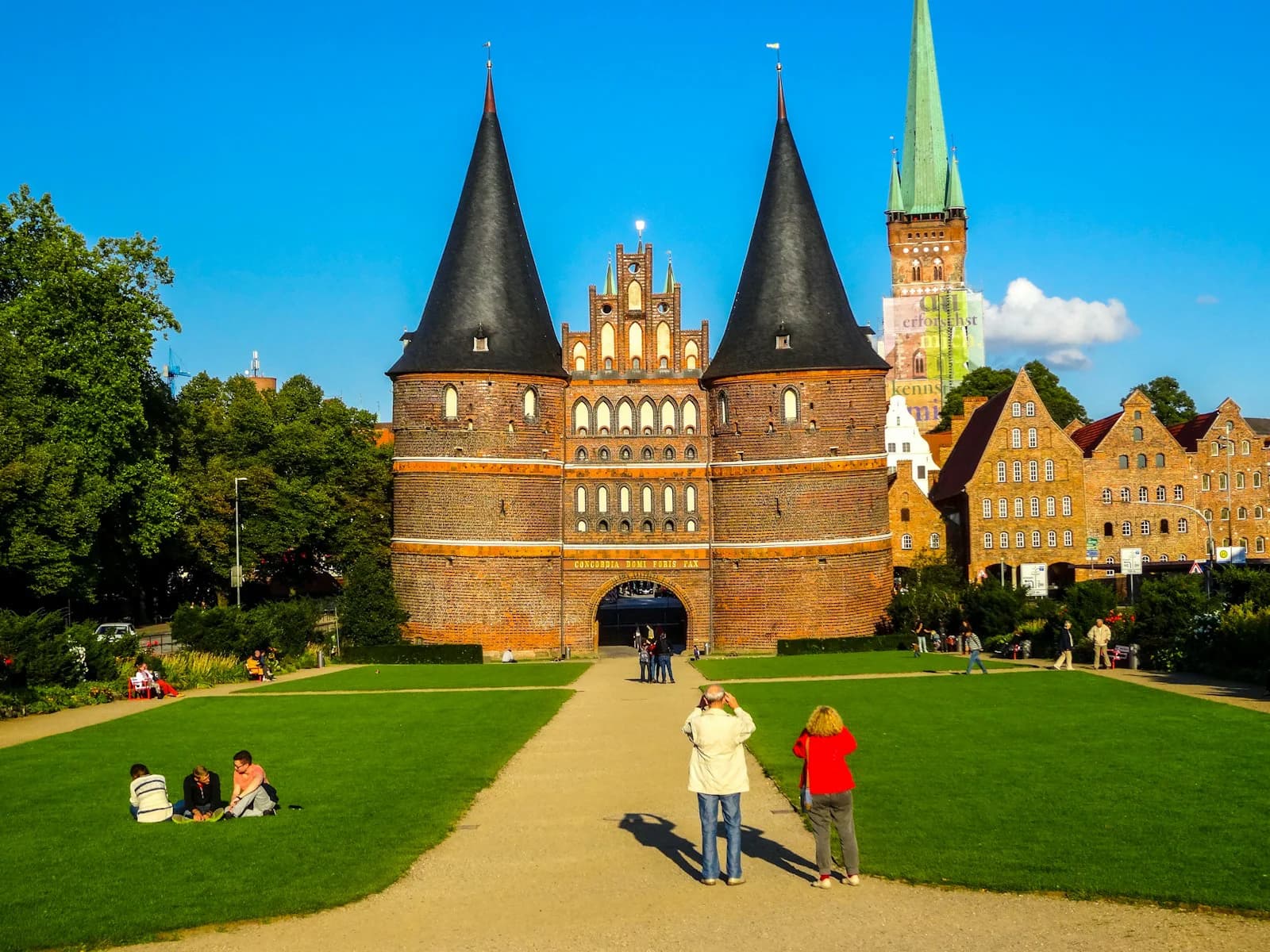
The regional tourism feature sets out a sequence worth borrowing: begin at the Holstentor, follow the Trave bank towards the Malerwinkel with its small houses and flower pots, continue to the Wallanlagen, and work in the Koberg beds and the Schulgarten further along. Walking the whole thing without stopping is a different proposition from doing it with breaks, so plan for the latter.
The advantage of this order is that the green stretches break up the built-up sections instead of arriving in one long block at the end. It also keeps you near the Trave and the Wakenitz edges, where the air moves and the light is better for most of the day. Save the market square and the main shopping streets for the middle of the day, when shade matters most.
Green Loop or Travemünde: Choosing by Time
With roughly half a day, stay on and immediately around the Old Town island. Combine the Wallanlagen ring with Koberg, and add the Trave bank if the weather holds. That gives you a real walk with the city's landmarks still within reach, and it involves no transport planning.
With a full day, extend east to the Schulgarten and Drägerpark, or west to the Stadtpark, but not both in comfort. With two days or more, the Travemünde garden and beach front become a sensible second-day anchor, especially in summer when the coast adds something the inland city cannot.
Families should weight the decision differently. Playgrounds, sports pitches and open spaces are part of how the city presents itself to children, and the Koberg beds with their sandbox sit right in the middle of the sightseeing route. A visit built around those is often more workable than one built around tower climbs, and the family-focused guide is a better fit if children are setting the pace. For wider planning, see Lübeck with Kids.
Free Grounds, Paid Interiors and Seasonal Timing
The cleanest rule for planning is that the outdoor spaces themselves are open public ground, while the buildings near them are separate attractions with their own admissions. One example nearby is the Museum of Nature and Environment on Musterbahn, whose official listing gives opening times of Tuesday to Friday 09:00 to 17:00 and Saturday and Sunday 10:00 to 17:00, closed on Mondays. That pattern of a free street and a ticketed door is the norm here, so never assume one ticket covers both.
Lübeck is a Baltic-coast city, which means weather decides more than any published schedule. Wind and rain can arrive quickly, and summer evenings stay light late. A garden visit that feels generous in June can be a short, brisk walk in October. Check the forecast the same day rather than planning green time weeks in advance.
If you are driving, parking demand in the Old Town and in Travemünde varies sharply with events, and the city's parking operator publishes live availability. The operator also notes that the Am Holstentor parking garage was closed and is being removed, with new construction scheduled for early 2027, so do not assume that garage is an option.
If you are watching costs, several of the city's best-known sights are free to walk around from the outside, which is where the dedicated budget guide earns its keep, and the landmark hub is the place to check individual buildings before assuming anything about tickets. For wider planning, see Lübeck landmark visitor guides.
Plan Your Green Day in Lübeck
Start with the Wallanlagen, because it is the one green space that fits almost any itinerary and requires no decision about transport. Add Koberg on the same walk, since the raised beds sit directly on a route you are already covering. Then choose one further stop, towards the Schulgarten or the Stadtpark, depending on how far you want to walk.
Keep paid interiors as separate decisions. Check each museum's or church's own published times on the day you intend to visit, and do not assume that a garden's opening implies anything about the building next to it. For Travemünde, confirm the current programme before committing a half-day to the coast.
Frequently Asked Questions
Are Lübeck's parks and gardens free to visit?
The outdoor spaces themselves, including the Wallanlagen ring, the Koberg garden project and the Brügmanngarten in Travemünde, are open ground rather than ticketed attractions. The buildings nearby, such as churches and museums, are separate and generally have their own admission and opening times. Check each interior individually on the day rather than assuming a single ticket covers a whole complex.
Can you picnic in the Bürgergärten or Übergangsgarten on Koberg?
The Koberg project is laid out as a public square with seating between the raised beds, and the regional tourism feature describes it as a place to sit and eat in front of the Heiligen-Geist-Hospital. It is also a working garden with planting and a children's sandbox, so keep to the seats and paths rather than walking through the beds. Because the project has evolved since it was created, check the city's environmental pages if you want certainty about the current layout.
Is the Brügmanngarten in Travemünde worth the trip from Lübeck's Old Town?
It is worth a half-day if you have two days or more, or if you are visiting in summer and want the Baltic coast as well as the Old Town. Travemünde is a separate seaside resort rather than a neighbourhood adjacent to the island, so it is a journey rather than a detour. If you have only one day, spend it on the Wallanlagen ring and one nearby park instead.
What is the Schulgarten in Lübeck and who is it for?
It is both a school garden teaching local children about plants and a botanical garden with themed beds, so it serves pupils and interested visitors at the same time. Expect labelled planting and seasonal variation rather than landscaped parkland. A pavilion and a small café building form part of the site, and their availability varies, so confirm access before travelling specifically for them.
When is the best time of year to walk the Wallanlagen?
The ring is a year-round public space, but this is a Baltic-coast city, so wind, rain and short winter days affect the experience more than any published schedule. Late spring through early autumn gives the mildest conditions and the most daylight for a longer loop. Whatever the season, check the same-day forecast and choose a shorter section near the Holstentor if conditions turn.
How long does a green walk around Lübeck's Old Town take?
A relaxed loop combining the Wallanlagen with the Koberg gardens is a suggested half-day activity once you allow time to sit and look around, rather than a quick hour. Adding the Schulgarten or Drägerpark lengthens it into most of a day because those lie beyond the island. Treat these as suggested durations rather than official figures, and adjust for your own pace and the weather.


