

Most people arrive in Füssen with one frame in mind, the castle on its wooded hill, and then photograph everything else as an afterthought. That usually produces a rushed morning at the bridge and nothing from the town itself, which is a fair trade only if the castle is your sole subject. A more reliable approach is to shoot the town first while the light is soft and the streets are quiet, then treat the castle area as one stop rather than the day's only stop.
Füssen is the historic town at the centre of it all, with the Hohes Schloss and the former Benedictine monastery of St. Mang sitting above the roofs. The neighbouring places, Hohenschwangau village and the wider Schwangau area, hold the castle viewpoints and the lake, so plan them as separate short trips rather than expecting everything within walking distance of your hotel. If you want to fix your bearings before you shoot, the Füssen itineraries and city travel guides show how the town and the castle area connect.
The order that works best for most photographers is Old Town facades early, the Lechfall weir before or after the midday crush, and the castle viewpoints either at the very start or the very end of the day. Build in slack, because mist can hide the castle completely for an hour and then lift. Before leaving the hotel, check the town's own visitor pages for current notices, routes and weather rather than relying on a photo guide alone.
Why Füssen Rewards Photographers Beyond the Castle Shot
Füssen sits at the foot of the Alps on the Lech, and the town itself is a compact museum of pastel facades, fountains and painted walls. Time in town is rarely wasted, because the streets are short, the squares are close together and the mountains keep appearing behind the rooflines. That backdrop is what separates a photograph of Füssen from a photograph of any other decorated Bavarian town.
The trick is to plan a loop rather than a list of individual pins. Start at a square, walk toward the river, and let the castle hill stay in the corner of the frame as you go. Once the light turns harsh, move to shaded lanes or take the short trip out to the water. Photographers who want a wider choice of angles should compare the town's viewpoints before choosing what to climb.
Give yourself a realistic window. A relaxed half day in the Old Town, plus a separate half day for the castle area and lake, covers the strongest material without forcing you to sprint between them. If you can spread it over a couple of days, you gain a second chance at the castle shot, which matters because the condition you came for may not show up on the first attempt.
Füssen Old Town: Working the Pastel Squares
Lautenmacherbrunnen, Stadtbrunnen, Franziskanerplatz and Gesellenbrunnen form the natural circuit for a first photo walk. The names come from the markets that once operated there, and the fountains and statues now act as convenient anchors for a composition. Many of the squares are framed by cafes and shops that fill up later, so the early hour is both the quietest and the most flattering.
The fountains are the obvious subject and the least interesting result. What actually makes these frames work is the mountains rising above the roofs, so step back and let the peaks sit over the buildings instead of cropping them out. A modest lens and a lower angle often beat a wide shot from the middle of the square.
Franziskanerplatz is where the decorated lanes open toward the Lech, and the views over the water give you a different kind of frame from the enclosed squares. Treat the whole circuit as a single continuous walk rather than separate stops, and use the Füssen old town walking tour to plan the sequence before you set out.
Keep an eye on the ground as well as the skyline. Cobbles, drain covers and the shadows of balconies all add texture, and painted facades photograph better in soft, angled light than in full midday sun. If the light is flat and grey, the same streets still work as atmospheric rather than bright frames.
The Hohes Schloss Above the Roofs
The Hohes Schloss is Füssen's own castle, once the summer residence of the prince-bishops of Augsburg, and it watches over the town from the ridge. Its mix of medieval, Renaissance and Baroque elements makes the exterior a subject in its own right, with the tower and the painted facade above the lanes. Walking beneath it and looking up gives you layers of roofs, walls and sky in one frame.
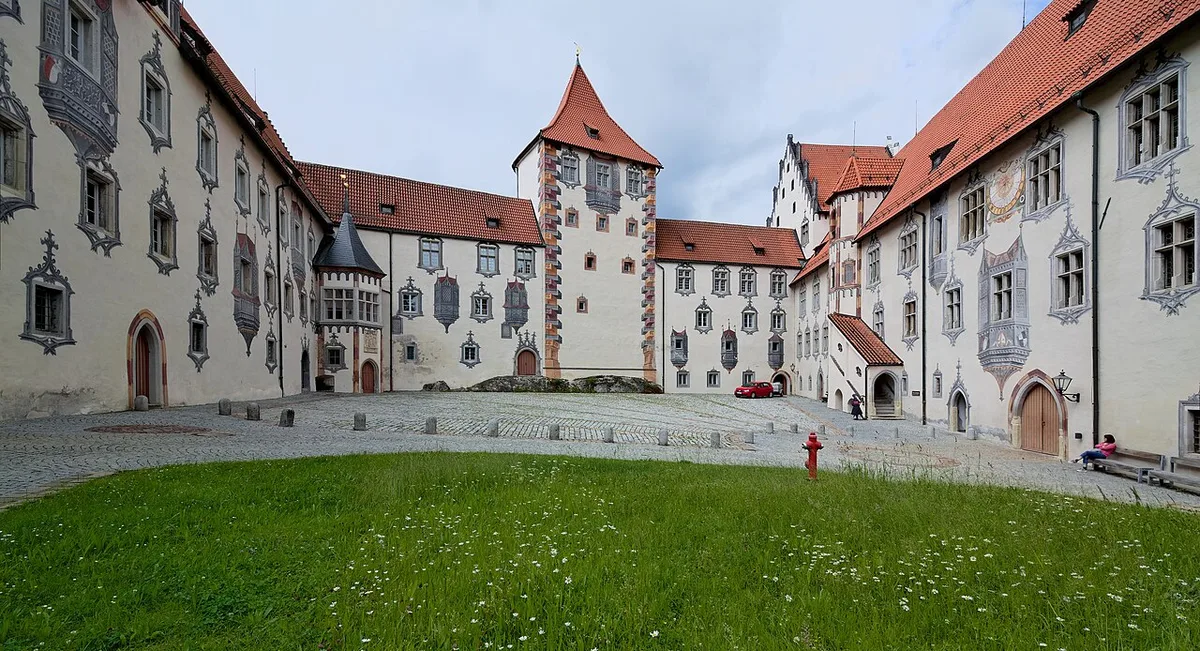
It is worth separating the outside from the inside. The exterior and the castle hill are the freely accessible part of the experience, while the interior belongs to the museum and the Bavarian State Collections of Paintings, which run on their own terms. Do not assume a single ticket covers everything in the complex, and do not assume interior photography is permitted; both depend on the day and the collection you are visiting. Check current conditions with the operator before you plan your day around them, and use a visitor guide to understand what is ticketed and what is not. For wider planning, see Neuschwanstein Castle Visitor Guide.
The most useful vantage point in town is often not on the castle itself but below it, where the lanes frame the tower against the mountains. Late afternoon light rakes across the painted walls, which gives the facade depth that flat midday light destroys. If the castle interior is closed or booked out, the exterior and the surrounding lanes still justify the walk.
Lechfall: Bridge, Riverside Paths and Gorge Context
Lechfall is the weir where the Lech drops through a narrow gorge, and it is one of the easiest photogenic stops in the area. The structure was originally built to control flooding, but it now functions as an attraction in its own right, with a bridge across the river for the classic side-on view. What many photographers miss is that the best angle is not from the middle of the bridge but from the riverside paths that follow the gorge.
Shoot from the bridge for the widest view and from the paths for the compressed frame. From the bridge you get the drop, the rushing water and the rock walls together; the paths let you place greenery and stone in the foreground and lose the railing entirely. Look for the bust of King Maximilian II set into the rock on the far side, which makes a small, specific detail for a second frame.
Because the water moves fast and the gorge is shaded, the scene rewards patience. Slower shutter speeds turn the falls into a smooth ribbon, while shorter exposures keep the spray crisp. If the light is dull, the gorge still has contrast from the white water against dark rock, so this is a good fallback stop when the castle is hidden by cloud.
Framing Neuschwanstein from the Marienbrücke Area
The pedestrian bridge over the Pollat gorge is the source of most castle photographs you have seen, and it is genuinely the strongest single angle on Neuschwanstein. It is free to cross and needs no ticket; tickets apply to the castle tour rather than to the viewpoint. You can reach it on foot from Hohenschwangau village or use the shuttle service that drops you close to the bridge.
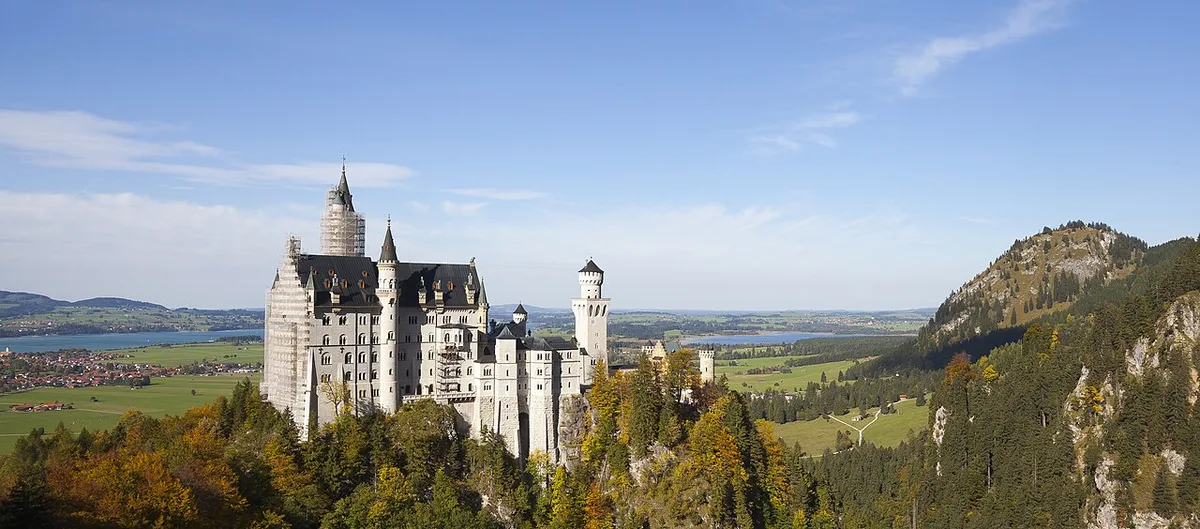
One practical habit is to walk to the far end of the bridge once you are on it. Guides report that the throng tends to bunch near the entrance, while the far end is usually calmer and gives a slightly different angle on the castle. Reports also describe entry being limited for safety at busy times, though that is a visitor-reported pattern rather than an official rule you should plan around. Build a margin into your schedule and be ready to shoot whenever a gap opens.
If you want a higher frame, the short climb from the far end of the bridge leads to an elevated viewpoint above the gorge. The path is steep and short rather than a proper hike, and the reward is a cleaner castle outline above the treeline. The same guide also notes that the bridge has historically been closed in the winter, so treat any seasonal pattern as something to verify locally rather than a fixed rule.
Panoramablick Schwangau: The Wider Landscape Frame
Panoramablick Schwangau sits between the bridge and the castle, and it photographs a completely different subject. Instead of the castle alone, the viewpoint opens onto Hohenschwangau Castle, the Alpsee and the Bavarian Alps, with the Neuschwanstein side masked by trees. It is one of the few places where the landscape around the castle, not the castle itself, becomes the picture.
Access is free and open, so there is no ticket or booking to worry about, but that also means it is rarely empty. Because the viewing area is open ground rather than a narrow platform, you can almost always find a place to stand even when it feels busy. This is the frame to keep in reserve when the castle is in cloud but the valley is clear.
Pair the panorama with the castle shot on the same walk and you come back with two distinct sets rather than two versions of the same image. A wide lens handles the valley; a longer lens pulls Hohenschwangau Castle out of the landscape. If you have time for a higher view over the whole region, the cable car up the Tegelberg adds an entirely different altitude.
Hohenschwangau Village and Alpsee Reflections
Hohenschwangau village is easy to treat as a car park and a bus stop, but its painted facades, sculpture and flowers deserve a few minutes. Frescoes on the houses and small decorative details make strong foregrounds that add depth to a castle frame instead of a flat silhouette against trees. Look for a musician or floral element to anchor the bottom of the image.
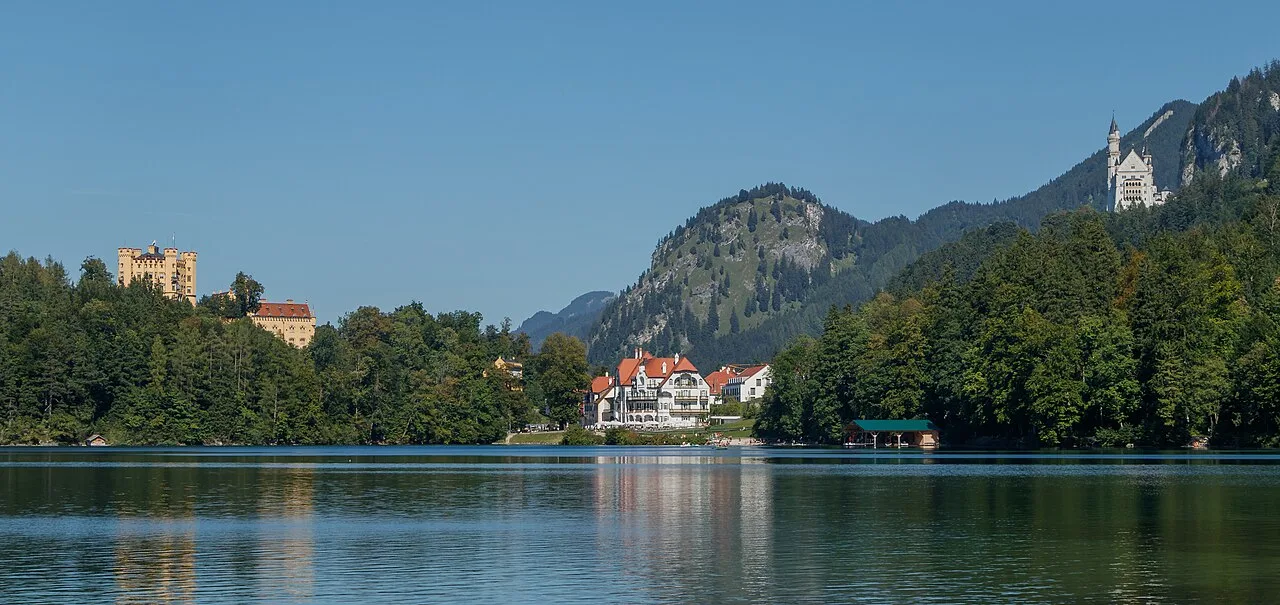
The Alpsee rewards anyone willing to wait for calm water. On a still morning the surface reflects the hills and, depending on the angle, the castle or the village shoreline. Even a slight breeze breaks the reflection, so this is a subject that suits the earliest or latest part of the day rather than the middle.
Several other lakes sit within easy reach of Füssen, including the Alatsee, Weißensee and the larger Forggensee reservoir, each with a different character and shoreline. A short drive opens up calmer water and fewer people than the castle-side lake. Füssen's lake and river pages list the local waters, and they are a sensible starting point for choosing a second location.
Practical Constraints: Crowds, Timing and Weather
Crowds peak around the middle of the day, when tour groups and day trippers converge on the castle and the bridge. Photographers who go early or late usually get more space and better light in the same place. The town's squares follow a similar pattern, quiet at breakfast and busy by early afternoon.
Weather in the Alps changes quickly, and mist is part of the deal rather than a failure of planning. Waiting a few minutes at the same spot sometimes produces the clearing you were hoping for; if it does not, switch to a subject that does not depend on a distant view. The gorge, the town lanes and the lake shore all keep working when the peaks disappear.
Check for closures and access notices on the day, since seasonal rules and construction can affect paths and roads around the castle area. The official visitor site carries current notices and webcams, which is the fastest way to see what the weather is actually doing. Castle opening hours, prices and any interior photography rules should be confirmed with the operator directly, because those details change.
What To Do When the Obvious Shots Fail
If the castle is lost in cloud or the bridge is packed, change the subject rather than the location. Foreground details such as doorways, fountains, painted walls and sculptures carry a frame on their own, and they are usually within a few steps of where you are standing. A wider composition that includes the village, the water or the treeline can still tell the story of the place.
Keep a fallback list of two or three stops that work in any weather, and use them when the headline shot is not available. The Old Town lanes and the Lechfall gorge are reliable in flat light, while the Alpsee shoreline works when there is at least a hint of brightness. Photographers who want to build a longer plan around these options can start with the Füssen landmark visitor guides.
It also helps to compare approaches from other cities when you are learning a new town. The logic of light, foreground and crowd timing is the same whether you are shooting Alpine architecture or a larger city, and the best photo spots in Munich and the best photo spots in Berlin show how other guides structure the same decisions.
Plan Your Visit
Good photographs in and around Füssen come from ordering your day well rather than finding a secret location. Shoot the town while it is quiet, take the water and the gorge when the light flattens, and save the castle viewpoints for the edges of the day when space and atmosphere are both better. Carry a fallback plan for mist, and you will come home with more than one usable image.
Before you travel, confirm the details that change: castle and museum opening hours, ticket scope, interior photography rules and any current access notices around the bridge and paths. The operator sources publish those answers, and local visitor pages carry the weather and closure updates you need on the morning itself. Everything else, from framing to where to stand, is yours to decide.
Frequently Asked Questions
Where is the best place to photograph Neuschwanstein Castle near Füssen?
The pedestrian bridge over the Pollat gorge is the classic viewpoint and is where most recognizable castle photographs are taken. It is free to cross, and the far end of the bridge is often calmer than the entrance. A short climb from there leads to a higher viewpoint. Nearby, the Schwangau panoramic point frames Hohenschwangau Castle, the Alpsee and the Alps instead of Neuschwanstein alone, so the two spots give you different pictures rather than duplicates.
Can you take photos inside Neuschwanstein Castle?
Interior photography rules are set by the castle operator and can change, so confirm the current policy before you rely on it. Many visitors photograph the exterior, the courtyards and the surrounding landscape instead, and those views need no special permission. If you are planning a tour specifically for interior images, check the official castle information shortly before your visit rather than assuming the rule from an older blog post.
Which Füssen photo spots are free to visit?
The Old Town squares, the Lechfall weir and its riverside paths, the bridge viewpoint above the gorge, the Schwangau panoramic point and the Alpsee shoreline are outdoor locations that do not require a ticket. Paid elements in the area are the guided interiors, such as the castle tours and museum collections, which are sold separately. Do not assume one ticket covers every building in a complex; check with each operator.
What is Füssen known for besides the castles?
Füssen is known for its medieval Old Town, its pastel and painted facades, and the Hohes Schloss that sits above the roofs alongside the former Benedictine monastery of St. Mang. The town also has a long musical history connected to lute and violin making, and the Lechfall weir on the river is a popular short stop. The wider area adds lakes, Alpine hiking and the neighbouring villages of Hohenschwangau and Schwangau.
When is the light and crowd situation best for photos in Füssen?
Early morning and late afternoon usually give the softest light and the most space, while the middle of the day brings both harder light and the largest number of visitors. Both the town squares and the castle viewpoints follow this pattern. Mist can hide the castle at any hour, so allow time to wait for a break in the cloud rather than treating a single attempt as final.
Is the Marienbrücke open year-round for photographs?
Reports describe the bridge being closed during the winter, but seasonal access is managed locally and can change with conditions, so this should be verified rather than assumed. Check the official visitor information and local notices shortly before you travel, and have an alternative viewpoint ready. The Schwangau panoramic point and the castle observation areas do not depend on the bridge being open.


