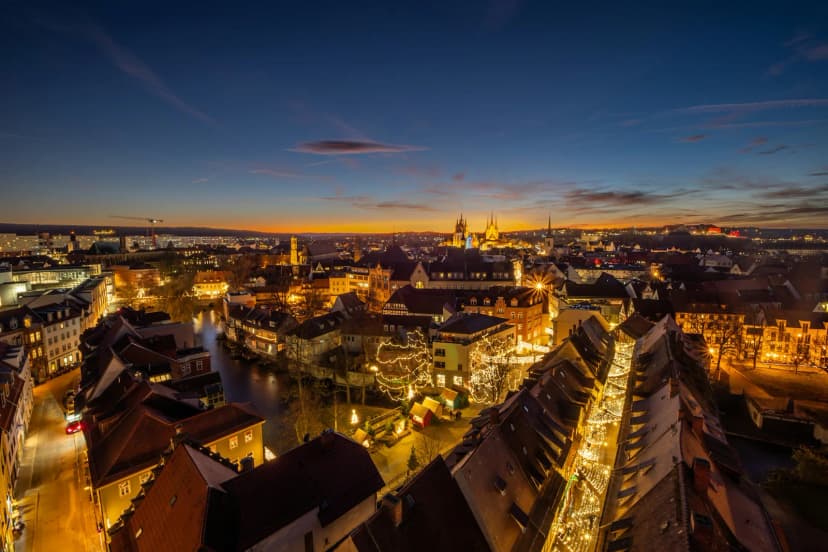
Erfurt's old town fits inside a walkable medieval core, so a single day can cover the cathedral hill, the Krämerbrücke and Fischmarkt without rushing. One concrete planning anchor comes from the city's own tourism pages: the Municipal Museum "Haus zum Stockfisch" publishes opening hours of 10:00 to 18:00, Tuesday to Sunday, for 03.01.2026 to 31.12.2026, with free admission on the first Tuesday of the month. Treat those as the operator's own published figures and confirm everything else with the operator before travelling. For the wider city, see the Erfurt city guide, and for individual sights the Erfurt landmark visitor guides are the place to start.
What follows is a suggested order, not an official tour. Budget roughly six to eight hours on foot for the highlights, and add interior or museum time on top. Every price and opening time below belongs to the venue that publishes it, and the volatile ones should be rechecked in the week before you travel.
Why Erfurt Works as a One-Day Walking City
The old town is small enough that zig-zagging costs you almost nothing, but a little planning still helps. Stand on Domplatz and you can see the Cathedral of St. Mary and the Church of St. Severus on one side and the rooftops of the medieval quarter on the other. Building the day downhill from the cathedral hill toward the river makes the old town unfold in front of you rather than behind you. If you want to look at individual sights before committing to an order, the Domplatz visitor guide is a good place to start.
A 2022 first-hand account reports that the tram hop from the main station up to the cathedral took about ten minutes and that the sights sat close enough together that a day ticket was convenient rather than essential. Treat that as a planning convenience from a dated trip report, not a current timetable, and check the local transport operator for anything you intend to rely on.
Suggested Shape of the Day
Start mid-morning on Domplatz, give the cathedral hill an hour from outside, then consider the Petersberg if the weather is clear. Drop into the old town around Fischmarkt for lunch and a proper sit-down, because the square suits lingering rather than a quick photo. Finish on the Krämerbrücke and let the late afternoon dissolve into the lanes near Barfüßerkirche and the Augustinian Monastery.
This order suits walkers who prefer architecture and atmosphere over ticketed interiors. If you are museum-first, flip the shape: book interior visits for the middle of the day and keep the hills for the late afternoon. Keep one anchor stop per half-day so the plan bends instead of breaking, and remember that the free-entry pattern at the municipal museums can justify moving the whole day.
Morning: Domplatz, the Cathedral and St. Severus
Domplatz is the natural starting point, and the two churches that dominate it are the reason. The city's own tourism page describes the Cathedral of St. Mary as a late Gothic cathedral with a high-Gothic choir and a Romanesque tower that replaced the church built on this site for Bishop Boniface in 742. Directly beside it stands the Church of St. Severus, whose three spires are its signature. Walk up the broad steps between them for the classic view back over the square.
Decide before you go whether you want the interiors. A 2022 trip report says admission to the cathedral was free when they visited, with a separate bookable guided tour up the central tower to see the Gloriosa bell. Because that account is now dated, confirm both admission and any tower tour with the cathedral before building your morning around it.
Give the hill an hour if you stay outside, and longer if you go in. The steps up from Domplatz are steep and can be crowded around midday, so an earlier start is more comfortable. The square also hosts markets and open-air events, so its character changes through the day.
Optional Detour: Petersberg Citadel
Petersberg Citadel sits on the hill just above Domplatz and is one of the largest and best-preserved town fortresses in Europe, built from the seventeenth century onward. Treat the grounds and the interiors as two different things: wandering the walls and courtyards is a viewpoint experience, while the museum, exhibitions and guided tunnel tours are separate, ticketed offers. Decide which of those you actually want before you climb.
A 2022 first-hand account rates the museum as skippable but the views as the main reason to come, especially toward sunset, and notes that public guided tours ran in German at the time unless an English one was arranged in advance. That is a useful trade-off: come for the panorama, and pay for interiors only if fortress history genuinely interests you. Confirm current tour languages and access on the operator's own pages rather than trusting a dated trip report.
Allow about forty-five minutes for the grounds and a good two hours if you add a tour or exhibition. The paths are uneven and parts of the fortress involve stairs, so wear shoes you trust. If you are short on time, the cathedral hill earns the slot more clearly than a second hilltop.
Midday: Fischmarkt and the Rathaus
Descend from Domplatz into the old town and let Fischmarkt be your midday pause rather than a drive-by photo. The square is framed by the neo-Gothic town hall, and the pedestrian streets around it connect naturally to the shopping stretch along Anger. Trams run past the Rathaus, which makes it an easy point in the day to reset with a coffee or a meal. The Rathaus Erfurt and Der Römer sit right on the square, so the cathedral-hill detour and the Erfurt Altstadt walk share this anchor.
Food is where itineraries usually go wrong. Thuringian bratwurst is the obvious local street snack, long and grilled and generally served in a roll with mustard, and it is easy to find around the centre. Beyond that, treat any named cafe or restaurant as an example rather than a guarantee, and check it is open on the day.
Afternoon: the Krämerbrücke
The Krämerbrücke is Erfurt's signature sight and the reason many people come. A travel account explains that this medieval stone bridge was first built in 1325, with the timber-framed houses added in the 1480s, and that it still spans the Breitstrom arm of the Gera as one of the few inhabited medieval bridges left in Europe. Walk it from end to end first, then loop around to the riverside paths to see the houses from below, where the Gera river passes beneath. The Krämerbrücke visitor guide covers the bridge in more depth.
Give the bridge an hour if you browse, and add time for the river view and a stop at the small bridge museum, which tells the story of the structure in German. The riverside angle is what most photographs miss, so budget ten minutes on the bank even on a tight day. Shops and studios on the bridge keep their own hours, so treat any opening time you read as something to verify locally.
At the western end of the bridge stands the Ägidienkirche, whose tower offers one of the best views of the old town, but do not build your day around a climb. A traveller account from 2022 describes waiting more than half an hour past the advertised 11:00 opening time to find the door still shut, and only getting up on a later attempt. Treat access as dependent on the door actually being open, and have a plan B.
Old Town Wander: Barfüßerkirche, Predigerkirche and the Augustinian Monastery
Use the last stretch of daylight for the quieter old-town churches and lanes. One visitor account describes the Barfüßerkirche as a former Franciscan monastery church with Gothic vaults, badly damaged in the Second World War and reopened in 1988 after a long restoration. The Predigerkirche, a thirteenth-century mendicant church, is now Erfurt's main Protestant church, and the same account notes its notably simple interior.
The Augustinian Monastery is the strongest of the optional stops if you care about the Reformation. The city's own thematic tour description states that Martin Luther was admitted to the monastery on 17 July 1505 and lived as a monk there until 1511. It also confirms that the original thirteenth-century buildings survive largely intact and include the Luther cell and a historical Reformation library with over 60,000 volumes, which makes the monastery a coherent single-site visit rather than a vague detour. The Augustinian Monastery visitor guide explains what you can see inside.
If church history is a theme you want to follow properly rather than skim, the Luther in Erfurt walking route is worth a dedicated half-day. Otherwise keep this section loose and let the lanes decide. The Erfurter Altstadt rewards wandering more than a fixed route, so leave the last hour unplanned on purpose.
Choosing a Museum: the Municipal Collections
Erfurt's municipal museums are separate venues, so do not assume one ticket covers several. The Stadtmuseum Haus zum Stockfisch occupies a late Renaissance house on Johannesstraße and covers the city from its early history to the present, including the Reformation era and Erfurt's role as Luther's intellectual centre. The operator page lists Tuesday to Sunday opening from 10:00 to 18:00 for 03.01.2026 to 31.12.2026, with adult admission at 6,00 EUR, reduced admission at 4,00 EUR, a family ticket at 13,00 EUR, and free entry on the first Tuesday of the month. The Erfurt Stadtmuseum visitor guide mirrors those details.
The Museum für Thüringer Volkskunde on Johannesstraße is the strongest pick for folk culture, with collections on rural dress, painted furniture and everyday life in Thuringia. Its own site lists Monday closures and Tuesday to Sunday opening from 10:00 to 18:00, adult admission at 6,00 EUR with reduced admission at 4,00 EUR, and states plainly that the municipal museums waive entry on the first Tuesday of each month. The Museum für Thüringer Volkskunde visitor guide collects those visiting details.
The Angermuseum on Anger is the art counterpart, in a baroque building that originally served as a packing and weighing house, with holdings from the Middle Ages to contemporary work. The Angermuseum visitor guide has the visiting details, and the operator's own page is the page to check before relying on any single source for its hours.
If your visit lands on the first Tuesday of the month, the free-entry pattern across the city's museums rewards shifting the whole plan. Otherwise pick one museum, not three, and give it proper time. Choosing a single interior usually beats a rushed run through several.
UNESCO Jewish Heritage as a Half-Day Alternative
If you have already seen the cathedral hill on a previous trip, the Jewish heritage quarter is the better use of a day. Contemporary news coverage of the UNESCO decision confirms that the Old Synagogue, the medieval mikveh and the Stone House were the three Erfurt sites inscribed on the World Heritage List. The Stone House visitor guide explains what is inside the building today.
Research on the medieval community adds a layer worth knowing before you arrive: a 2022 study summarised by a medieval Jewish studies blog found that the Erfurt Jewish community was more genetically diverse than modern Ashkenazi populations, suggesting at least two distinct groups living there. Read that as context for the exhibits, not as a substitute for them, and check the current guided-tour offer before planning around one.
What to Cut When Time Is Short
With four hours, cut the citadel and pick one church interior rather than two. Keep the cathedral hill, the walk down through Fischmarkt and the Krämerbrücke, because those three carry the day. A 2022 first-hand account describes covering the main old-town sights on foot in around four hours, which is a realistic benchmark for a brisk visitor.
With a full day, add the citadel and one museum, and keep the evening for the riverside and the lantern-lit lanes. What you should not do is bolt on the egapark, which sits well outside the centre and deserves its own visit. If you have more than one day in the city, A Two-Day Erfurt Itinerary splits the sightseeing properly instead of compressing it.
Practical Constraints: Cobblestones, Steps and Keeping the Plan Loose
Erfurt's old town is cobbled throughout, and the cathedral hill and citadel both involve real staircases. Neither the Domberg nor the Petersberg is a smooth push, so plan shorter walking blocks and use the flat stretch around Fischmarkt and Anger as a breather. If mobility is a concern, stay on the lower streets and see the hills from ground level rather than climbing them.
Weather changes the plan more than anything else. Rain makes the cobbles slippery and pushes you into churches and museums, which is exactly when a first-Tuesday free-entry day becomes very useful. Keep one indoor option in reserve for each half of the day so a shower does not derail the loop.
Finally, decide what you are not doing before you arrive. Erfurt is compact, and a day that tries to cover the cathedral hill, the citadel, two museums, the Jewish quarter and the egapark will end in the train station feeling short-changed. Pick three anchors and let everything else be a bonus.
Plan Your Visit
One day in Erfurt is enough to understand why the city is often described as an underrated stop in central Germany. Walk up to the cathedral hill in the morning, pause properly at Fischmarkt, and let the Krämerbrücke take the afternoon. That sequence keeps the day moving downhill and leaves the lanes around Barfüßerkirche and the Augustinian Monastery for the quiet end of the day.
Everything volatile, including admission prices, opening hours, tower access and tour times, should be checked against the operator's own page in the week before you travel. The patterns that change less often are the free entry on the first Tuesday of the month at the municipal museums and the fact that the city core is genuinely walkable. If you want a slower version, spread the same stops across more time rather than adding new ones.
Frequently Asked Questions
How long do you need for one day in Erfurt?
Plan for roughly six to eight hours on foot if you want the cathedral hill, Fischmarkt, the Krämerbrücke and a relaxed wander through the old town. That is a planning suggestion rather than an official duration, and it excludes time inside museums. If you add one municipal museum or the Petersberg Citadel interiors, budget extra time for it, and check the venue's own opening hours first.
What is the best walking order for Erfurt's main sights?
Start at Domplatz, look at the Cathedral of St. Mary and the Church of St. Severus, then consider the Petersberg Citadel while you are already on the hill. Descend to Fischmarkt and the Rathaus for a midday break, continue to the Krämerbrücke in the afternoon, and see the bridge again from the riverside paths below. Finish the day among the old-town churches and lanes rather than doubling back uphill.
Can you climb a tower in Erfurt for a view?
The tower of the Ägidienkirche at the end of the Krämerbrücke is the one visitors ask about most, but access is inconsistent in practice. A traveller account from 2022 describes arriving at the published opening time to find the door locked and waiting well past it. Treat a climb as a bonus rather than a fixed part of the day, and check on the ground before planning around it.
Is Petersberg Citadel free to visit?
The grounds and the viewpoints at Petersberg Citadel are best treated as separate from the museum, exhibitions and guided tunnel tours, which are offered as ticketed products. Do not assume a single ticket covers everything on the hill. Check the current offer for the parts you actually want before you climb, especially if you need an English-language tour, since public tours have run in German in the past.
Are Erfurt's municipal museums free on certain days?
Yes. The Museum für Thüringer Volkskunde states on its own site that Erfurt's municipal museums are free to enter on the first Tuesday of each month. If your visit can be moved to a first Tuesday, it is the single most useful scheduling decision you can make. Otherwise, expect each museum to have its own separate ticket.
Sources
- Startseite: Museum für Thüringer Volkskunde Erfurt | Volkskundemuseum Erfurt
- Municipal Museum - Museums - Erfurt Tourismus
- New study analyzes the DNA of the medieval Ashkenazi Jewish community in Erfurt, Germany | medievalJewishStudiesNow!
- Erfurt, Germany. 16th Aug, 2023. Erfurt's mikvah, a Jewish ritual bath of medieval origin in the Old Town, is one of the three sites selected for inclusion in the Unesco World Heritage List at the city's request. The Old Synagogue and the Stone House are also among them. Credit: Jens Kalaene/dpa/Ala