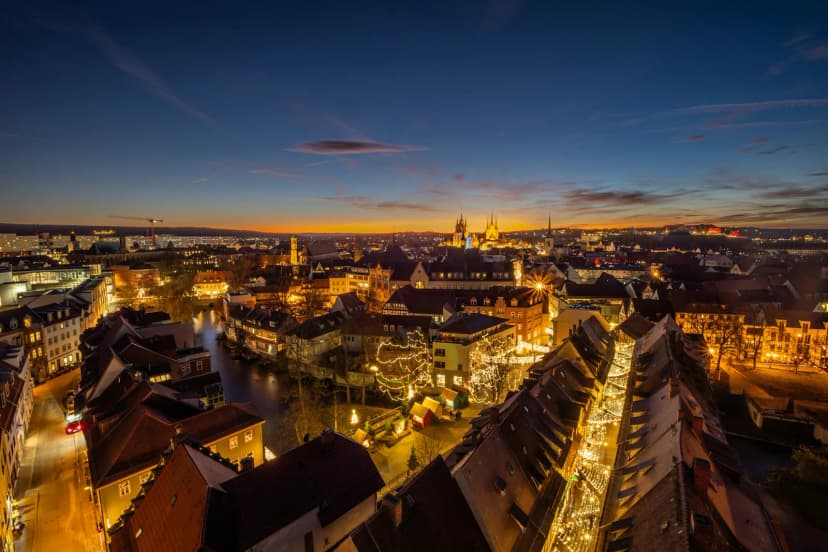
Erfurt rewards the pedestrian. Germany's national travel board describes the Thuringian capital as a city of towers whose restored timber-framed houses and Renaissance buildings cluster in the historic centre, with St Mary's Cathedral and the Church of St Severus forming a Gothic ensemble it calls like no other in Europe, and the Merchants' Bridge carrying the longest row of inhabited buildings on any European bridge. That density means most headline sights sit within a short stroll of one another.
The catch is the arrival point. Erfurt Hauptbahnhof lies outside the medieval core, so the first decision of any visit is how to bridge that gap. Trams and buses do the job, but route numbers, journey times and platform or exit details are deliberately not stated here because the operator publishes them and they change.
Treat everything below as a framework rather than a timetable. Confirm live routes, fares and service alerts with EVAG, the city's transport operator, and use Erfurt Tourismus for arrival and visitor information.
Why Erfurt's Compact Centre Rewards Walking
The old town's landmarks sit close together. The Krämerbrücke, the Fischmarkt with its merchant houses and neo-Gothic town hall, and the cathedral square known as Domplatz all belong to the same walkable cluster of lanes and squares. Germany's travel board notes that this medieval centre is where the city's restored timber-framed buildings and Renaissance architecture are concentrated, which is why so much of a visit happens on foot rather than on wheels.
That compactness shapes your transport budget. You do not need a tram or bus ticket to sightsee inside the centre itself; you need one mainly to reach the centre from the station, or to leave it for outlying stops such as Egapark. Build your plan around that distinction and the network becomes a simple shuttle rather than something to master.
Walking also keeps you inside the atmosphere the city is known for. The Krämerbrücke is lined with the shops of artisans and artists, and the surrounding lanes open onto squares where street musicians often play. Stopping and starting is the point, which is awkward to do from a vehicle.
Erfurt Hauptbahnhof: What to Sort Out Before You Leave It
Erfurt Hauptbahnhof is the main rail gateway to the city and sits outside the compact medieval centre, so plan your onward leg before you step off the train. Rather than memorising an exit letter or a walking time that may change with building work, check the station's own signage and the live departure boards for the tram and bus stops serving the centre.
The practical sequence is straightforward. Find the local transport departure board, identify the next service heading towards the old town, and only then buy or validate a ticket. If you are arriving late, confirm the last connections for the evening on the operator's site before you travel, since late-night frequency is thinner than daytime service and is exactly the kind of detail that shifts with the timetable period.
For the wider visitor picture, including tourist information and what is currently running in the city, the official Erfurt Tourismus site is the better starting point than a search result. Have its getting-there page open on your phone as you arrive so you can cross-check the station signage against published information.
Tram and Bus Basics: The Operator to Look Up
Erfurt's urban network is operated by EVAG, which publishes route maps, timetables and service alerts. That is the source to check for which tram or bus serves your stop, how often it runs on the day you travel, and whether engineering works are diverting services. Because routes and schedules are revised, any line number printed in a guide can age badly.
Use the network in two ways. First, as an arrival shuttle between Hauptbahnhof and the edge of the old town; second, as a way to reach outlying sights such as Egapark, which sits away from the medieval core. Everything between those two poles is usually faster on foot than waiting for a vehicle.
Set up alerts before you rely on a connection. Operator apps and websites typically offer disruption notices, and a festival weekend or a market day on Domplatz can change how crowded services feel. If you are travelling to a specific event, check whether extra services are advertised rather than assuming normal frequency applies.
Tickets and Fares: What This Guide Does Not State
Fares, ticket types, day passes and validation rules are set by the transport authority and revised periodically, so no figure here would stay accurate. Confirm the current range and the conditions attached to each ticket on EVAG's own ticketing pages, and check whether your rail ticket or a visitor card already includes local travel before buying separately.
The one habit worth adopting is validating your ticket if the system requires it. Rules differ between German networks and between ticket formats, so read the small print on the machine or the operator's site rather than copying what you did in another city.
If you plan to combine the city with surrounding towns, buy the ticket that matches the actual journey rather than stacking singles. The regional fare structure typically covers more than the urban zone, but the boundaries and conditions are exactly the sort of thing to verify on the operator or regional authority page before you board.
Walking the Old Town: Krämerbrücke, Fischmarkt and Domplatz
Start at the Krämerbrücke and let the lanes pull you west. The bridge's half-timbered buildings house craft workshops, and one shop sells pigments and displays the woad that made medieval Erfurt wealthy as a blue-dye trading town. Look for the house symbols above the doors, a reminder of the era before street numbering, and step into the foundation house exhibition if it is open.
From there the Fischmarkt is a natural next stop. The square's merchant houses and town hall sit around open space that once hosted the fish market, and pavement cafes make it a sensible pause. Walk on and the ground rises towards Domplatz, where St Mary's Cathedral and the Church of St Severus face each other across the square. The pair form an architectural ensemble of German Gothic design that Germany's travel board singles out as unmatched in Europe.
Keep the two categories of sight separate in your plan. Squares, bridges and the walkable grounds of St Augustine's Monastery cost nothing to enter, while interiors such as the Old Synagogue, the cathedral and the Mikveh are separate, sometimes guided, and should not be assumed to share one ticket. Check each site's own access conditions rather than expecting a single pass to cover a complex.
Erfurt is known for two annual events, the Cathedral Steps Festival on the steps below the cathedral and the Merchants' Bridge Festival in the old town, which Germany's travel board describes as a summer revival of the Middle Ages with crafts, songs and stalls. If your dates overlap with either, check that year's programme and any transport changes directly, because the content and staging change annually.
Building a Suggested One to Two Days
As a suggestion rather than an official recommendation, one to two days suits most first visits. Give the first day entirely to the compact centre: Krämerbrücke, the Fischmarkt, Domplatz and one interior of your choice. Because these sit close together, the day stays flexible and you can follow whatever is open.
If you have a second day, use transport to widen the radius. Egapark lies outside the medieval core, and Petersberg Citadel sits on high ground overlooking the centre with tunnels that have their own visiting arrangements. Grouping these stops lets you buy the appropriate ticket once and avoid shuttling back and forth.
A third day is best spent beyond the city. Thuringia's rail links make Weimar and other towns straightforward day trips, and doing them from Erfurt avoids moving hotels. Check connections and any regional ticket conditions on the operator's site the day before, since engineering work is the usual cause of an unwelcome surprise.
Museums, Interiors and Access Conditions
Treat the old town as a set of separate doors rather than one attraction. The Old Synagogue holds medieval building fabric and a collection including the Erfurt Treasure found buried nearby in the 1990s; the Mikveh, a thirteenth-century ritual bath, typically requires a registered guide or a scheduled public tour to enter, though it can be viewed from above through a window in the park near the Merchants' Bridge. The Ägidienkirche tower, the last remnant of an earlier church, is climbable when posted hours allow.
Hours and admission are the volatile part. Rather than relying on a printed schedule, check each site's own page or the city's tourist information before setting out, and keep a second option ready in case a tower or bath is closed on the day you choose.
Practical Planning: Apps, Accessibility and Peak Times
Load the operator's website or app before you travel and use it for live departures, disruption notices and ticket purchase. For accessibility questions, including step-free access at specific stops, ask the operator directly rather than assuming a route is barrier-free; older European tram networks vary widely stop by stop.
Luggage is easiest left at your accommodation or a station facility before you walk the centre, since the lanes and the bridge are not designed for wheeled bags. In peak season and during festivals, services and squares are busier, so allow slack in your plans and travel earlier than you think necessary if you have a fixed train to catch.
Plan Your Visit
The short version: walk the old town, ride only for the station and outlying stops, and verify fares and timetables with EVAG before you go. Erfurt's centre is compact enough that a car adds cost and parking hassle without unlocking anything the tram cannot reach.
Keep the two official sources saved on your phone: EVAG for routes, tickets and alerts, and Erfurt Tourismus for visitor information and arrival guidance. That pair answers nearly every question this guide has deliberately left to the operator.
Frequently Asked Questions
Is Erfurt easy to get around without a car?
Yes. The medieval centre is compact and its headline sights sit close together, so most of a visit happens on foot. Trams and buses fill the gaps, chiefly between the main station and the centre and for outlying stops such as Egapark. A car is more of a hindrance than a help for a city visit.
How do I get from Erfurt Hauptbahnhof to the old town?
Use the local tram or bus network. Erfurt Hauptbahnhof sits outside the compact medieval core, so check the station's departure boards on arrival and confirm which service is running towards the centre that day. Live routes, stops and frequencies are published by the operator, EVAG, and are the reliable source before you travel.
Do I need a tram or bus ticket to sightsee in Erfurt's centre?
Not for the central cluster. The Krämerbrücke, the Fischmarkt and the streets around Domplatz are close enough to cover on foot. You need a ticket mainly for the leg between the station and the centre, or to reach outlying sights. Confirm current fares and ticket conditions with EVAG rather than assuming a day pass is worthwhile.
How long do you need in Erfurt?
As a suggestion rather than an official recommendation, one to two days covers the old town comfortably. Use the first day for the central cluster and one interior, and a second day for transport-dependent stops such as Egapark or Petersberg Citadel. Add a third day only if you want to explore Thuringia beyond the city.
Are Erfurt's main sights free to enter?
Some are. The Krämerbrücke, the Fischmarkt and the walkable grounds of St Augustine's Monastery cost nothing, and the Domplatz cathedral ensemble can be admired from the square. Interiors such as the Old Synagogue, the cathedral and the Mikveh are separate and sometimes guided, so check each site's own access conditions rather than assuming one ticket covers a complex.