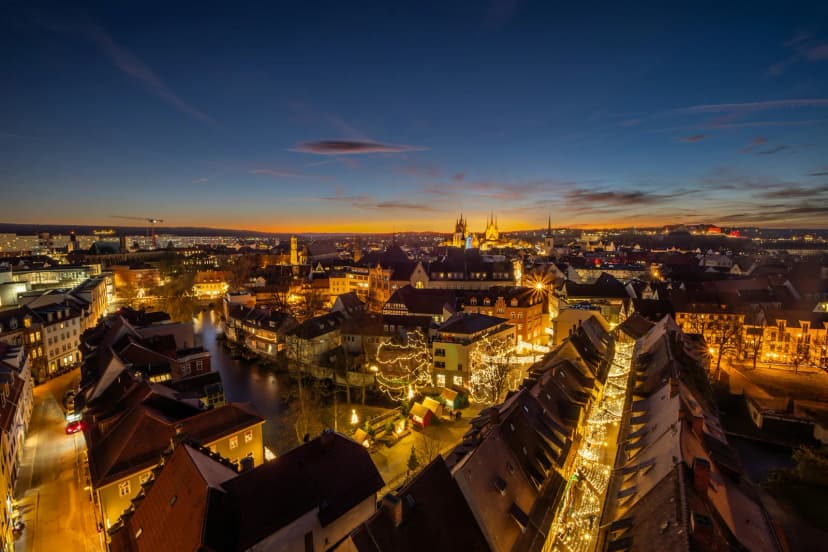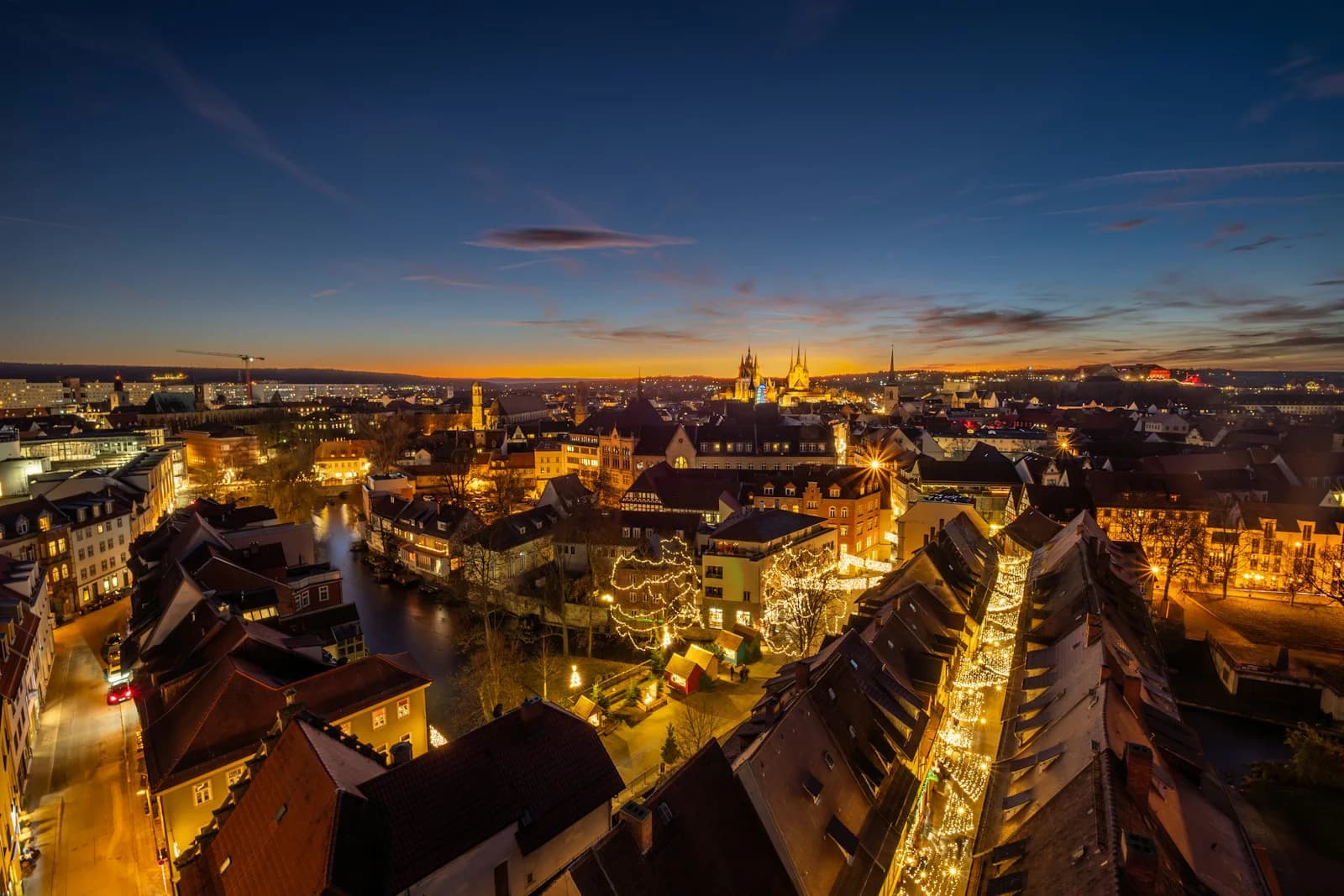
Two churches stand side by side on the Domberg above Erfurt's Domplatz: the cathedral, dedicated to St. Mary, and the smaller Severikirche, dedicated to St. Severus. They share one of the most photographed approaches in Germany, a broad flight of steps rising from the square between them, and they are usually seen together rather than separately. This guide treats them as a single ensemble while keeping clear that they are two distinct buildings with their own interiors, art and access arrangements.
One practical point to settle early: the ensemble is not a single ticketed attraction. There is no combined ticket covering both churches, and there is no cathedral treasury ticket to buy in the same transaction. Travel accounts describe walking into the cathedral without paying, while the operator's own accessibility record treats the church as a working place of worship with staff on hand during opening hours. Treat any entry-free statement as what visitors report rather than a published policy, and confirm current arrangements with the Domberg office before a special trip.
Why the Domberg Ensemble Matters
The cathedral is the oldest and largest church building in Erfurt, with a site history reaching back to a church founded for Bishop Boniface in the eighth century. The present structure grew over centuries, which is why Romanesque and Gothic elements sit together in the same building. Its central tower holds the Gloriosa, described as the largest medieval free-swinging bell in the world and cast in 1497.
The Severikirche is Erfurt's second-largest church and was built around 1300, with three spires that finish the skyline beside the cathedral's towers. Its interior is often described as quieter and less visited, which makes it a useful counterweight if the cathedral is busy with a service, a concert or a tour group. The two buildings together form the visual signature of the city seen from almost every high viewpoint.
The wider Erfurt old town rewards a slow walk afterwards, and the city's landmark and itinerary pages give useful context for building the rest of a day around the Domberg.
Approaching the Cathedral Steps from Domplatz
Almost every first visit begins on Domplatz, the large square below the hill, framed by historic buildings and cafés. The cathedral's west front and the Severikirche's spires rise directly above the square, and the staircase between them is the ceremonial route up to the churchyard platform. Walkers arriving from the old town will reach the square in a few minutes on foot from the Fischmarkt and town hall area.
If you come by tram, the Domplatz stop is served by lines 2, 3 and 6, and there is a multi-storey car park on the square with spaces reserved for visitors with reduced mobility when arranged in advance. Bringing a car into the old town otherwise means navigating pedestrian zones and limited parking, so public transport or a walk from a central hotel is usually simpler.
The steps themselves are the gathering point as much as the entrance; people sit on them to photograph the square and the two façades. That also means they can be crowded at mid-morning and again around sunset in fine weather. For a calmer climb, aim for the first hour after the churches open rather than the middle of the day.
Inside St. Mary's Cathedral
Once through the west doors, the scale of the nave and the height of the vaulting are the first things most visitors notice. The high-Gothic choir is the architectural focal point, and the stained glass in the nave windows dates from the late fourteenth and early fifteenth centuries, showing biblical scenes and saints. Look for the carved fourteenth-century choir stalls, which are among the finer pieces of medieval woodwork in the building.
The Gloriosa hangs in the central tower and is the reason many visitors time a visit around a ringing. Because it is a working bell in a working tower, you cannot count on seeing it up close; access to the tower depends on whether a guided tour is running. Check with the cathedral information point or the Domberg website rather than assuming a tower visit is available on the day you arrive.
Cathedral staff are present during opening hours to answer questions and assist visitors, so if you want to know whether the crypt, the higher choir or the treasury area is accessible on a given day, ask at the entrance instead of relying on older trip reports. Descriptions of guided tours that include the bell tower and crypt exist in older write-ups, but availability, times and booking arrangements change.
Inside the Severikirche Next Door
The Severikirche is entered separately from the cathedral, and its atmosphere is different: lower, darker, and usually far quieter. It is known for its organ, counted among the largest and oldest in Thuringia, and for the architecture of its triple-spired exterior seen from the square. Walking in and sitting in the pews for a few minutes is a reasonable way to experience it without needing a fixed schedule.
Pacing matters here. Many visitors give the cathedral the bulk of their time and treat the Severikirche as a short second stop, which is a sensible split if your day in Erfurt also includes the Krämerbrücke, the Augustinian Monastery and the old town lanes. If you are interested in church architecture specifically, reverse the emphasis and spend longer in the Severikirche, where you are less likely to be moved along by crowds.
Accessibility at the Cathedral
An accessibility audit of the cathedral records a deactivated ramp between the nave and the higher choir, completed in autumn 2019, which allows wheelchair users to reach the Hoher Choir. The same audit notes a reserved accessible toilet opened with a Euro key or on request from staff, a magnetic induction loop for following services, and information texts in Braille. Objects are available for tactile exploration by visitors with visual disabilities, but these need to be requested in advance.
The audit also describes a ramp at the main entrance that can be used independently, with a handrail, and a doorway at least 78 centimetres wide. Parking spaces for visitors with reduced mobility are available at the Domplatz multi-storey car park when notice is given. Staff are trained to support visitors with specific needs, so it is worth contacting the Domberg office before travelling if you need assistance arranged on a particular day.
Because the audit is a point-in-time assessment rather than a live status page, verify current conditions directly before relying on any single feature. The operator does not publish a continuously updated access statement for every part of the building. Email or call the Domberg contact address to confirm the ramp, the toilet and the availability of tactile materials for the date you plan to visit.
How Much Time to Allow
As a suggestion rather than official guidance, allow around 45 to 60 minutes for the cathedral and 15 to 20 minutes for the Severikirche, plus time on the steps and in the square. That puts a comfortable Domberg visit at roughly one and a half hours without a guided tour or a climb. Add 30 to 45 minutes if you join a guided element such as a tower or crypt visit, subject to what is actually running.
Many travellers explore the whole old town on foot in about four hours, taking in Domplatz, the Fischmarkt and town hall, the Krämerbrücke and the Augustinian Monastery. The Domberg usually takes the largest single share of that time. If you only have half a day in Erfurt, start at the cathedral steps and work downhill into the old town rather than the other way around.
For a two-part plan that pairs the Domberg with the city's other headline site, the Augustinian Monastery and its Luther connection sit a short walk away and make a natural second stop.
Seasonal Context and Events
Domplatz changes character through the year. In summer the square hosts markets and open-air events, with street cafés along its edges; in the run-up to Christmas it becomes the setting for Erfurt's Christmas market, with stalls filling the space below the cathedral. The tourism office promotes both the Cathedral Steps Theatre Festival and the Christmas market as seasonal highlights, but it does not publish those dates on a rolling basis far ahead.
When the Cathedral Steps Festival is running, staging and seating can block the staircase itself, so the approach up to the churchyard changes and you may need to walk around the side of the square. Check the Erfurt tourism events calendar shortly before you travel for the current year's programme rather than planning around dates from an earlier season.
The ErfurtCard and similar visitor cards can reduce entry fees at some municipal museums and attractions, but they do not act as a combined church ticket. If you plan to add the Old Synagogue or a museum to your day, check what each venue accepts separately.
Beyond the two churches, Erfurt's museum landscape is varied and separately ticketed, from the Angermuseum's art collections to the city's folk-culture holdings. Budget time and money for each venue individually rather than assuming one pass covers them.
Making the Domberg Work in Your Day
Treat the cathedral and Severikirche as one destination with two interiors, arrive via the Domplatz steps, and decide in advance whether you want a quick look or a slower visit with a guided element. Confirm opening times, tour availability, any entry arrangements and accessibility provisions directly with the Domberg office or the Erfurt tourism service before you go, since these details shift with services, seasons and events.
Build the rest of your Erfurt day around the square: the old town, the Krämerbrücke and the Augustinian Monastery are all within walking distance, and the city's wider guide pages help you sequence them.
Frequently Asked Questions
Is there an entry fee for Erfurt Cathedral?
Visitor accounts consistently describe walking into the cathedral without paying, but the operator does not publish an explicit free-entry policy statement covering every area. Some parts of the building, such as the crypt or treasury spaces, may be treated differently, and guided elements can carry their own arrangements. Confirm with the cathedral information point or the Domberg office before you travel, especially if you are planning around a specific part of the building.
What is the difference between Erfurt Cathedral and Severikirche?
They are two separate churches standing next to each other on the Domberg. The cathedral, dedicated to St. Mary, is Erfurt's oldest and largest church building and holds the Gloriosa bell in its central tower. The Severikirche, dedicated to St. Severus and built around 1300, is the second-largest church in the city and is generally quieter inside, with a notable historic organ.
How long should I allow to visit the cathedral and Severikirche?
As a personal suggestion rather than official guidance, around 45 to 60 minutes in the cathedral and 15 to 20 minutes in the Severikirche works for most visitors, with extra time on the steps and in Domplatz. Allow more if you join a guided element such as a tower or crypt visit. The operator does not publish a recommended duration, so treat these figures as planning aids.
Is the cathedral accessible for wheelchair users?
An accessibility audit records a deactivated ramp between the nave and the Hoher Choir, completed in autumn 2019, which allows wheelchair users to reach the higher choir. It also describes a ramped main entrance usable independently, with a handrail, and doorways at least 78 centimetres wide. Because this is a point-in-time assessment, contact the cathedral before travelling to confirm current conditions and any assistance you may need.
When does the Christmas market take place on Domplatz?
The tourism office lists Erfurt's Christmas market as a seasonal event on Domplatz, but it does not publish a fixed set of dates on a rolling basis. Christmas markets in Germany generally run through Advent into late December, but you should check the current year's dates on the official Erfurt tourism calendar rather than relying on previous seasons.
What is the Cathedral Steps Festival?
The Cathedral Steps Theatre Festival is a summer programme of open-air performances staged on the grand staircase leading up to the cathedral. The tourism office promotes it as a seasonal highlight. When it is running, staging and seating can block the steps themselves, so plan your approach to the churchyard via the side of Domplatz and check the current programme before you travel.
Sources
- Erfurt - Cathedral, Krämerbrücke & other sights (Germany)
- TUR4all: Turismo accesible - Catedral de Erfurt Dom St. Marien
- egapark Erfurt - Erfurt Tourismus
- ERFURT Tourismus - Stadtführung und Übernachtung
- Things to see in Erfurt - a walk through the old town | Velvet Escape
- Erfurt Travel Guide: What to Do in The Fairytale City On a Berlin Day Trip — Blake Erik.
- Erfurt Cathedral