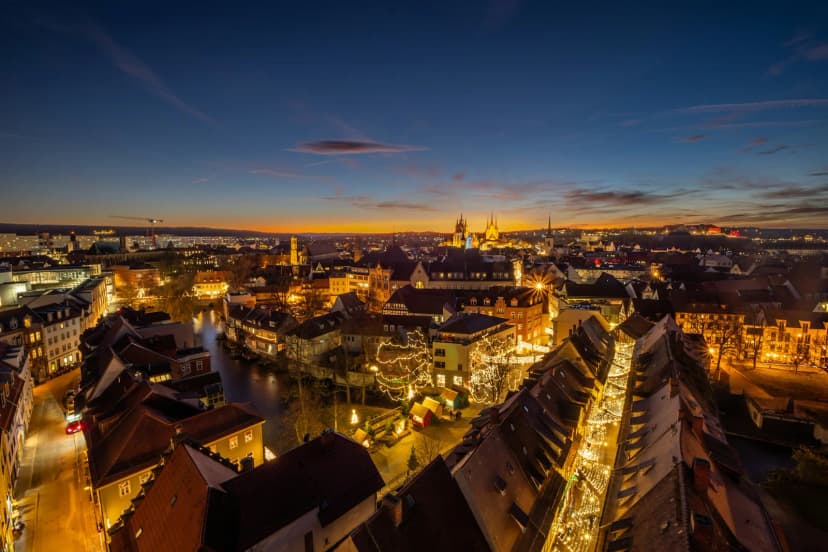
The Augustinian Monastery at Augustinerstraße 10 is where Martin Luther entered the Augustinian order on 15 July 1505, after studying at the university in Erfurt since 1501, according to Erfurt Tourismus. The same source records that he took his vows in the Augustinian church in 1506 and celebrated his first Mass there on 2 May 1507. The monastery runs a public guided tour daily at 11 a.m. lasting about one hour, which is the fixed point to build a visit around. This guide covers what the complex contains, how the exhibition and audio route work, how library access is arranged, and how to combine the monastery with other Luther sites nearby.
Why the Augustinian Monastery Matters
Luther's years in Erfurt were decisive for the path to the Reformation. He was a student at the university and then a monk in this house. The church and monastery complex of the Augustinian hermits was built around 1300, and Erfurt Tourismus describes the site as a rare example of medieval monastic architecture because a church, three enclosed courtyards, convent buildings and farm buildings survive together.
The building's later history carries comparable weight. Erfurt Tourismus notes that the spring 1850 Erfurt Union Parliament demanded a united Germany with more civil rights, and that in autumn 1989 the monastery again became a place of commitment to democracy and freedom in society. The house bears the European Cultural Heritage seal and is a place of democratic history, an official monument and a Luther memorial site. It has served since 1988 as an ecumenical event and conference centre, which is why it functions as a living institution rather than a closed museum.
What the Complex Contains Today
Between 2000 and 2010 the buildings and grounds were extensively restored, renovated and rebuilt into a contemporary meeting place, according to Erfurt Tourismus. The same listing calls the monastery one of five large conference centres in central Germany, sponsored by the Protestant Church, with historic and modern conference rooms and simply furnished guest rooms. Expect meeting guests alongside day visitors, and accept that parts of the complex may feel busier during a conference or event.
The monastery is a member of Wege zu Luther, the central German cultural tourism initiative, and of the Nail Cross Community. The tourism listing records practical facilities including free Wi-Fi, a souvenir shop, seating, a rest area and baggage storage, plus a mobile audio guide app. The gardens on the monastery grounds are described there as small islands of tranquillity, with lavender bushes, roses and oleanders that give the courtyards an unexpectedly green character in the city centre.
The Daily 11 a.m. Monastery Tour
The monastery's public guided tour runs daily at 11 a.m., lasts about one hour and needs no registration, according to the operator. The operator lists its route as covering the cloister, chapter house, Luther cell, monastery garden and the new exhibition, along with the history of the Augustinian church and the monastery buildings. Because it is the only regularly scheduled walk-through of these interiors, it is the thing to plan the day around if you want the site interpreted rather than simply seen. The operator lists admission at 7.50 EUR per person, with a reduced 4.00 EUR rate for children aged twelve and over; these are source-stated figures, so confirm them at reception rather than treating them as permanent.
The exhibition can be visited inside the daily 11 a.m. guided tour or on a self-guided route with an audio guide, and the operator lists both at 8.50 EUR per adult. That is a separate offering from the 7.50 EUR guided tour admission, so do not assume one purchase covers the library, the exhibition and the tour. Individual group tours are quoted separately. The most useful habit at this site is to stop at reception first and ask what a given ticket includes before relying on access to a particular room.
The Permanent Exhibition "Frustration and Freedom"
The permanent exhibition "Frustration and Freedom" sets out the events attached to this address: Luther's search for a liberating faith, the spring 1850 Erfurt Union Parliament with its demand for a united Germany and more civil rights, and the autumn 1989 role of the monastery in the push for democracy. Erfurt Tourismus describes the exhibition as the element that explains the site's place of democratic history, so give it time rather than treating it as a corridor between rooms.
Choosing between the guided and self-guided versions is the real planning decision here. If you want the cloister, chapter house and Luther cell interpreted aloud, take the 11 a.m. tour. If the 1850 and 1989 material is your main interest and you prefer to read at your own pace, the audio route is the more flexible choice, but it is issued at reception only during the operator's stated issue windows, so an early-evening arrival will not get one.
The Historical Library and How Access Works
The historic monastery library was built at the beginning of the 16th century. Its original collection was largely destroyed during the Reformation, the theological service library of the Protestant ministry moved into the building in 1646, and the library building was almost completely destroyed in a bombing raid in 1945, according to Erfurt Tourismus. Today's collection comprises around 60,000 volumes and is described there as one of the most important ecclesiastical book collections in Germany. This is a fragile research collection with cradle prints, Reformation writings and Luther editions, not a browsing room.
Access is the practical trap worth planning around. The operator states that participants on the public 11 a.m. tour can visit the historical library Monday to Friday after the tour, with about ten additional minutes to plan for, while the 45-minute guided library tours are by appointment only and listed at 5.00 EUR per person. The operator's listed library opening hours are Monday to Wednesday 08:00 to 16:00 and Thursday to Friday 09:00 to 12:00, so an afternoon arrival will not get you in. If the library is a priority, contact the monastery team in advance rather than arriving unannounced.
Church Services and the Monastery as a Living Congregation
The Augustinian church is not a decommissioned monument. The operator lists worship on Sundays at 9.30 a.m. and publishes prayer times and other spiritual-life offerings alongside visitor information. If you want to attend rather than tour, check the current schedule first, because service times and special events change more often than the building does. Attending a service is also the simplest way to see the church interior without joining a paid tour.
The house presents itself as a testimony to Lutheran tradition, Protestant faith and present-day church life, which is why worship, concerts, talks and exhibitions appear alongside guided tours in its programme. That activity is worth factoring into timing: a service, concert or conference can temporarily change what is accessible or how quiet the courtyards feel. Check the events listing for your date rather than expecting a fixed museum rhythm.
Gardens and Courtyards as a Break in the Old Town
The grounds include three enclosed courtyards, a Renaissance courtyard and monastery gardens. Erfurt Tourismus notes that a sensory tour starting at the monastery reception passes through the Renaissance courtyard, the Luther cell, the chapter house, the cloister and the church, then continues to the Georgenburse, the Collegium Maius and St Michael's Church, ending at the cathedral square. If you join that route, you will meet a group moving through the same spaces, so use the courtyards as a pause rather than expecting them to be empty.
The contrast between the enclosed courtyards and the surrounding streets is the point. Despite its central location in the old town, the conference centre is experienced as a place of inner reflection and security, which is unusual for an address this close to the main shopping streets. Build the return to the city deliberately, because stepping out of the cloister into Augustinerstraße is abrupt.
Hours and Practical Information
For the calendar year 2026, Erfurt Tourismus lists the monastery's opening hours as Monday to Friday 08:00 to 18:00 and Saturday and Sunday 08:00 to 16:00, with public holidays running 10:00 to 14:00. Treat those as the published 2026 baseline and verify before travelling, because special opening hours differ. The same listing notes free public access, free Wi-Fi, seating, a rest area, baggage storage and a souvenir shop, and states that the site is accessible for free public access with disabled toilets and a nappy changing area.
The most important practical distinction is between the freely accessible grounds and church and the ticketed guided interiors and exhibition. Ask at reception what is included in what you buy rather than assuming one purchase covers everything. Reception is also where audio guides are issued and where group and library appointments are arranged, so stop there first. The tourism listing records the nearest streetcar stop 200 metres away, parking at the Domplatz car park and the Q-Park Anger 1 multi-storey car park, and notes that the city centre, including Domplatz, the Fischmarkt, the town hall and the Krämerbrücke, is reachable on foot within a few minutes.
One rule deserves a close read before you photograph interiors: the tourism listing states that taking pictures is permitted but a photo licence fee is required. The same listing records payment in cash and by EC, MasterCard, Visa and American Express, and notes that pets are allowed. Because access and house rules can shift with renovation or events, confirm specific needs with reception before your visit.
Pairing the Monastery with Nearby Luther Sites
The monastery anchors a compact cluster of Luther sites that needs no transport. Erfurt Tourismus describes the sensory tour "Lust for life: Luther in Erfurt" as starting at the monastery reception and moving through the Renaissance courtyard, Luther cell, chapter house, cloister and church, then past the Georgenburse, the student residence Luther moved into as a seventeen-year-old in April 1501, the Collegium Maius where he studied, and St Michael's Church, ending at the cathedral square. That is the most efficient way to see the sites in one continuous stretch.
If you prefer to move at your own pace, the same geography works as a self-guided walk, and the stops are close enough that backtracking costs little. The monastery is the natural starting point because reception can answer questions before you set off, and the route ends near the cathedral square by Domplatz. Treat the pairing as a suggestion rather than a fixed itinerary if you want time inside the exhibition or the courtyards.
Erfurt was the young Luther's spiritual home, and the city string of sites makes more sense together than separately. A fuller Luther in Erfurt walking route and our Erfurt: Itineraries and City Travel Guides hub are the natural next reads if you want the city-level context before fixing your day.
How Long to Allow
As an editorial suggestion rather than official guidance, allow about one hour for the daily 11 a.m. tour, around ten minutes more if you continue to the historical library afterwards, and further time for the exhibition and for sitting in the courtyards. A relaxed half-day lets you cover the monastery properly and still walk the nearby Luther sites to the cathedral square. If you only have an hour, take the tour and leave the museum-style reading for a return visit.
Combine the visit with the old town rather than treating it as an isolated stop. The Krämerbrücke, the Fischmarkt, the town hall and the cathedral square are all a few minutes away on foot, and pairing the monastery with Domplatz works well as a single afternoon. The Erfurt: Landmark Visitor Guides index collects the city's individual attraction pages if you want to build a longer list.
Audio Guides and Other Tour Formats
An audio guide narrated in the voice of Margot Käßmann is issued at reception only during the operator's stated windows: Monday to Friday 10:00 to 16:00, Saturday and Sunday 11:00 to 14:00, and public holidays 11:00 to 12:30, according to Erfurt Tourismus. Outside those windows you should not count on getting one. The adult rate is listed at 8.50 EUR per person, with a 7.50 EUR rate for house guests, and a digital monastery tour is offered as an app for mobile devices for visitors who prefer to move independently.
Evening tours are a separate format again. Erfurt Tourismus describes "Luther's sleepless nights in Erfurt" as a candlelight route that runs in very large parts open-air and in very large rooms, on Fridays from 1 April to 30 September at 9 p.m. and from 1 October to 31 March at 8 p.m., lasting about 1.5 hours and listed at 13.00 EUR per person and 6.00 EUR for children. The monastery also runs seasonal themed offers and special guided tours whose dates change from year to year, so check the operator's current programme rather than assuming any one format is running during your stay.
Plan Your Visit
Decide first whether you want the daily 11 a.m. guided tour or the self-guided audio route, because that choice determines how you experience the cloister, chapter house, Luther cell and exhibition. If the historical library matters to you, build the visit around a weekday and ask reception about after-tour library access before you arrive. Checking the operator's current opening hours and ticketing closes the remaining uncertainty, since published times and listed admission figures can change.
Then treat the monastery as the first stop on a walk rather than a destination in itself. The Georgenburse, Collegium Maius and St Michael's Church sit close by, and the cathedral square is the natural end point of the route. If you want to extend the day beyond the old town core, our Egapark Erfurt visitor guide and the Krämerbrücke Erfurt visitor guide cover two very different Erfurt attractions.
Frequently Asked Questions
Was Martin Luther a monk at the Augustinian Monastery in Erfurt?
Yes. Luther entered the Augustinian monastery on 15 July 1505, after studying at the university in Erfurt since 1501. He took his vows in the Augustinian church in 1506 and celebrated his first Mass there on 2 May 1507, according to Erfurt Tourismus. He was ordained a priest in Erfurt Cathedral a year after taking his vows.
What can you see inside the Augustinian Monastery?
The daily guided tour covers the cloister, the chapter house, the Luther cell, the monastery garden and the permanent exhibition, along with the history of the Augustinian church and the surrounding buildings. The wider complex includes the church, three enclosed courtyards, and convent and farm buildings. The historical library can be reached after the public tour on weekdays or through a separate appointment with the library director.
When is the daily guided tour of the Augustinian Monastery?
The monastery's public guided tour runs daily at 11 a.m. and takes roughly one hour, with no registration required, according to the operator. Separate formats exist, including a candlelight evening route on Fridays with seasonal start times and a sensory Luther route offered on selected Saturdays. Confirm the current schedule, and any changes to it, with reception before you travel.
Is the Augustinian Monastery free to visit?
The tourism office listing records free public access to the monastery, so the grounds and courtyards can be entered without a ticket. Guided tours, the audio guide route, the permanent exhibition and library visits are separate offerings with their own listed admission, and the operator does not describe them as covered by a single combined ticket. Ask at reception what a specific ticket includes.
Can you visit the historical library at the Augustinian Monastery?
Yes, but not as a walk-in browsing room. Participants on the public 11 a.m. tour can visit the library Monday to Friday after the tour, with about ten additional minutes to plan for, and 45-minute guided library tours are arranged by appointment through the library director. If the library is your priority, contact the monastery team in advance rather than arriving unannounced.
Which Luther sites are near the Augustinian Monastery in Erfurt?
Within walking distance are the Georgenburse, the student residence Luther moved into in April 1501, the Collegium Maius where he studied, and St Michael's Church, with the route ending at the cathedral square. The monastery itself is the logical starting point, and the cluster sits in Erfurt's old town near Domplatz, the Fischmarkt and the Krämerbrücke.
How long does a visit to the Augustinian Monastery take?
As an editorial suggestion rather than official guidance, allow about one hour for the daily 11 a.m. tour, plus around ten minutes more if you continue to the historical library afterwards, and additional time for the exhibition and courtyards. A relaxed half-day covers the monastery properly and still leaves room to walk the nearby Luther sites to the cathedral square.