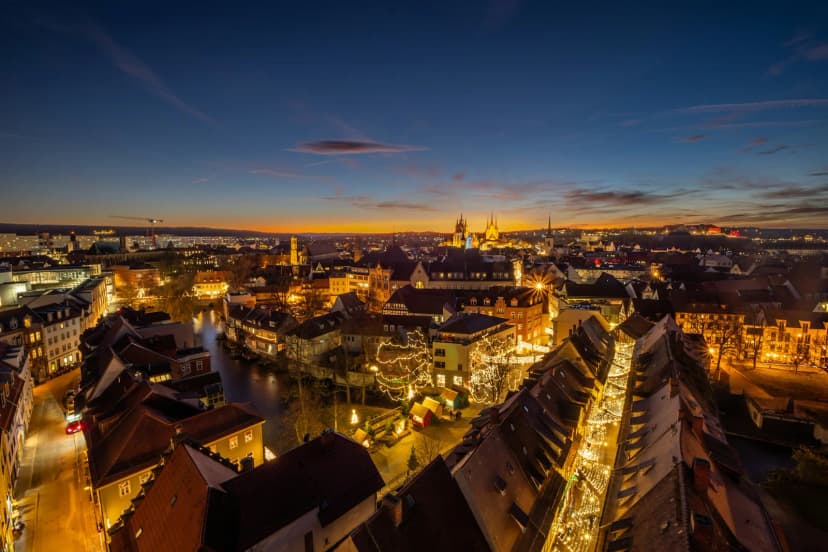
The Krämerbrücke in Erfurt is described by the city's anniversary site as the longest bridge in Europe that is entirely covered with houses and permanently inhabited. That single sentence is the reason the crossing draws visitors: it is not a bridge with a few buildings beside it, but a street of houses carried on stone arches over the Gera.
The bridge street is a public thoroughfare. There is no gate, no turnstile and no admission charge for walking across it; the operator describes the bridge as a landmark that invites you to stroll among its shops, cafés and bistros. Whatever you spend on the crossing is a matter of what you choose to buy or add.
This guide treats the visit as three separate decisions: the free walk along the lane, the exhibition inside house 31, and the themed guided tour run by the city tourist office. Keeping them apart is what stops a short crossing from turning into a confusing booking.
What the Krämerbrücke Actually Is
The Krämerbrücke is a complete row of houses standing along both sides of a crossing over the Gera. The houses are three storeys high and roughly 13 to 15 metres tall, and the walkway between the house fronts is about 5.5 metres wide. The overall width of the structure, including the buildings, is around 26 metres. That clear width is what makes the crossing read as an ordinary narrow lane until you notice the water passing underneath.
The bridge began as a wooden crossing next to a ford over the Gera and formed part of the west-east trade route known as the Via Regia. It was first mentioned in 1117 after being destroyed by one of the many fires that damaged it, and merchants had already set up stalls on both sides of the wooden bridge before the stone version existed.
Repeated fires pushed the city toward a permanent solution. After fires in 1175, 1178, 1213, 1222, 1245, 1265 and 1293, the Erfurt council acquired all bridge rights from the monasteries in 1293 in order to build a new stone structure, completed in 1325. Erfurt has been marking 700 years of that stone bridge with a theme year of lectures, concerts, publications, guided tours and competitions.
Fire shaped the bridge a second time. After a town fire in 1472 destroyed half the town and the houses on the bridge, the crossing was rebuilt in its present form with 62 half-timbered buildings, finished in 1486. Building mergers and reconstruction after later fire damage reduced that count over the centuries, and 32 residential buildings remain on the bridge today. Two stone churches with gateways once stood at the bridgeheads: the Benediktikirche at the western end and the Ägidienkirche at the eastern end. The Benedictine church was sold in 1807 and demolished in 1810, so only one of the pair still shapes the view.
A Living Street, Not a Museum Piece
What you find on the bridge today is largely shops for arts, crafts and antiques rather than the chain stores that dominate many European old towns, and that mix is deliberate. When the city reconsidered the bridge's future after 1989, one stated goal was to promote art, culture, handicrafts and a regional focus instead of allowing chain stores and corporations to open branches on the crossing.
In 1996 the city council decided to transfer the buildings, most of which the city already owned, together with the bridge that supports them, to a foundation. Since then the Krämerbrücke Foundation has been responsible for preserving the monument and keeping it permanently inhabited and revitalised by art and trade, supported by the German Foundation for Monument Protection and a fiduciarily managed Thayssen foundation.
That arrangement has a practical consequence for visitors: shop tenancies are not awarded purely on rent. Anyone interested in one of the units approaches the board of trustees with a concept and is assessed on art, culture, handicrafts, uniqueness and regional focus. What is on offer therefore changes over time, and a shop you read about may not be the one trading when you arrive.
Not every building along the crossing is open to the public, and the bridge is a residential address as much as a shopping street. Some doors are homes, some are workshops, and some are simply closed on the day you visit. Wander with the expectation of looking rather than systematically ticking off interiors.
Free to Walk, Paid to Add
The bridge itself is not a ticketed attraction. The operator presents it as a walkable landmark with little shops, cafés and bistros that invites you to stroll and linger, and there is no admission charge for crossing it. Budget nothing for the crossing itself and treat any spend as a shop, café or exhibition decision. If a ticket price has appeared in something you read, it almost certainly referred to a different offer.
The one clearly separate interior operated as part of the bridge's foundation story is the exhibition in house number 31, known as Haus der Stiftungen. There you can find many publications, a permanent exhibition with a model of the bridge at 1:100 scale, a medieval plank room from around 1578 or 1579, and a walk-in cellar inside one of the bridge's arches. The exhibition covers the bridge's history and the foundations that keep it standing.
That exhibition is the reason to step off the lane and behind a facade. It answers the question the street itself cannot: how a row of houses and the arches beneath them have been carried, repaired and paid for over centuries. If you have time for one interior on the bridge, this is the one with real substance.
Do not assume a single ticket covers the bridge houses or that every building forms one complex. There is no shared admission concept across the crossing, and access arrangements are set by the individual operators. Check the foundation's own pages before travelling if the exhibition is the point of your visit.
The Krämerbrücke Guided Tour
Erfurt Tourismus runs a themed walk called The Stone Krämerbrücke, a journey through time with sweet tastings. It is scheduled on Sundays from April to October at 10.30, lasts about two hours, and is capped at a maximum of 15 participants. The meeting point is the tourist information office at Benediktsplatz 1.
The operator lists tastings as part of the offer, including fine egg liqueur and a bridge truffle, a praline created to match the Krämerbrücke story. Tickets are sold at the Erfurt tourist information office or through online booking. The operator's page also carries a price, but it appears without a clear date, so treat any figure you see there as needing confirmation before you rely on it for 2026.
Because the group is capped at 15, this is a decision you make in advance rather than something you join on impulse. It also fixes your morning: a two-hour start at 10.30 rules out a leisurely breakfast and pushes the rest of your city walk later. Choose it for the stories, the different angles on the bridge and the tastings, not because the crossing needs explaining.
If you prefer to keep the day flexible, the free walk plus the house 31 exhibition covers the same ground at your own pace. The tour adds a guide, a fixed route and the tasting element. Both approaches are legitimate; they simply suit different travellers.
How Long to Spend on the Krämerbrücke
As an editorial suggestion rather than an official figure, allow about 45 to 90 minutes for the bridge and the streets immediately around both ends. That is enough to walk the lane in both directions, read the house fronts, and stop where something catches your eye. It assumes browsing rather than shopping with intent. For wider planning, see Erfurt city travel guides.
Add time if you include the foundation exhibition in house 31, and about two hours plus waiting if you take the guided tour. A realistic half-day in this corner of the old town combines the bridge, one interior and a coffee stop without rushing. Anything beyond that is a city walk, not a bridge visit.
Late morning works well because the lane is narrow and the shops are active, while an early evening visit trades foot traffic for softer light and a quieter crossing. The bridge has no closing gate, but the businesses along it keep their own hours, and the themed tour runs on Sunday mornings from April to October. Work around those two constraints and the timing takes care of itself.
Nearby Squares and Pairing the Visit
Benediktsplatz sits at the western end of the bridge and doubles as the tourist information address, so it is a natural place to start or finish. Walking east, the bridge finishes near the Ägidienkirche, where a church and tower have marked the crossing point since the medieval period. Those two ends frame the visit and give you fixed points to navigate by. The Fischmarkt Erfurt visitor guide covers the market square a short walk away, and the Domplatz Erfurt visitor guide covers the cathedral square on the other side of the old town.
The bridge works best as one link in a longer old-town loop rather than a standalone stop. With around 32 houses on a lane of roughly 5.5 metres clear width, the crossing itself is short; what surrounds it fills a morning. Compare the crossing with the squares around it before deciding how to sequence the day.
Erfurt rewards walking between its set pieces, and the bridge sits comfortably inside a route that includes the cathedral square and the market streets. If you want a structured walk rather than a loose amble, an Erfurt Altstadt walk is a sensible frame: it lets the bridge be one stop among several and keeps you from over-investing in a single landmark.
If your visit is built around one day, a one-day Erfurt itinerary can hold the bridge alongside the cathedral and the market squares without turning the crossing into the whole trip. Use it to decide the order of stops, then drop into the bridge when the street is calm rather than when a group is passing through. The sequence matters more than the checklist.
The Anniversary Year and the Festival
Erfurt has been marking 700 years of the stone Krämerbrücke with a theme year rather than a single event, including lectures, concerts, prize games, publications, guided tours and festivals. If particular anniversary activities matter to you, check the bridge's own news page for what is currently listed.
The Krämerbrückenfest is described as Erfurt's largest old-town festival and is named after the bridge, traditionally held around the third weekend in June. A listing on the tourist office's own site gives 18 to 20 June 2027 for the 50th edition, but programme details and dates for future editions are published closer to the time. Treat any announced edition as provisional until the organisers confirm it.
The festival is a bonus, not the reason to visit. The bridge is a permanent, inhabited street with a working exhibition and a seasonal tour, and none of that disappears outside an anniversary year or a festival weekend. Plan around the crossing itself and let the programme be a pleasant extra if it coincides.
Mistakes to Avoid
The most common error is expecting a ticket booth. There is no admission charge for walking the bridge street and no single pass covering the houses along it. If you have read about an entrance fee, it almost certainly referred to a different attraction or a separate offer.
A second mistake is budgeting the guided tour at whatever price appears in an undated listing. The operator's figure should be checked before you rely on it, and availability for the Sunday slot confirmed at the same time. Prices and schedules for themed tours move; the shape of the offer is what stays stable.
A third is assuming every house on the bridge is open or that shop hours are uniform. Some buildings are homes, others are studios, and opening days vary by operator. If you have come for a particular craft or for the foundation exhibition, verify before making the trip rather than after.
Plan Your Visit
Decide first whether you are crossing the bridge or studying it. The free walk takes around an hour and asks nothing of you; the exhibition in house 31 and the Sunday tour each add depth at the cost of time and, in the tour's case, money. Most visitors are well served by the walk plus one interior.
Then fit the bridge into a wider old-town route so the crossing does not carry more weight than it can. Confirm current tour pricing, Sunday availability and opening arrangements directly with the operator before you travel, since those are the details most likely to have moved. The bridge itself will still be there, and it will still be free to walk.
Frequently Asked Questions
Is the Krämerbrücke free to visit?
Yes. The bridge street is a public thoroughfare lined with houses, shops and cafés, so there is no admission charge to walk across it. The separate exhibition in house number 31 and the guided tour run by the city tourist office are distinct offers with their own arrangements, so budget for those only if you choose to add them.
Can you walk across the Krämerbrücke?
Yes, on foot along the lane between the house fronts, which is roughly 5.5 metres wide. It functions as an ordinary narrow street within the old town and connects Benediktsplatz at the western end with the area around the Ägidienkirche to the east. Some houses are private homes or closed workshops, so the crossing can be open even when individual doors are not.
How long should I spend on the Krämerbrücke?
As a rough suggestion rather than an official figure, allow about 45 to 90 minutes to walk the lane and the streets at both ends. Add time for the foundation exhibition in house 31, or about two hours plus waiting if you join the Sunday themed tour. Browsing pace varies, so treat these as planning ranges.
What can you see inside the exhibition on the bridge?
The exhibition in house number 31, called Haus der Stiftungen, presents the bridge's history and the foundations that maintain it. It includes a 1:100 scale model of the bridge, a medieval plank room dating from around 1578 or 1579, and a walk-in cellar inside one of the bridge arches. Access arrangements are set by the operator, so check before travelling.
Is there a guided tour of the Krämerbrücke?
Erfurt Tourismus offers a themed walk on Sundays from April to October starting at 10.30, lasting about two hours and limited to a maximum of 15 people. The meeting point is the tourist information office at Benediktsplatz 1, and tastings are included. Tickets are available at that office or through online booking, and the current price should be confirmed with the operator.
How many houses are on the Krämerbrücke today?
There are 32 residential buildings on the bridge. The crossing was rebuilt with 62 half-timbered houses after the town fire of 1472, and the count fell over the centuries through building mergers and reconstruction after later fire damage. The bridge has been permanently inhabited and used for trade throughout that history.
When was the Krämerbrücke built in stone?
The stone bridge was completed in 1325, after the Erfurt council acquired the bridge rights from the monasteries in 1293 in order to build a new stone structure. Earlier versions were wooden and were repeatedly damaged by fires. Erfurt has been marking 700 years of the stone bridge with a theme year of events around the anniversary.
Sources
- Aktuelles zum Themenjahr 700 Jahre steinerne Krämerbrücke - Krämerbrücke - Urlaub, Reisen, Tagen
- Die Stiftung- Krämerbrücke Erfurt - Krämerbrücke - Urlaub, Reisen, Tagen
- Die steinerne Krämerbrücke – Eine Zeitreise mit süßen Genüssen - Thematische Führungen - Erfurt Tourismus
- Krämerbrücke Erfurt - SIMsKultur