

Bamberg's old town is compact but vertically generous: the cathedral sits on one hill, St. Michael's monastery on another, and the Regnitz threads between them. That geography is what makes a one-day visit realistic, because you can walk almost everything and let the hills do the separating. The city's own tourism board is unusually blunt about the trade-off, noting that Bamberg is so varied that a single day will not be enough. Treat the plan below as an order of operations rather than a schedule to keep.
The shape of the day matters more than the number of stops. Walk the Cathedral Hill cluster first while it is quiet, drop down to the river for the Old Town Hall and Little Venice around midday, then spend the afternoon in the lower town around the brewery streets and, if your legs agree, up to St. Michael's for the terrace view. Any timing you see below is a suggestion built from how the sights relate to each other on foot, not an official schedule published by anyone.
Why Bamberg Suits a Single-Day Walking Loop
The old town is a UNESCO World Heritage site precisely because so much of its medieval and baroque fabric survived intact, which means the interesting buildings are stacked rather than spread out. Three historic quarters do most of the work: the Bergstadt around the cathedral, the Inselstadt with Little Venice and the pedestrian zone, and the Gärtnerstadt market gardeners' district to the north. Because they sit within a few minutes of each other, a single loop can touch all three without any transport leg.
What a day cannot do is everything inside those quarters. The Domberg alone holds the cathedral, the Old Court with the Historical Museum, the New Residence state rooms with the Rose Garden, and the Diocesan Museum with the cathedral treasury, each with its own entrance. Trying to do all four interiors plus the river and St. Michael's is the classic way to finish the day exhausted and remembering very little.
Set Your Shape First: Timing, Terrain and What to Wear
Cobbles and gradients define this walk more than distance does. Cathedral Hill sits above the river, the lower town sits partly below it, and St. Michael's is a climb on top of that, so shoes with grip matter more than any packing item you might agonise over. Choose one or two interiors for the whole day rather than sampling all of them, and you buy yourself a genuinely relaxed afternoon.
As a working framework only, consider starting on Cathedral Hill between about nine and ten, moving down to the Old Town Hall and Little Venice around midday, eating lunch in the lower town in the early afternoon, then deciding on St. Michael's or the brewery cellars based on energy rather than ambition. The reason morning beats afternoon on the Domberg is that the square fills with guided groups later, and the cathedral itself is calmer before the first wave. Nothing here is an official timetable, so shift it freely.
Morning on Cathedral Hill: Cathedral, Old Court and the New Residence
Start at the cathedral, founded in the eleventh century and rebuilt after fires, which still holds the Bamberg Horseman, the tomb of Emperor Henry II and Cunigunde, and the papal tomb of Clement II. Note that the cathedral contains several separate monuments rather than one narrative, so pick what you actually want to see instead of walking the nave in a loop. If you want the detail on what is inside and how to read it, the cathedral visitor guide is the place to start.
Directly across the square, the Old Court is a layered ensemble that served as the bishop's residence from the eleventh century; its half-timbered rear buildings date from the fifteenth century and the Renaissance wings on the square from the sixteenth. The complex today houses the city's Historical Museum, which publishes a Tuesday to Sunday and public-holiday opening window and an adult admission price, with reductions for seniors, students and visitors with severe disabilities and free entry for children and young people up to eighteen. Checking the museum's own information page before you travel is the reliable move, because exhibition dates and the last-minute ticket arrangements change.
Opposite, the New Residence shows how the prince-bishops lived from the late seventeenth century, with the Imperial Hall as the centrepiece and the Old German and Baroque galleries attached to it. Bavarian Palace Administration notes that the Elector's Apartment and the Old German section of the State Gallery are closed until further notice for renovation while the remaining state rooms can be visited without restriction. That is exactly the kind of detail worth confirming on the palace administration's own page, since the scope of renovation work changes.
The Rose Garden behind the New Residence is the one thing on this hill that costs nothing and gives the best view. It has been laid out since the early seventeenth century, was expanded in the eighteenth, and looks down over the roofs towards St. Michael's, which is a useful preview of your afternoon. Because it is free and open regardless of museum tickets, it also works as the flexible stop if you run short of time elsewhere.
Decision Point: How Many Interiors Before Lunch
The most common mistake on this hill is assuming one ticket covers the cluster. It does not. The Historical Museum, run by the city, the Diocesan Museum next to the cathedral, and the New Residence state rooms administered by the Bavarian Palace Administration are separate institutions with separate admission and separate opening patterns. Budget your interiors as separate purchases and separate chunks of time, or you will spend the morning queueing instead of looking.
If you can only manage one interior, match it to your interest rather than to status. The Diocesan Museum holds the cathedral treasury, including the medieval imperial cloaks and the papal regalia of Clement II, which is a very specific draw for textile and church-history visitors. The Historical Museum leans towards the city's own past, with current exhibitions on the Old Court, Jewish life in Bamberg, and porcelain painting among others, and is free for under-eighteens, so families get more value there than from the palace rooms.
Midday: The Old Town Hall, the Bridges and Little Venice
Walk downhill from the cathedral square towards the river and you reach the strangest building in Bamberg: the Old Town Hall, built on an artificial island in the Regnitz and reachable by the Lower and Upper bridges. The origin story that locals repeat is that the bishop refused the citizens land for a town hall, so they made their own island; the building was reworked in the eighteenth century and its frescoes are among the most photographed details in the city. The Upper Bridge in particular gives you the classic view straight down the river.

From the bridges, turn downstream and follow the riverbank into Little Venice, the former fishermen's quarter of half-timbered houses with tiny gardens running down to the water. Historical sources mention boats in this quarter, but that is a historical detail rather than a statement that gondolas are available for hire today, so treat any offer you see as something to verify locally. The walk itself is the point, and the light on the water is the reason to do it here rather than later.
This is also the stretch where group traffic builds through the day, so arriving before the tour coaches do is a real advantage. The riverside walk along the Regnitz and the Main-Danube Canal continues beyond the old town if you want to extend it, but for a one-day plan the Little Venice section is enough before you turn inland for lunch.
Where the Ludwig Porcelain Collection Actually Is Now
Older guides place the Ludwig Collection inside the Old Town Hall, and that is out of date. The city's museum service states that the town hall is undergoing extensive renovation and that a small selection of the porcelain and faience pieces is displayed at the New Residence under the title Courtly Encounters until 21 June 2026. After that date, the display arrangement changes again, so anyone specifically travelling for the porcelain should check the museum service before booking anything around it.
This matters for planning because it changes where you spend time. Treat the Old Town Hall as an exterior and bridge experience, not as a museum visit, and slot the porcelain into your New Residence stop instead. The collection itself remains significant, with European porcelain and faience of a quality that justifies a deliberate look rather than a passing glance.
Lunch and the Smoke Beer Question
Rauchbier tastes the way it does because the malt is dried over an open beechwood fire rather than with indirect heat, which is why the smoke reads as part of the grain and not as an added flavouring. Bamberg's brewers keep this going at a scale you can watch: some still kiln their own malt on site, which is unusual for breweries of their size. That is the difference between a smoked beer here and a smoked beer elsewhere, and it is why the style is associated with this city specifically.
Pace the stop realistically. A brewery lunch with one beer takes about an hour; adding a second stop turns it into an afternoon. Bamberg's breweries cluster conveniently, with the traditional taverns of the lower town and the Sandstraße area a short walk from the Old Town Hall, so you do not need to choose between eating well and staying on route.
If you want a specific flavour reference rather than a general one, the local specialty is the brew made from the brewery's own smoked malt, which has been documented in beer writing for decades. Historic beer prices quoted in older travel writing, including per-half-litre figures from the 2010s, are not current and should never be used to budget today's visit. Check the brewery's own page or simply ask at the door for what is pouring and what it costs.
Afternoon Uphill: St. Michael's Monastery on Michaelsberg
St. Michael's was founded in 1015 on the order of Emperor Henry II and became one of the largest and wealthiest Benedictine houses in Europe before secularisation in 1803. The baroque complex you see today, largely shaped by the Dientzenhofer brothers, includes the monastery church, the abbey wings and a terraced baroque garden with a fountain and pavilions. The terrace behind the church is the reason to make the climb, with a view back over the whole old town.
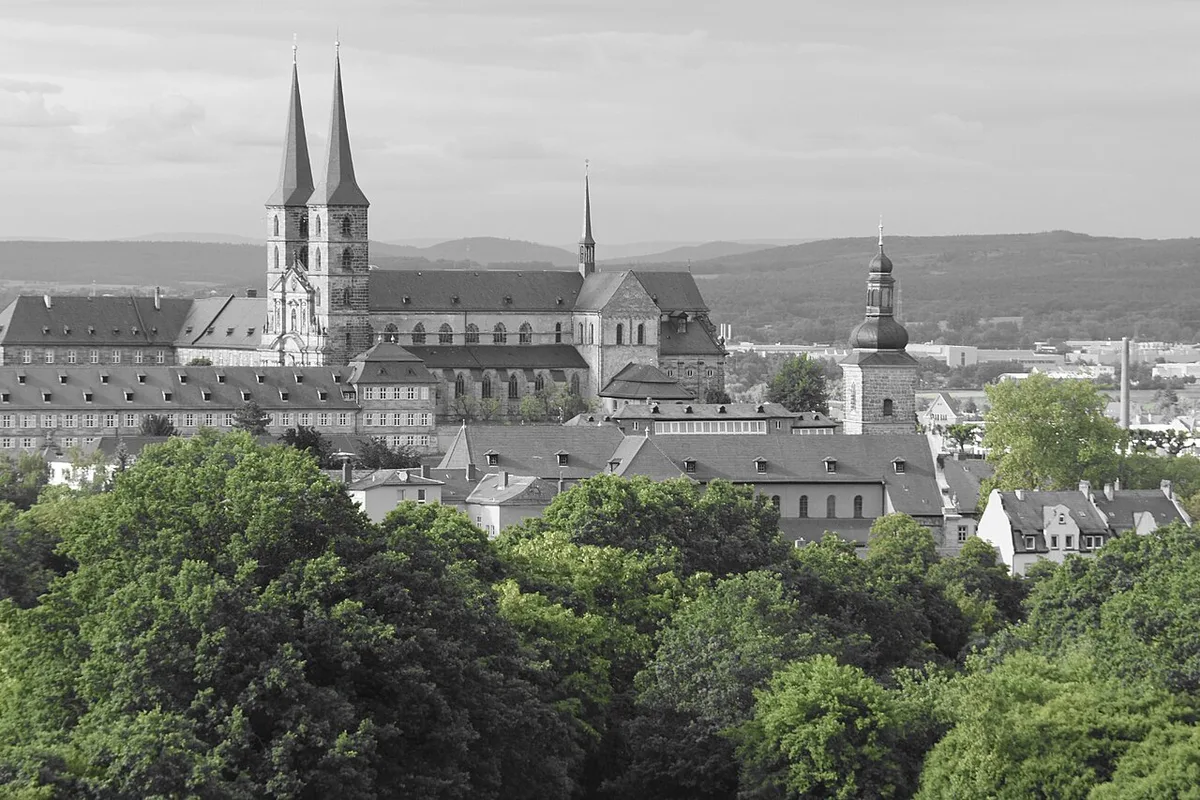
The church is not fully available to visitors. The foundation that owns the site reports that St. Michael's Church is open only Friday to Sunday and on public holidays, from 11 am to 4 pm, with renovation work continuing in the church and across the whole complex for years to come. The gardens, the monastery courtyard and the observation deck can be visited at any time, which is what makes an out-of-hours arrival still worthwhile if the church itself is closed.
Getting there is a walk, not a ride. You can approach on foot via the Panoramaweg along Aufseßstraße and Benediktinerweg or via Maienbrunnen, and city bus line 910 connects the central bus station with the Klinikum Michelsberg stop on weekdays, which saves the climb if you are running late. Parking on the grounds is limited to evenings and weekends for restaurant visitors, so driving up is not a practical midday option.
If You Still Have Energy: Beer Cellars Above Town
Bamberg's beer cellars are hilltop gardens built over the old storage tunnels, which is why locals say they are going on the cellar rather than into it. The practice dates from when brewers used the hillside tunnels to ferment and store beer, then built gardens on top so people could drink where the beer was kept. In summer this is the local way to end an afternoon; the trade-off is that each cellar sits above the town, so every one of them costs you an uphill walk and a later dinner.
Three of the traditional cellars in Bamberg are set up as proper cellar beer gardens, and at least one permits you to bring your own food and order only beer, which makes them cheaper than a full restaurant stop. Because hours and seasonal closures vary widely, verify the individual cellar's own page on the day you intend to go rather than assuming a summer opening pattern. If the climb is not appealing after St. Michael's, the same beer culture is available in the taverns of the lower town with no gradient involved.
Evening: Back Through the Lower Town as the Light Changes
Finish by walking back down through the lower town and the pedestrian zone towards the river, which lets you see the Old Town Hall and the bridges in different light than you saw them at midday. The Sandstraße area is where the city's taverns and student bars concentrate, so it functions as a natural end point if you want dinner without walking back uphill. This is also when the tour groups have gone, which changes the feel of the squares considerably.
If you planned two days instead of one, this is the point where you would add Seehof Palace outside town, the Altenburg, or the Hain park, none of which fit comfortably into a single day. The 2 days in Bamberg itinerary covers that second day properly, and if you are weighing whether to stretch further, the 3 days in Bamberg itinerary shows what a third day adds. The honest answer is that most visitors who try to include those in one day end up rushing the old town instead.
Getting Around and What to Leave Out
Bamberg is a walking city, and the old town rewards it. Where you need wheels, the city is served by buses connecting the outlying quarters and the surrounding villages with the centre, and the relevant bus line for the cathedral and for St. Michael's is the 910, which stops at Domplatz and at Klinikum Michelsberg respectively. Exact journey times and frequencies are not something to rely on from a guide; check the current timetable before you travel. Visitor details: Visit Bamberg: 2026 Travel Guide for Bamberg, Bavaria | Expedia.
For a single day, leave out anything that needs a bus or a car to reach, however tempting. Seehof Palace in Memmelsdorf sits well outside town and is a separate excursion, not part of a walkable loop, and the Altenburg and the outlying parks fall into the same category. Better to do the old town properly and keep one or two interiors than to spend the day in transit between half-seen sights.
It is also worth deciding in advance which of the Domberg museums you are skipping, because three separate institutions on one hill is a genuine scheduling problem rather than a matter of willpower. If you are planning a longer Germany trip and want to compare how other cities handle a single-day visit, the one day in Berlin itinerary shows what a completely different scale of city demands from a one-day plan.
Plan Your Visit
The reliable version of this day is simpler than the list of sights suggests. Walk the cathedral hill early, choose one or two interiors rather than all of them, drop to the river for the Old Town Hall and Little Venice before the groups build, then eat and drink in the lower town and only climb to St. Michael's if you still want the view. Bamberg's own tourism site is useful for confirming what is currently bookable before you commit.
The two things most likely to catch you out are the ongoing renovation at St. Michael's, which limits church access to part of the week, and the relocation of the Ludwig porcelain collection away from the Old Town Hall. Check both on the owning institution's page close to your travel date, and confirm opening patterns for the museums on Cathedral Hill individually, since they do not share a ticket or a timetable. For related planning, see Bamberg Public Transport: Walking, Buses and the BambergBus.
Frequently Asked Questions
Is one day in Bamberg enough?
A single day is enough for the old town's essentials if you accept that you will not see every interior. The cathedral, the Old Town Hall and the Little Venice riverbank all sit within a walkable loop, but the museums on Cathedral Hill are separate institutions with separate admission, and St. Michael's sits on its own hill. The city's own tourism board describes Bamberg as too varied for one day, so treat a day as a strong overview rather than a complete visit.
What is the best order to see Bamberg's old town in one day?
Start on Cathedral Hill in the morning and choose one or two interiors, then walk downhill to the Regnitz for the Old Town Hall and Little Venice around midday. Eat in the lower town in the early afternoon, and only then decide between the climb to St. Michael's and the beer cellars above town. Doing the hills early leaves the flatter riverside and tavern streets for when your legs are tired.
Do you need tickets for the cathedral and the museums on Cathedral Hill?
The cathedral is a working church rather than a ticketed attraction, so entering it is not the same transaction as visiting the museums around it. The Historical Museum in the Old Court, the Diocesan Museum with the cathedral treasury, and the New Residence state rooms run by the Bavarian Palace Administration are separately administered, with their own admission and opening patterns. Do not assume one ticket covers the cluster; check each institution's page before you go.
Where can you try Rauchbier in Bamberg?
The traditional breweries and their taverns are concentrated in the lower town within walking distance of the Old Town Hall, and the city is known internationally for the style. Breweries that kiln their own malt on site produce the most direct version of the flavour, since the smoke comes from the drying process rather than from an additive. Check individual brewery pages for current opening times rather than relying on older travel accounts, whose prices and hours are out of date.
Is St. Michael's Monastery open every day?
No. The foundation that owns the site reports that the church is open only Friday to Sunday and on public holidays, from 11 am to 4 pm, with renovation work continuing across the complex. The gardens, the monastery courtyard and the observation deck are accessible at all times, so an out-of-hours visit still gives you the terrace view. Confirm the current pattern before making the climb, since renovation schedules change.
Sources
- Bamberg Tourismus
- Visit Bamberg: 2026 Travel Guide for Bamberg, Bavaria | Expedia
- Ultimate Bamberg Budget Travel Guide: How To Travel Bamberg In 1 Day
- Official event website
- The Beer Trotter: Enjoying a Franken stein in Bamberg
- Englisch - Museen der Stadt Bamberg
- Startseite
- DiözesanMuseum Bamberg (Diocesan Museum Bamberg) - Museen in Bayern
- General information
- Bavarian Palace Administration | Palaces | Bamberg New Residence


