

Ulm's most photographed face is not the one on the Minster. On the Zeughaus site at Am Zeughaus, the tourism office describes a bronze Albert Einstein sticking out his tongue at fountain visitors, admirers, selfie hunters and collectors of picture souvenirs. The Jürgen Goertz sculpture dates from 1984, and the tourism office's own reading is that Einstein is mocking the cult that sometimes surrounds him.
Recognising that the fountain is satire, not a monument to genius, changes what you do with your ten minutes there. This guide covers where the piece stands, who made it, what the rocket-snail is doing, why Ulm's relationship with Einstein carries a soft irony, and how to photograph the bronze without reducing it to a selfie backdrop. It also separates the outdoor sculpture from the ticketed museum landscape around it, because those are different visits with different planning needs.
Treat it as a short stop rather than a destination in itself. A suggested duration of roughly ten to fifteen minutes is a plan, not an official figure: long enough to walk around the sculpture, find the Ein Stein marker, and move on into the old town. Anyone building a fuller day in the city can lean on the Ulm: Landmark Visitor Guides for the wider landmark set.
Where the Einstein Fountain Stands
The fountain sits on the Zeughaus site at Am Zeughaus in central Ulm, postcode 89073, directly in front of the historic arsenal building. The tourism office gives the address as Am Zeughaus, while Lonely Planet lists the same attraction under Zeughausgasse, so search for both names if your map app disagrees with itself. The two labels describe one location, not two separate fountains.
Position matters more than directions here. The Zeughaus stands in the old town rather than out on the Danube bank, so the fountain slots naturally into a walk that passes the Marktplatz and Rathaus. Fold it into a broader Ulm Old Town walk rather than making a special trip across the city for it alone.
Because the sculpture is an outdoor monument on a public square, there is no gate, no turnstile and no ticket desk. The city's own pages treat the Zeughaus site as part of the walkable historic centre rather than as a museum property. Check the official tourism site before a trip if you want to confirm the surrounding sites are reachable on the day.
The Artist, the Date and the Bronze
The fountain was created in 1984 by Jürgen Goertz, an artist who lives in Angelbachtal. Cast in bronze and plastically shaped, the figure is not an abstract allegory but a recognisable, comic portrait of the physicist. The 1984 date matters for expectations: this is a late twentieth-century public commission, not a historic city monument.
Goertz's sculpture is described as a fountain, which sets up a mismatch with what many visitors expect. It reads first as a sculptural group with water, so the joke and the composition carry more weight than any ornamental basin. That is why a quick glance from the pavement misses most of the content.
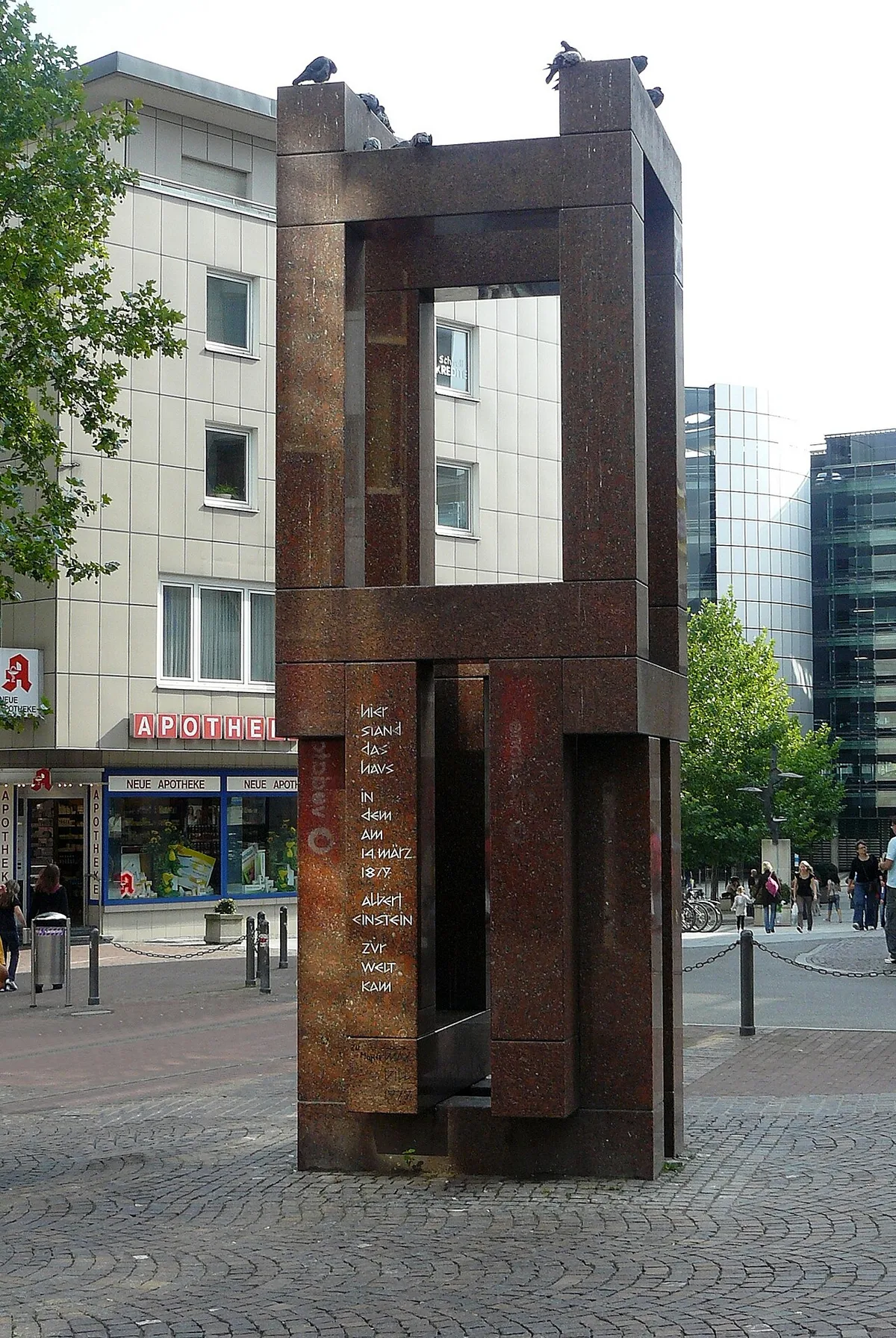
Nearby, at Zeughaus 14, a single stone carries the inscription Ein Stein, meaning one stone. Lonely Planet places the marker there, turning Einstein's surname into a literal object and rewarding anyone who reads the square carefully instead of photographing only the bronze. Many visitors walk past it without noticing, so look for the marker while you are already standing there.
Reading the Rocket-Snail: What the Satire Means
The composition stacks a wild-haired Einstein head inside a snail shell on top of a rocket. The snail brings slowness and biological patience; the rocket brings acceleration, ambition and technological reach. Putting them in one object is the joke, and it is aimed less at Einstein himself than at what people do with his name.
Lonely Planet reads the rocket-snail creation as a satirical play on humanity's attempts to manipulate evolution for its own self-interest. Read that way, the fountain is not anti-science; it is sceptical about the motives that steer science. The tourism office adds that Einstein's protruding tongue mocks the cult that sometimes surrounds him, aimed at admirers, selfie hunters and collectors of picture souvenirs alike.
Knowing this changes how you look at it. Instead of a tribute to a genius, you are looking at a city gently teasing its own habit of trading on a famous name. That framing is worth a sentence to whoever you are travelling with, because the sculpture is otherwise easy to file away as just a funny face.
Why Ulm and Einstein Have an Uneasy Relationship
Albert Einstein was born in Ulm on 14 March 1879, and his father Hermann registered the family in Munich on 21 June 1880. That means he spent roughly 15 months of his 76-year life in the city. He died on 18 April 1955 in Princeton in the United States, having built his life and career elsewhere.
The tourism office describes Ulm's pride in the connection as boasting with soft irony while still taking it seriously, which is a fair summary of the fountain's tone. Part of Einstein's widely scattered kinship continued to live in Ulm, so the link was never fully severed even after he left as an infant. The office also notes that Ulm's relationship with him remained tense after 1945 and that the city has faced that history without relativisation.
That tension is the reason the sculpture works as a city portrait rather than a generic statue. If you want the broader historic backdrop for the square you are standing in, the Ulm: Itineraries and City Travel Guides put the fountain into a wider set of routes and stops.
Free Street Monument, Ticketed Museums
The fountain is an outdoor monument, so treat it as freely visible rather than as a ticketed attraction; the tourism pages do not list opening hours or admission for it. If a listing somewhere quotes a price or a closing time for the Einsteinbrunnen itself, that is a sign the listing is confused about what the site is. Verify any condition on the day via the city's official pages rather than relying on aggregators.
Do not assume the surrounding institutions share a single ticket. The tourism office states that Museum Ulm has been under renovation since 17 April 2023 and is therefore temporarily closed, with the Hybrid Creatures exhibition relocated to the first floor of the kunsthalle weishaupt since 13 December 2025. The Lion-Man and its surrounding wallpaper are to remain on display there until 4 October 2026. Because that arrangement is changing, check the museum's current status and location directly before planning a visit.
The kunsthalle weishaupt is a separate private museum on Hans-und-Sophie-Scholl-Platz with its own ticketing and its own programme. The Baden-Württemberg museum service confirms it was opened in 2007 by the entrepreneur Siegfried Weishaupt to house his private collection, and the museum itself posts opening hours of Tuesday to Sunday, 11am to 5pm, closed Mondays.
Treat any ticket price or exhibition date there as volatile and check the museum's own pages, because the programme and any charges can move. The same caution applies to the EinsteinHaus gallery: the tourism office describes a first-floor gallery showcasing the most famous photographs of Albert Einstein, but opening status is not something to assume from a single description.
Photo Notes: Framing Without Flattening
The obvious shot is the head at eye level, and it is the least interesting one. Step back far enough to include the shell and the rocket together, so the vertical stack reads as a deliberate composition rather than a face on a plinth. If you only capture the head, you lose the joke.
Try one wide frame that includes the Zeughaus facade behind the bronze, because the 16th-century building is what gives the sculpture its setting and scale. Then move in for a second frame on the tongue and the shell, and a third on the Ein Stein stone if you have found it. Three purposeful frames beat thirty near-identical ones.
Watch your own shadow and the reflections in the metal rather than chasing particular light. If you want other viewpoints on the same walk, the Fischerviertel Ulm visitor guide covers the photogenic quarter on the other side of the centre.
Nearby Context: Minster, Old Town and the Discovery Center Project
The fountain is a small piece in a city whose headline landmark is enormous. The German national tourist board treats Ulm Minster and the surrounding old town as the core of a visit, noting the Minster as the city's most dominant building. Pairing the two is sensible: the Minster visitor guide covers the tower and the square, while the fountain fills in the city's twentieth-century self-image.
The Albert Einstein Discovery Center is a separate, unfinished story. The association behind it publishes a draft by Daniel Libeskind and describes four themed dimensions covering Einstein's life, ingenuity, influence and dreams, but it does not present a completed museum with a date and a ticket price. Read the association's own site for the current state of the project instead of assuming either.
The Fischerviertel and Gerberviertel districts, the Rathaus with its painted facade and the museum cluster around Hans-und-Sophie-Scholl-Platz all sit within the same compact centre. That density is the argument for walking rather than scheduling, since the fountain works best as one stop on a continuous route. Build the day around the old town and let the bronze be a punctuation mark inside it.
Planning Your Stop at the Einstein Fountain
The Einstein Fountain rewards a specific kind of visit: short, curious, and ideally slotted between the Marktplatz and the river. Go expecting a bronze with a joke in it rather than a museum, take the time to find the Ein Stein stone, and move on into the old town while your attention is still fresh. Nothing about the site requires booking or a ticket check.
Check the city's official tourism pages for anything that can change, including the status of nearby museums, and treat hotel or tour prices found on booking platforms as volatile rather than fixed. If you want to build the stop into something longer, the Ulm: Itineraries and City Travel Guides page is the natural next step.
Frequently Asked Questions
Did Albert Einstein actually live in Ulm?
He was born in Ulm on 14 March 1879, and the tourism office records that his father Hermann registered the family in Munich on 21 June 1880. That comes to roughly 15 months of his 76-year life in the city. The fountain's gentle irony plays on exactly that short connection, which Ulm still trades on.
Where exactly is the Einstein Fountain in Ulm?
It stands on the Zeughaus site at Am Zeughaus in central Ulm, in front of the historic arsenal building, in the 89073 postcode area. Lonely Planet lists the same spot under Zeughausgasse, so both names point to one place. It sits within the old town and is easy to fold into a walk past the Marktplatz and Rathaus.
Who created the Einstein Fountain and when?
Jürgen Goertz, an artist who lives in Angelbachtal, created the bronze in 1984. It shows Einstein pulling a face from inside a snail shell mounted on a rocket. Because it is a late twentieth-century public commission rather than a historic monument, its value lies in the satire rather than in age.
What is the rocket-snail sculpture supposed to mean?
Lonely Planet reads it as a satirical play on humanity's attempts to manipulate evolution for its own self-interest, combining the slowness of a snail with the speed and ambition of a rocket. The tourism office says Einstein's protruding tongue mocks the cult of personality that surrounds him. The joke is directed at the worship around the scientist rather than at the science.
Is the Einstein Fountain free to visit?
It is an outdoor monument on a public square, so there is no ticket desk and no gate to pass. Opening hours and admission prices of the kind a museum charges do not apply, and the tourism pages publish none for the fountain. Anything quoting a fixed price for the Einsteinbrunnen itself is describing something else.
Is the fountain the same as the EinsteinHaus or the planned Einstein museum?
No. The fountain is a bronze sculpture on the Zeughaus site. The EinsteinHaus is a separate building whose first-floor gallery the tourism office describes as showcasing the most famous photographs of Albert Einstein. The Albert Einstein Discovery Center is a third thing again: an association project with a published Libeskind draft rather than a finished museum. Check each one's own current status before planning around it.
What is the Ein Stein marker at Zeughaus 14?
It is a single stone nearby inscribed with the words Ein Stein, meaning one stone, turning Einstein's surname into a literal object. Lonely Planet places it at Zeughaus 14, close enough to the fountain that many visitors miss it entirely. Look for it while you are already standing at the sculpture.
How long should I spend at the Einstein Fountain?
A short stop of roughly ten to fifteen minutes is a suggestion, not an official figure. That is enough time to walk around the bronze, read the composition, find the nearby stone marker and continue into the old town. Building a whole outing around it would overstate what it is.
Sources
- Einstein-Brunnen | Tourism Ulm/Neu-Ulm
- Einstein Fountain & Monument | Ulm, Germany | Attractions - Lonely Planet
- HOME - Albert Einstein Discovery Center Ulm e.V.
- Official event website
- Official event website
- kunsthalle weishaupt
- Kunsthalle Weishaupt
- Visit Ulm: Minster, modernity and tradition - Germany Travel
- Discover Ulm and Neu-Ulm! | Tourism Ulm/Neu-Ulm


