

The German Football Museum occupies a spot directly opposite Dortmund Hauptbahnhof, which means you can step off a train and be at the entrance without navigating the city first. That location makes it unusually easy to slot into a short stopover or a rainy afternoon, and there is no need to plan a complicated journey across town. One detail worth settling before you travel: the museum publishes opening hours on its site and separately flags special opening hours, so the listed schedule is the starting point rather than the final word.
This guide covers what is actually inside the permanent exhibition, how admission and guided tours relate to each other, and what a visitor with zero football interest should realistically expect. It also explains the language situation honestly, because the exhibition texts and the multimedia stations are not treated the same way. Prices, tour availability and special programmes shift over time, so every figure below comes with a pointer to the operator's own pages for verification.
Where the Museum Is and How It Fits a Dortmund Day
The museum stands next to the main station, which effectively makes it the first cultural stop on any Dortmund itinerary that begins by rail. Arriving from elsewhere in the Ruhr region or from another German city, visitors can walk out of the station and start their visit without a transfer. The city's own portal is the sensible place to check what else is running during your dates, from markets to exhibitions, before you fix your schedule.
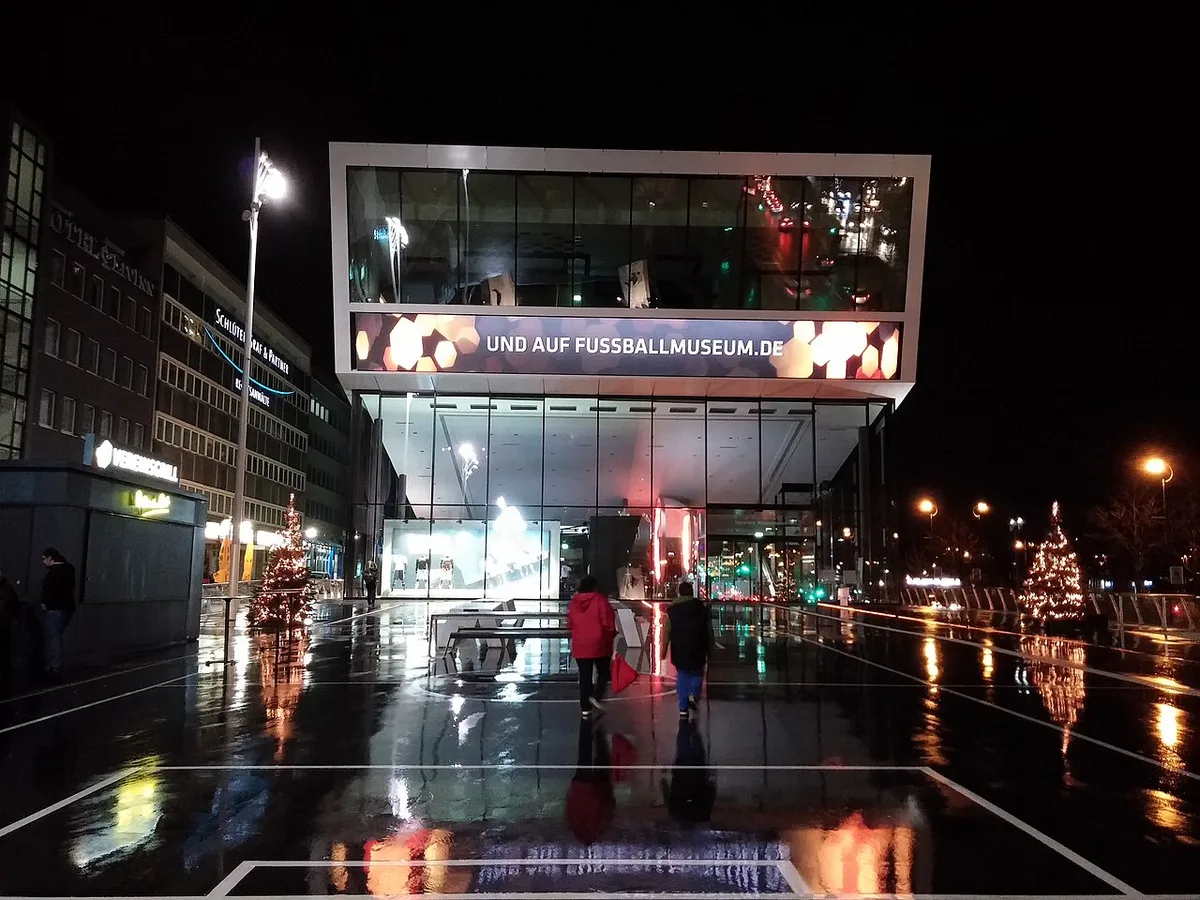
Because the museum sits on the edge of the city centre rather than in a distant district, it pairs naturally with an afternoon of walking through the old town or along the shopping streets. The trade-off is that a station-side location also means you are in a busy area at peak times, and the entrance can feel crowded when tour groups assemble. Building the museum into the front or back end of a day, rather than the middle, tends to keep the rest of your plan flexible.
What Is Actually Inside the Exhibition
The permanent exhibition covers more than 140 years of German football history through a mix of original objects, film, audio and hands-on stations. Highlights named by the operator include a 3D cinema featuring Leroy Sané and other legends, a treasure chamber displaying original trophies, and the Hall of Fame of German football. There is also an outdoor kicking area, which is a useful release valve if you are visiting with children who have been reading and listening for a while.
The route through the displays is built around storytelling rather than a simple chronological wall of memorabilia, which is why guides are able to pull out individual threads such as the 1954 Miracle of Bern, the old name of the DFB Cup, and the shift from nine strikers to the false nine. That narrative framing is confirmed on the museum's own tour pages, where those examples are given as the kinds of stories a guided visit unpacks. If you go without a guide, the exhibition still works, but you will be assembling the through-line yourself.
Special exhibitions change, and the museum's homepage regularly promotes a rotating highlight alongside the permanent collection. It is worth checking the exhibition section of the operator's site for what is currently running, because a themed display you read about previously may no longer be on view.
Opening Hours and How to Verify Them
The museum publishes its regular opening hours as Tuesday to Sunday, 10:00 to 18:00, with last admission at 17:00. That leaves Monday out entirely under the standard schedule, so if your Dortmund trip is short, plan around the closed day rather than discovering it at the door. The same page also carries a notice about special opening hours, which is the part that catches people out around holidays and school breaks.
Before travelling, confirm the day's schedule on the operator's site rather than relying on a third-party listing, because aggregator pages blend museum information with user posts and can lag behind. Ticket enquiries can also be directed to the museum's ticket service, whose contact details are published alongside the hours. If your visit depends on a specific date, treat the standard schedule as a baseline and the special-hours notice as the deciding factor.
Admission Versus Guided Tours: Two Separate Purchases
This is the decision that most often surprises visitors: a museum admission ticket does not automatically include a guided tour, and the tour prices listed by the operator are described as being charged on top of admission. The open guided tour, for example, is priced per person plus museum admission, while the exclusive, themed and group formats are quoted as flat rates for a set group size and are also stated as being valid only in conjunction with a ticket. Treat the two as separate line items in your budget.
Tour products also differ in scope. The open tour runs roughly 90 minutes and includes the 3D cinema, the exclusive tour runs about two hours with the cinema included, the women's football themed tour runs around 70 minutes, and the family tour lasts 90 minutes including the cinema. Prices for the exhibition itself are published on the museum's Prices & Information section rather than on the tour page, so check that page separately if cost is your deciding factor.
One practical consequence: if you buy a combination ticket through the operator's ticket shop, it covers the visit and the tour together, which is simpler than arriving and hoping a place remains. Walking up and joining an open tour is possible when spots are free, but that is a gamble on busy weekends and public holidays. Book through the operator's ticket shop if your dates are fixed.
Choosing Between the Guided Tour Formats
The open tour is the low-commitment option: it runs on set days and times, can be joined without pre-booking when places remain, and is conducted in German. It suits a solo visitor or a couple who want context without arranging a private guide. The exclusive tour runs on the hour from 10:00 to 16:00, is charged as a flat rate for up to 20 people, and can be tailored, which makes it the better fit for a group with a particular interest.
Family tours are aimed at households with children aged six to 13 and lean on touchable exhibits, quizzes and commentary games, which is a different experience from a standard history walk. The women's football themed tour tackles the obstacles the women's game faced, including the period when the DFB banned it, and runs on a tighter schedule across the week. If you are travelling with a club or youth group, the dedicated children's and youth group tour is priced per tour rather than per head and requires the group ticket.
For visitors with mobility, hearing, visual or cognitive impairments, the museum offers tours on request lasting around 90 minutes, with accessible exhibition space, induction loops, tactile models, and assistance and guide dogs welcome. These are booked by email rather than through the standard online flow. Because the formats and their conditions are published in detail, it is worth reading the tour page before choosing, especially if you are coordinating several households.
Language: Bilingual Texts, German-Language Multimedia
The museum states plainly that exhibition texts are available in both German and English, but that many multimedia stations are German-only. For an English-speaking visitor, that means the panels will carry you through the history while some of the film and audio moments will not. It is an honest limitation rather than a dealbreaker, and it is the single most useful thing to know before you arrive.
The workaround the museum itself promotes is the digital museum guide, narrated by ARD commentator Tom Bartels, which walks you through 12 highlights and can be selected in German, English, sign language or easy-to-read language. You scan a code at the start and use your own phone, so bringing headphones is the practical preparation. Guides who speak English, French or Spanish can also be arranged on request, with pricing aligned to the exclusive tour format.
If your group does not speak German, enquire about a foreign-language guide by email well ahead of your date instead of assuming one will be available on the day. The museum directs these requests to a dedicated group address. Availability depends on guide capacity, so earlier is safer.
How Much Time to Allow Inside
Our own suggestion, and not an official museum figure, is to plan for roughly two hours if you want a focused pass through the permanent exhibition, and closer to three or four hours if you add a guided tour, the 3D cinema and the interactive and outdoor football areas. The scale of the collection is the reason: visitor reviews published on the museum's own homepage describe stays running from around three hours to four and a half, with several people noting they could have stayed longer.
The arithmetic changes once a tour is added. A 90-minute open or family tour, a roughly two-hour exclusive tour, or a 70-minute themed tour all sit on top of your own time in the galleries, and the tour price does not shorten the rest of the visit. If you are combining the museum with anything else in the city that day, book the museum slot first and let the rest flex.
Travelling with younger children usually compresses the visit rather than extending it, but the touchable exhibits and the kicking area provide natural breaks. A realistic family plan is one tour plus a looser wander, rather than an attempt to absorb every panel.
Does It Work for Non-Football Fans?
The exhibition is designed as social and cultural history as much as sport, which is why the women's football section, the treatment of fan culture and the design of the displays can hold attention even when the match results mean nothing to you. The operator's own framing, built around stories rather than statistics, supports that reading. A visitor who enjoys museums about how a country changed will find plenty to work with.
The honest counterpoint is repetition. Once you have absorbed the pattern of historic shirt, historic boot, grainy footage and trophy, the middle stretch can feel long if the subject itself does not interest you. A guided tour mitigates this because the guide selects and edits, and the 3D cinema gives a clear endpoint. A non-fan on a tight schedule might reasonably choose the tour and skip the deepest corners of the collection.
The practical compromise for mixed groups is to split: the football-inclined take the full visit while others use the time on a city attraction and rejoin afterwards. Dortmund's parks, industrial heritage sites and lakeside walks make that an easy arrangement rather than a sacrifice.
Families, Children and Accessibility
Family tours are built for children aged six to 13 and run during North Rhine-Westphalia school holidays on Tuesdays to Sundays at 11:30, outside the holidays on Saturdays and Sundays at 11:30. The format deliberately mixes exhibits you can touch with quizzes and commentary games, so younger visitors are doing something rather than being talked at. If you are visiting in the school holidays, arrive for the morning slot and treat the rest of the day as optional.
Accessibility is handled concretely rather than as a footnote: accessible exhibition space, induction loops for hearing-impaired visitors, free admission for sign language interpreters, tactile models for visually impaired visitors, and a welcome for assistance and guide dogs. Inclusive tours are available on request and use simple language with content adjusted to the participants. Booking goes through the museum's group email or contact form rather than the standard checkout.
For families with very young children, the museum also runs a day-care centre tour aimed at five- and six-year-olds, lasting about 60 minutes with a recommended total of 90 minutes including arrival. That gives a sense of how long the youngest visitors can sustain attention before the experience should end. Pair the museum with a playground, park or lake later in the day if you are travelling with small children, and keep the museum block short.
Combining the Museum With Other Football Stops
Dortmund's football landscape is spread across several venues, and none of them share a ticket with the museum. Signal Iduna Park, the club's stadium, and the Borusseum, Borussia Dortmund's own museum, are separate operations with their own admission arrangements, so decide in advance whether you want one football venue or three. The Borusseum visitor guide covers what that club museum offers if you want to compare before committing.
A sensible sequence is to start at the German Football Museum, whose location by the main station makes it the easiest to reach, then move outward to the stadium on a separate day or slot. Club fan shops in the city centre are free to browse and make an easy filler between other plans. Keep stadium tours and match tickets in a different budget line from museum admission.
What to Do If You Are Not the Football Fan
Travel companions who would rather not spend hours on German football history have a genuinely good city waiting outside. Westfalenpark is one of Germany's larger urban parks and works as a half-day in its own right, while the U-Tower art centre and the lakeside circuit at Phoenix Lake offer very different textures of the same city.
If the forecast turns, indoor options matter as much as outdoor ones, and Dortmund has enough museums, galleries and covered markets to absorb a wet afternoon. Planning a wet-weather fallback in advance prevents the common situation where one person is inside the football museum and the other is standing under a station canopy. Splitting the day by weather rather than by interest often works better.
Families juggling different interests should also check what is running for children during their dates, since holiday programmes and hands-on activities can tip the balance. A short city-wide look at family-friendly options before you book the museum slot avoids double-booking the same afternoon.
Costs to Budget and How to Check Them
The structure to budget for is admission plus, optionally, a tour supplement, and the tour page is explicit that its quoted tour prices are additional to museum entry rather than inclusive of it. That means a family of four taking a tour is paying admission four times plus the tour charge. Because the museum does not publish current admission figures on its tour pages, verify the current price on the operator's Prices & Information section before you book rather than relying on older figures you may have seen elsewhere.
Group arrangements have their own logic: some formats are quoted per person on top of admission, others as a flat rate regardless of how many of the permitted places you use. If you are organising for a club, school or large family, the flat-rate formats can be more efficient, but only if you actually fill enough places to make the per-head comparison work. Ask about the ticket type that must accompany the group tour before you assume a single price covers everything.
Some third-party travel pages list a ticket figure, but these are aggregator snapshots that can be out of date or refer to a resold product rather than the museum's own pricing. Use the operator as the authority and treat everything else as a prompt to go and check. Budget a rough range in your head, then confirm the exact number.
Booking Strategy and Pre-Visit Checks
The cleanest route is to buy through the operator's ticket shop, which is also the route the museum recommends for combining a visit with a guided tour. For foreign-language tours, the museum asks for an email enquiry rather than an online booking, so build in lead time. If you want a specific tour time, treat it like a timed reservation and secure it early.
Before you travel, run a short checklist: confirm the day's opening hours including any special hours, decide whether you want a tour and which format, check what special exhibition is currently showing, and note whether you need to email about language or accessibility. Then pick one other Dortmund sight to pair with the visit so the day has a second anchor. The city's official site is a reasonable place to see what else is on during your dates.
Plan Your Visit
The German Football Museum is unusually convenient, sitting opposite Dortmund Hauptbahnhof, and it rewards a little preparation: check the current opening hours and any special hours, decide whether you are buying admission alone or admission plus a tour, and confirm the price on the operator's own pages rather than from memory. If you do not read German, plan around the multimedia limitation by using the digital guide and, for groups, enquiring about a language-specific tour.
Non-football fans should go in expecting a well-designed social history exhibition rather than a wall of statistics, and should feel free to take a tour and skip the deepest galleries. Pair the visit with one other Dortmund stop, whether that is a park, an industrial heritage site or the stadium, and treat the day as a route rather than a single destination.
Frequently Asked Questions
Is the German Football Museum worth visiting for non-football fans?
It can be, because the exhibition is built around stories, cultural change and design rather than match statistics. The women's football section, the treatment of fan culture and the interactive elements give visitors who do not follow the sport something to engage with. The risk is repetition: once the pattern of historic shirts, boots, footage and trophies becomes familiar, the middle of the collection can feel long. A guided tour helps because the guide selects and edits the material, and the 3D cinema provides a clear finish. If your interest is genuinely low, consider taking the tour rather than attempting every gallery.
Do you need a separate ticket for a guided tour?
Yes. The museum presents guided tours as an addition to museum admission rather than something included in it, and the tour formats are priced separately. Some are charged per person on top of an admission ticket, while others are quoted as flat rates for a group and are still valid only in combination with a ticket. The practical step is to buy your admission and your tour together through the operator's ticket shop so you are not trying to assemble two purchases on the day. Confirm the current structure on the operator's own pages before booking, since formats and conditions change.
Are the exhibits in English?
The exhibition texts are available in both German and English, so you can read your way through the displays as an English speaker. The catch is that many multimedia stations are German-only, which means some film and audio moments will not be accessible without German. The concrete workaround is the digital museum guide, which covers twelve highlights and can be set to German, English, sign language or easy-to-read language; you use your own phone, so bring headphones. For groups, the museum can also arrange a guide who speaks English, French or Spanish on request.
How much time should you allow for the German Football Museum?
As a rule of thumb rather than an official recommendation, allow around two hours for a focused walk through the permanent exhibition and closer to three or four hours if you add a guided tour, the 3D cinema and the interactive areas. Guided formats themselves take roughly 70 to 120 minutes depending on type, and that time sits on top of your own exploration. Visitors writing on the museum's own homepage describe stays from about three hours up to four and a half. Families with young children usually need less, not more.
Is the German Football Museum within walking distance of Dortmund Central Station?
Yes. The museum is located directly opposite Dortmund Hauptbahnhof, which is the reason it works so well as a first or last stop on a rail-based trip. You do not need to plan a separate journey across the city to reach it, and the surrounding area is the city centre rather than a remote district. Because arrival is this simple, the main planning question is not transport but timing: check the day's opening hours and any special opening hours before you set out.
What guided tour types does the German Football Museum offer?
The museum publishes several distinct formats: an open guided tour that individuals can join, an exclusive tour booked for a group, family tours during school holidays and weekends, a themed tour on women's football, a guided tour for children's and youth groups, an inclusive tour for visitors with disabilities, foreign-language tours in English, French or Spanish on request, and a short day-care centre tour. Each has its own duration, target audience and pricing structure. Some can be joined on the day when places remain, while others need advance arrangement, so check the guided tour section before deciding.
Is the German Football Museum accessible for wheelchair users and visitors with disabilities?
The museum lists accessible exhibition space, and states that wheelchair users and visitors using walking frames can take part in public guided tours. It also provides induction loop systems for hearing-impaired visitors, free admission for sign language interpreters, tactile models for visually impaired visitors, and welcomes assistance and guide dogs. Inclusive guided tours are available on request and use simple language with content adapted to participants, running around 90 minutes including the 3D cinema. These tours are arranged by email or contact form rather than through the standard online booking, so request them ahead of your date.


